
Category
Cloud & FinOps
Cloud cost optimisation, FinOps practice, multi-cloud architecture, and the rupee economics of AWS / Azure / GCP for Indian and global teams.
-
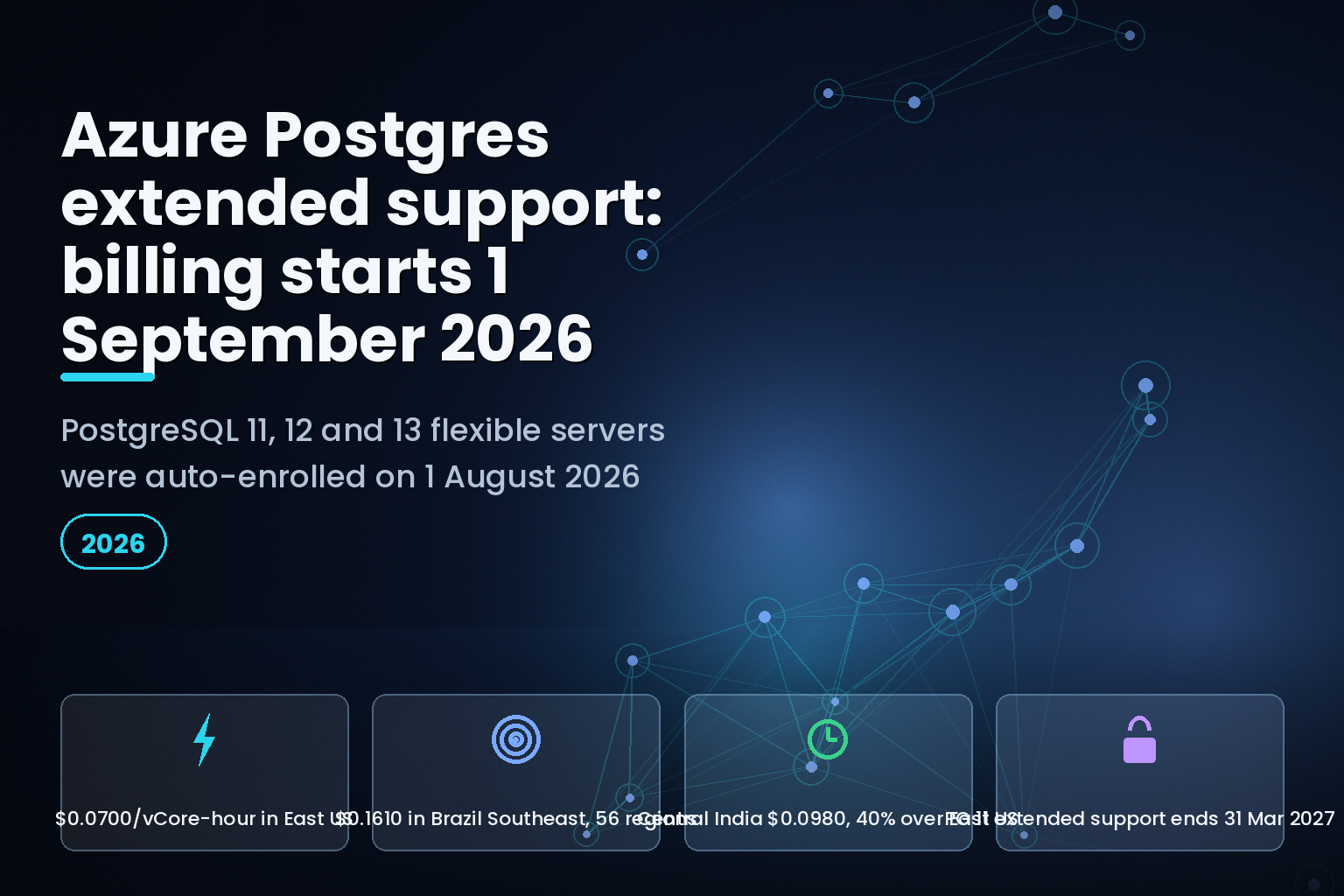
$0.07/vCore-hour: Azure Postgres extended support billing starts 1 September 2026
Azure auto-enrolled PostgreSQL 11, 12 and 13 servers in extended support on 1 August 2026 and bills from 1 September at $0.07 to $0.161 per vCore-hour. The upgrade escape hatch is narrower than it looks.
 Manu Shukla
 -
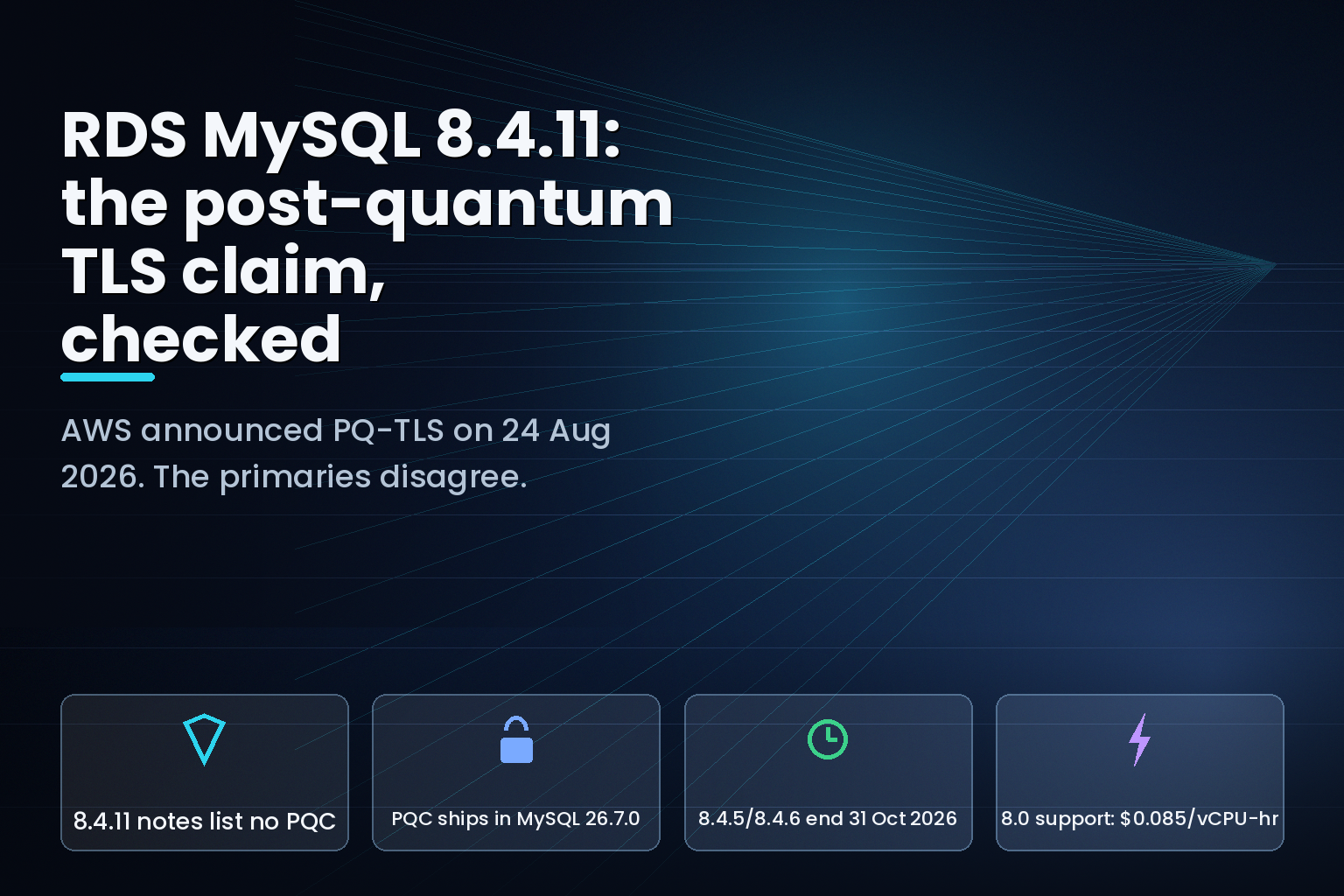
RDS MySQL 8.4.11 post-quantum TLS: the claim its release notes do not make
Amazon's 24 August 2026 post credits MySQL 8.4.11 with post-quantum TLS key exchange. The 8.4.11 release notes list no such feature, and RDS MySQL 8.4 is built on AWS-LC rather than OpenSSL 3.5.
Manu Shukla -
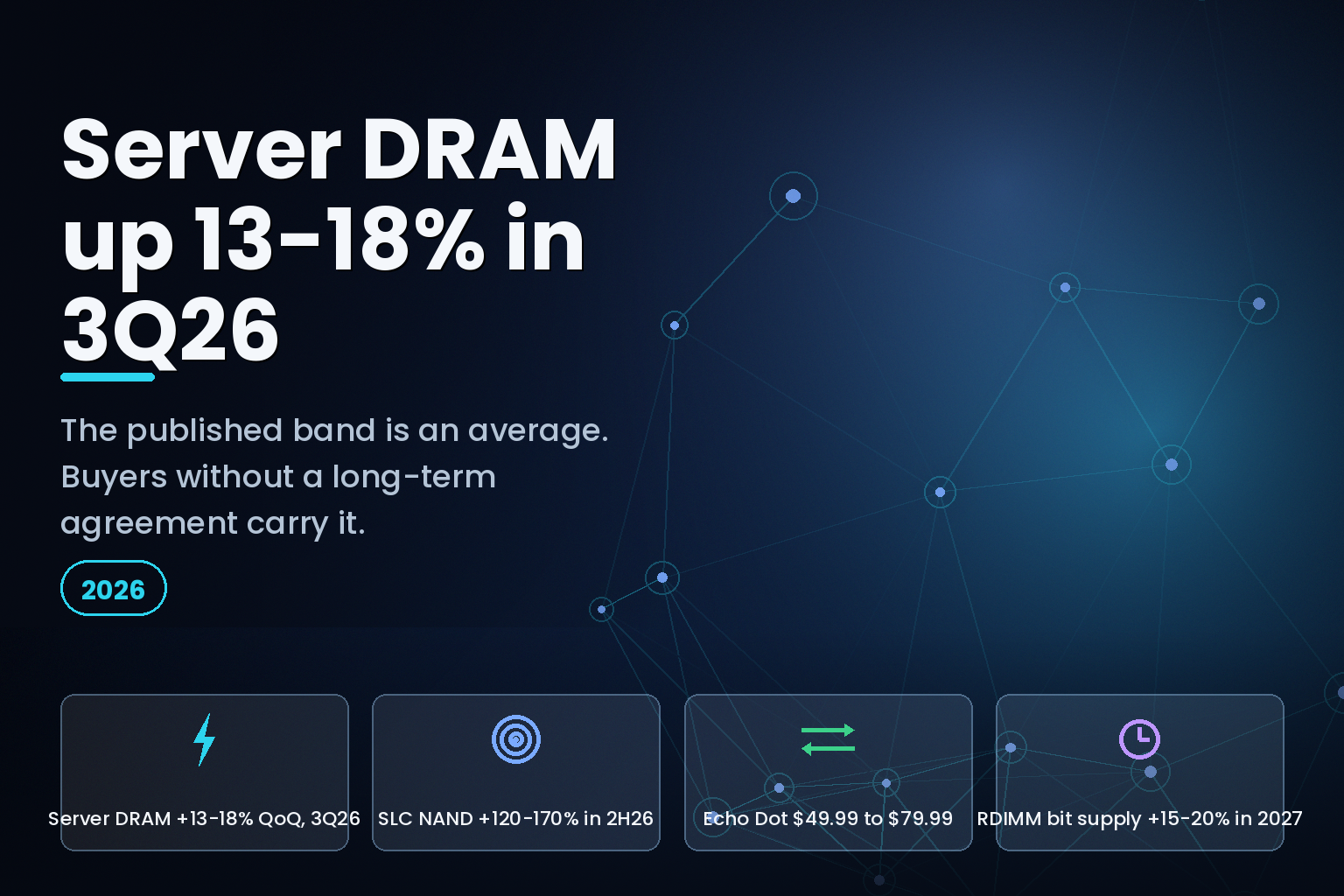
Server DRAM prices rose 13-18% in 3Q26: non-LTA buyers absorb the full increase
TrendForce forecasts server DRAM contract prices up 13-18% QoQ in 3Q26 and SLC NAND up 120-170% across 2H26. Amazon raised device prices by as much as 60%. The published averages hide who actually pays.
Manu Shukla -
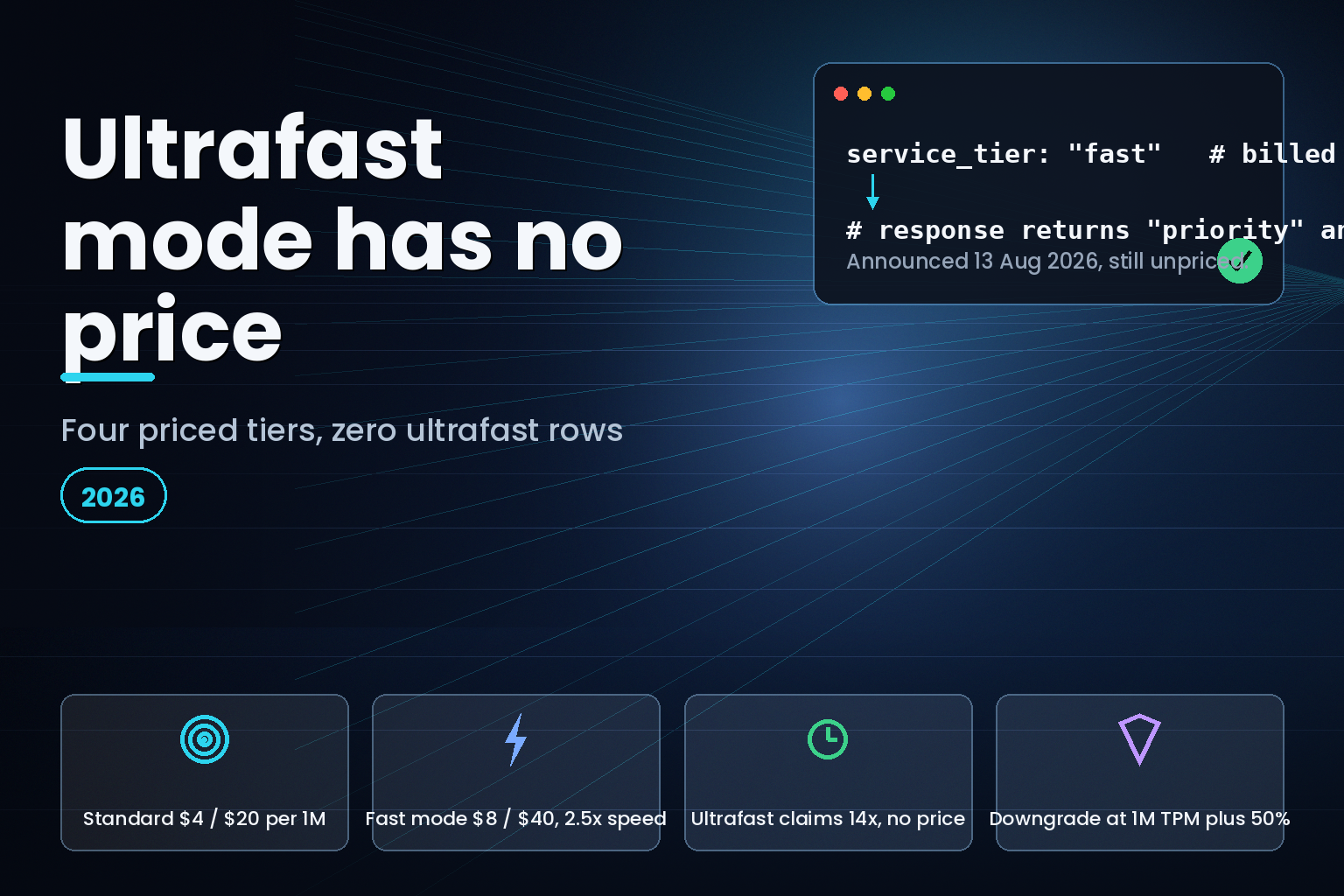
OpenAI announced Ultrafast mode on 13 August 2026 with no price on any of its four pricing tables
OpenAI announced Ultrafast mode on 13 August 2026 as an API service tier up to 14x faster than Standard. Eleven days later the pricing page still publishes four tiers and no Ultrafast row.
Manu Shukla -
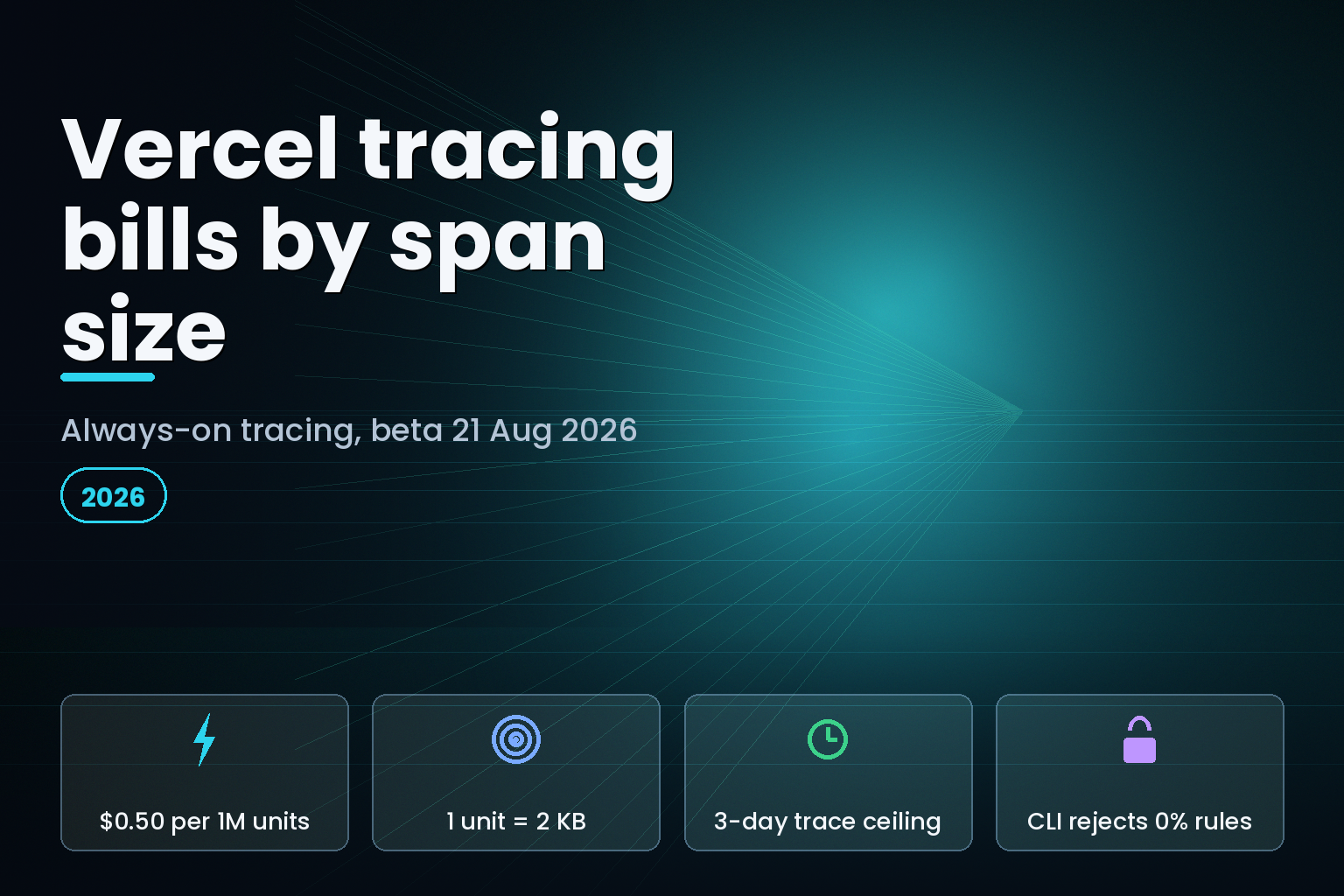
Vercel shipped always-on tracing at $0.50 per 1M span units on 21 August 2026, and the pricing doc omits it
Always-on tracing went to beta on 21 August 2026 at $0.50 per 1M span units, a price only the changelog states. Trace retention stops at 3 days even where Observability Plus keeps 30 days of logs.
Manu Shukla -
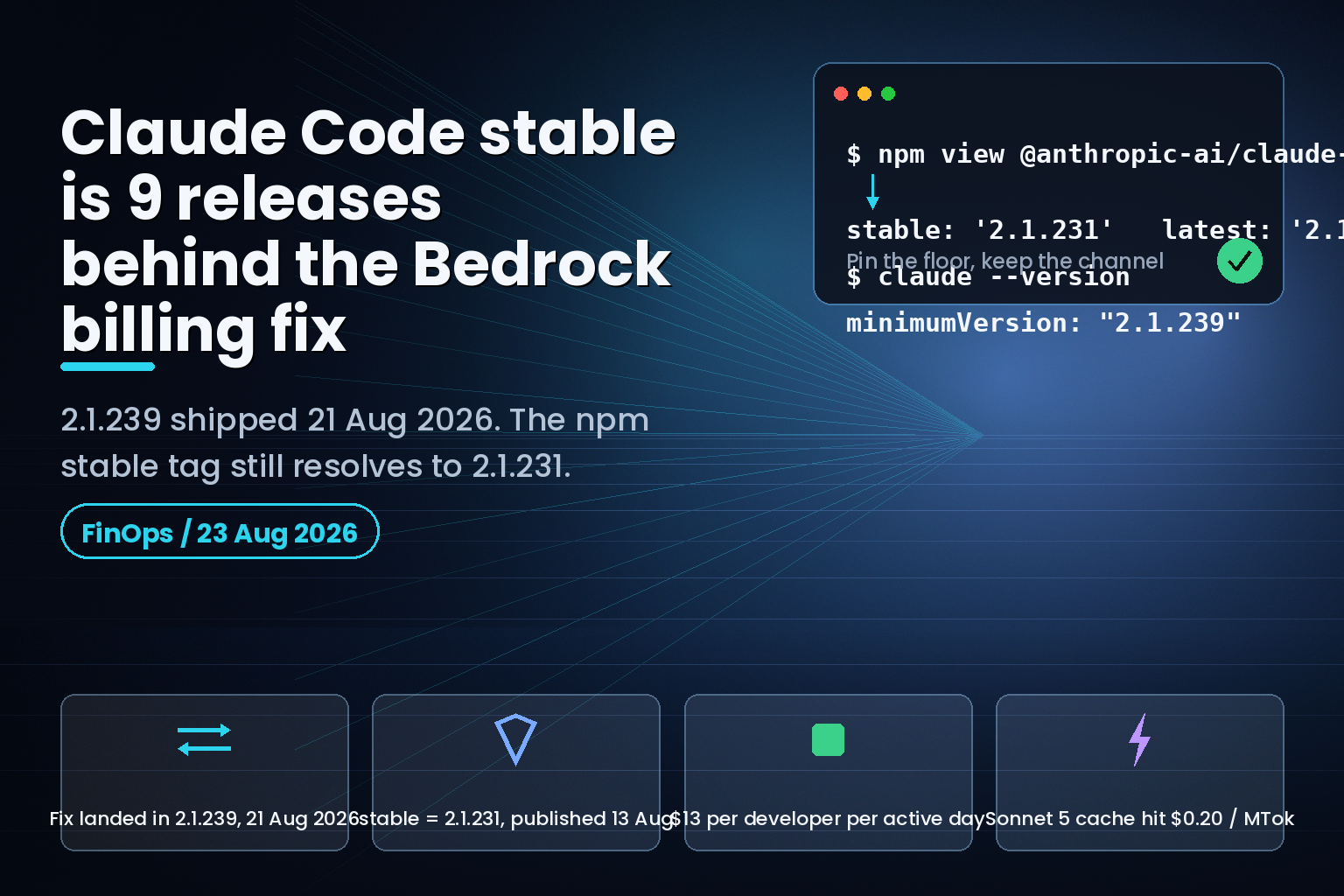
Claude Code 2.1.239 fixed silent Bedrock double-billing, but the stable channel is 9 releases behind
The npm stable tag for Claude Code still resolves to 2.1.231, published 13 August 2026. The fix for a proxy defect that silently doubled billed Amazon Bedrock calls shipped 8 days later in 2.1.239.
Manu Shukla -
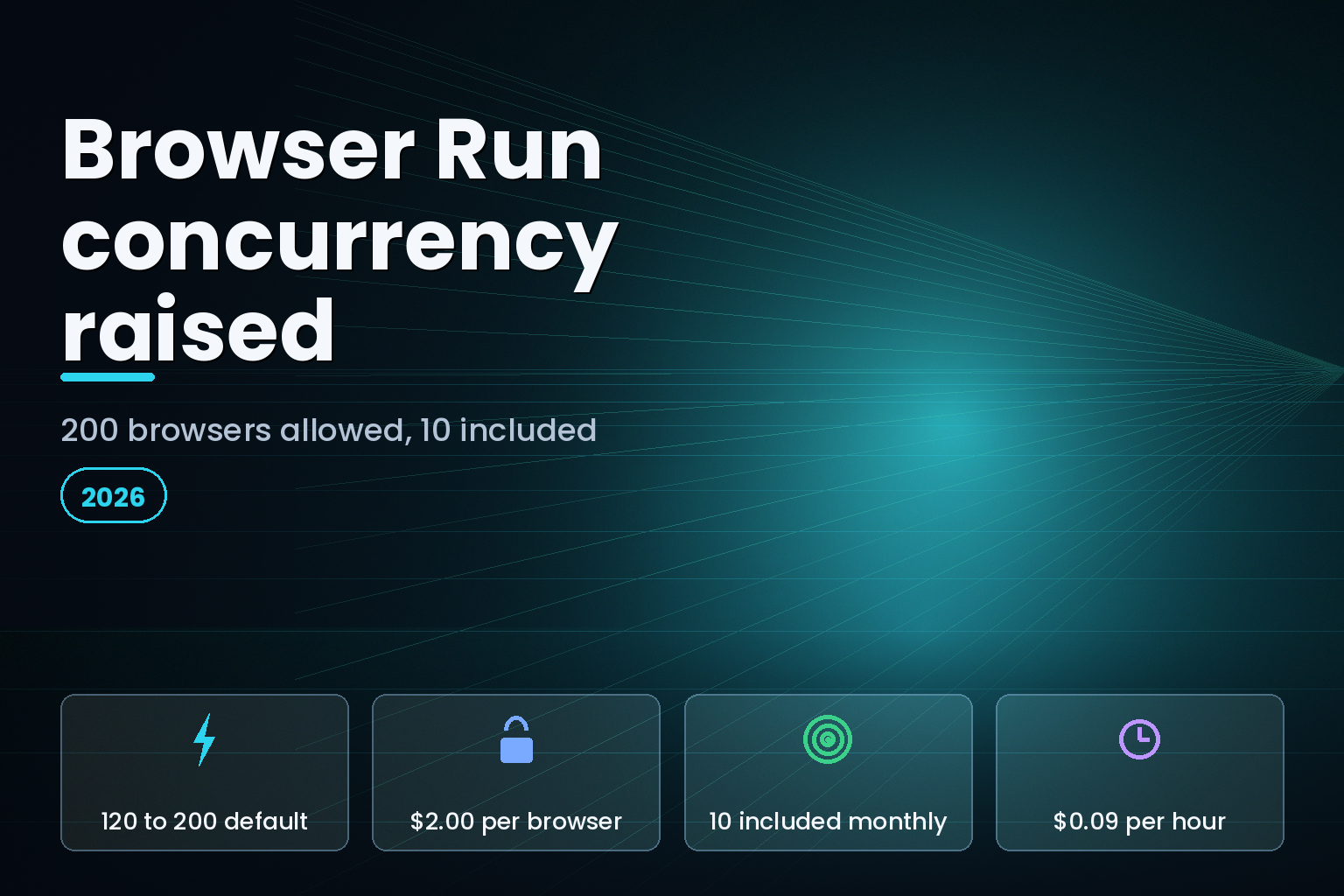
Cloudflare raised Browser Run to 200 concurrent browsers on 20 August 2026, but only 10 are included
The 20 August 2026 Browser Run changelog raised the Workers Paid concurrency default from 120 to 200 browsers. The pricing page, last updated 21 April 2026, still includes 10 at $2.00 each.
Manu Shukla -
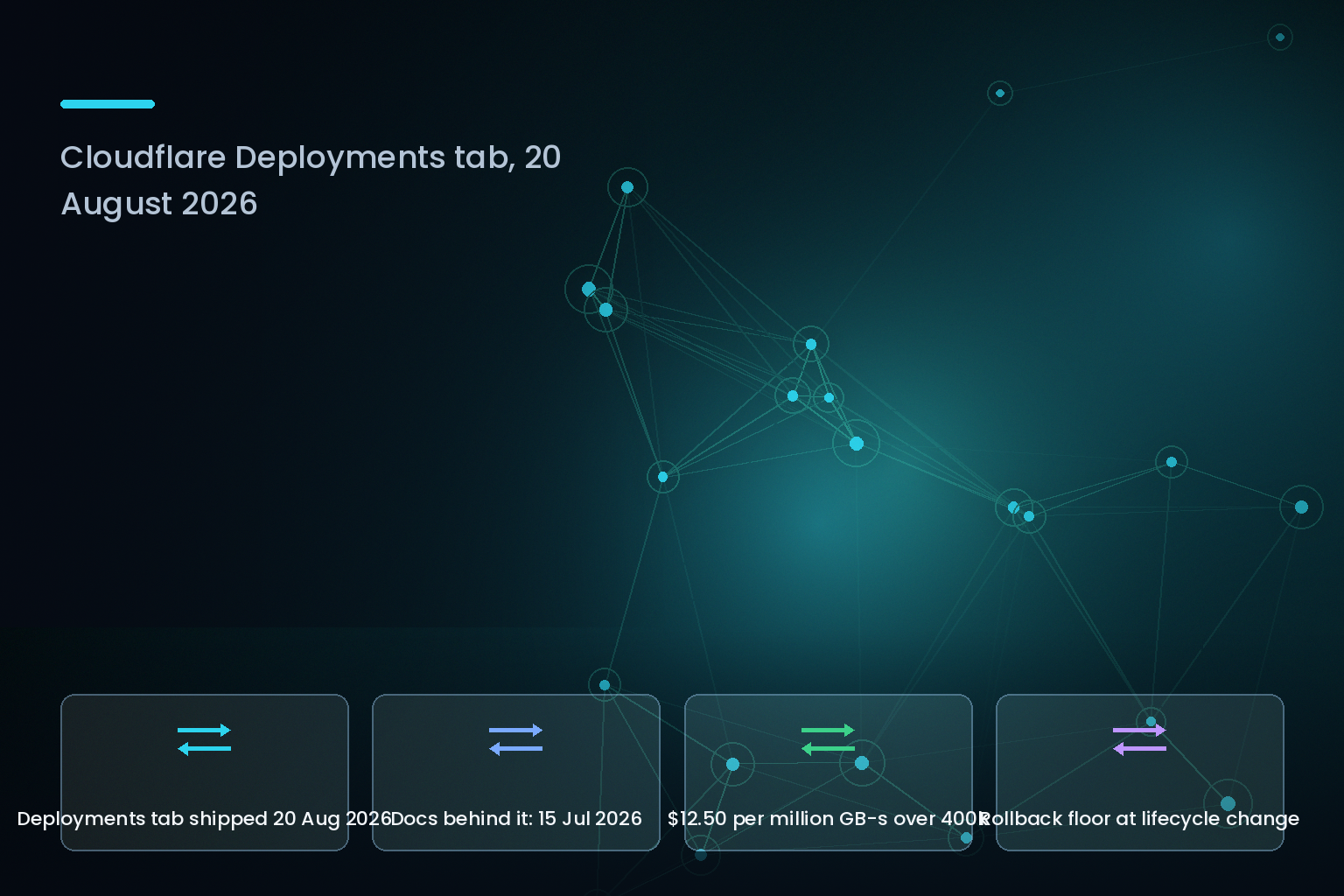
Cloudflare's 20 August 2026 Durable Objects deployments tab exposes a configured-vs-actual traffic gap
On 20 August 2026 Cloudflare added a Deployments tab to Durable Object namespaces and a second Traffic % number. The docs explaining the first were last updated 15 July 2026.
Manu Shukla -
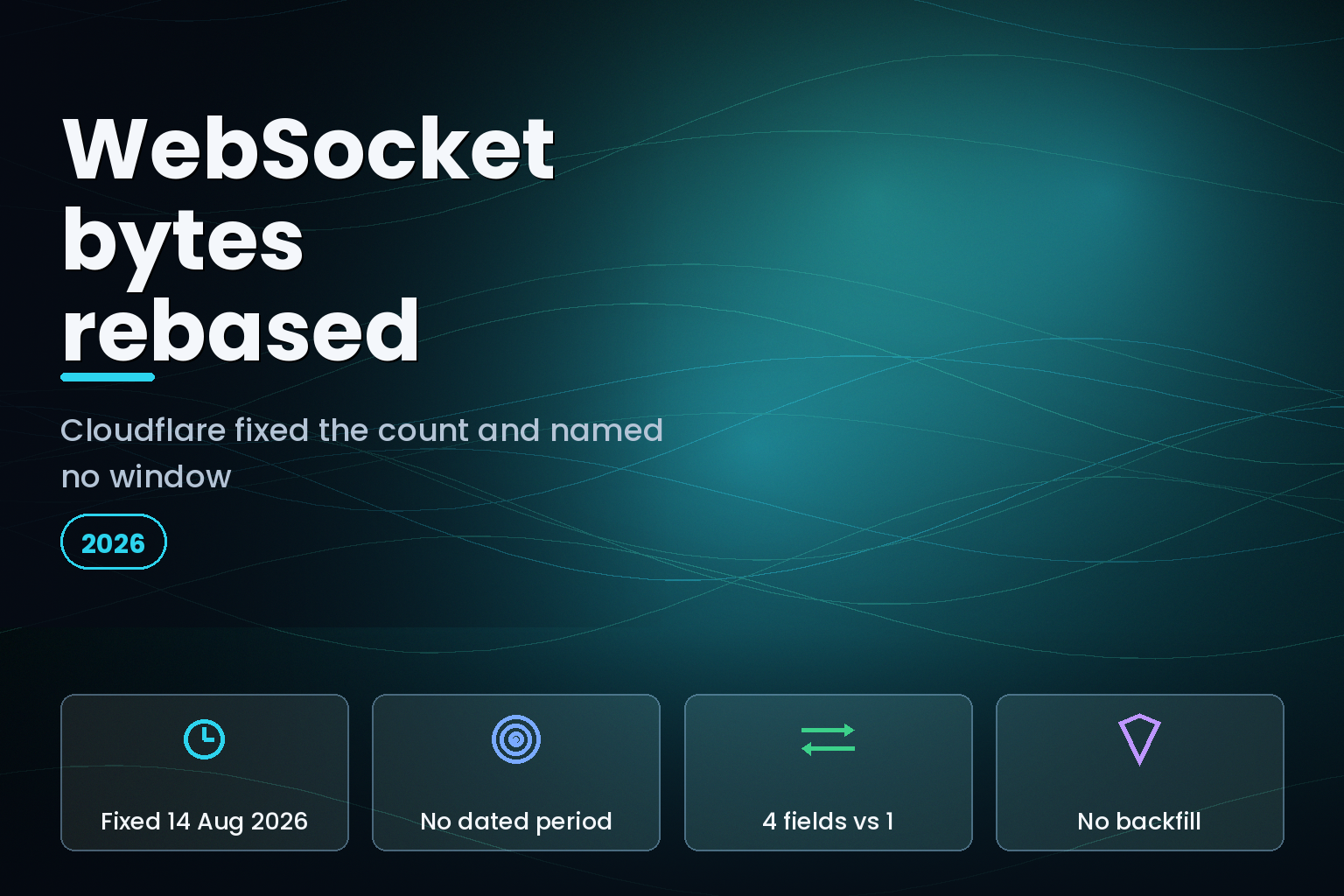
Cloudflare's 14 August 2026 WebSocket data transfer fix names no affected period
Cloudflare restored WebSocket data transfer accounting on 14 August 2026 but never dated the affected period. EdgeResponseBytes counts one direction; the websocket_analytics Logpush dataset counts four.
Manu Shukla -
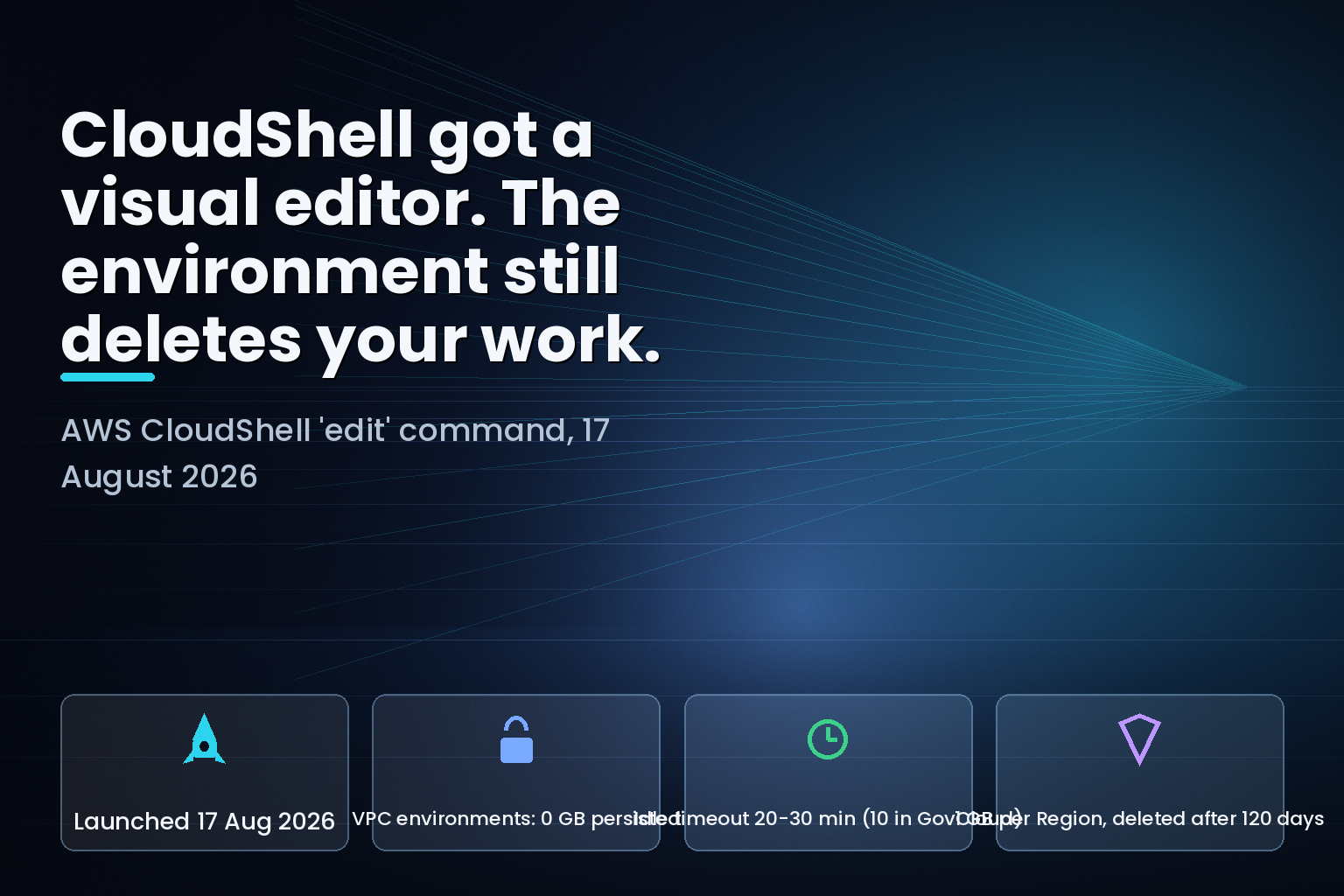
AWS CloudShell got a visual editor on 17 August 2026 — and 3 limits that delete your work
AWS gave CloudShell an "edit" command on 17 August 2026 and aimed it at IaC and agentic work. VPC environments have no persistent storage, and sessions idle out in 20 to 30 minutes.
Manu Shukla -
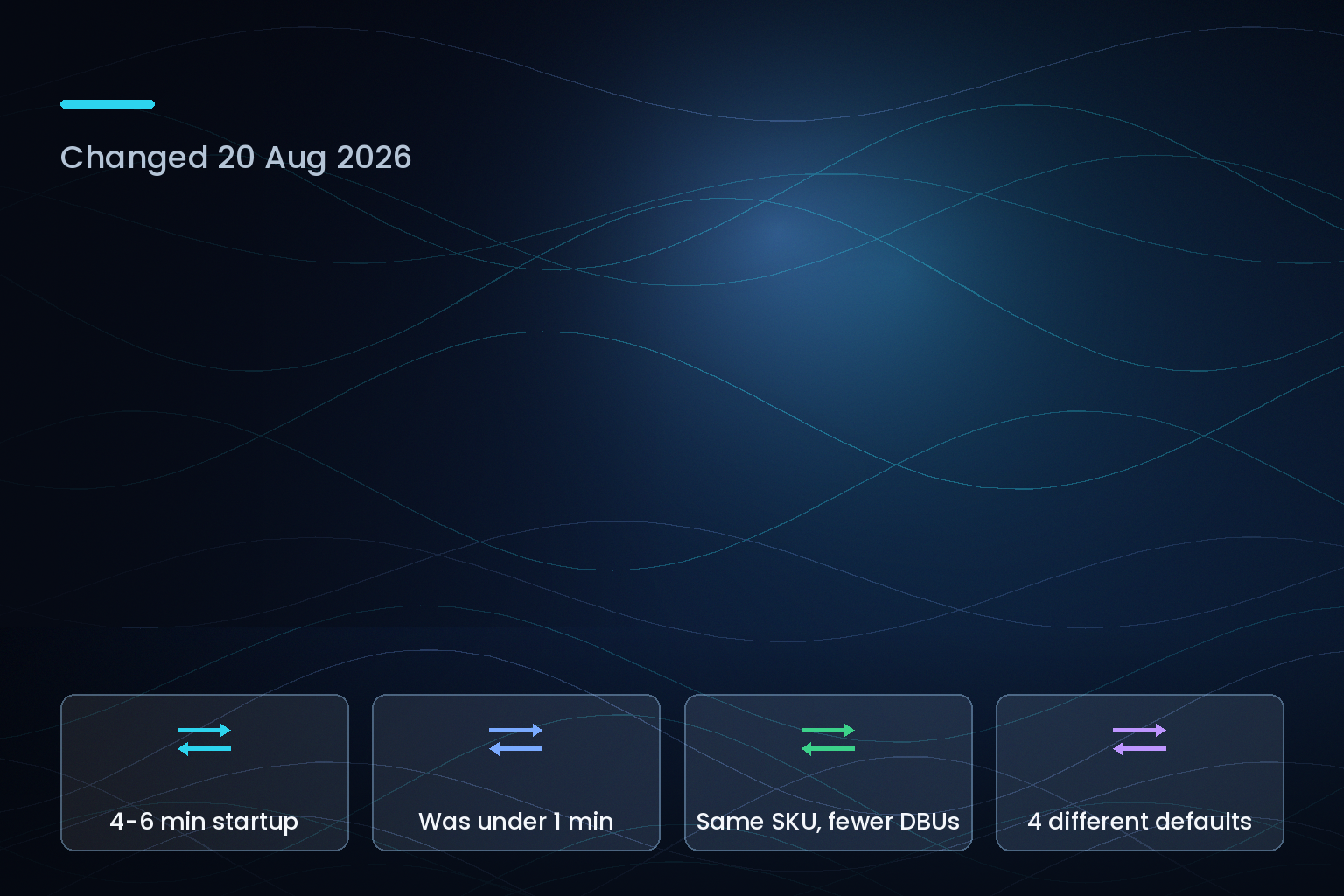
Databricks dbt refreshes just inherited your cost setting, and 4 to 6 minutes of startup latency
Databricks changed how dbt tasks refresh materialized views and streaming tables on 20 August 2026. Jobs that already had Performance optimized turned off for cost now pick up 4 to 6 minute startup latency.
Manu Shukla -
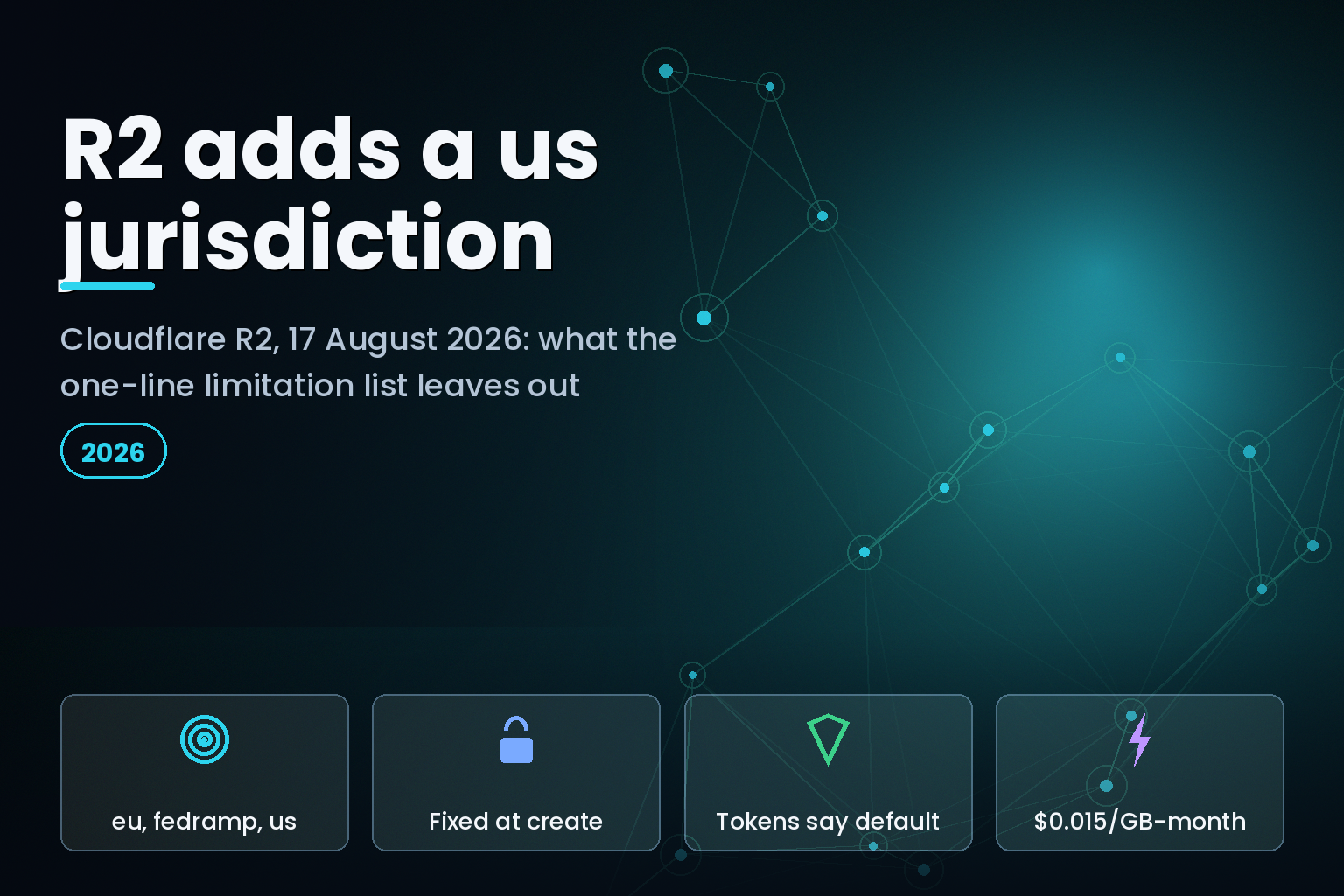
Cloudflare R2 us jurisdiction shipped 17 August 2026: 4 things it breaks
R2 gained a third jurisdiction on 17 August 2026, guaranteeing US storage and processing. The docs updated on 19 August list one limitation. Four more sit in pages Cloudflare has not touched since April.
Manu Shukla -
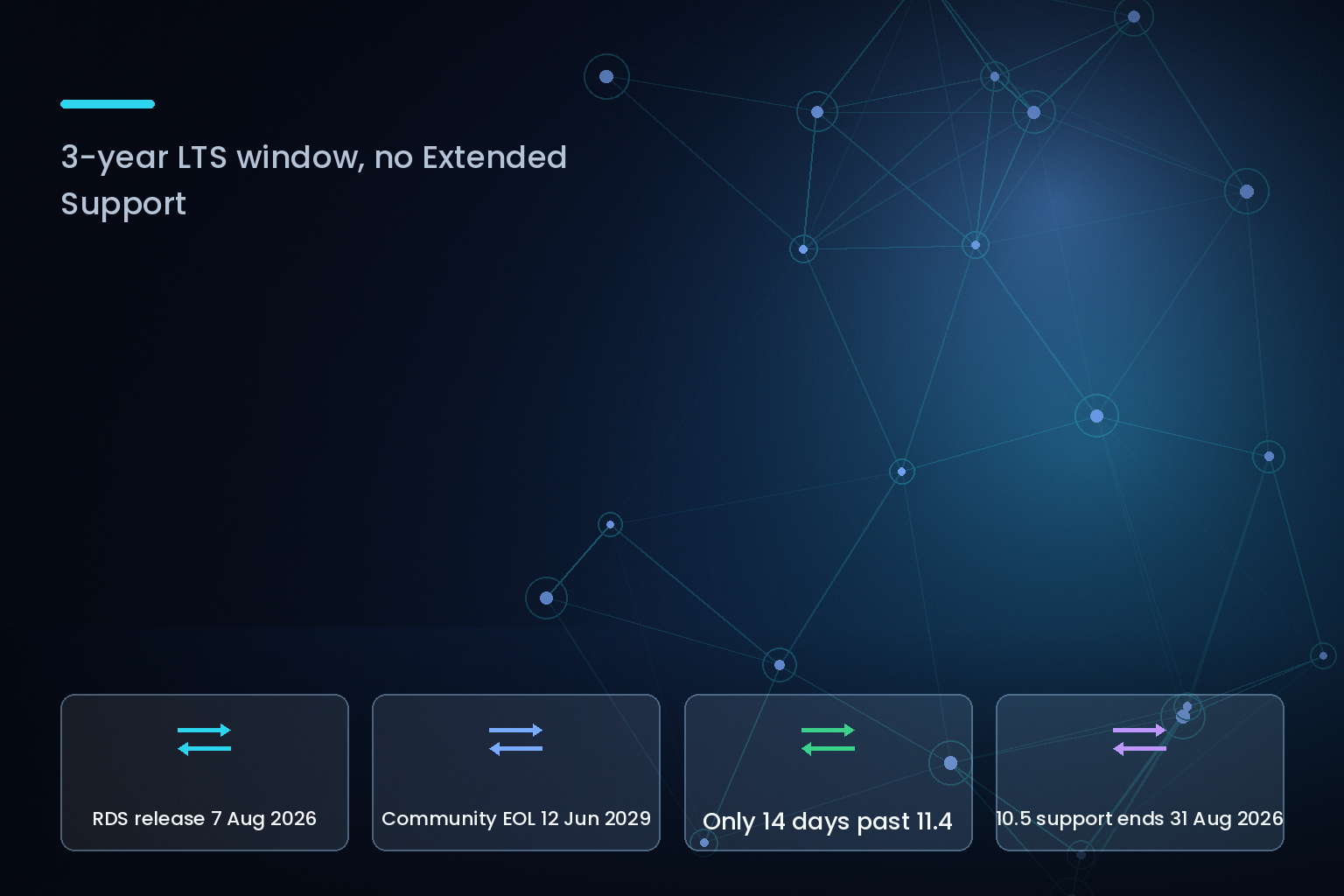
MariaDB 12.3 hit Amazon RDS in August 2026 with a 3-year LTS window
AWS calls MariaDB 12.3 the latest LTS release. MariaDB's own calendar gives it three years, not five: EOL 12 June 2029 against 29 May 2029 for 11.4, which shipped two years earlier.
Manu Shukla -
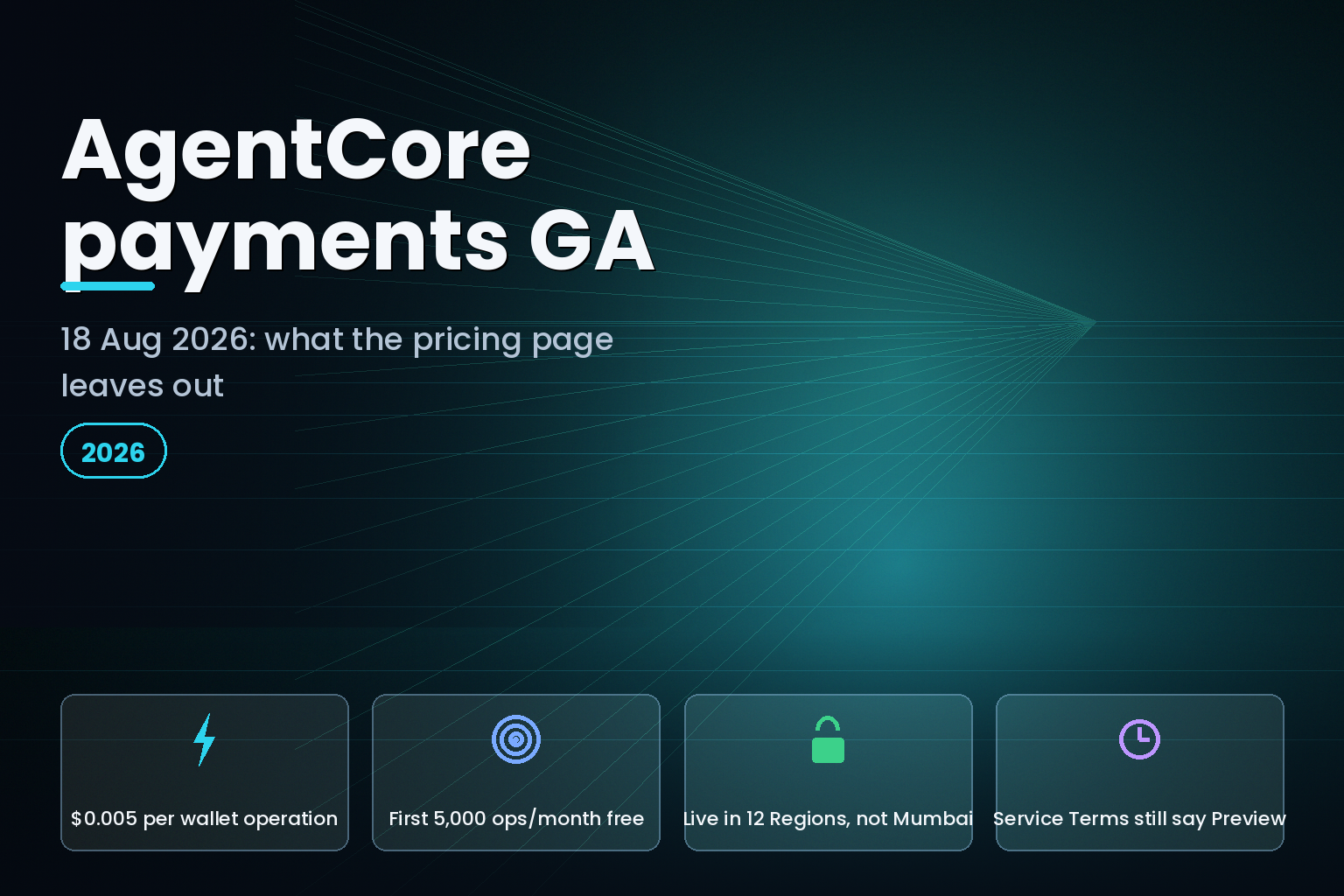
AgentCore payments went GA on 18 August 2026 with a $0.005 fee AWS calls no charge
AWS made AgentCore payments generally available on 18 August 2026 in 12 Regions. The pricing page says no additional charge, then bills an API that does not exist and omits both gas fees and a mandatory subscription.
Manu Shukla -
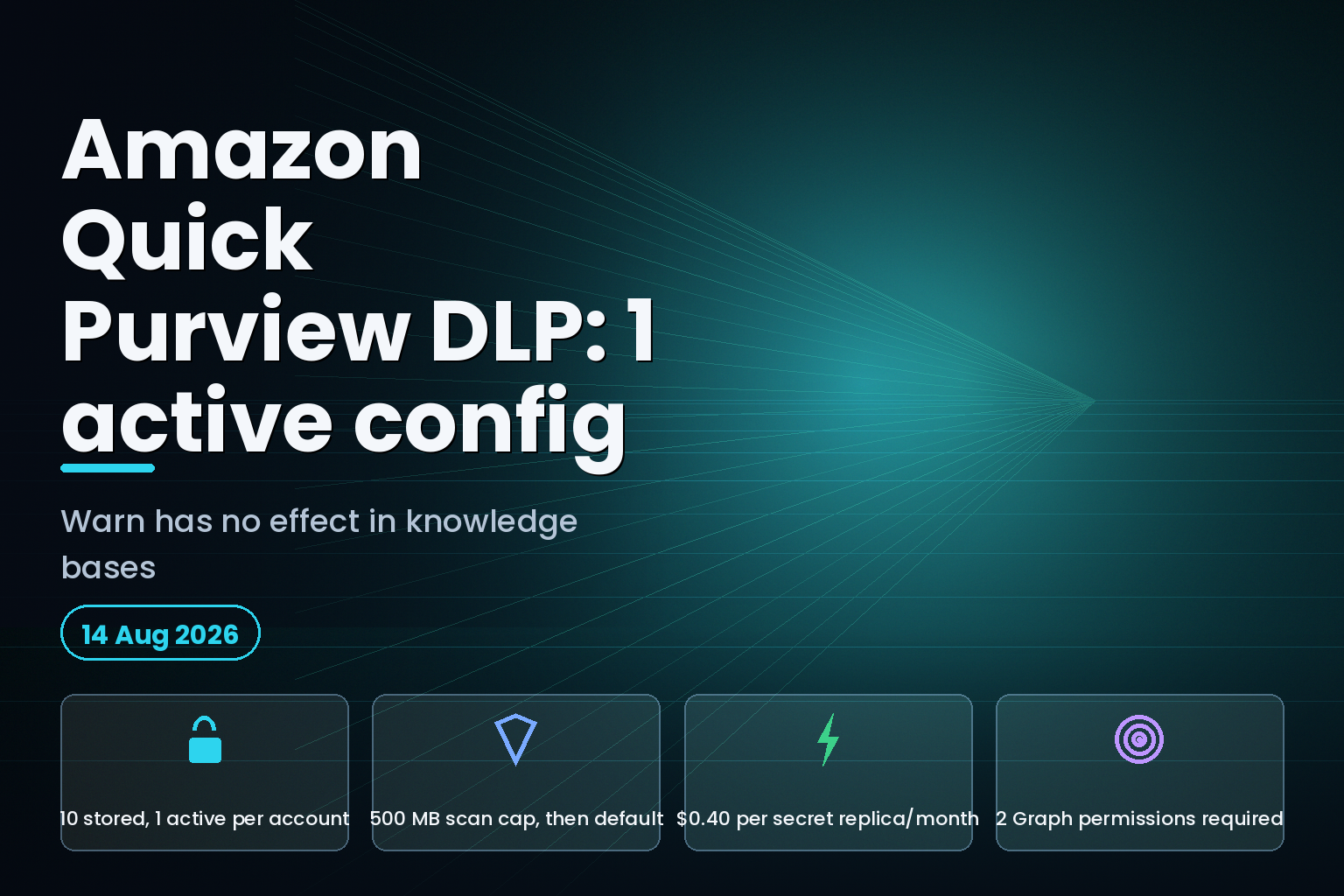
Amazon Quick Purview DLP, 14 August 2026: 1 active config, and warn does nothing in knowledge bases
Amazon Quick's Microsoft Purview DLP shipped 14 August 2026. The user guide caps you at 1 active configuration, skips files over 500 MB, and gives warn no user-visible effect during a knowledge base sync.
Manu Shukla -
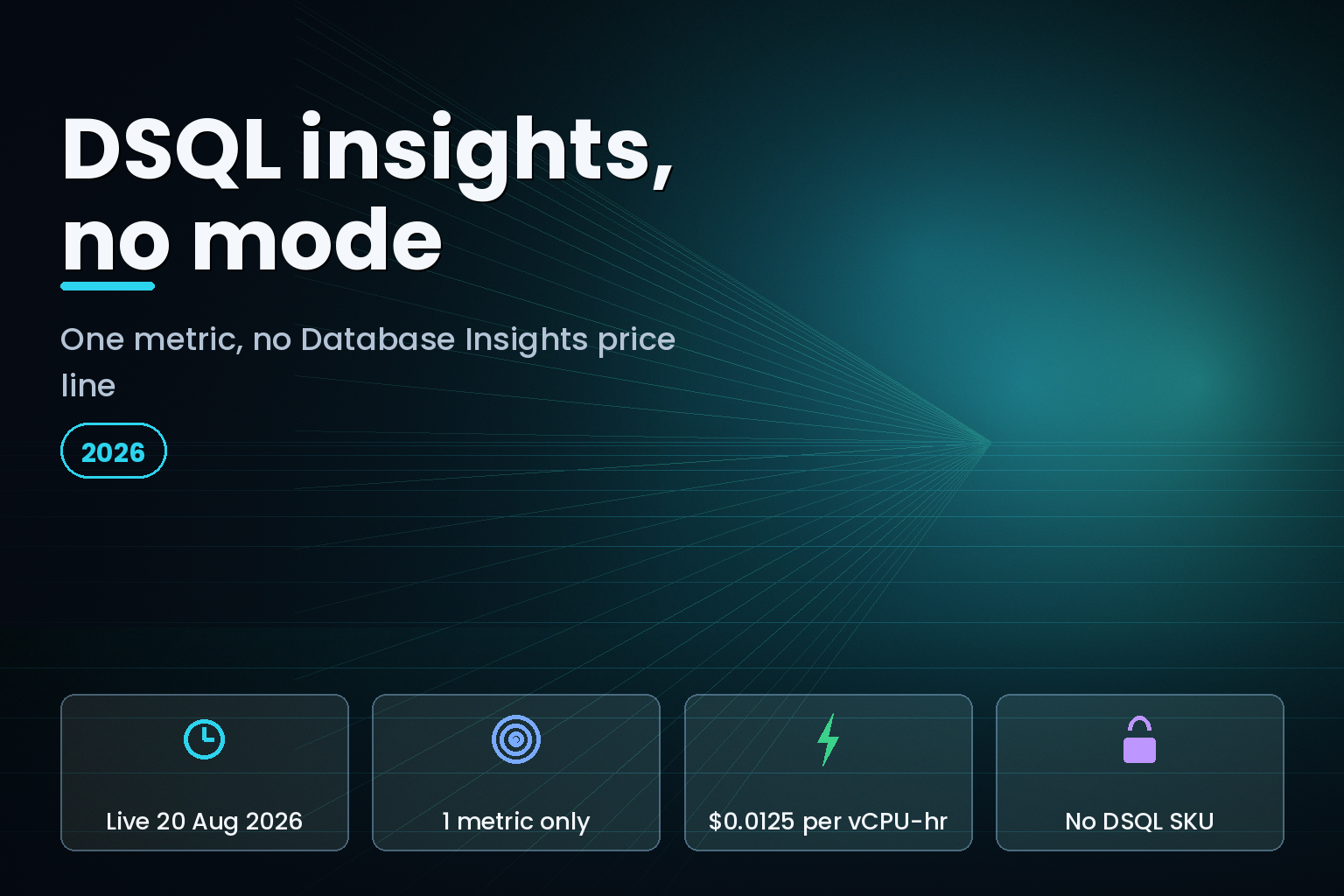
Aurora DSQL got Database Insights on 20 August 2026 with one metric, no mode and no price line
AWS gave Aurora DSQL a CloudWatch Database Insights metric on 20 August 2026. The mode model does not list DSQL and the AWS Price List API carries no Aurora DSQL Database Insights SKU.
Manu Shukla -
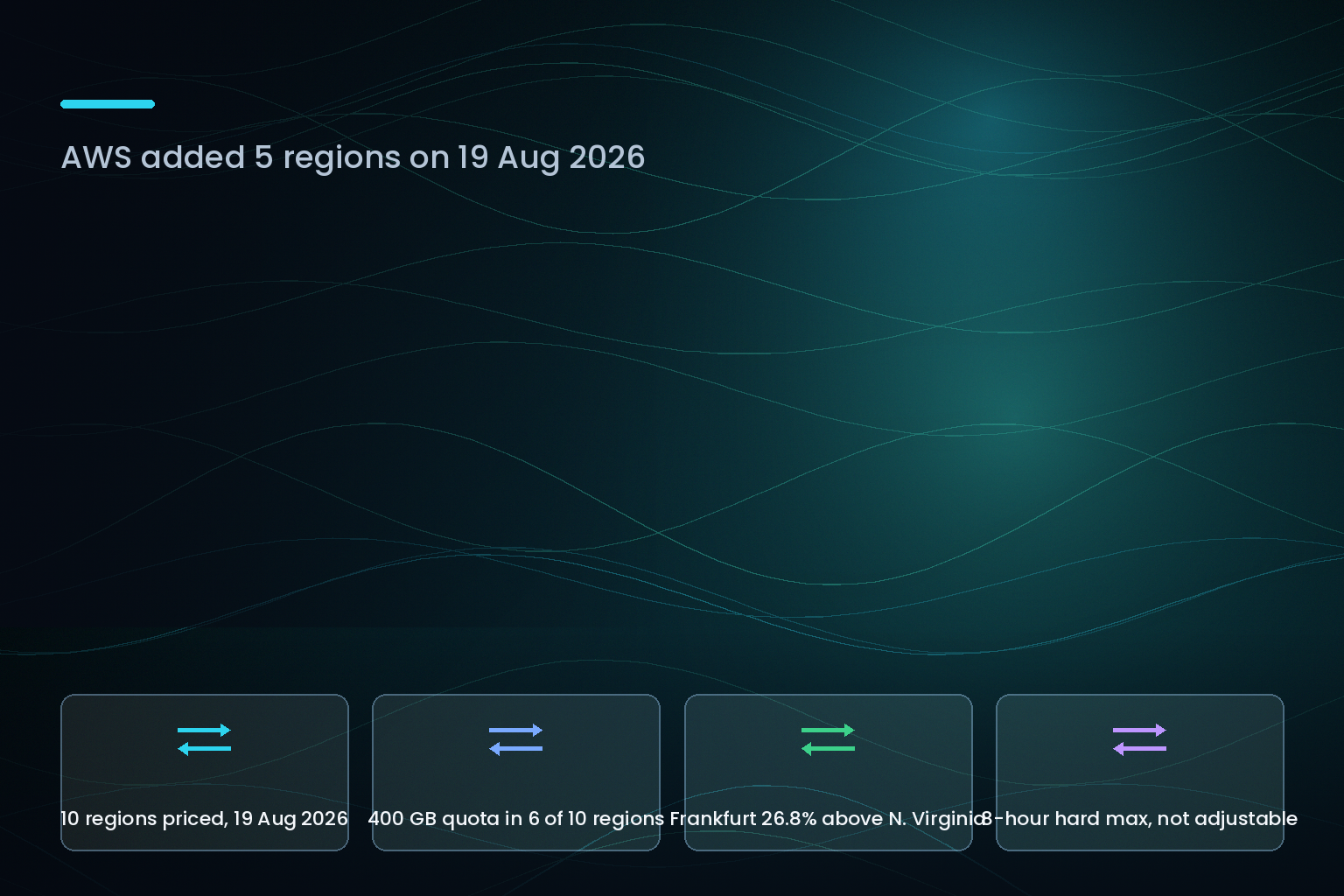
AWS Lambda MicroVMs reached 10 regions on 19 August 2026, and 6 of them cap you at 400 GB
AWS Lambda MicroVMs went from 5 regions to 10 on 19 August 2026. The AWS pricing API shows Frankfurt and Singapore running about 26% above N. Virginia, and six of the ten regions sit on a 400 GB account quota.
Manu Shukla -
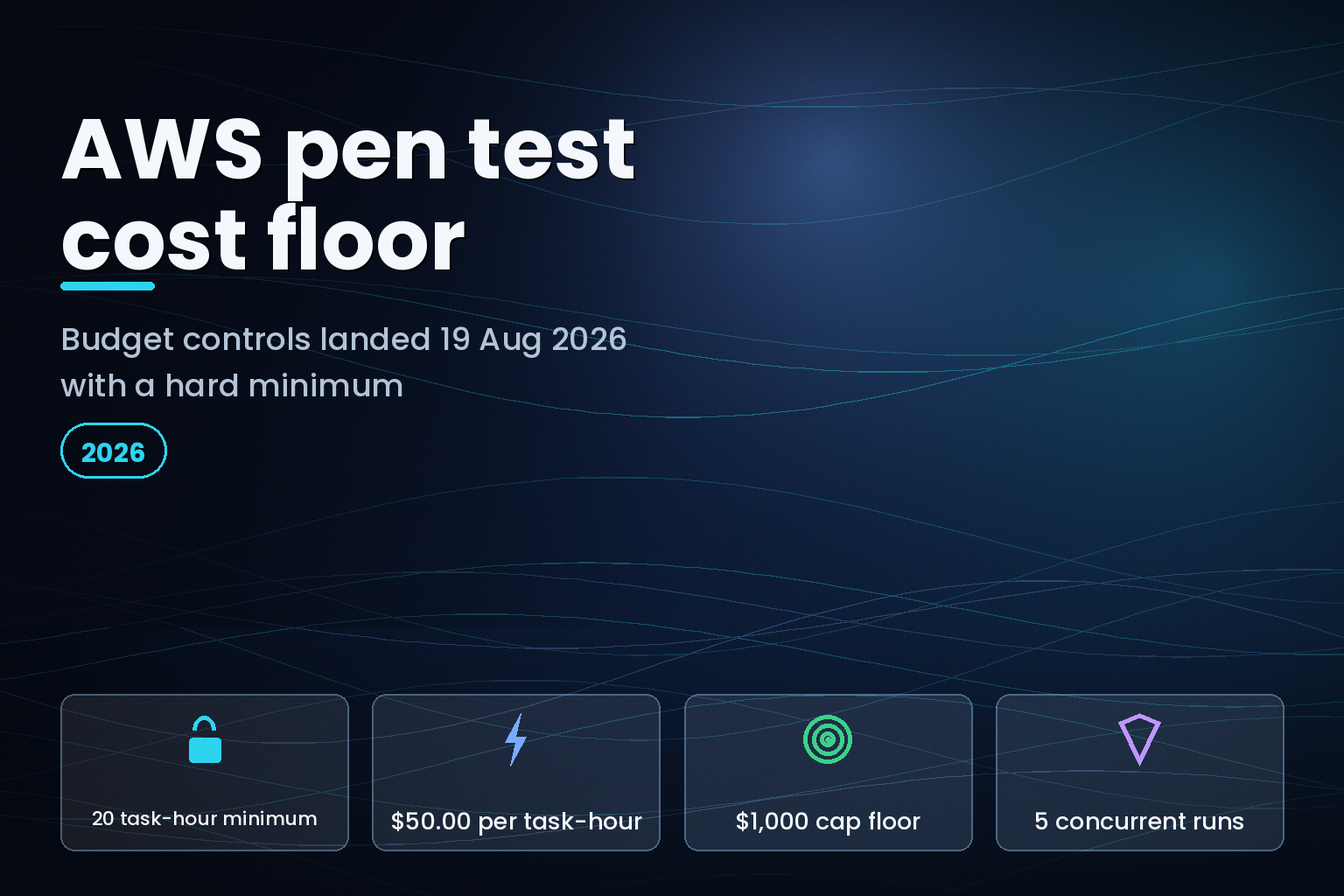
AWS Security Agent budget controls have a $1,000 floor: the 20 task-hour minimum, August 2026
AWS added a task-hours cap to Security Agent on 19 August 2026. The smallest allowed value is 20 hours, and the Price List API rates pen testing at $50.00 per hour, so the floor is $1,000 a test.
Manu Shukla -
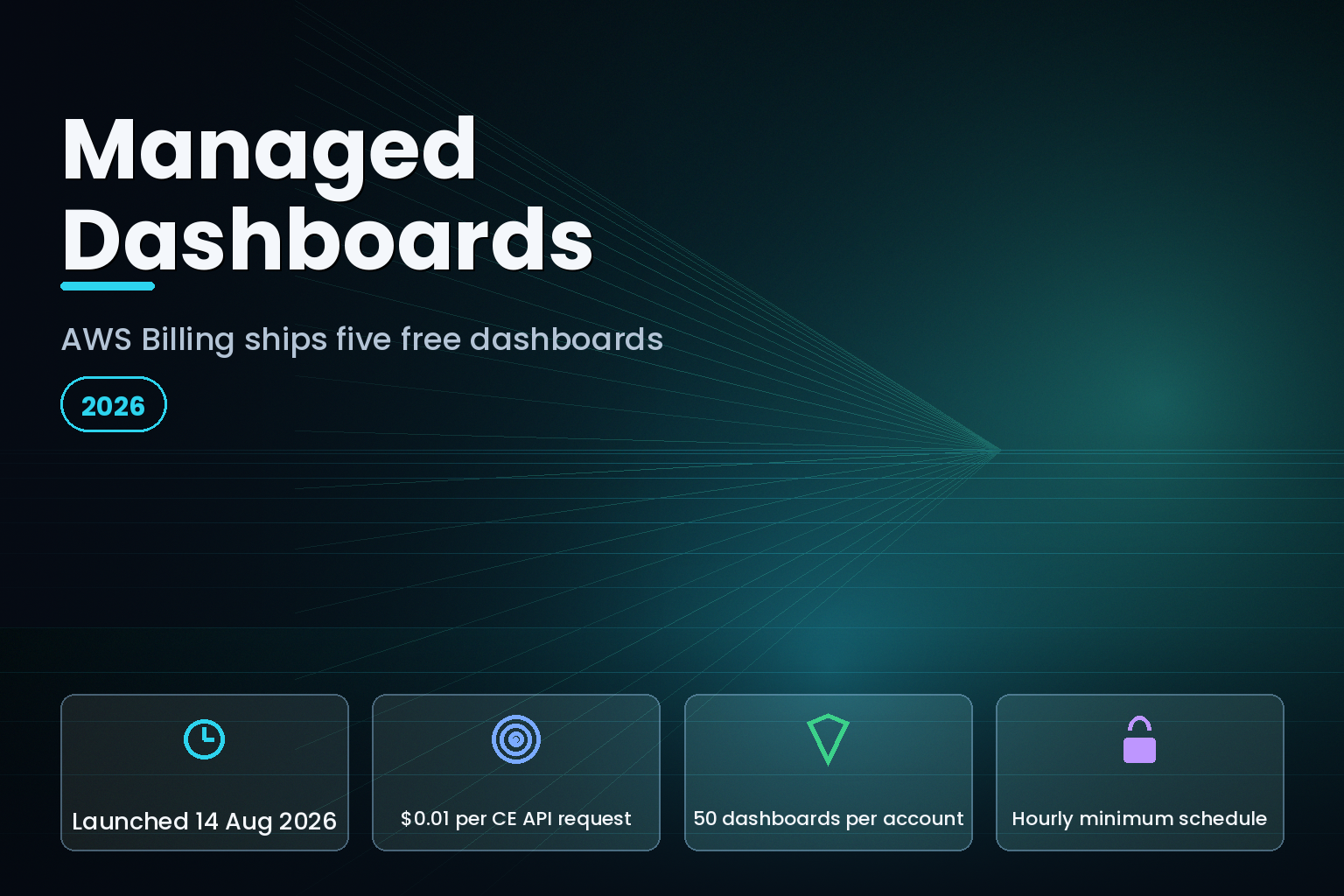
AWS Managed Dashboards shipped free on 14 August 2026 - scheduling one runs Cost Explorer API calls at $0.01 each
AWS shipped five read-only Managed Dashboards on 14 August 2026 at no additional cost. You cannot schedule one directly, and the duplicate you need runs Cost Explorer API calls billed at $0.01 per request.
Manu Shukla -
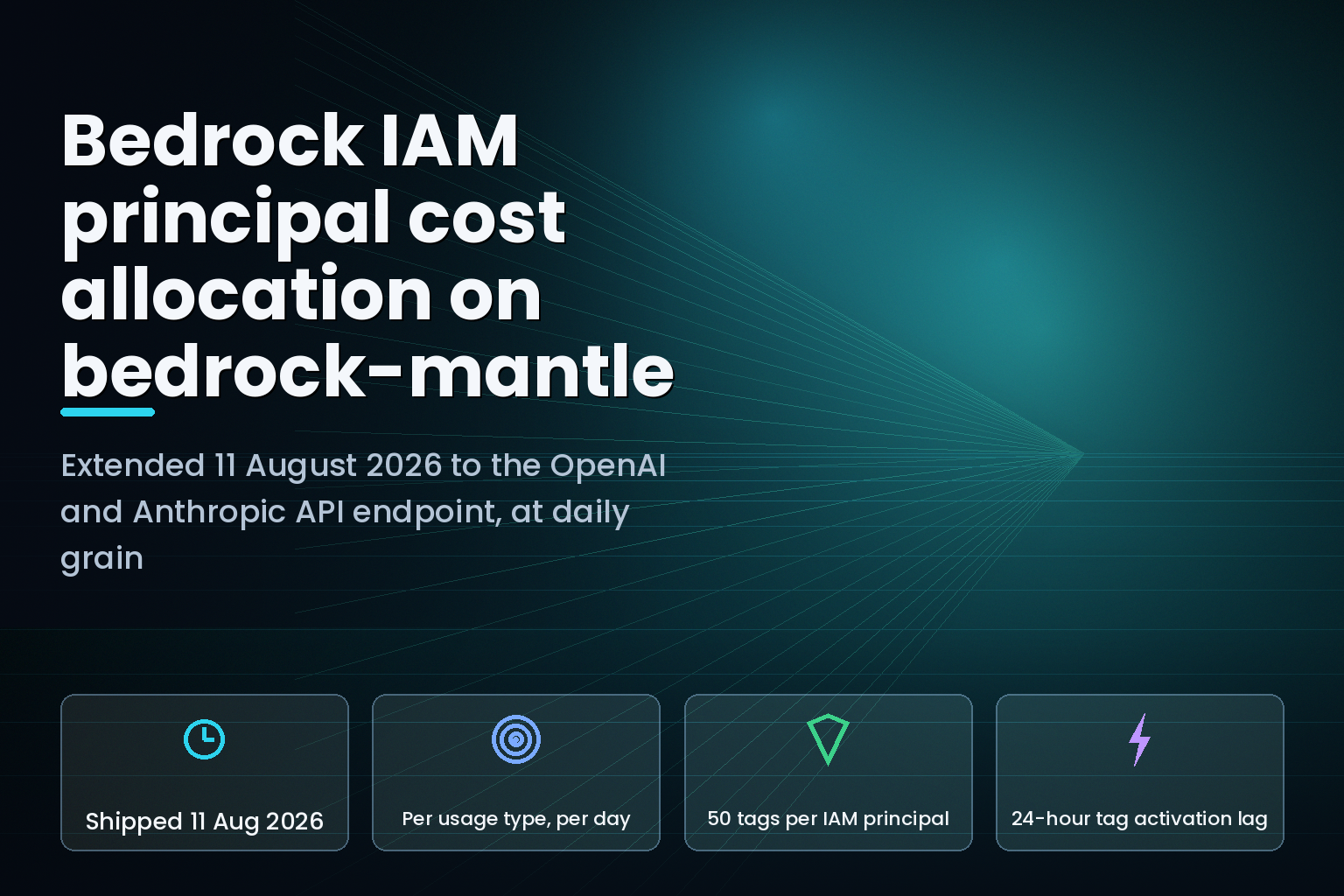
Bedrock IAM principal cost allocation reached bedrock-mantle on 11 August 2026, at daily grain
Bedrock now attributes bedrock-mantle cost by IAM user or role. The user guide says the finest grain is per usage type per day, tags are not retroactive, and existing CUR 2.0 exports must be recreated.
Manu Shukla -
CloudWatch pipelines added GeoIP, RDS and XML processors on 19 August 2026 at a metering fork
AWS says the three new CloudWatch pipelines processors cost nothing extra. The pipelines documentation says S3 and third-party sources are metered after processing, so every enriched byte is billed as a Custom log.
Manu Shukla -
Console-to-Code reached 32 AWS services on 17 August 2026, and the guide contradicts the cross-tab claim
The 17 August 2026 announcement says recordings now survive across browser tabs. The Amazon Q Developer guide, live on the same day, says the session ends when the tab closes.
Manu Shukla -
DynamoDB Streams ABAC shipped 19 August 2026 with a 7-day opt-out and a policy trap
DynamoDB Streams ABAC went live 19 August 2026: 50 tags per stream, a 10 KB cap, existing accounts disabled by default, and a seven-calendar-day opt-out window.
Manu Shukla -
EC2 Auto Scaling batch termination raised the blast radius to 100 on 18 August 2026 — scale-in protection still ignores
One call can now terminate 100 instances. AWS pitches it at container orchestrators - the workload whose main safety control, instance scale-in protection, explicitly does not apply to this API.
Manu Shukla -
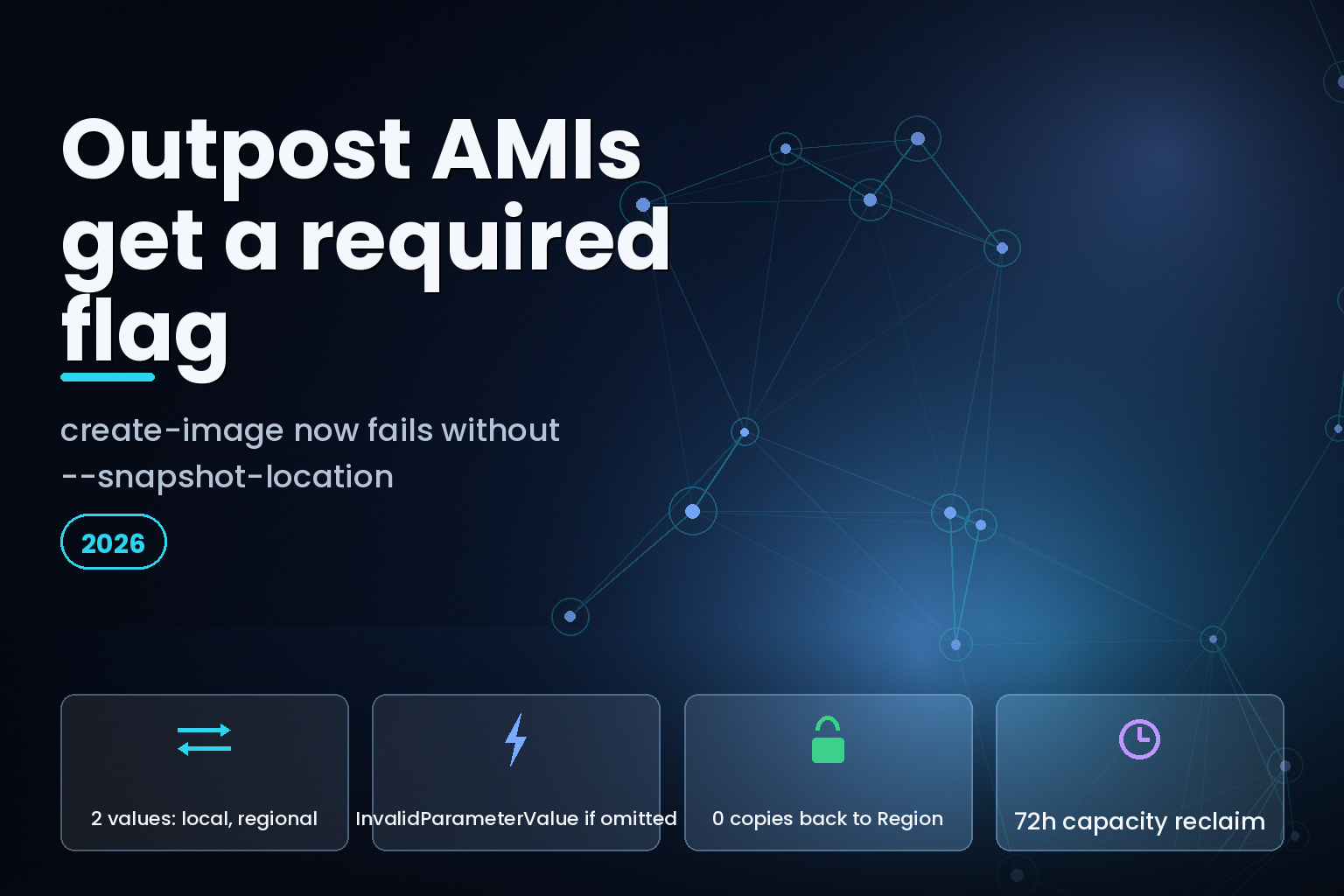
EC2 create-image on Outposts now fails without --snapshot-location: 2 values, 0 copies back to the Region
AWS enabled AMI creation with local snapshots on Outposts on 19 August 2026. The docs add a required --snapshot-location flag, so unchanged create-image automation now returns InvalidParameterValue.
Manu Shukla -
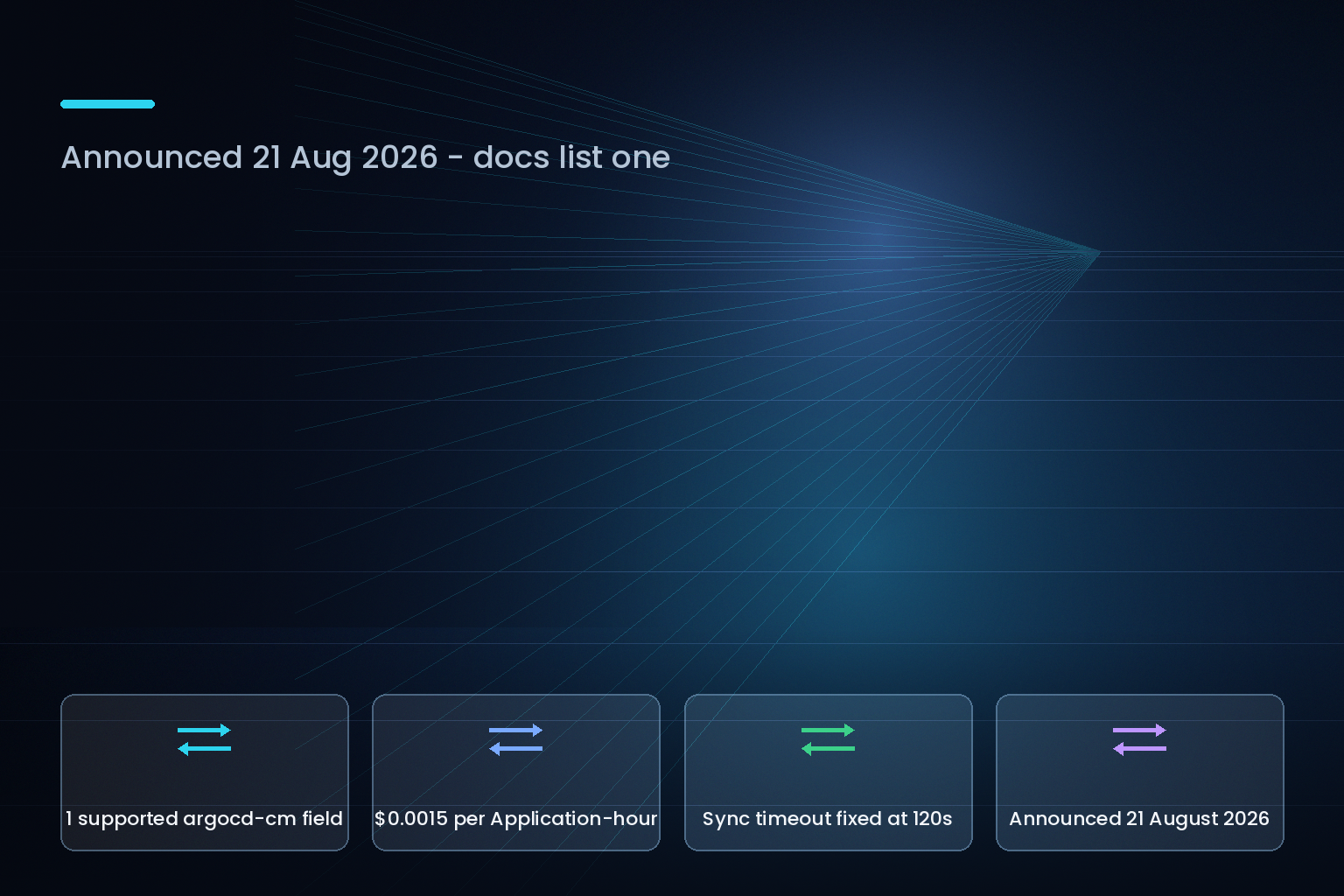
AWS shipped 1 of 3 promised Argo CD settings on 21 August 2026 — and ignores the rest silently
The 21 August 2026 AWS announcement names custom health checks, UI banners and watch/compare tuning. The EKS user guide lists exactly one supported argocd-cm field, and says unsupported keys are ignored without an error.
Manu Shukla -
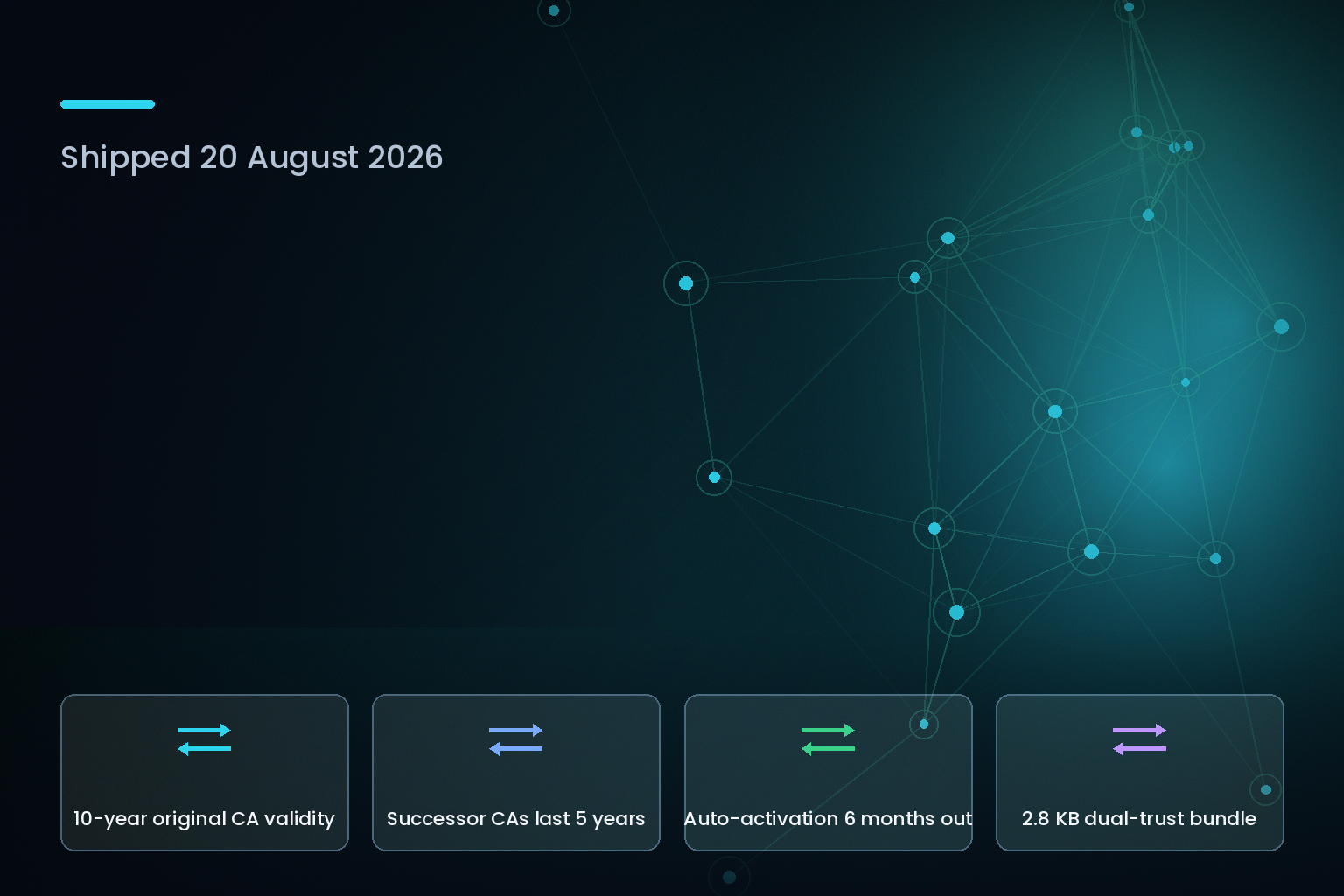
EKS CA rotation shipped 20 August 2026 with a 10-year clock and auto-activation you cannot decline
Amazon EKS clusters built since 2018 carry a 10-year certificate authority. AWS now appends a successor 2 years out and activates it 6 months before expiry, ready or not.
Manu Shukla -
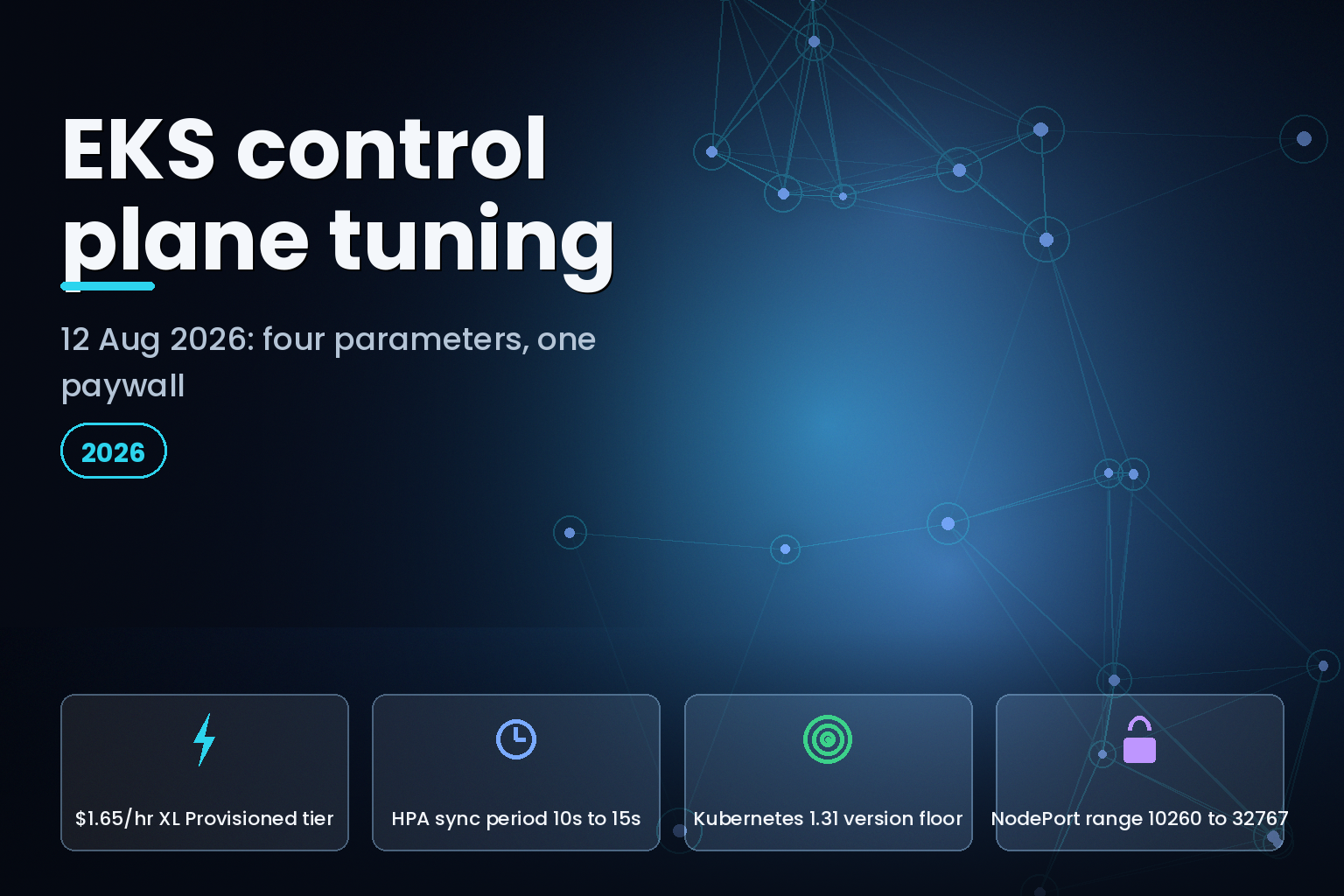
EKS control plane tuning shipped 12 August 2026 with four parameters and a $1.65/hr paywall
Amazon EKS now lets you tune the scheduler, controller manager and API server. Four parameters shipped on 12 August 2026, and the headline autoscaling one needs a control plane tier costing $1.65 an hour.
Manu Shukla -
MSK custom domain names shipped 17 August 2026, and the NLB behind them does not scale with your brokers
MSK shipped cluster-level custom domain names on 17 August 2026 at no extra charge. The docs add what the announcement omits: every new broker needs its own NLB listener and DNS record.
Manu Shukla -
MWAA Serverless added PythonOperator on 18 August 2026: 250 MB cap, 60-minute ceiling, no internet
MWAA Serverless can finally run your own Python and shell code, but the 250 MB package cap, 60-minute task timeout, fixed 1 vCPU worker and no-internet default decide whether your DAGs can actually move.
Manu Shukla -
AWS Network Firewall rule hit counts shipped 17 August 2026 and cannot see the pass rule that shadows your policy
AWS Network Firewall added stateful rule hit counts on 17 August 2026. The visualization reads alert logs, and alert logs never record a pass rule, which is the rule most likely to be shadowing your policy.
Manu Shukla -
OpenSearch semantic enrichment reached VPC domains on 17 August 2026 with an authorization step AWS did not announce
AWS said no VPC changes were required. The OpenSearch guide says every semantic enrichment index call on a VPC domain returns AccessDeniedException until you run AuthorizeVpcEndpointAccess first.
Manu Shukla -
S3 403 errors named the denying policy ARN from 13 August 2026, but bucket and VPC endpoint policies are excluded
AWS added the denying policy ARN to S3 403 messages on 13 August 2026. It appears only on explicit deny, covers five policy types, and skips bucket policies, VPC endpoint policies and directory buckets.
Manu Shukla -
SageMaker notebook TIP covers 2 of 5 engines, 3 flag names and a 23 July 2025 project cliff
AWS shipped trusted identity propagation for SageMaker notebooks on 19 August 2026. The admin guide names five engines, the user guide two, the flag has three spellings, and pre-23 July 2025 projects are out.
Manu Shukla -
Storage Gateway FIPS PrivateLink shipped in software 3.2.7 on 30 June 2026, seven weeks before AWS announced it
The FIPS endpoint type is baked into the Storage Gateway activation key, so an existing Tape or Volume Gateway cannot be switched over. Eight Regions, six TCP ports, and private DNS must stay off.
Manu Shukla -
WorkSpaces nested virtualization turns off Credential Guard — the 18 August 2026 announcement never says so
The AWS announcement lists three exclusions. The admin guide lists five, plus an automatic Credential Guard shutdown and an AutoStop hibernation failure that costs real money to work around.
Manu Shukla -
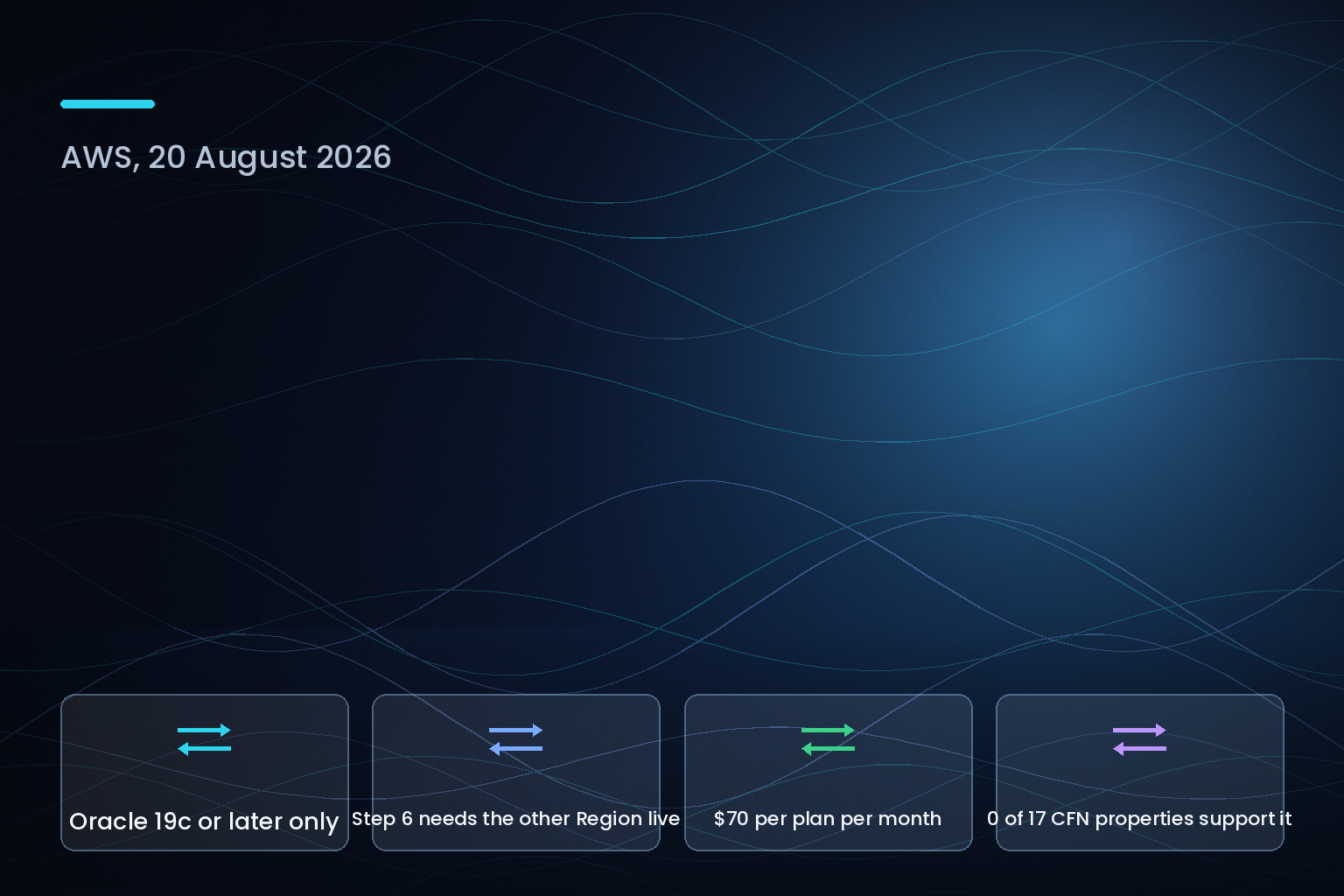
AWS shipped an RDS Oracle switchover block for ARC Region switch on 20 August 2026
The new Amazon RDS Switchover Read Replica execution block runs nine graceful steps, and step 6 validates that the primary in the other Region is available. In a real Region outage that check cannot pass.
Manu Shukla -
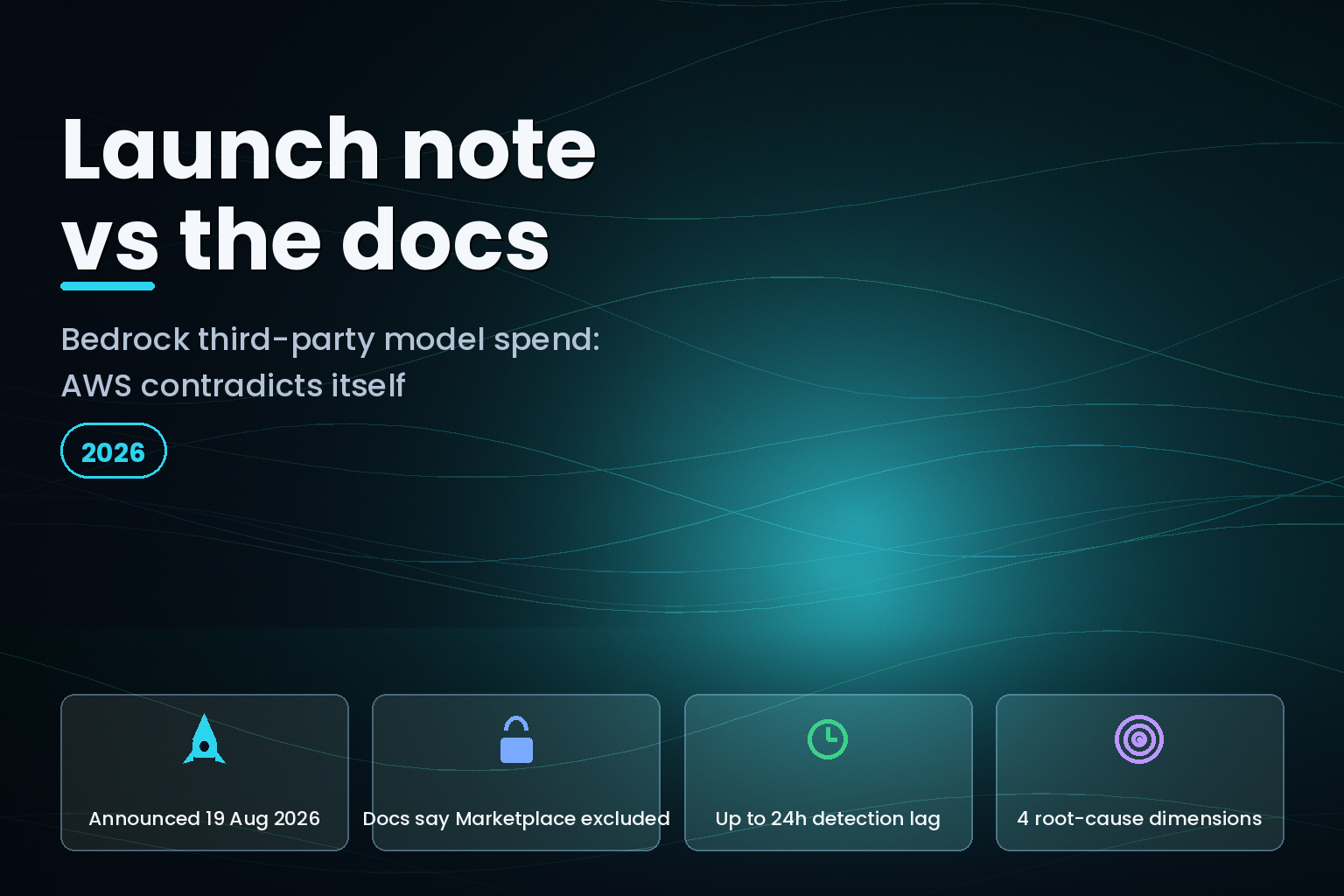
AWS said Cost Anomaly Detection covers Bedrock third-party models on 19 August 2026 — its own docs say it does not
On 19 August 2026 AWS said Cost Anomaly Detection now monitors third-party foundation models on Amazon Bedrock. The user guide page the announcement links to states the opposite, naming Anthropic Claude specifically
Manu Shukla -
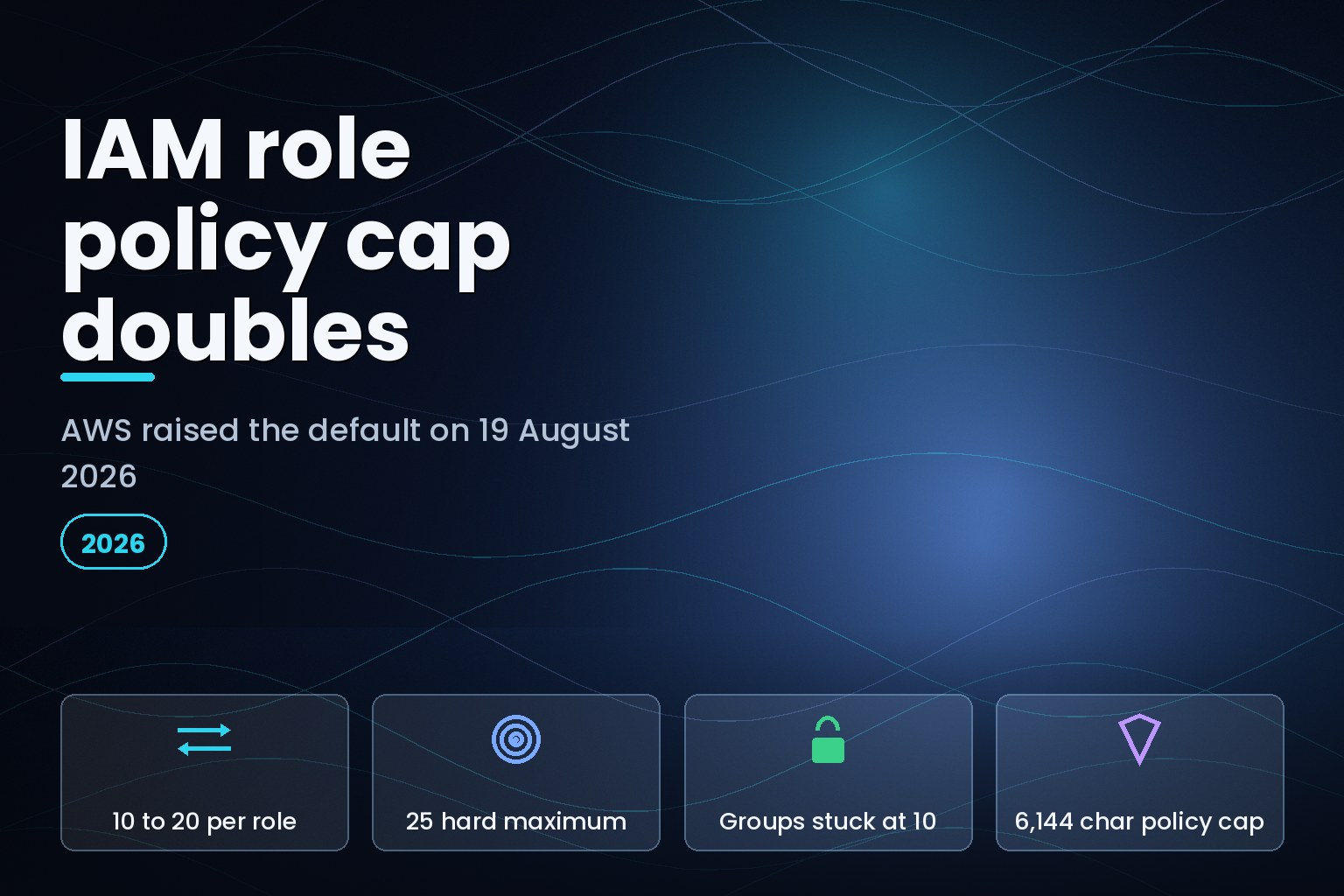
AWS IAM doubled managed policies per role to 20 in August 2026 — three caps did not move
On 19 August 2026 AWS doubled the default managed-policy attachment limit on IAM roles to 20, with a ceiling of 25. Three adjacent limits stayed exactly where they were, and AWS documentation now reports the same quota
Manu Shukla -
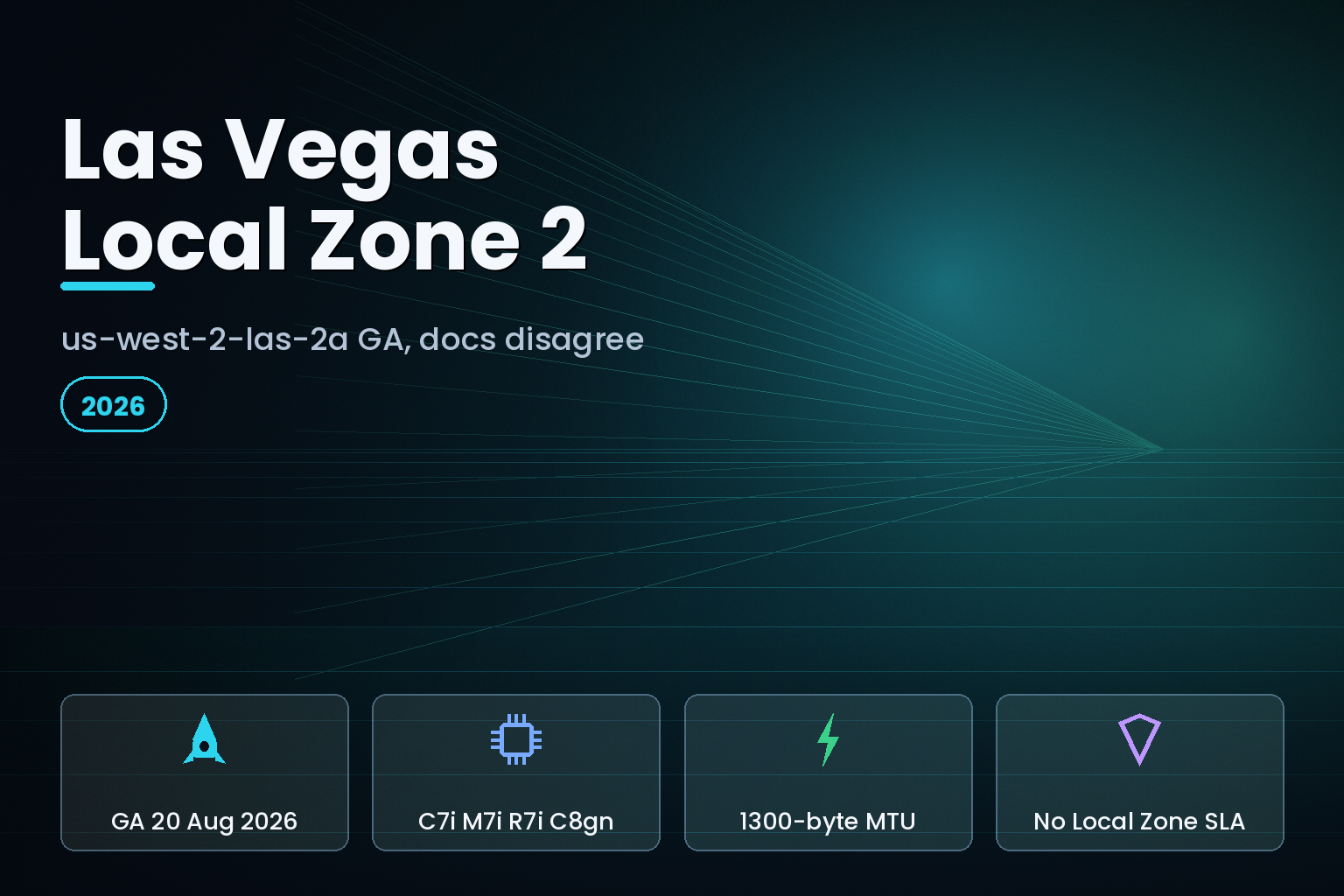
AWS launched a second Las Vegas Local Zone on 20 August 2026 and its own services table still omits it
AWS made a second Las Vegas Local Zone, us-west-2-las-2a, generally available on 20 August 2026. Its own services table, updated 7 August 2026, omits the zone and contradicts the announcement on EC2 and EBS.
Manu Shukla -
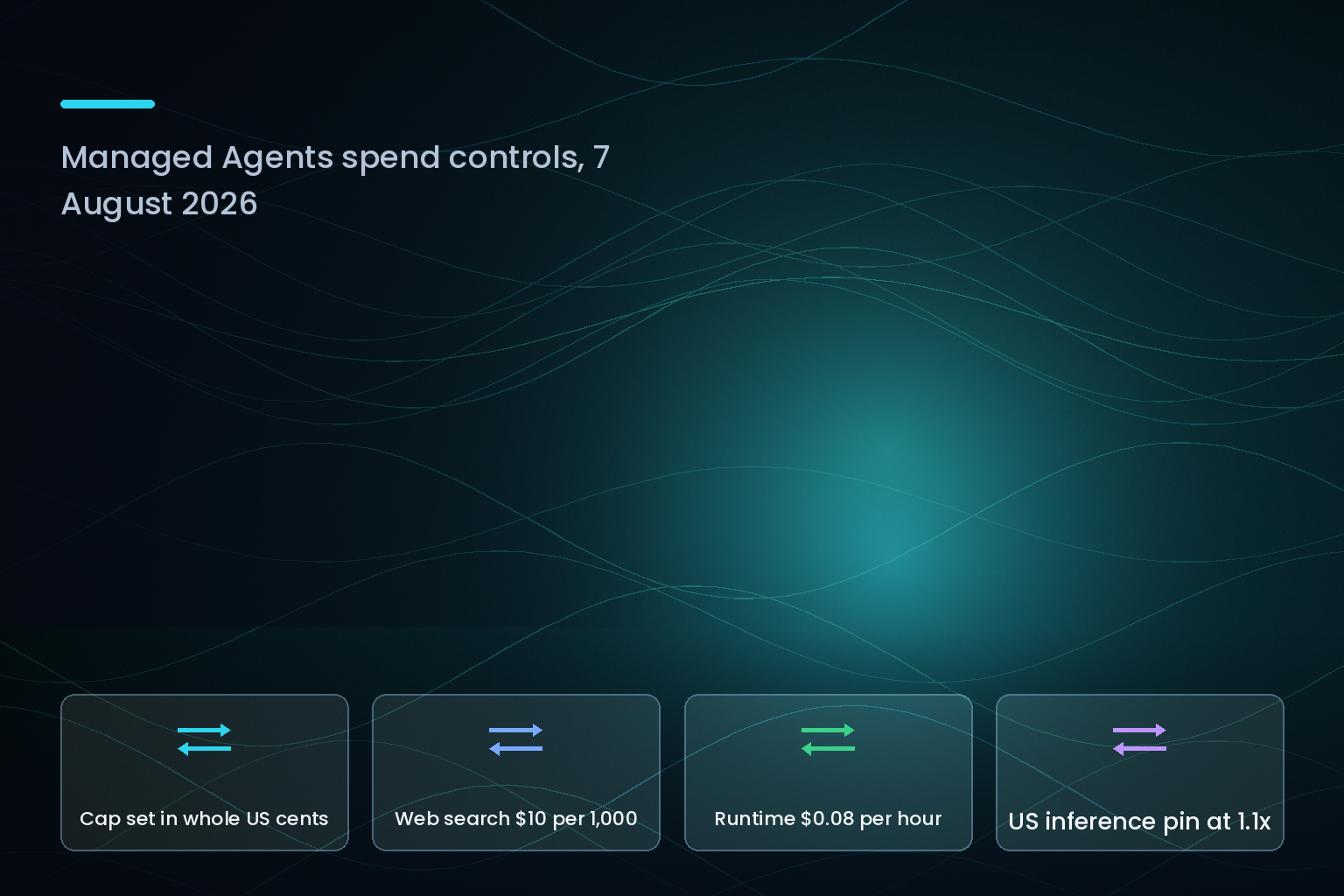
Claude session budgets cap list cost, not your bill: 4 gaps in the August 2026 controls
Anthropic shipped session budgets for Claude Managed Agents on 7 August 2026. The cap is priced at public list rates, overshoots by one model request per thread, and on a deployment it bounds every run separately.
Manu Shukla -
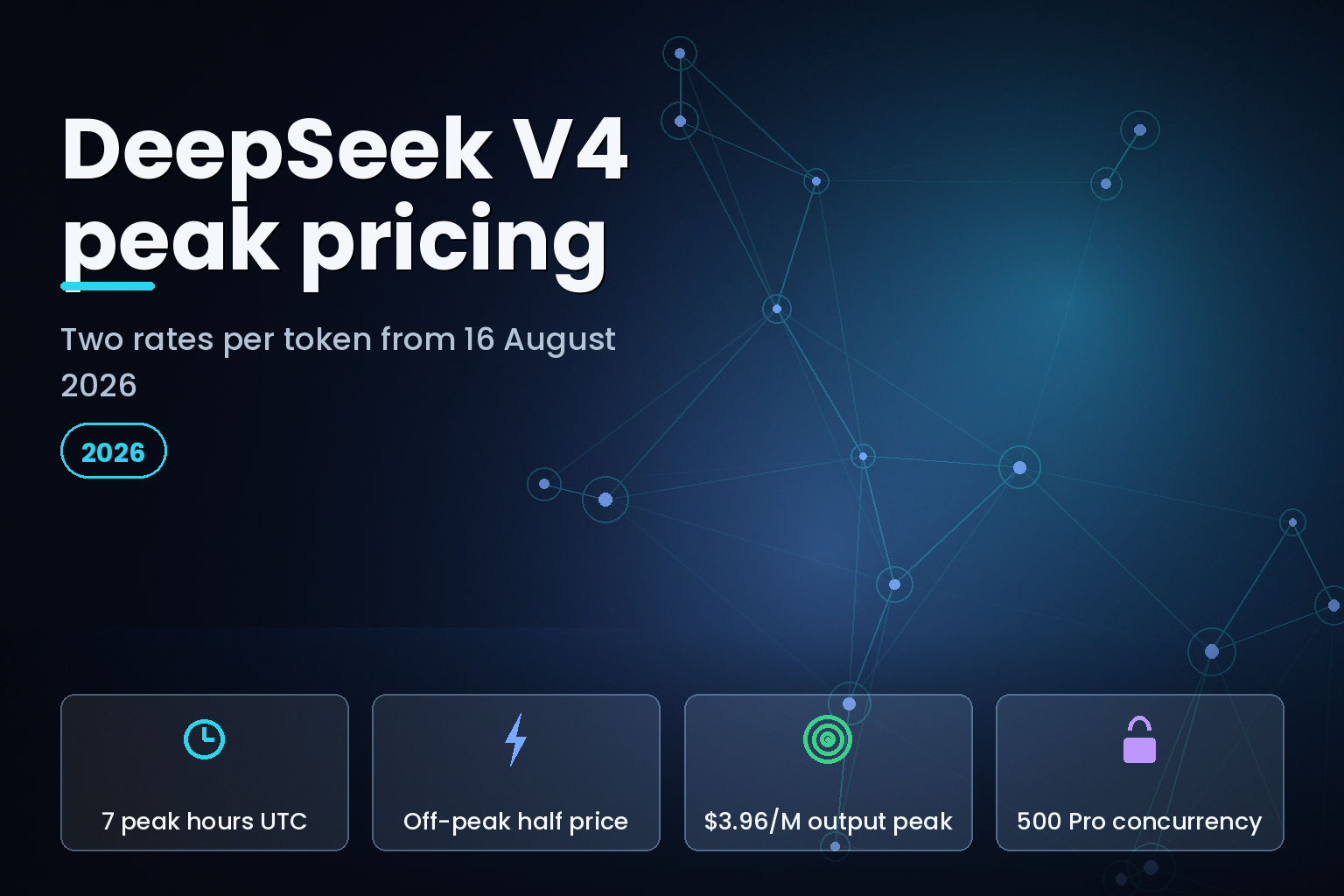
DeepSeek V4 split API pricing into 7 peak hours on 16 August 2026
DeepSeek's V4 rate card now has two prices for every token. Peak hours are 01:00-04:00 and 06:00-10:00 UTC, off-peak is half, and one of the two peak blocks lands inside the Indian working day.
Manu Shukla -
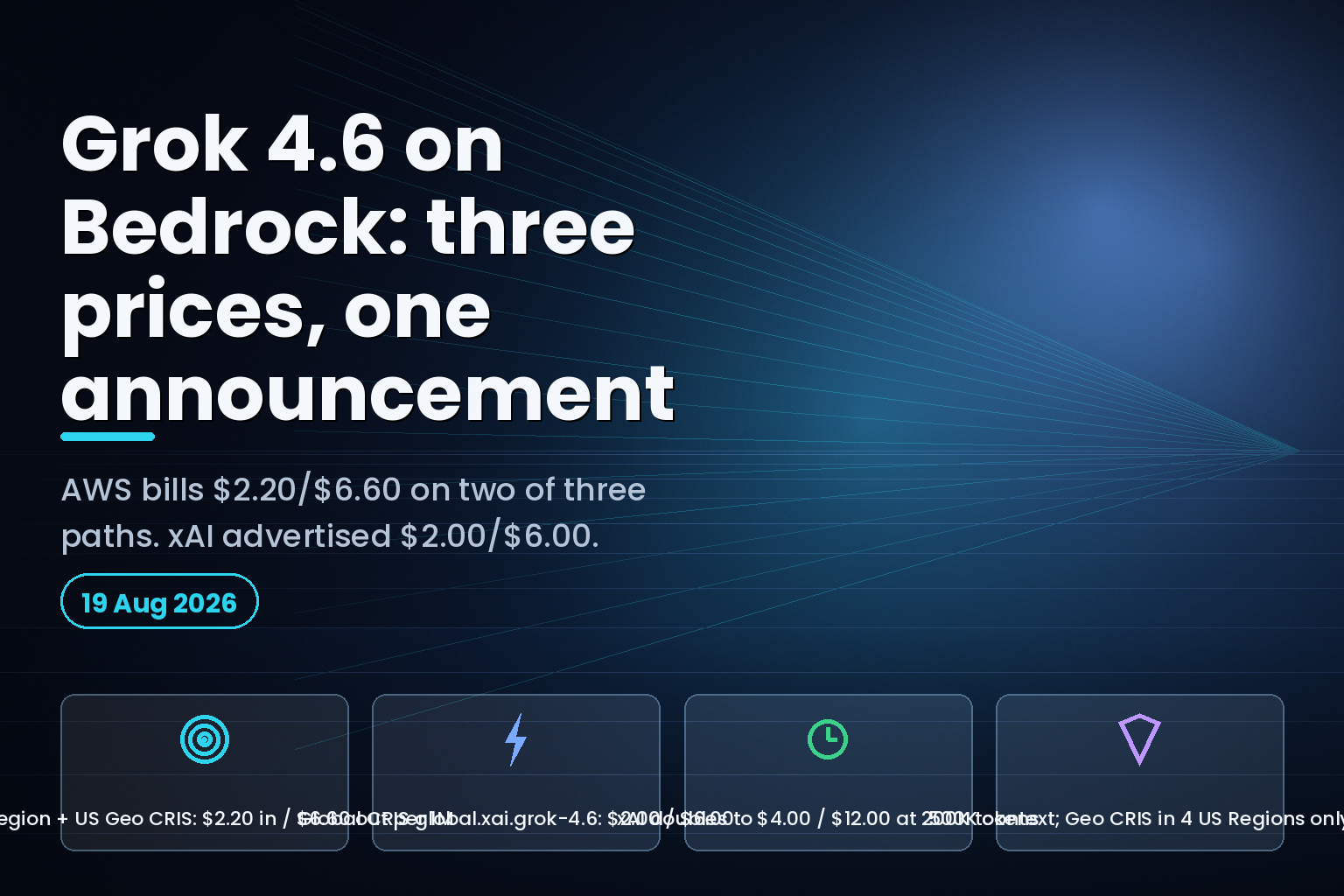
Grok 4.6 on Bedrock: $2.20 in-region, $2.00 global, and the 200K cliff AWS never published
xAI announced Grok 4.6 on Amazon Bedrock at $2 input and $6 output per million tokens. AWS's own model card prices two of the three inference paths at $2.20 and $6.60, and publishes no long-context tier at all.
Manu Shukla -
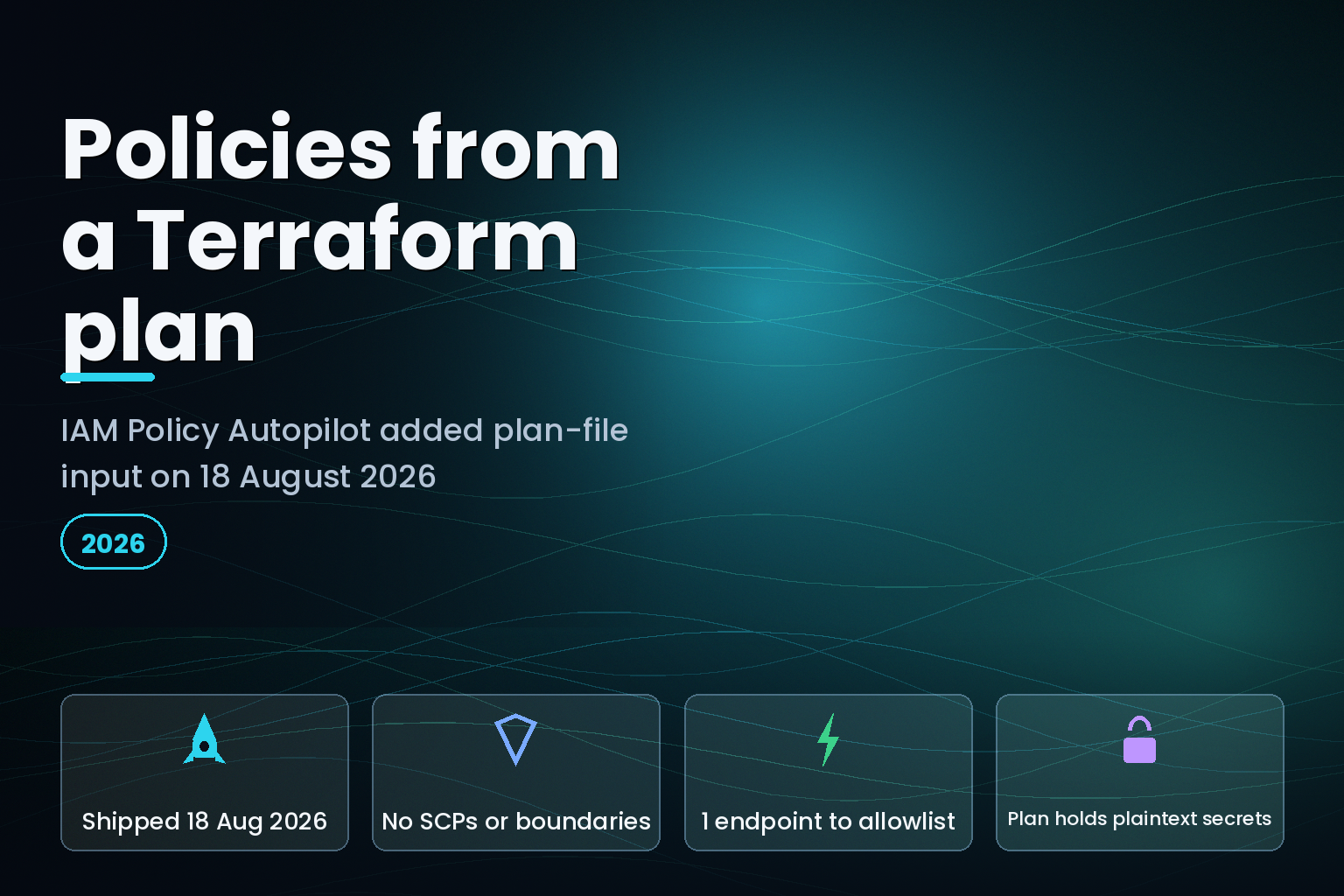
IAM Policy Autopilot gained Terraform plan support on 18 August 2026 — 4 limits AWS did not mention
On 18 August 2026 AWS taught IAM Policy Autopilot to generate scoped IAM policies straight from a Terraform plan file. Four constraints sit underneath that sentence, and one of them contradicts the phrase "runs on your
Manu Shukla -
Supabase moved read replicas to Infrastructure on 21 August 2026, and two live docs pages price disk throughput 10x
Supabase relocated read replica management to Project Settings then Infrastructure on 21 August 2026. The interesting part is the cost model underneath it, and a live 10x pricing contradiction.
Manu Shukla -
Timestream for InfluxDB customer managed keys shipped 20 August 2026 with no API or CLI reference
AWS announced customer managed key support for Timestream for InfluxDB on 20 August 2026. The developer guide hands you a --kms-key-id flag that six AWS reference pages do not document.
Manu Shukla -
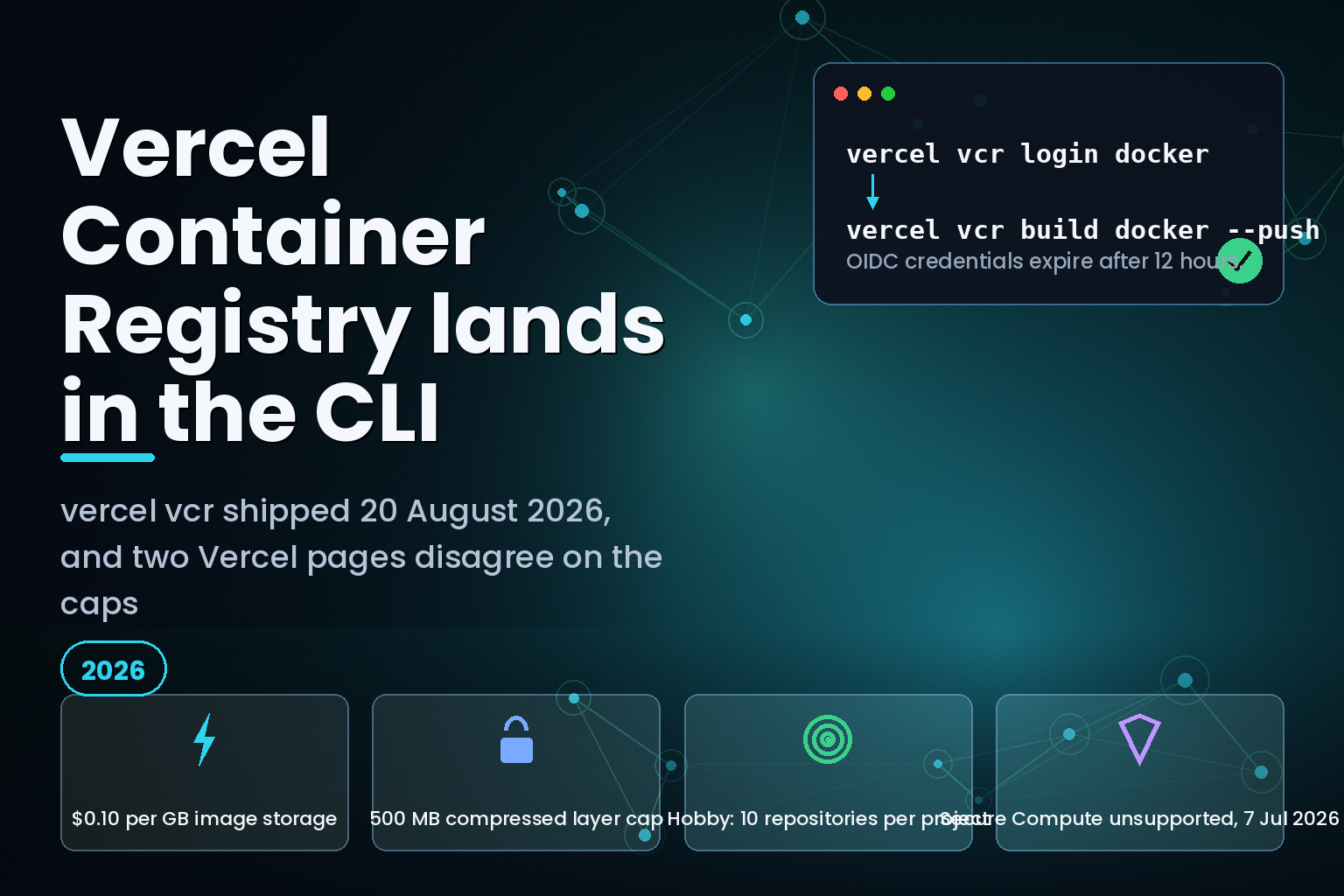
Vercel Container Registry hits the CLI on 20 August 2026 with a 10-repository Hobby cap its own launch post denies
Vercel's new vcr command group landed on 20 August 2026. Two live Vercel pages disagree on repository limits, and the 500 MB layer ceiling stops fat images before the 15 GB total does.
Manu Shukla -
Bedrock Web Search ships with no published price and a silent 403 on external web access
AWS made Web Search on Amazon Bedrock generally available on 4 August 2026 and told buyers to check the pricing page for costs. The pricing page has no price. Worse, the default IAM policy grants search but not external
Manu Shukla -
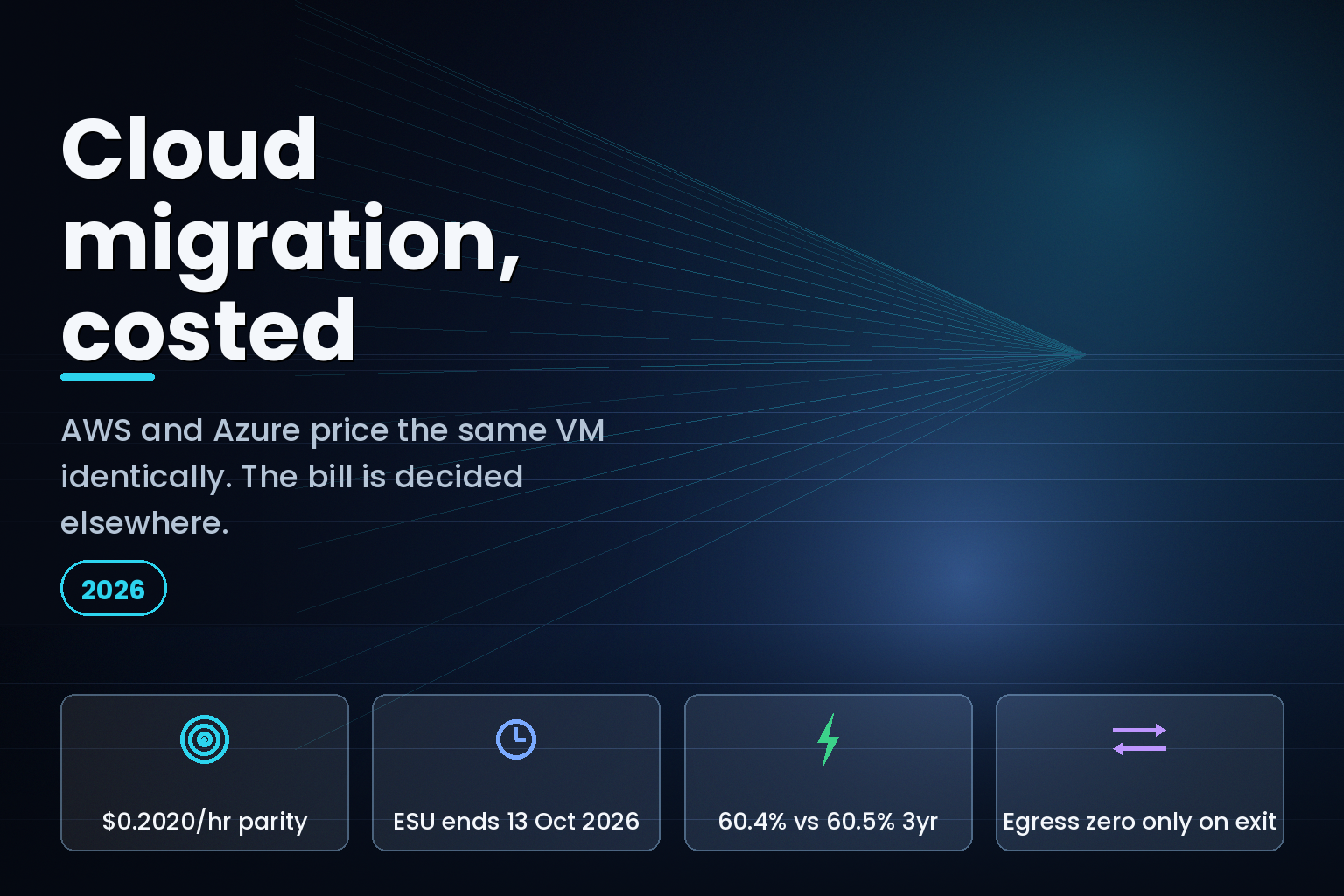
Cloud migration services in 2026: what a move off on-prem actually costs
AWS m6i.xlarge and Azure D4s v5 both cost $0.2020/hour in India as of 17 August 2026. Compute parity is not where migration budgets fail. This guide prices the replication meters, egress tiers, licence cliffs
Manu Shukla -
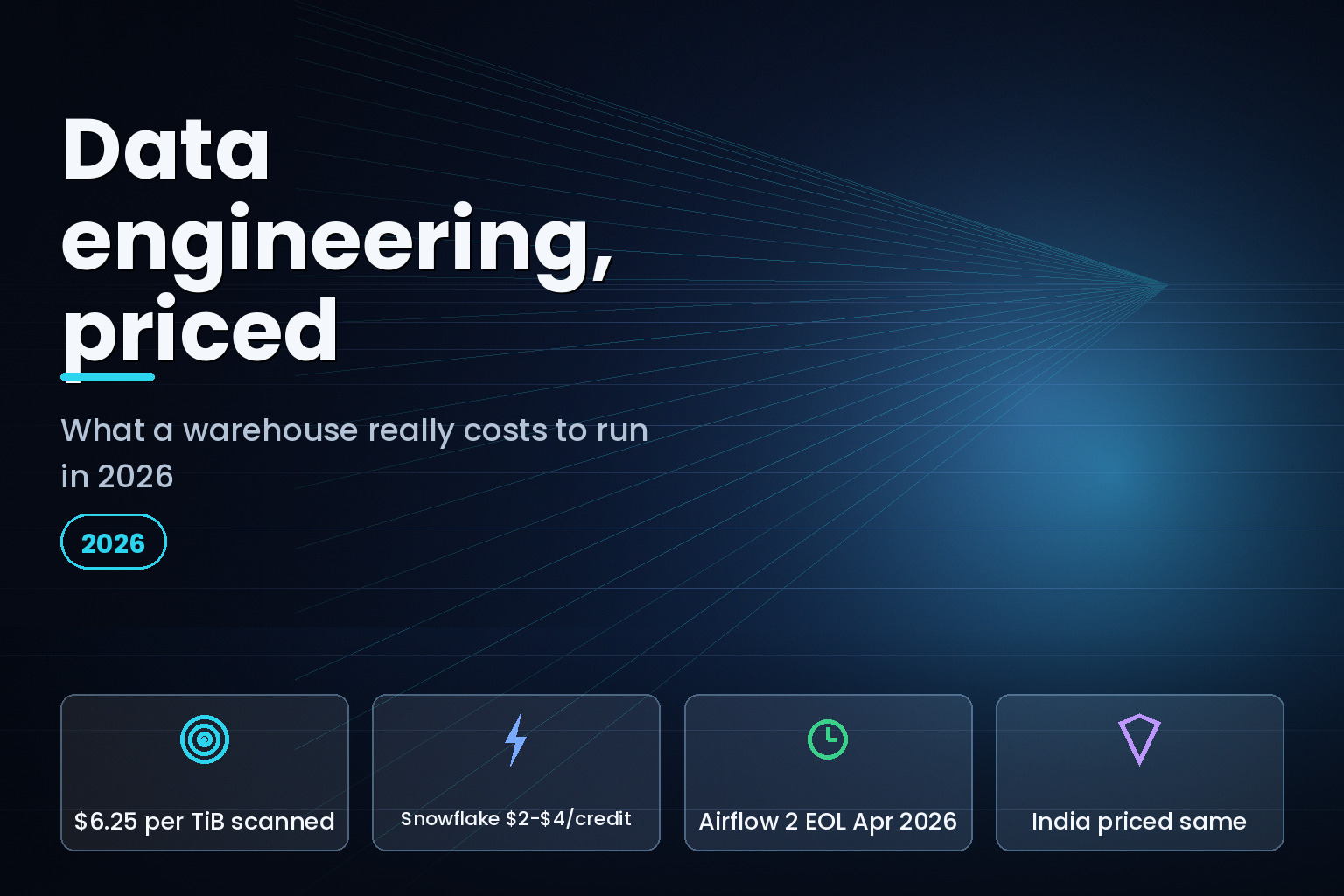
Data engineering services in 2026: what a pipeline and warehouse actually cost to run
Most data platform budgets miss because the build is quoted and the run is not. Here are the August 2026 list prices for Snowflake, BigQuery, Redshift, Databricks, dbt and Fivetran, what drives the bill, and how eCorpIT
Manu Shukla -
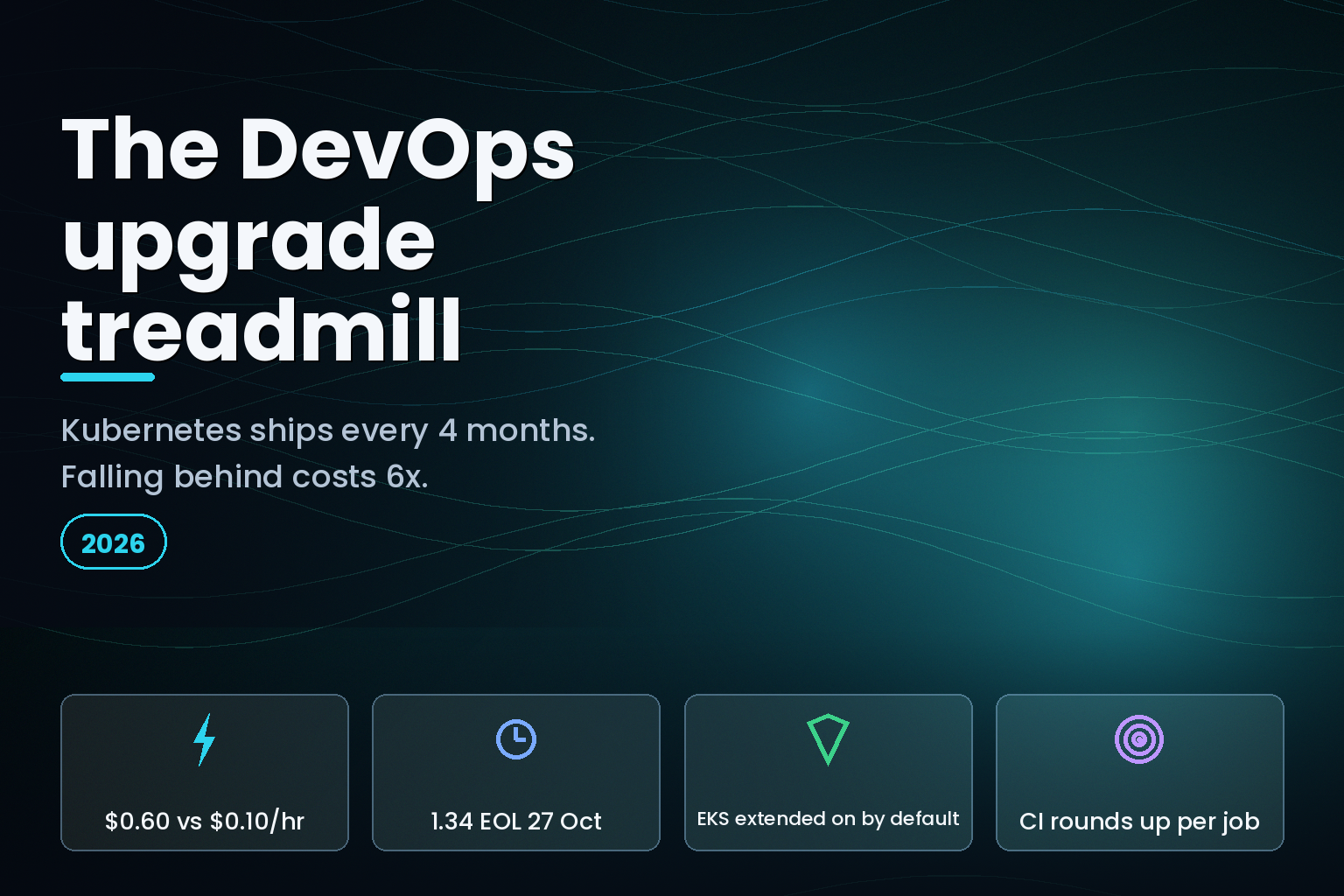
DevOps services company: 3 cloud fees that decide your 2026 budget
Buying DevOps services in 2026 is mostly a decision about who owns the upgrade treadmill. Kubernetes ships a minor version every four months with 14 months of support, and AWS, Google and Microsoft all charge
Manu Shukla -
AgentCore runtime instances: the 24% utilisation line that decides 2026 agent compute
Runtime instances bill EC2 plus a 12% management fee, and 7.8% on G-series. Worked against AWS's published microVM rates, the crossover on an 8 vCPU shape lands near 24% sustained utilisation.
Manu Shukla -
Originating products in Cloud Billing: 4 limits before you rebuild AI chargeback in 2026
Google Cloud Billing added an Originating products filter on 7 August 2026, so Gemini Enterprise spend no longer hides inside Vertex AI Search. The catch: the dimension is console-only, disables forecasting, and has not
Manu Shukla -
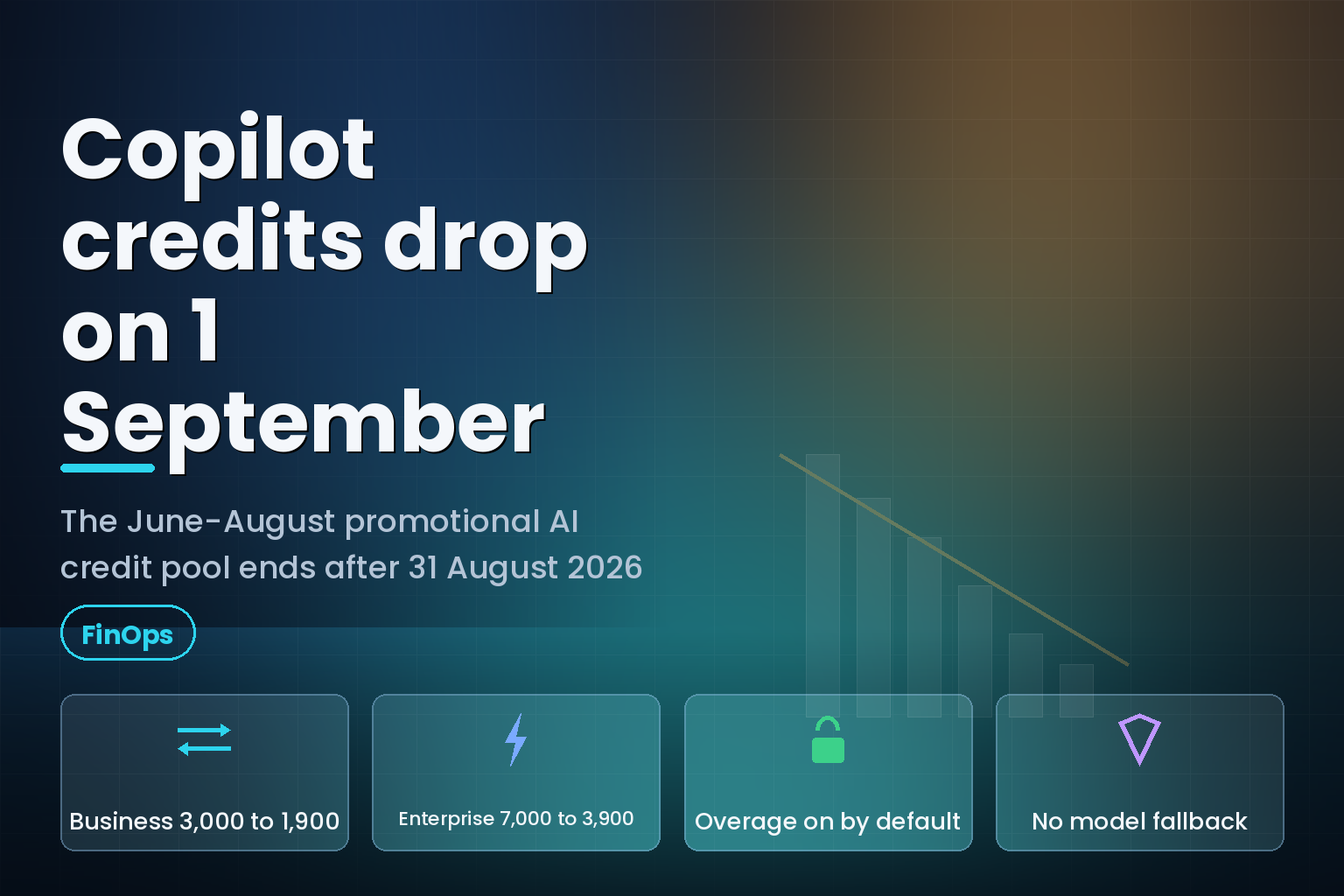
Copilot AI credits drop up to 44% on 1 September 2026: forecast your bill
GitHub's promotional AI credit allowance ends after 31 August 2026, cutting the pooled monthly allowance 37% for Copilot Business and 44% for Enterprise. Here is the arithmetic and the four defaults behind it.
Manu Shukla -
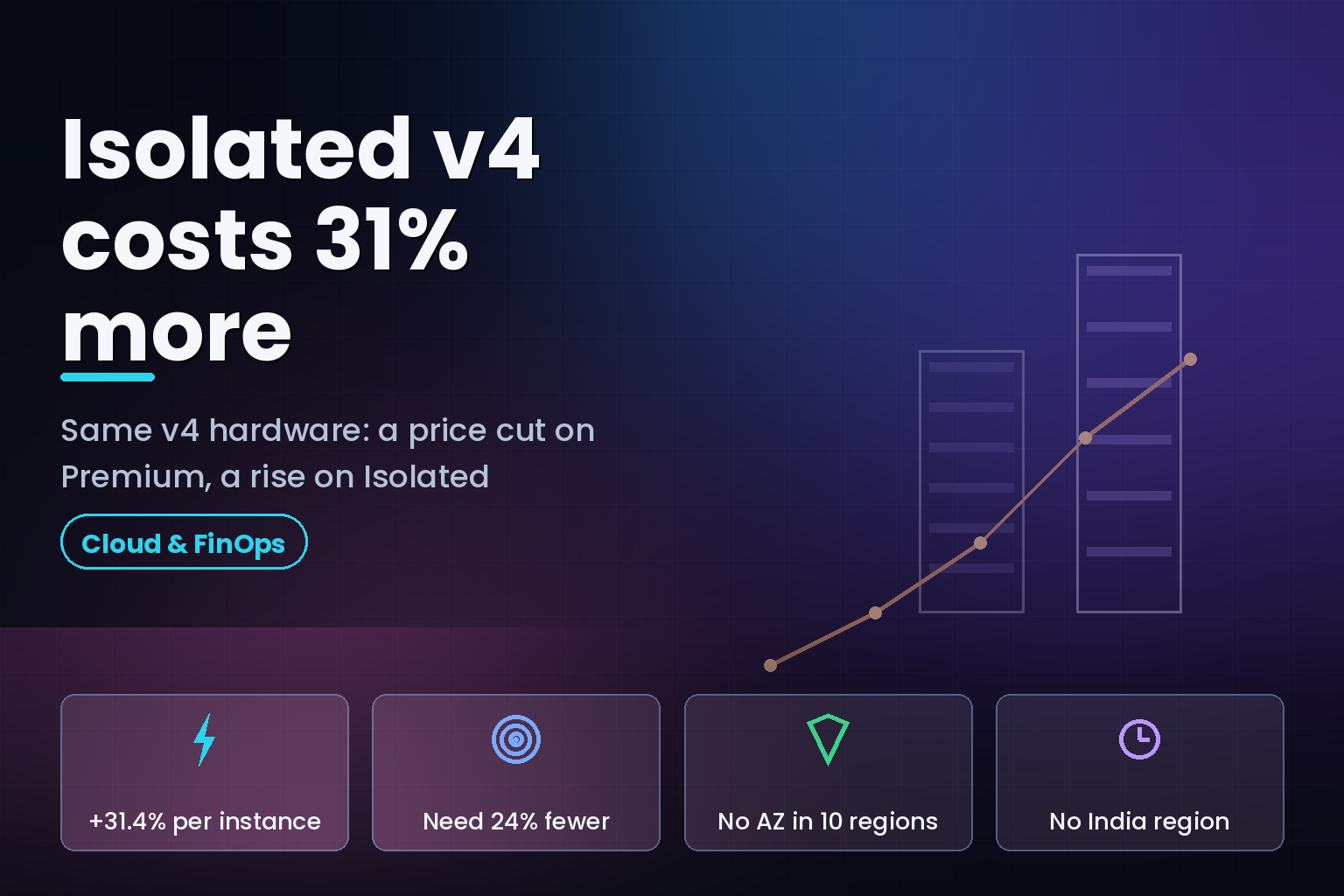
Isolated v4 costs 31.4% more than Isolated v2: the App Service Environment cost math for 2026
Azure's Isolated v4 tier for App Service Environment v3 costs 31.4% more per instance than Isolated v2 in Southeast Asia, while the identical v4 hardware made multitenant Premium 17.8% cheaper. Your fleet has to shrink
Manu Shukla -
Observability cost reduction in 2026: 6 billing rules that decide your bill
Most observability overspend is not a vendor problem. It is a data-model problem meeting a billing rule nobody read. Here are the six published rules that move the number, with the primary sources.
Manu Shukla -
PostgreSQL 14 dies 12 November 2026: the Extended Support bill on AWS, Azure and Google Cloud
PostgreSQL 14 reaches end of life on 12 November 2026. AWS starts Extended Support billing on 1 March 2027, Azure on 12 December 2026 and Google Cloud on 1 February 2027 - three different clocks, one upgrade plan.
Manu Shukla -
Leaving VMware in 2026: the 7-step cost model to run before your Broadcom renewal
Gartner puts typical VMware licensing increases at 300 to 400 percent, and 48 percent of customers plan to shrink their footprint by 2028. Here is the cost model to run before you sign.
Manu Shukla -
26% of AI spend is wasted in 2026: build the cost attribution layer before the next bill spike
Only 20% of organisations could explain an overnight doubling of their AI bill within hours. This is the provider-by-provider attribution layer, the ownership model and the 90-day sequence that closes the gap.
Manu Shukla -
BigQuery Omni vs Snowflake vs Databricks: query cross-cloud data without egress fees (2026)
Querying data that lives in another cloud can cost more in transfer fees than in compute. Here is how BigQuery Omni, Snowflake and Databricks each handle cross-cloud reads in 2026, with the per-TB numbers that decide
Manu Shukla -
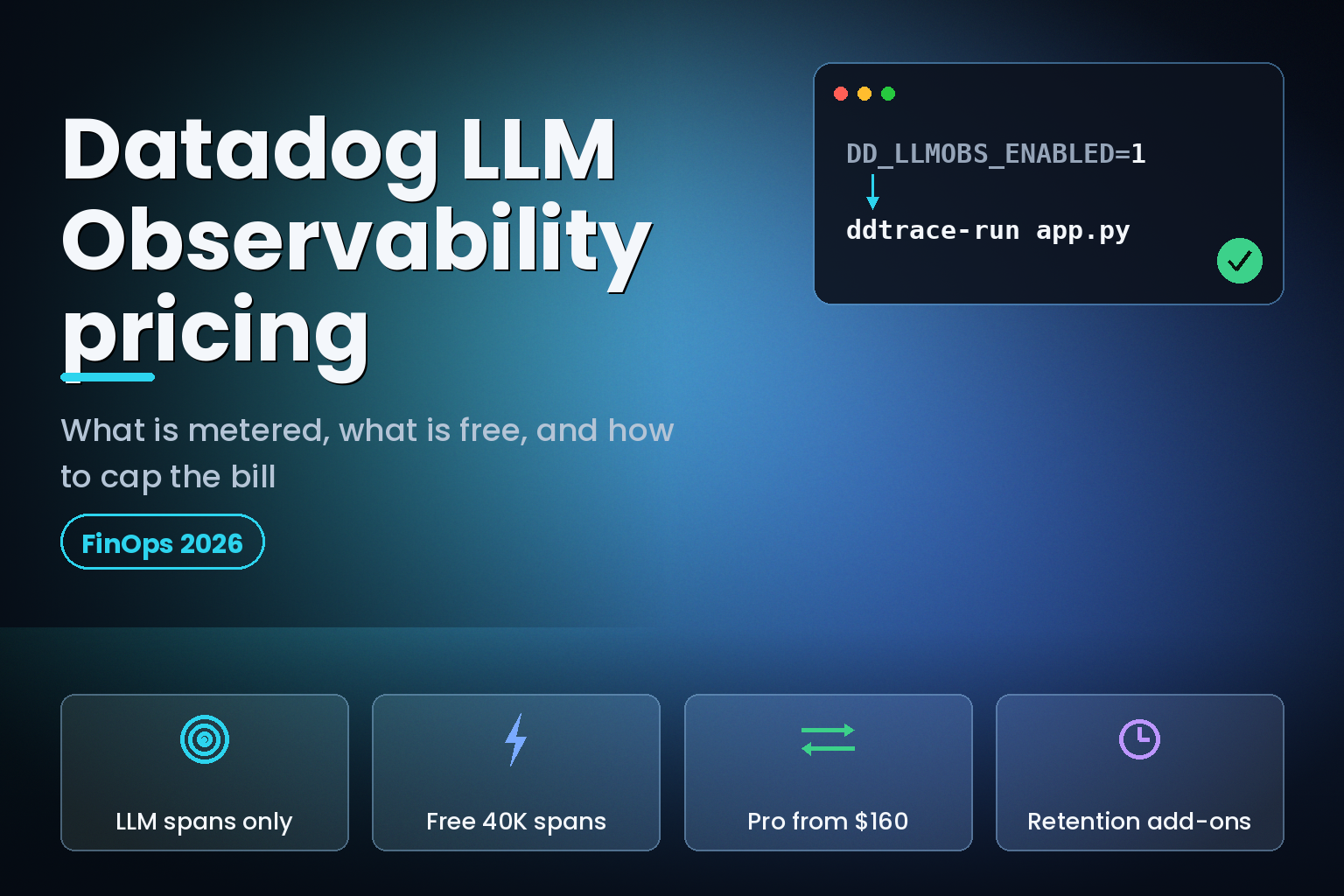
Datadog LLM Observability pricing 2026: 6 levers that cap the bill
Datadog's Agent Observability bills on one thing: the count of LLM spans. Tool, retrieval and agent spans are free. Here is how the meter works, where the published pricing stops, and six ways to cap it.
Manu Shukla -
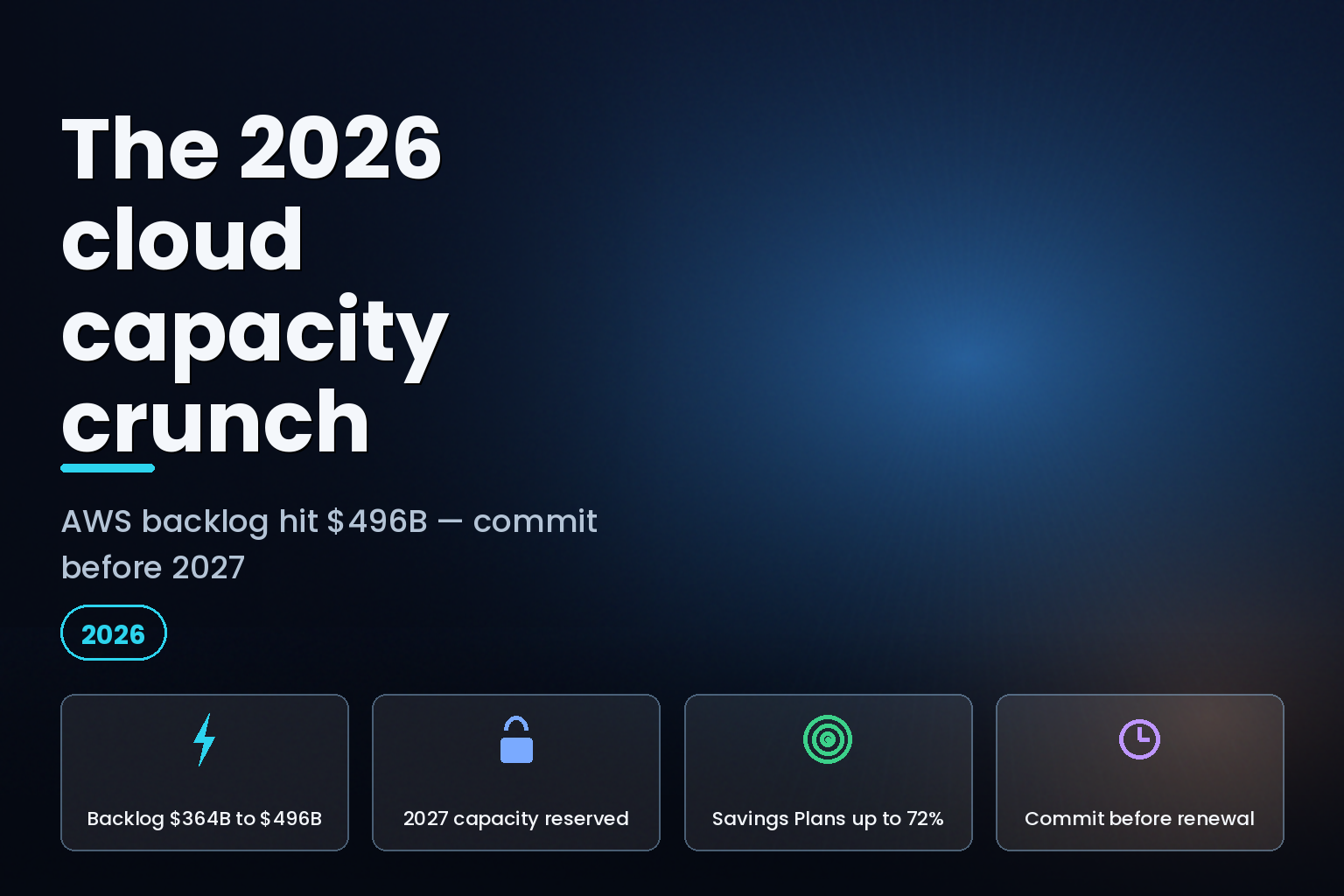
AWS's $496B backlog and the 2026 capacity crunch: a FinOps playbook to lock commitments before 2027
AWS's remaining performance obligations jumped to $496B in Q2 2026 and much of 2027 capacity is already reserved. Here is what the backlog means for your cloud bill and a sourced FinOps playbook for choosing Savings
Manu Shukla -
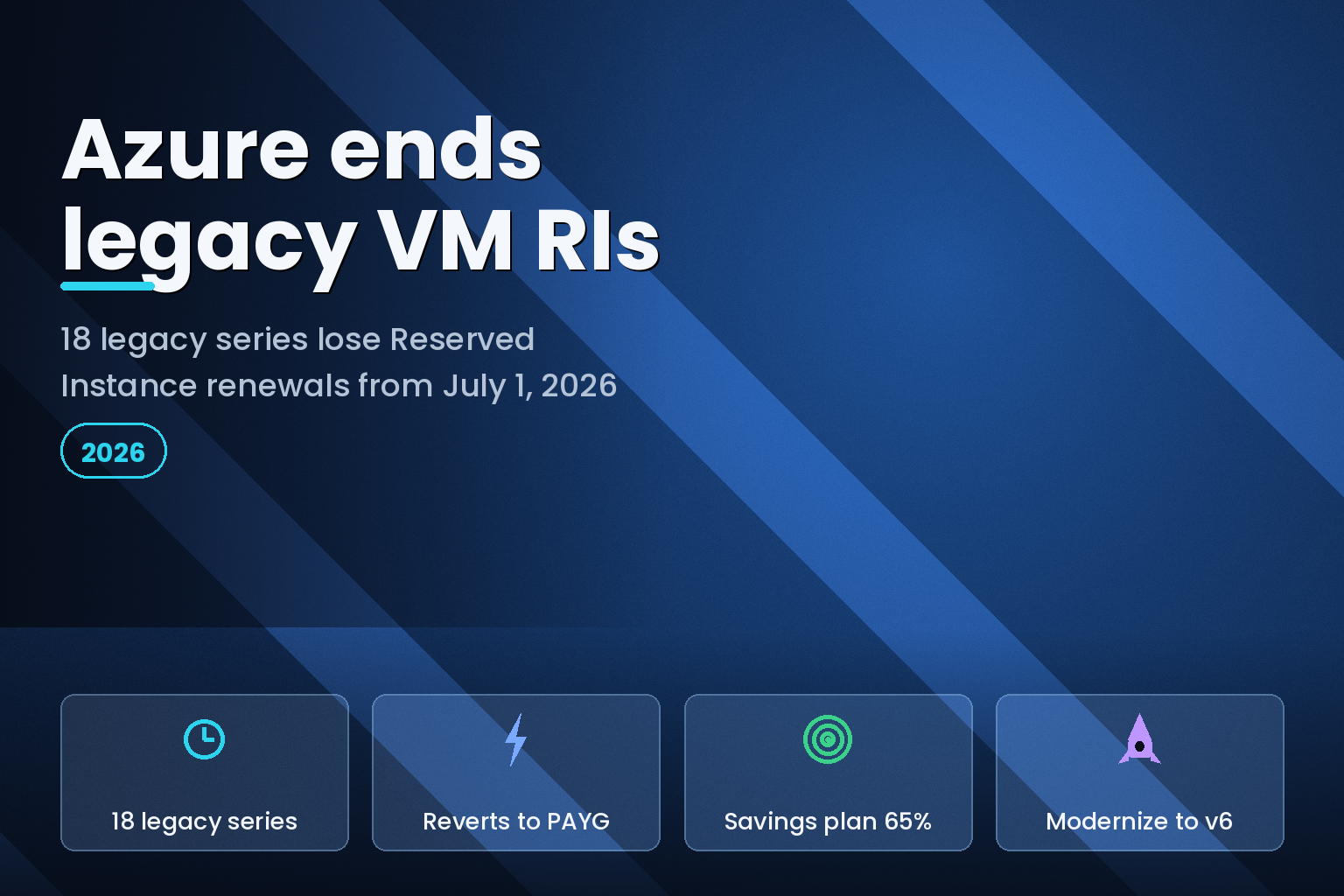
Azure retired Reserved VM Instances for 18 legacy series on July 1, 2026: the migration and cost playbook
On July 1, 2026 Azure ended Reserved VM Instance purchases and renewals for 18 legacy VM series. Existing reservations run to term, then revert to pay-as-you-go, erasing up to 72% savings. Your options: savings plan
Manu Shukla -
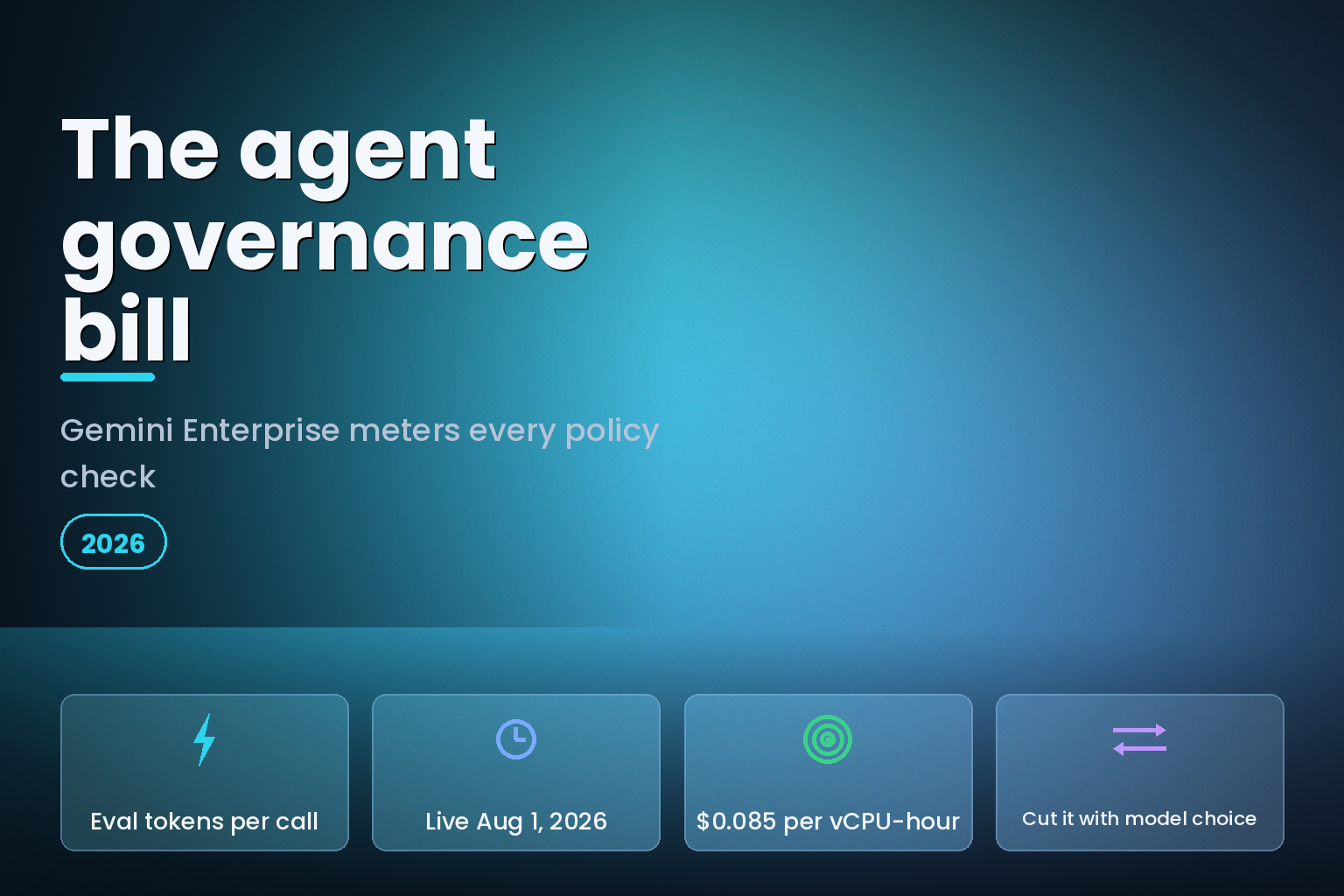
Gemini Enterprise agent billing in 2026: the August 1 governance charge and how to cut it
On August 1, 2026, Google Cloud began billing Semantic Governance Policies on the Gemini Enterprise Agent Platform, charging evaluation-model tokens for every governed agent action. Here are the metered rates, a worked
Manu Shukla -
Cut LLM spend 40-70% in 2026: an AI gateway and model-routing service
In 2026, 98% of FinOps teams manage AI spend, and LLM prices span more than 140x from budget to frontier. An AI gateway with cost-aware routing and caching cuts that bill 40-70% without downgrading quality. How eCorpIT
Manu Shukla -
AIOps and SRE managed services in India: cut incident MTTR without staffing a 24/7 team
Downtime costs most midsize and large enterprises over $300,000 an hour, and a 24/7 SRE rotation is costly to staff in India. Here is how AI-driven on-call and eCorpIT's managed AIOps and SRE service cut incident MTTR.
Manu Shukla -
Terraform vs OpenTofu in 2026: the fork has diverged, so which do you standardize on?
Terraform moved to the BUSL license in 2023 and IBM now owns HashiCorp. OpenTofu, the MPL 2.0 fork under the Linux Foundation, has diverged. A 2026 decision guide: pricing, feature gaps and migration steps.
Manu Shukla -
Amazon Q Business closes to new customers on July 31, 2026: your generative-BI migration playbook
Amazon Q Business stops taking new customers on July 31, 2026, and AWS points users to Amazon Quick. This playbook covers the BYOI migration path, what does not carry over, and Quick Suite costs.
Manu Shukla -
Survive a region outage: eCorpIT multi-region resilience and DR service (2026)
A single hour of downtime can cost a large enterprise over $300,000. eCorpIT designs multi-region resilience and disaster recovery: the right DR tier per workload, automated failover, and drills that prove your RTO
Manu Shukla -
AWS FinOps Agent vs Finout, Amnic and Cloudability in 2026: is the free native agent enough?
AWS launched a free FinOps Agent in June 2026 on Bedrock. A 2026 decision guide comparing it with Finout, Amnic, Cloudability and native Cost Optimization Hub, with pricing, so you know when native is enough and when
Manu Shukla -
AWS Savings Plans target coverage: size your 2026 commitment without over-buying
On June 8, 2026 AWS added target coverage analysis to the Savings Plans Purchase Analyzer. Here is how to pick a coverage percentage, run the analysis, and size a commitment without paying for unused capacity.
Manu Shukla -
Amazon SES pricing plans in 2026: Essentials vs Pro vs Enterprise, and when a-la-carte still wins
On July 21, 2026 AWS split Amazon SES into three plans, Essentials, Pro and Enterprise, while keeping a-la-carte pricing. The plans are not cheaper per email, so the real decision is tooling, not send price.
Manu Shukla -
AWS cut GPU management fees 60% on July 1, 2026: how to capture it on ECS Managed Instances
AWS reduced ECS Managed Instances management fees 60% for P-series and Trainium and 35% for G-series from July 1, 2026, the same day Capacity Block GPU rates rose. Here is how to capture the cut, with configuration
Manu Shukla -
Databricks Genie billing starts July 6, 2026: a cost-control playbook for admins
On July 6, 2026 Databricks Genie moved to pay-as-you-go DBU billing beyond a free per-user allowance. Here is how to set budgets, per-user caps and a billing query so a Genie rollout never surprises finance.
Manu Shukla -
Self-hosting Kimi K3 (2.8T) in 2026: GPU sizing, cost, and the API break-even
Kimi K3's API costs $3/$15 per million tokens. Self-hosting the 2.8T open weights needs roughly 1.4 TB of VRAM. We size the GPUs, price the node against 2026 cloud rates, and work out the break-even.
Manu Shukla -
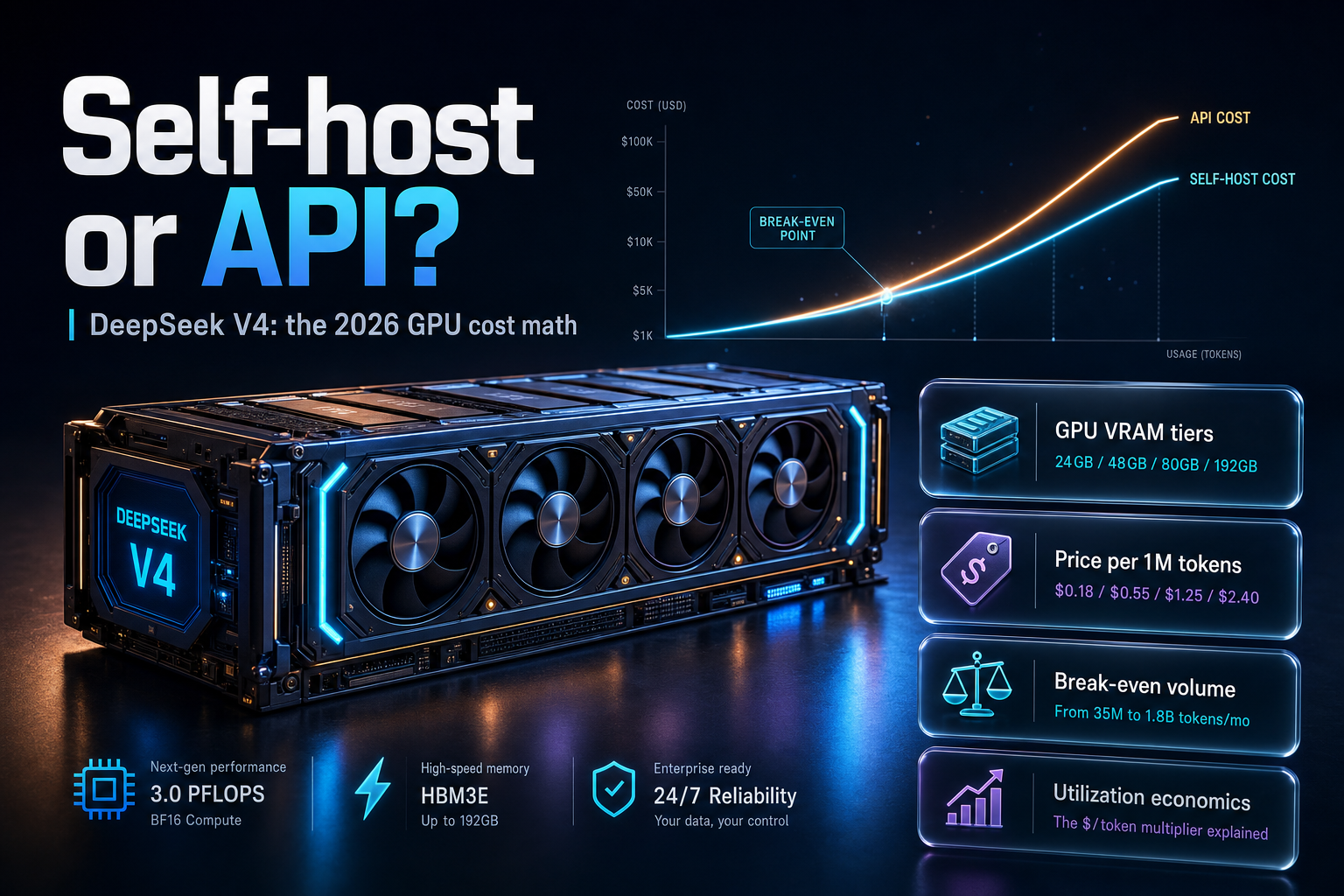
DeepSeek V4 self-hosted vs API in 2026: the real GPU cost and break-even math
DeepSeek V4 is both a cheap API and an open-weight model you can self-host. Here is the 2026 cost math: Flash at $0.14/$0.28 per 1M tokens, H100/H200 rental rates, and the GPU utilization point where self-hosting pays.
Manu Shukla -
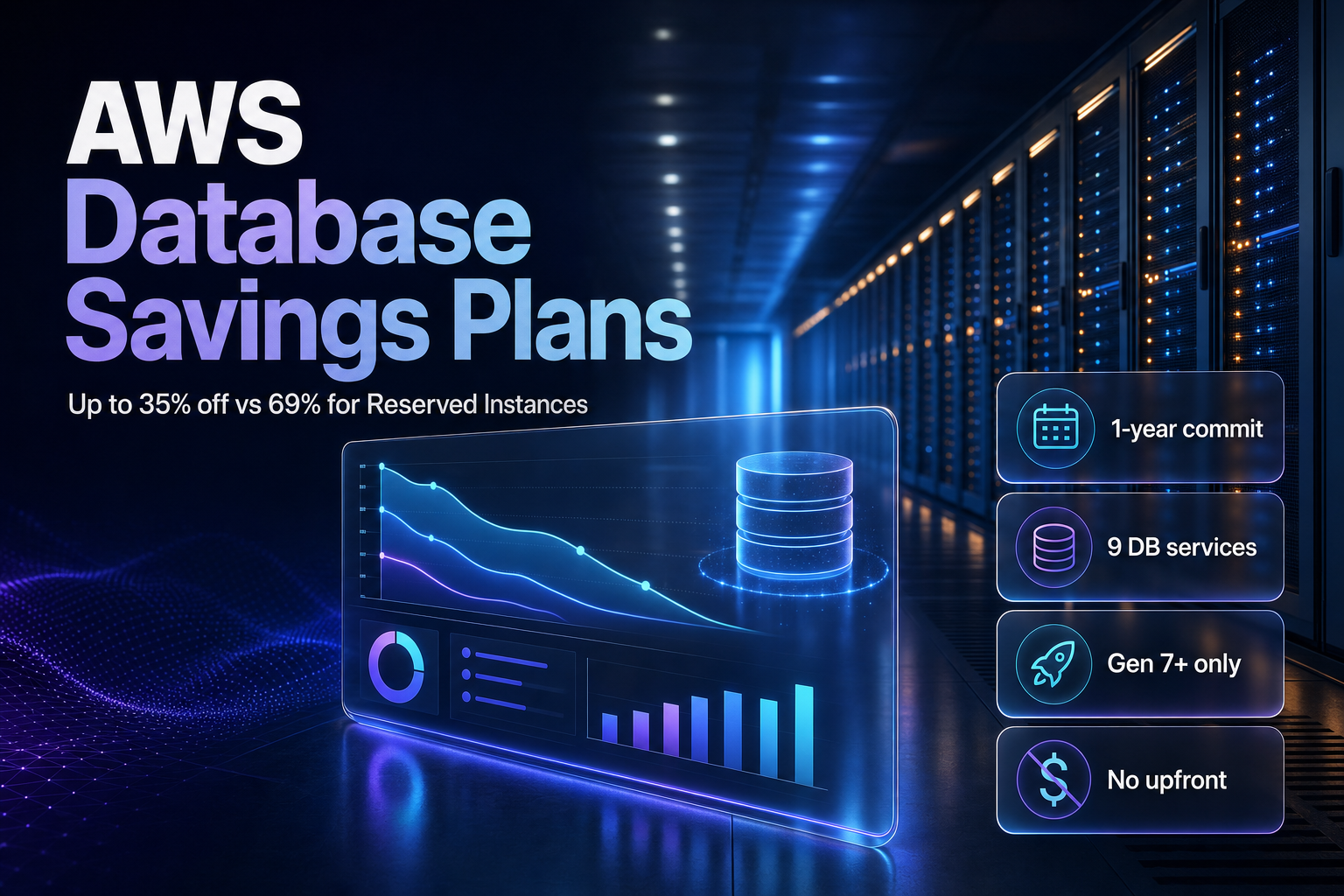
AWS Database Savings Plans in 2026: 35% Off, or Stick With Reserved Instances?
AWS launched Database Savings Plans at re:Invent 2025: up to 35% off nine managed database services for a 1-year commitment. We run the real numbers against Reserved Instances so you know when each one actually wins.
Manu Shukla -
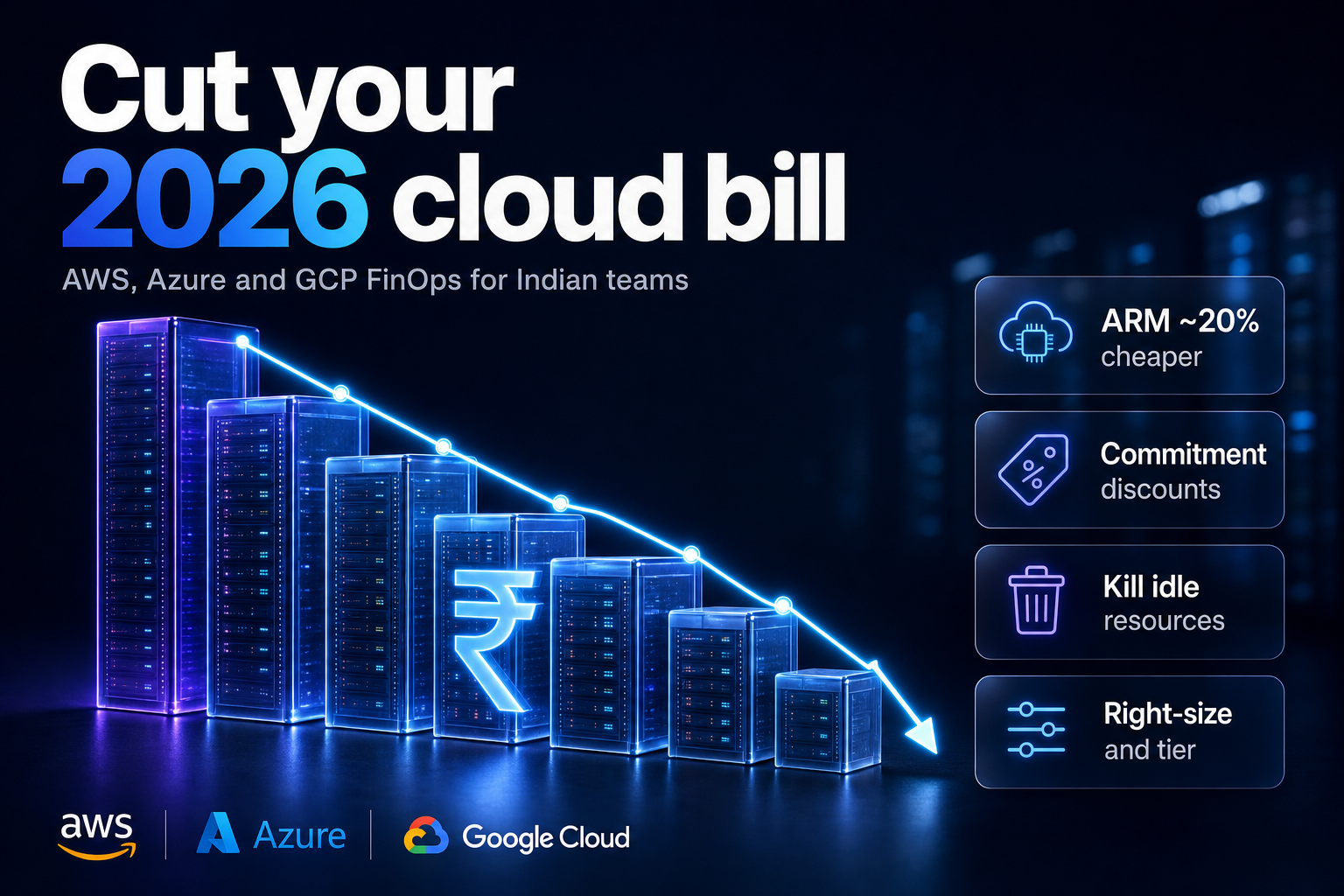
Cloud FinOps in 2026: 9 ways Indian teams cut AWS, Azure and GCP spend
India's public cloud spending is forecast to grow 28.1% to $17.5 billion in 2026, and Flexera says wasted spend rose to 29% for the first time in five years. This is a refreshed, senior-engineer FinOps playbook: nine
Manu Shukla -
Cloud storage pricing in 2026: AWS S3 vs Azure vs GCP compared
S3 Standard runs $0.023/GB and GCP Standard $0.020 in 2026, but egress and retrieval fees decide the real bill. Compare AWS, Azure and GCP storage tiers, and the tactics that actually cut spend.
Manu Shukla -
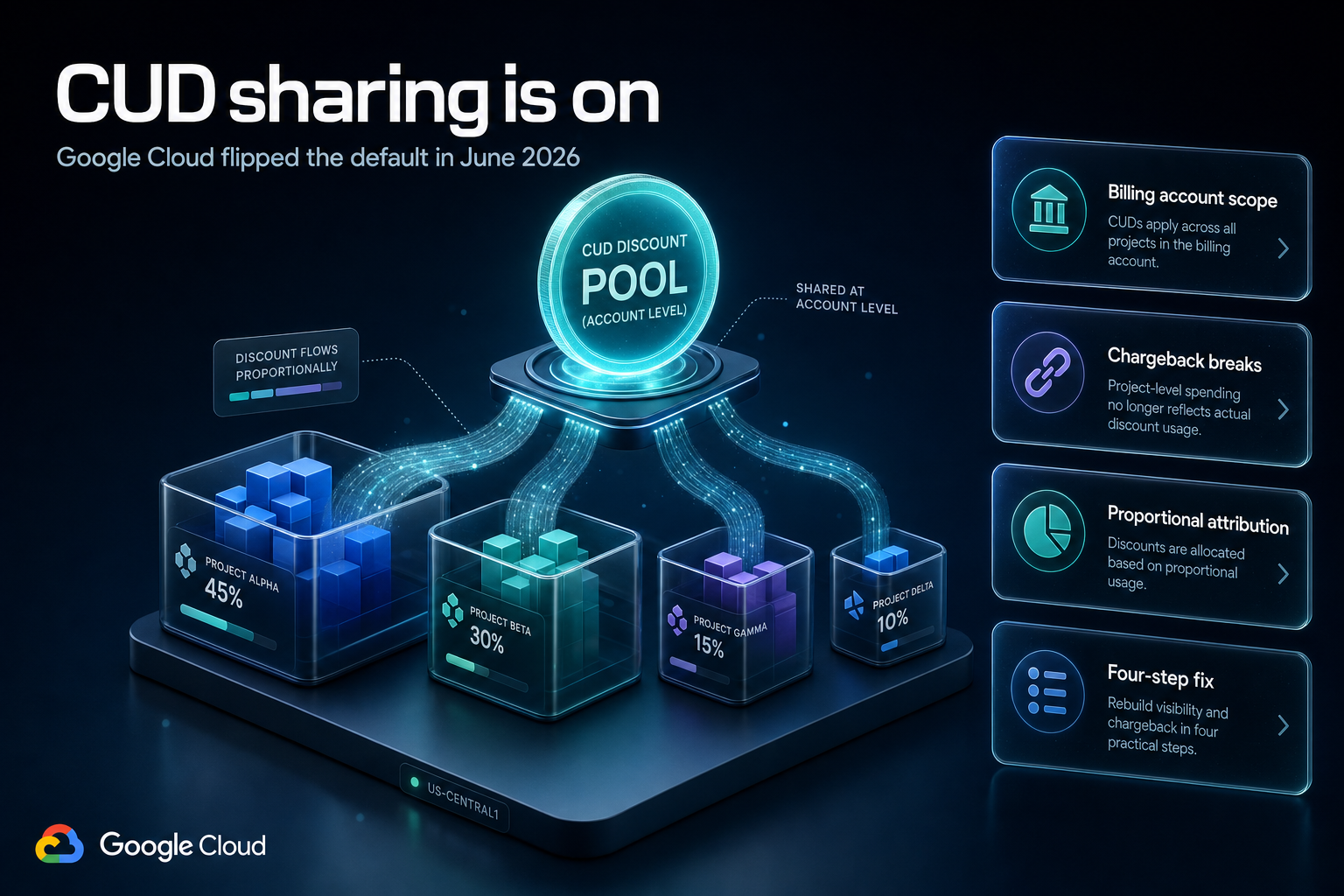
Google Cloud CUD sharing: the 16 June 2026 default flip and the four-step chargeback fix
On 16 June 2026 Google Cloud changed the default CUD scope from Project to Billing account. Commitments bought by one team now discount usage in projects that never paid for them. Here is how to check your scope
Manu Shukla -
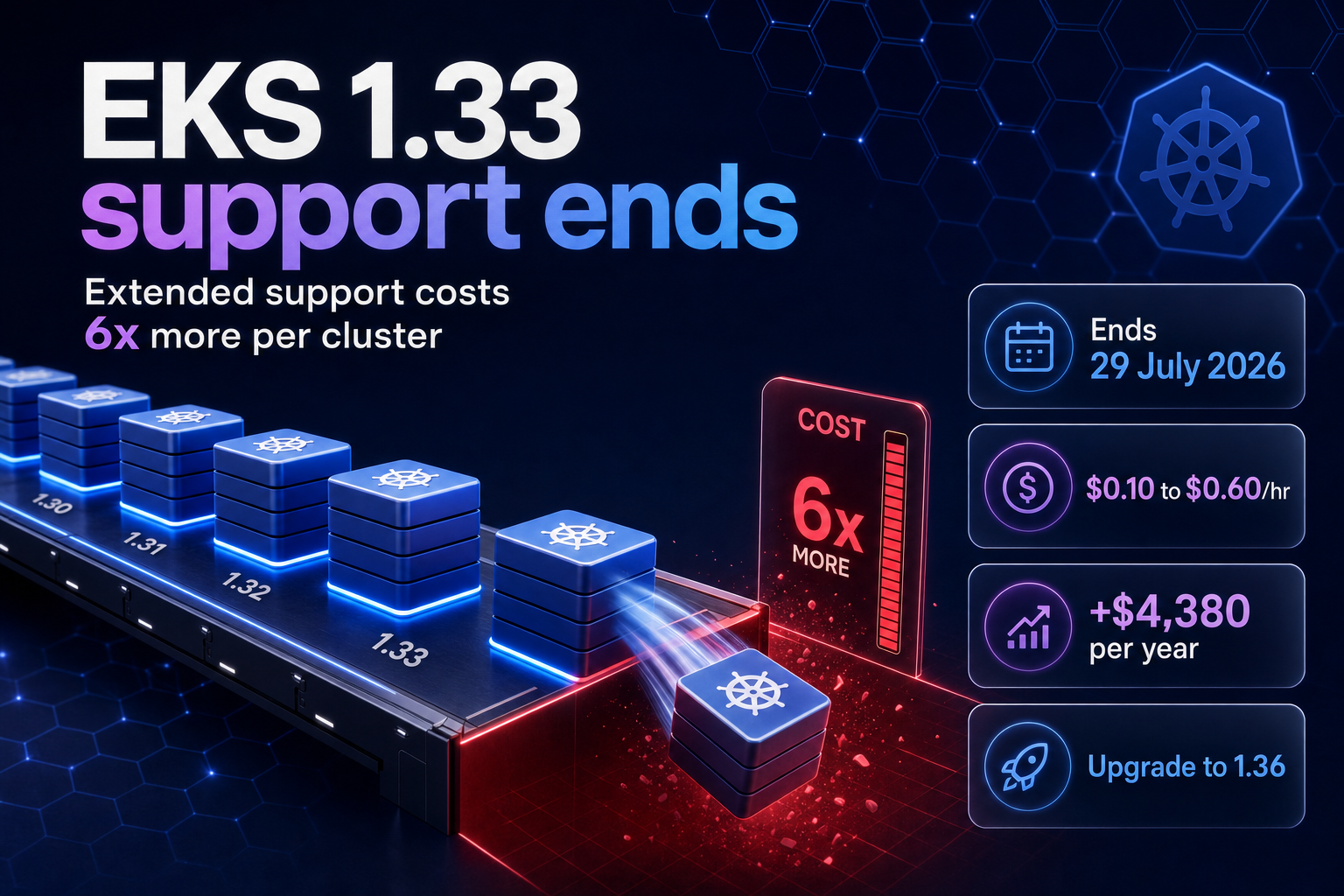
Amazon EKS 1.33 standard support ends 29 July 2026: the upgrade path and the $4,380 cost of waiting
Amazon EKS 1.33 drops out of standard support on 29 July 2026 and billing jumps from $0.10 to $0.60 per cluster hour that same day. Here is the upgrade path to 1.36 and every breaking change between.
Manu Shukla -
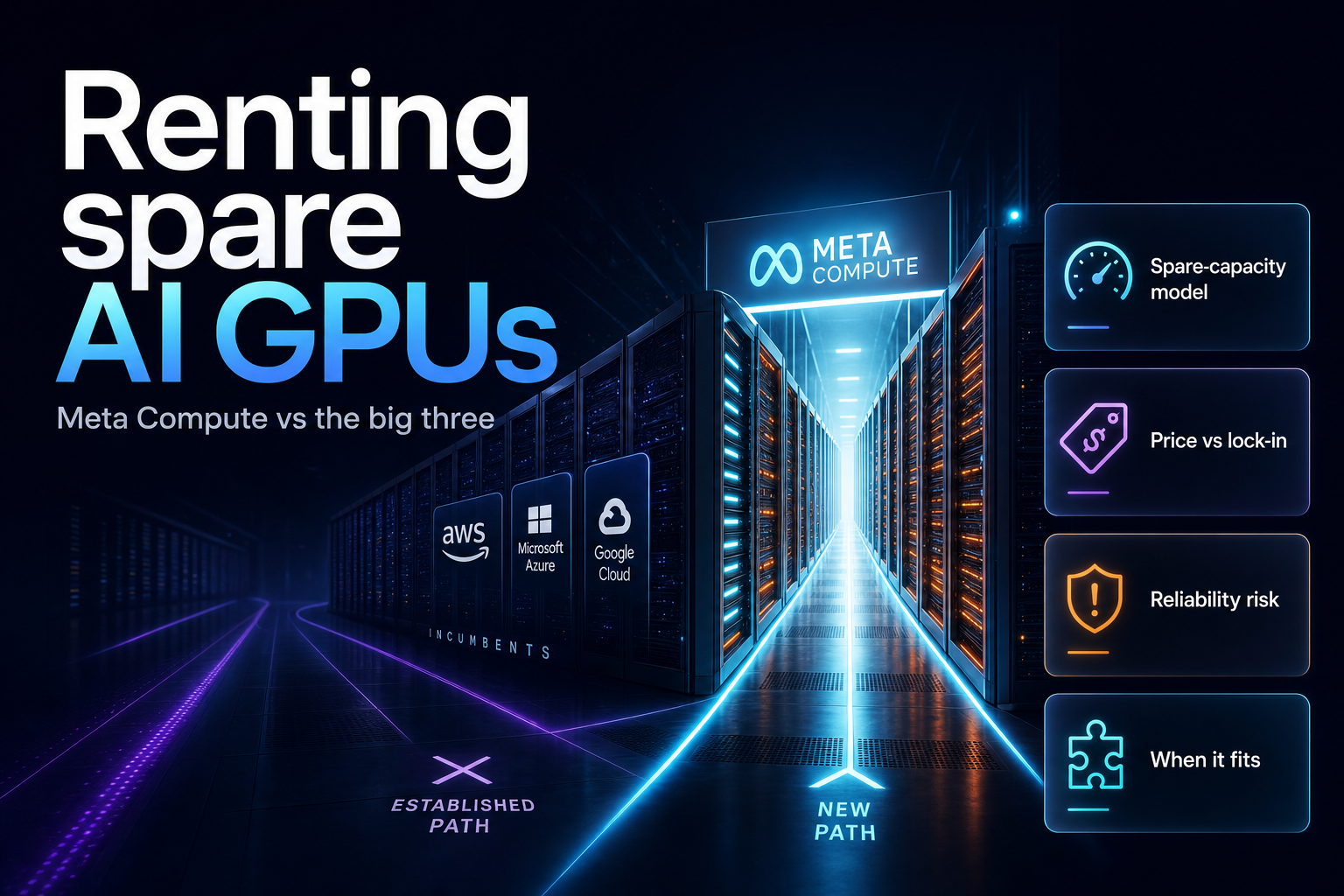
Meta Compute vs AWS, Azure and Google Cloud: is renting spare AI GPUs worth it in 2026?
Meta reportedly plans Meta Compute to rent out its spare AI GPUs, and the news moved billions on 1 July 2026. What is confirmed, why the neoclouds fell hardest, and whether renting surplus GPU capacity is worth it.
Manu Shukla -
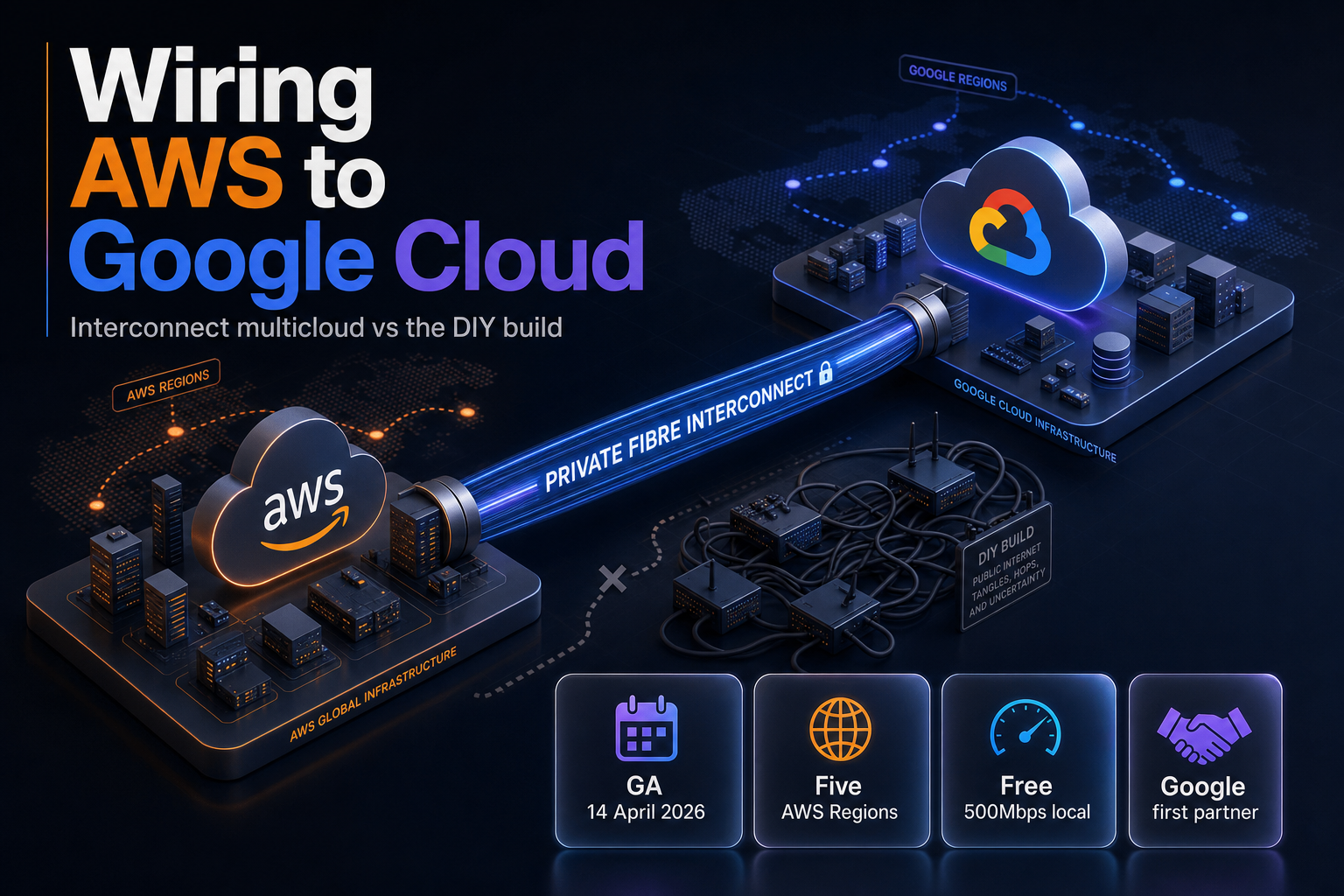
AWS Interconnect multicloud in 2026: how a Singapore edge turns $9,000 a month into $37,799
AWS Interconnect - multicloud reached GA on 14 April 2026 with Google Cloud as first launch partner. A 10 Gbps Tier 1 link costs $9,000.90 a month with no per-GB charges. Attach a Cloud WAN Core Network with a Singapore
Manu Shukla -
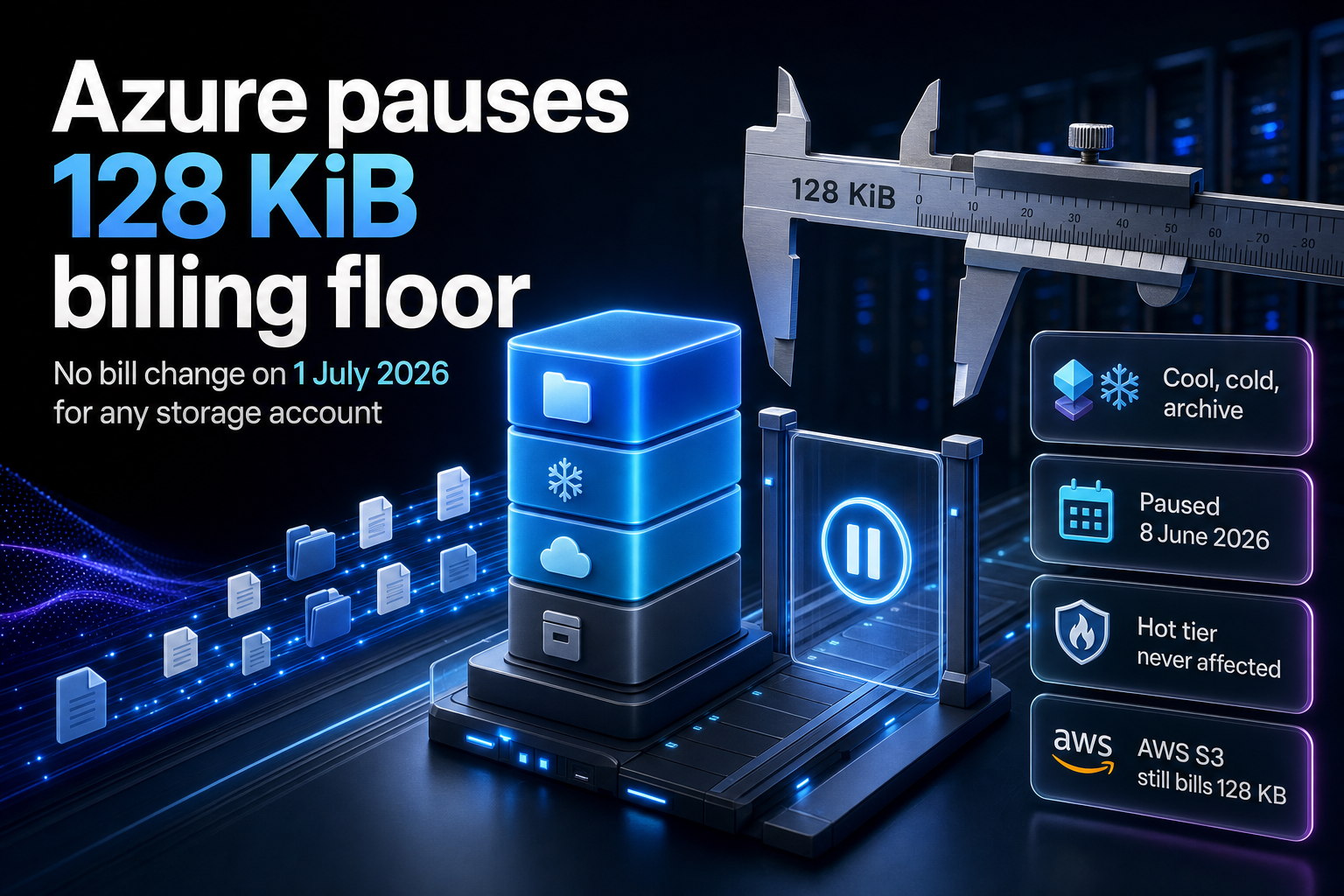
Azure paused the 128 KiB minimum billable object size: what changed on 1 July 2026
Azure Update 559756 paused the 128 KiB minimum billable object size for cool, cold and archive tiers. Billing did not change on 1 July 2026 for new or existing accounts. AWS still bills a 128 KB floor; Google does not.
Manu Shukla -
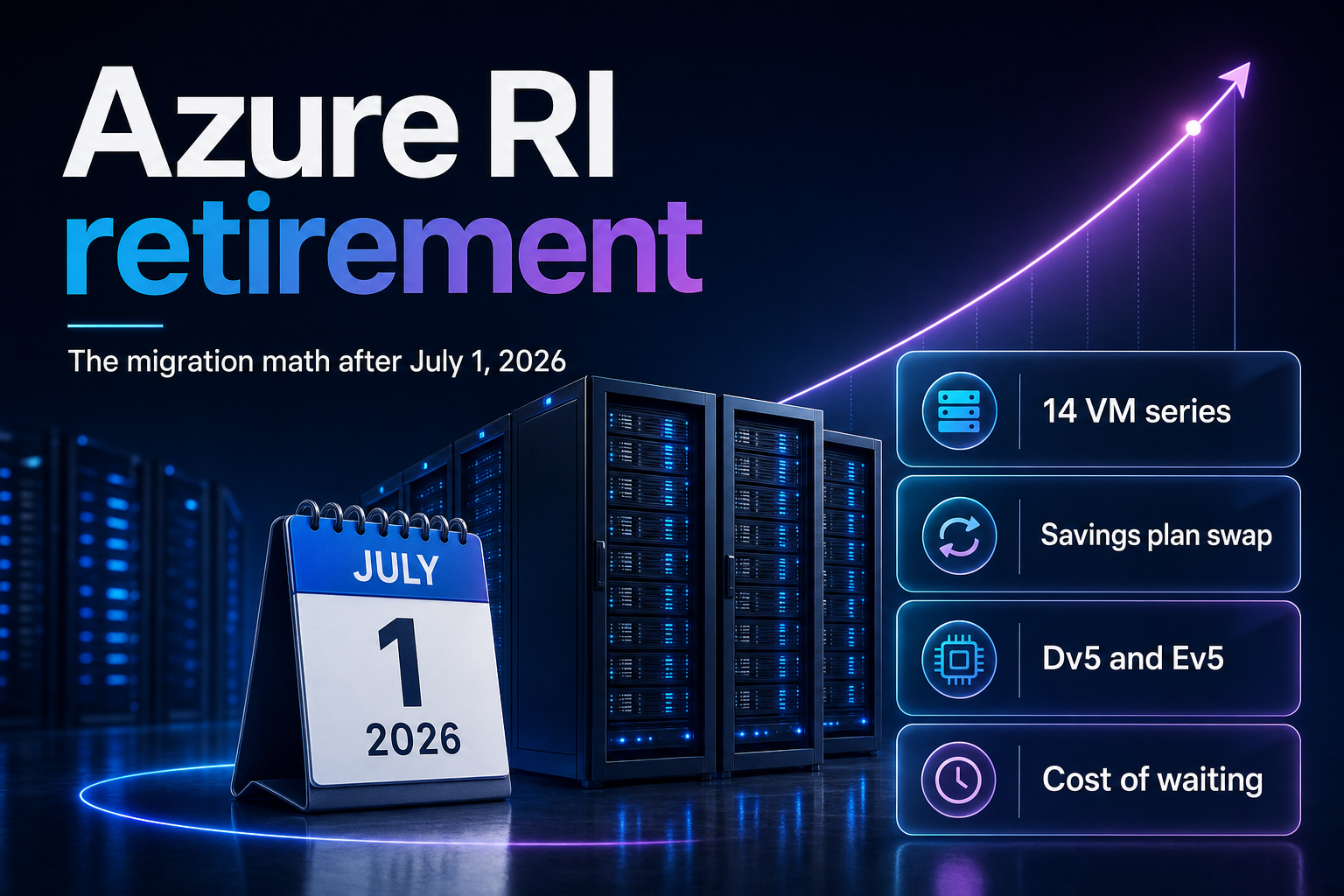
Azure retired RIs for 18 VM series on July 1, 2026: the migration math
On July 1, 2026 Azure stopped new purchases and renewals of Reserved VM Instances for 18 VM series, including Dv3, Ev3, Av2 and Fsv2. Existing RIs still run to term. Two options remain, the renewal escape hatch is gone
Manu Shukla -
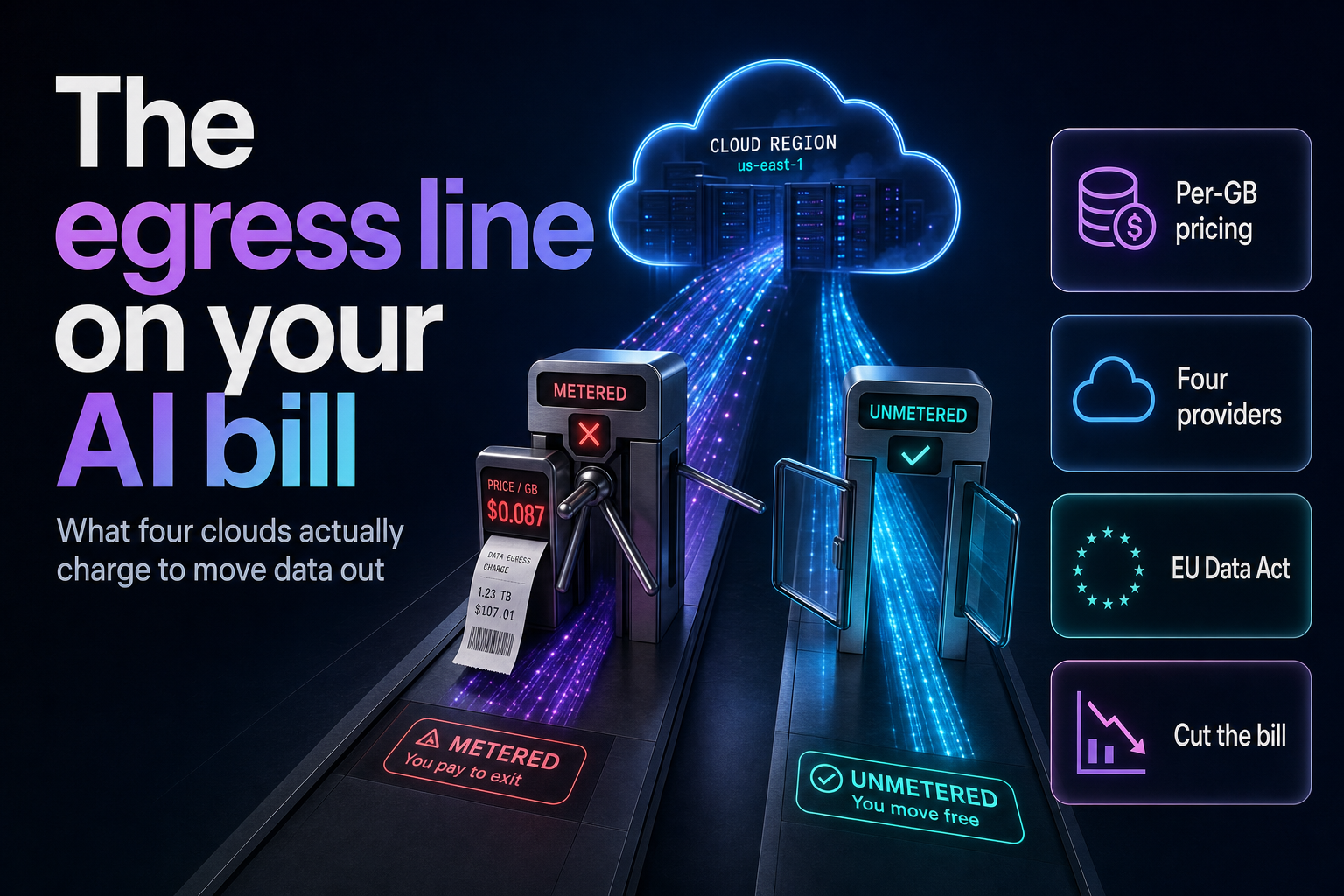
Cloud egress fees in 2026: what AWS, Azure, Google Cloud and Cloudflare R2 actually charge
Egress is the cloud line item nobody quotes in the sales deck. Here is what four providers charge per GB as of June 2026, the hidden charges that dwarf the headline rate, and what the EU Data Act actually abolishes
Manu Shukla -
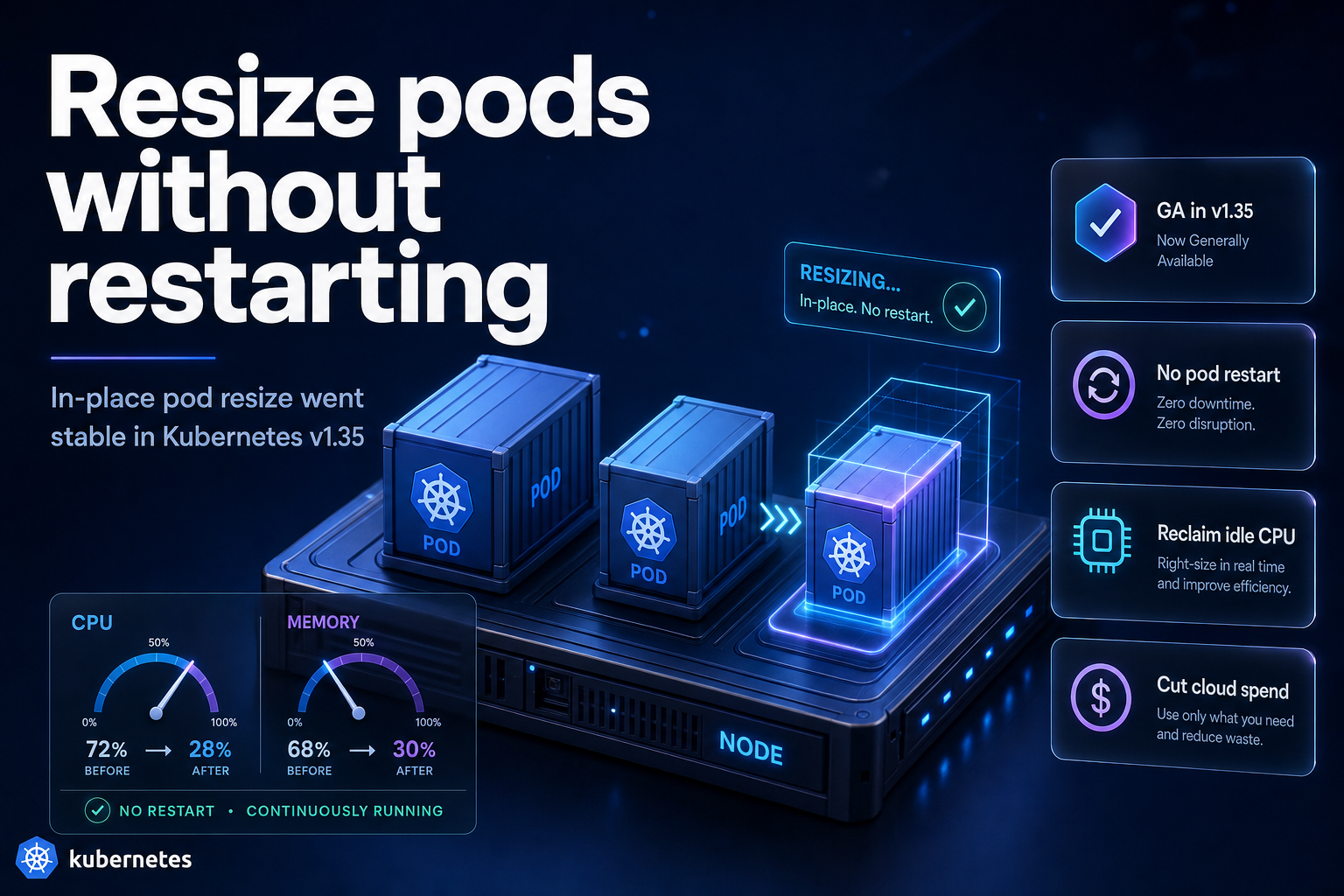
Kubernetes in-place pod resize hits GA in v1.35: rightsize pods without restarts
In-place pod resize graduated to stable in Kubernetes v1.35, and pod-level resize reached beta in v1.36. What changed, what still forces a restart, and how to wire it to the Vertical Pod Autoscaler.
Manu Shukla -
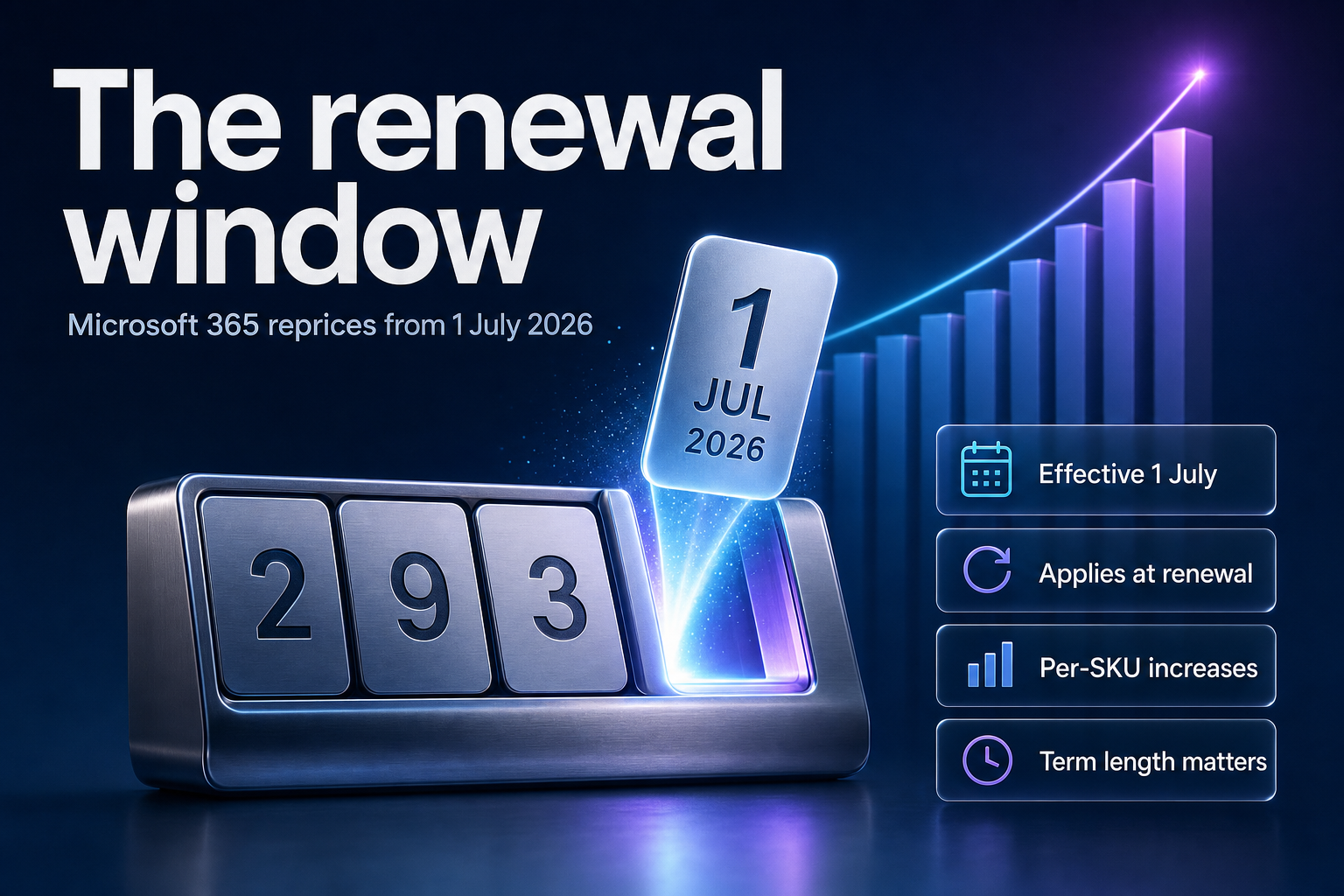
Microsoft 365 prices rise on 1 July 2026: every enterprise suite goes up exactly $3
Microsoft's July 2026 price update reads as a spread of increases from 5% to 43%. Read the table as dollars and it collapses into one number: every enterprise suite rises $3, and the SKUs without Teams take the same hit
Manu Shukla -

AI's $3 trillion question: how to budget cloud and GPU spend against a $1.5T buildout
AI infrastructure spending is projected at $1.5 trillion for 2026, and Sequoia's arithmetic says the industry must earn $3 trillion to justify it. Frontier lab revenue sits in the low hundreds of billions. Here is what
Manu Shukla -
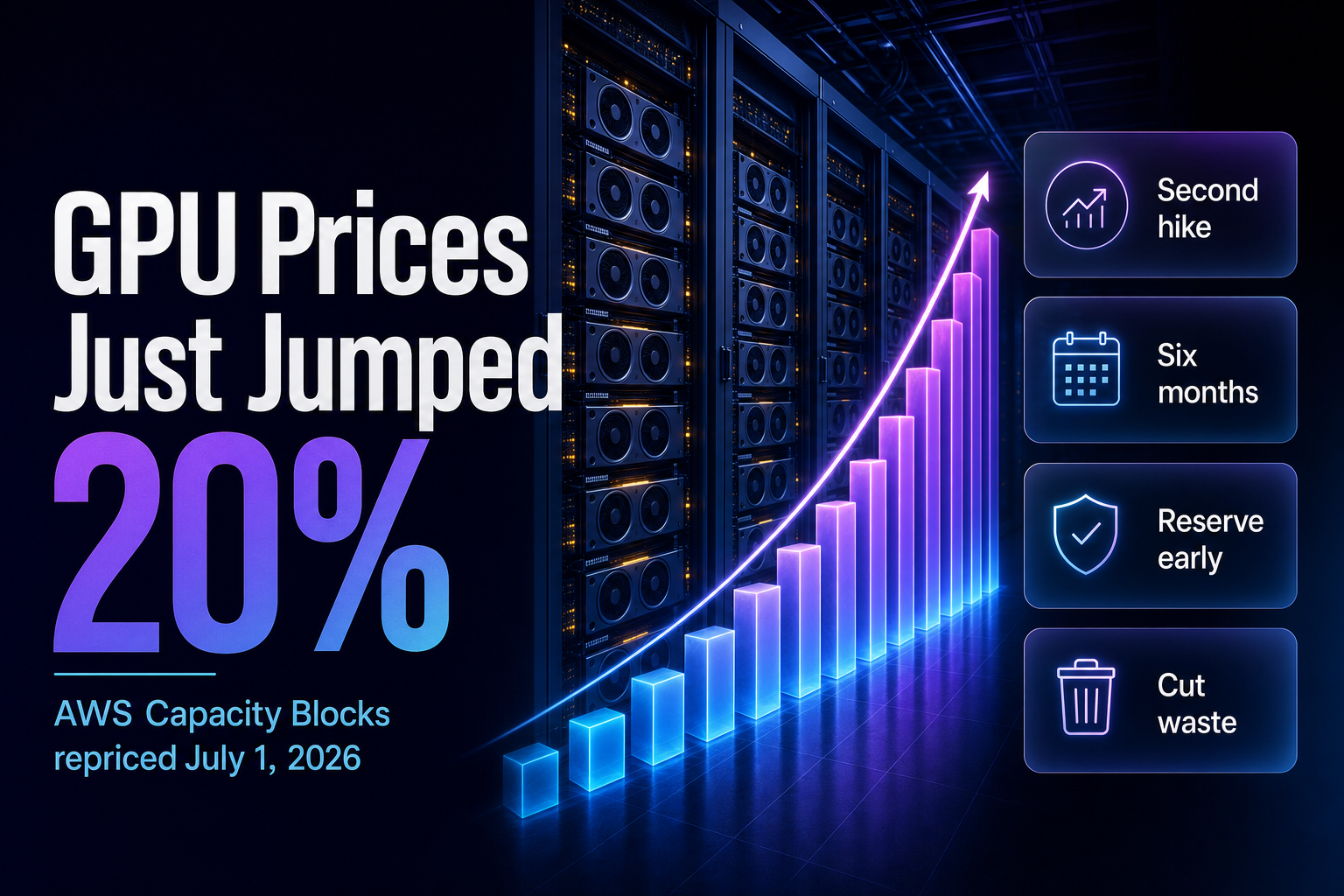
AWS raised GPU Capacity Block prices 20% on July 1, 2026: the FinOps response
AWS lifted EC2 Capacity Block rates roughly 20% on July 1, 2026, six months after a 15% rise on January 4. P6-B300 now bills at $14.04 per accelerator hour. Here is what changed, why analysts disagree on the cause
Manu Shukla -
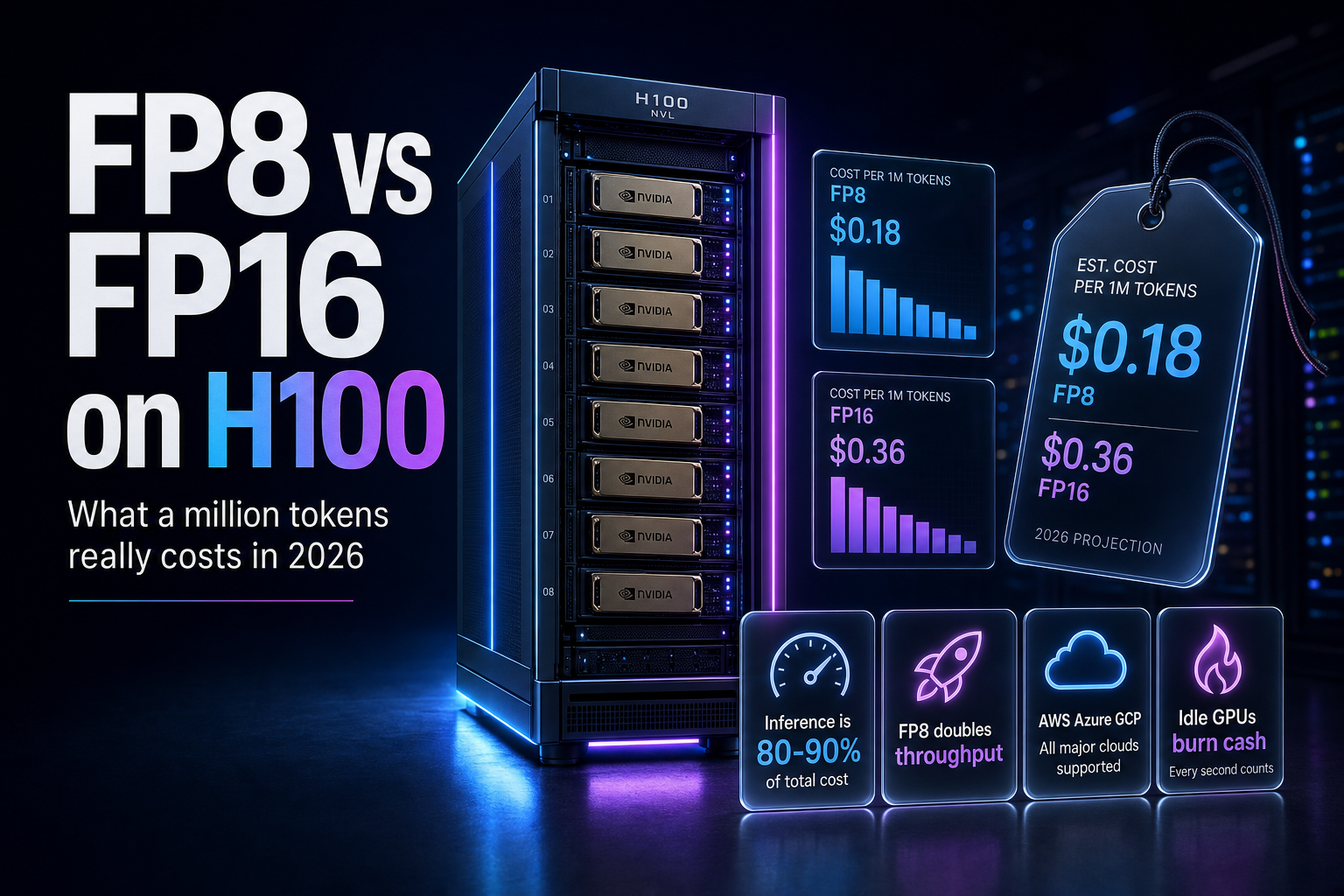
FP8 vs BF16 on H100: what a million tokens costs on AWS, Azure and GCP in 2026
vLLM's April 2026 benchmark put FP8 KV-cache 14.9% above BF16 on one H100. Priced out, that is $4.24 down to $3.69 per million output tokens - and your AWS purchase model moves the number four times further.
Manu Shukla -
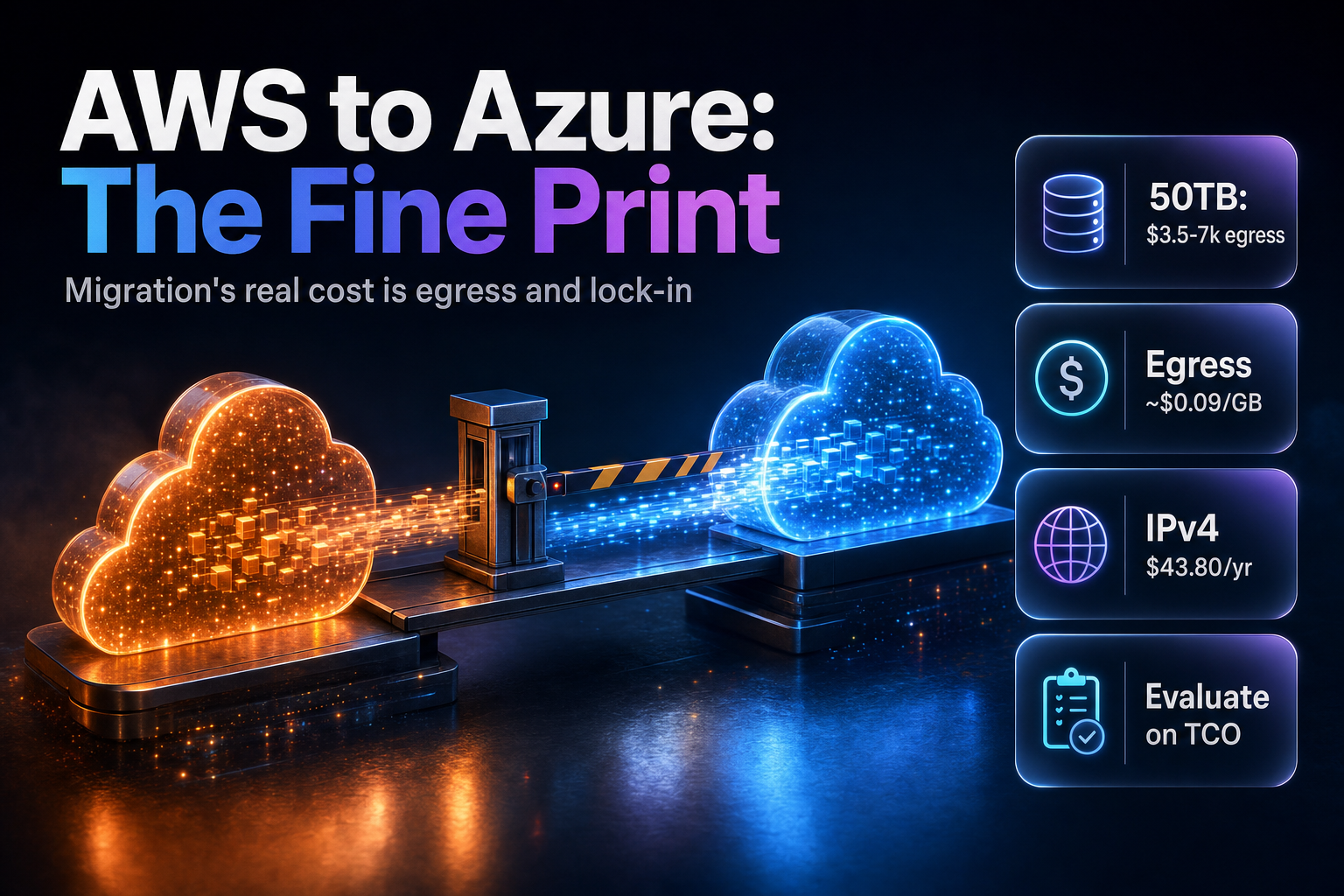
Microsoft shipped an AWS-to-Azure migration tool in 2026: read the fine print
Microsoft expanded its AWS-to-Azure migration tooling in 2026. But migration has hidden costs: moving 50 TB can cost $3,500 to $7,000 in egress alone. How to evaluate a switch on total cost, not vendor marketing.
Manu Shukla -
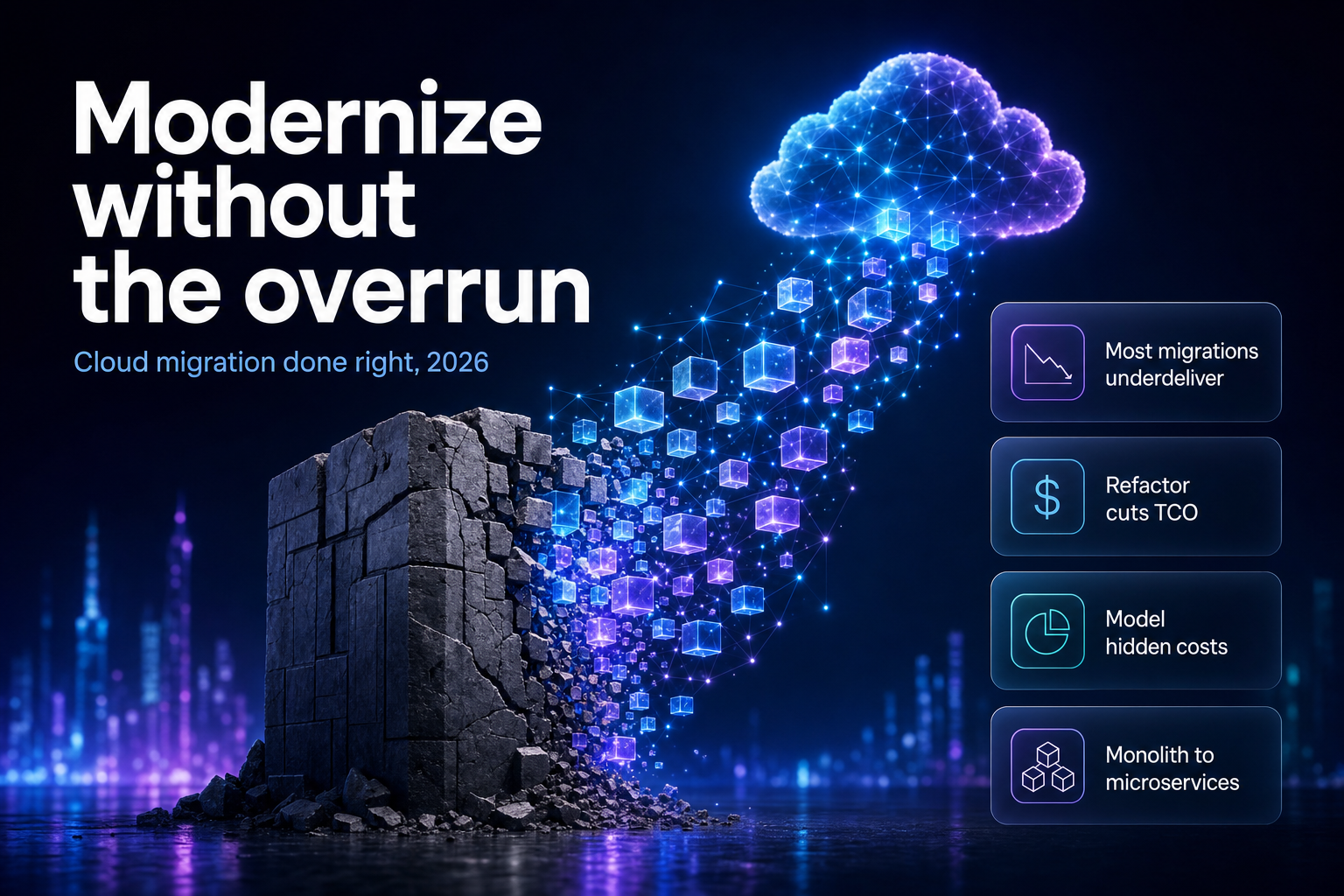
60% of cloud migrations underdeliver: how to modernize the right way in 2026
About 60% of cloud migrations deliver below their projected ROI, and hidden costs can inflate a bill by 200-300%. Here is how to modernize legacy stacks in 2026 without blowing the budget, and how eCorpIT delivers it.
Manu Shukla -
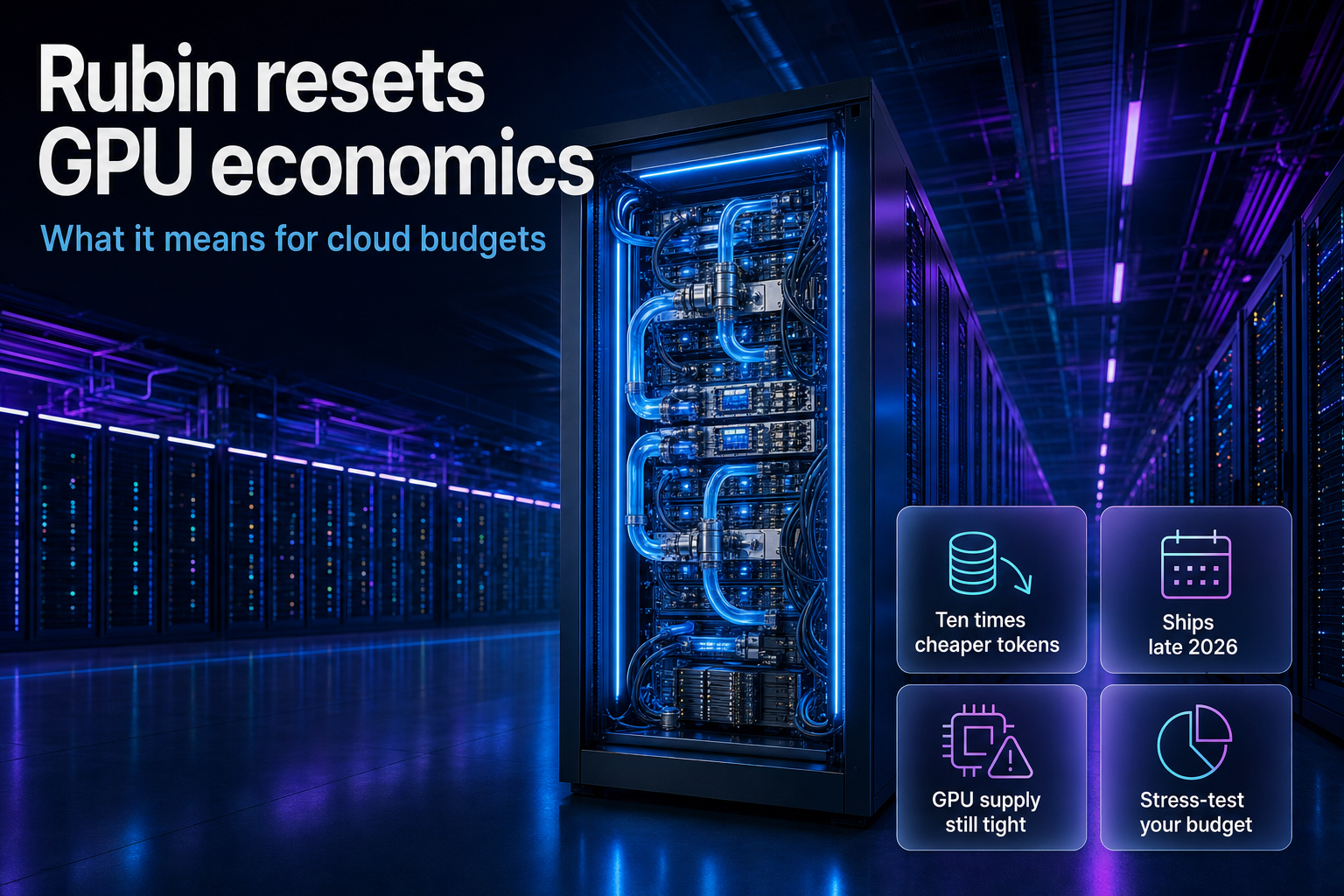
NVIDIA Rubin promises 10x cheaper tokens: what it means for your 2026 cloud budget
NVIDIA's Vera Rubin NVL72 is in full production and promises up to 10x lower cost per token than Blackwell, arriving in the cloud in H2 2026. Here is why your GPU bill may still climb first, and the FinOps moves that
Manu Shukla -
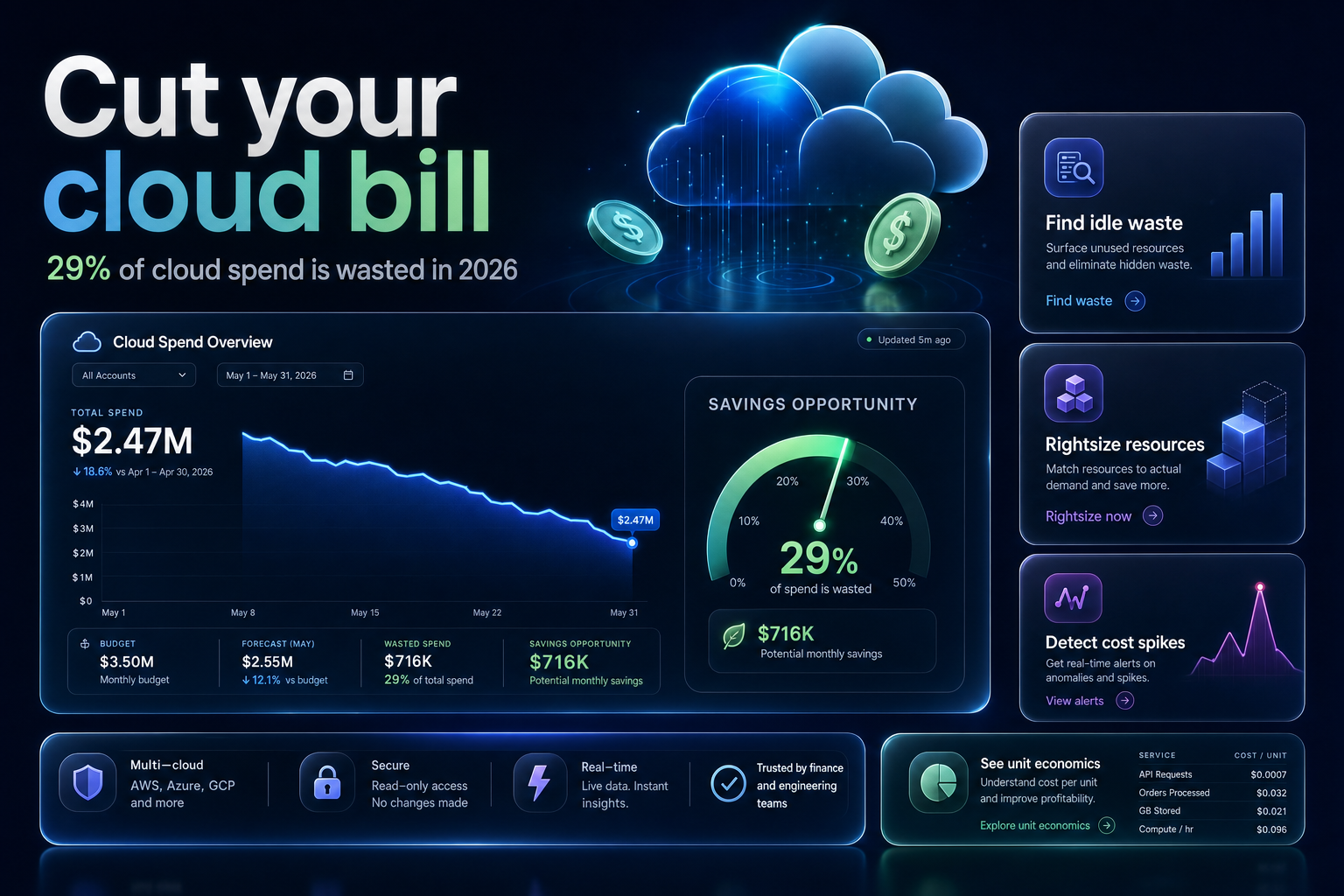
Cut your cloud bill in 2026: eCorpIT's cloud FinOps managed service
Cloud waste hit a five-year high of 29% in 2026 as AI workloads made spend unpredictable. eCorpIT's cloud FinOps managed service brings visibility, rightsizing, and anomaly detection to AWS, Azure, and GCP so teams cut
Manu Shukla -
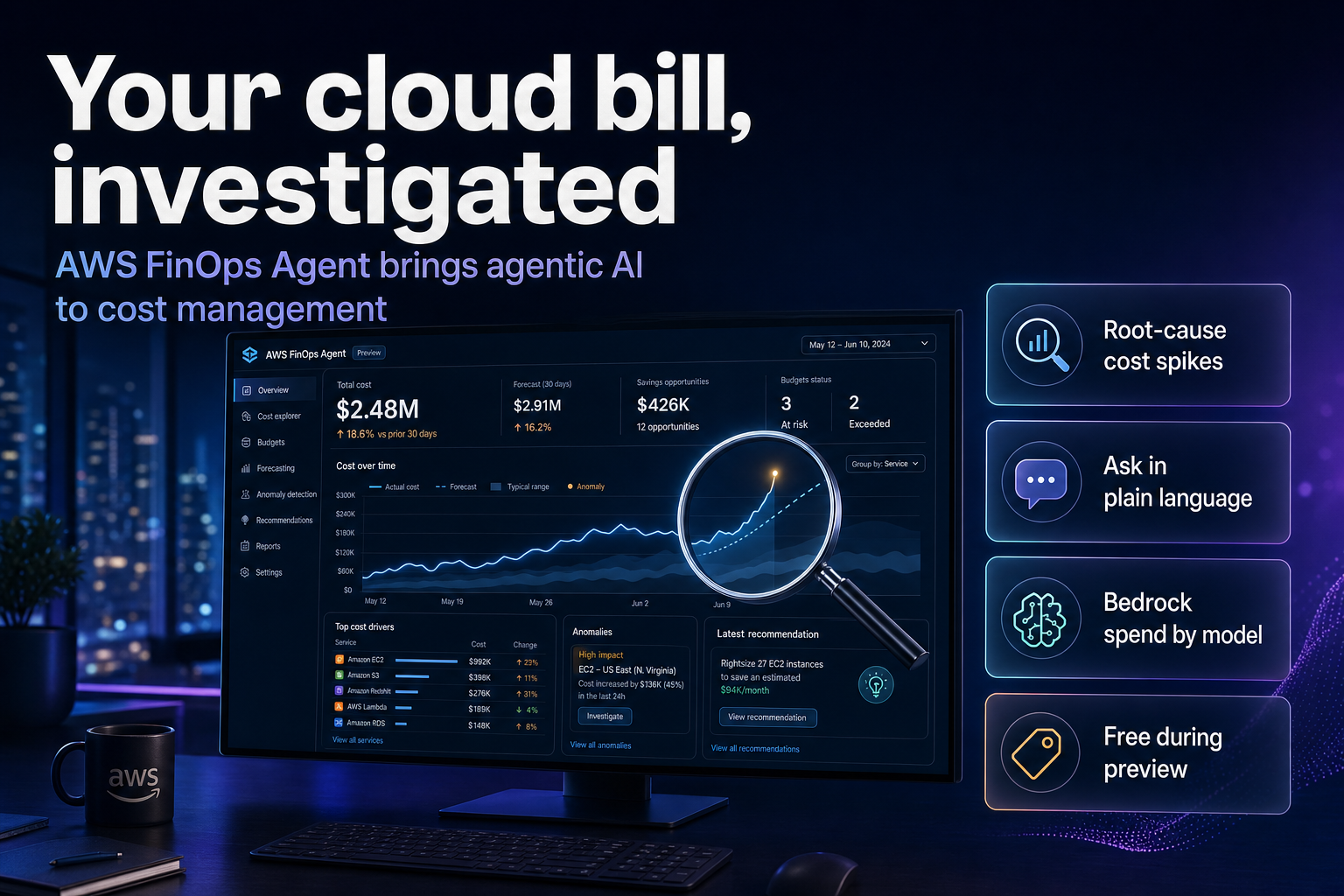
AWS FinOps Agent hits public preview: what the AI cost agent automates in 2026
AWS's FinOps Agent entered public preview at FinOps X 2026: agentic AI that root-causes cost spikes, answers plain-language cost questions, and attributes Bedrock AI spend by model and user.
Manu Shukla -
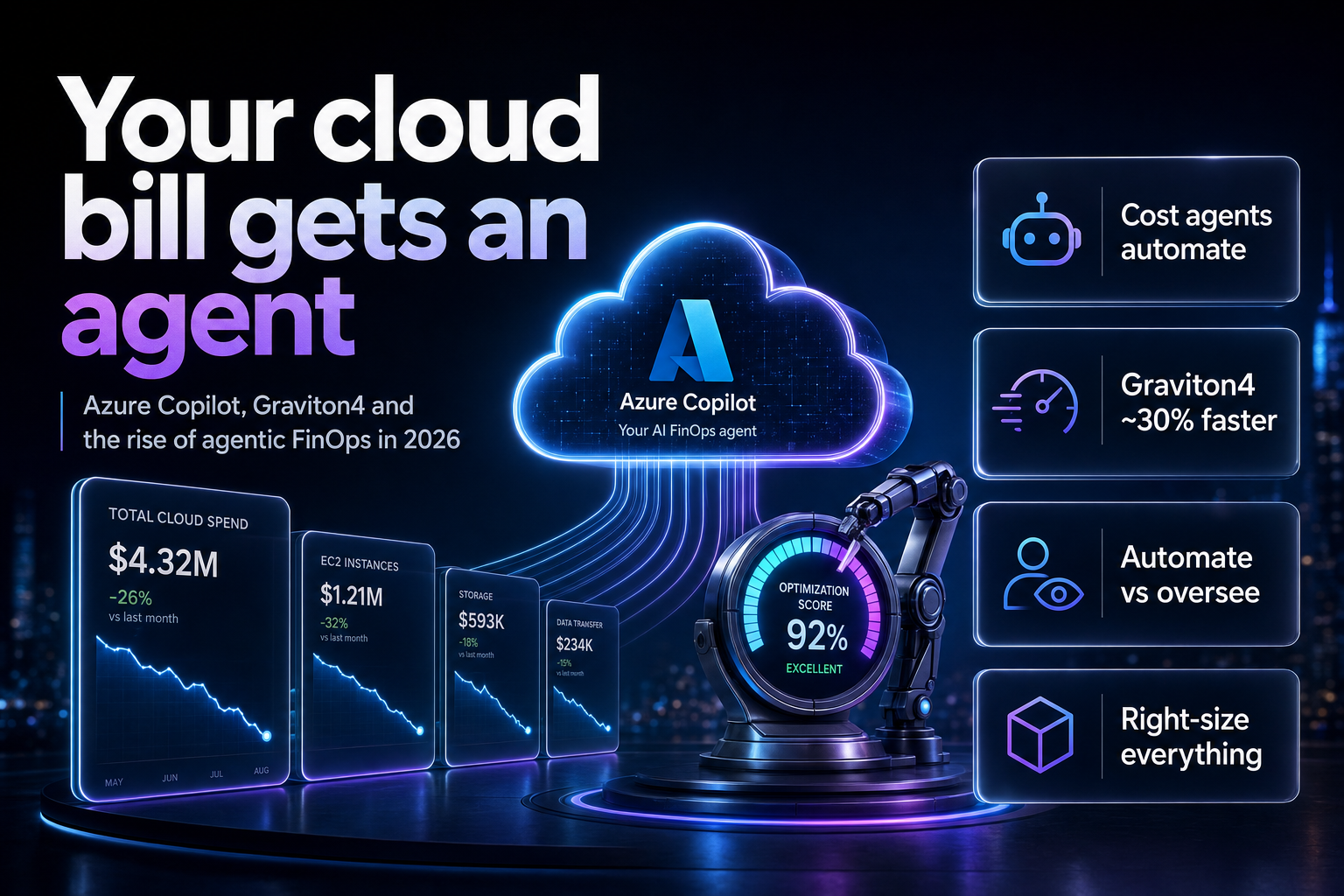
Agentic FinOps in 2026: Azure cost agents, Graviton4 and what to automate
In 2026, 98% of FinOps teams manage AI spend, Azure Copilot ships optimization agents that act under governance, and Graviton4 lifts price-performance up to 40%. Here is what cloud teams and CFOs should automate
Manu Shukla -
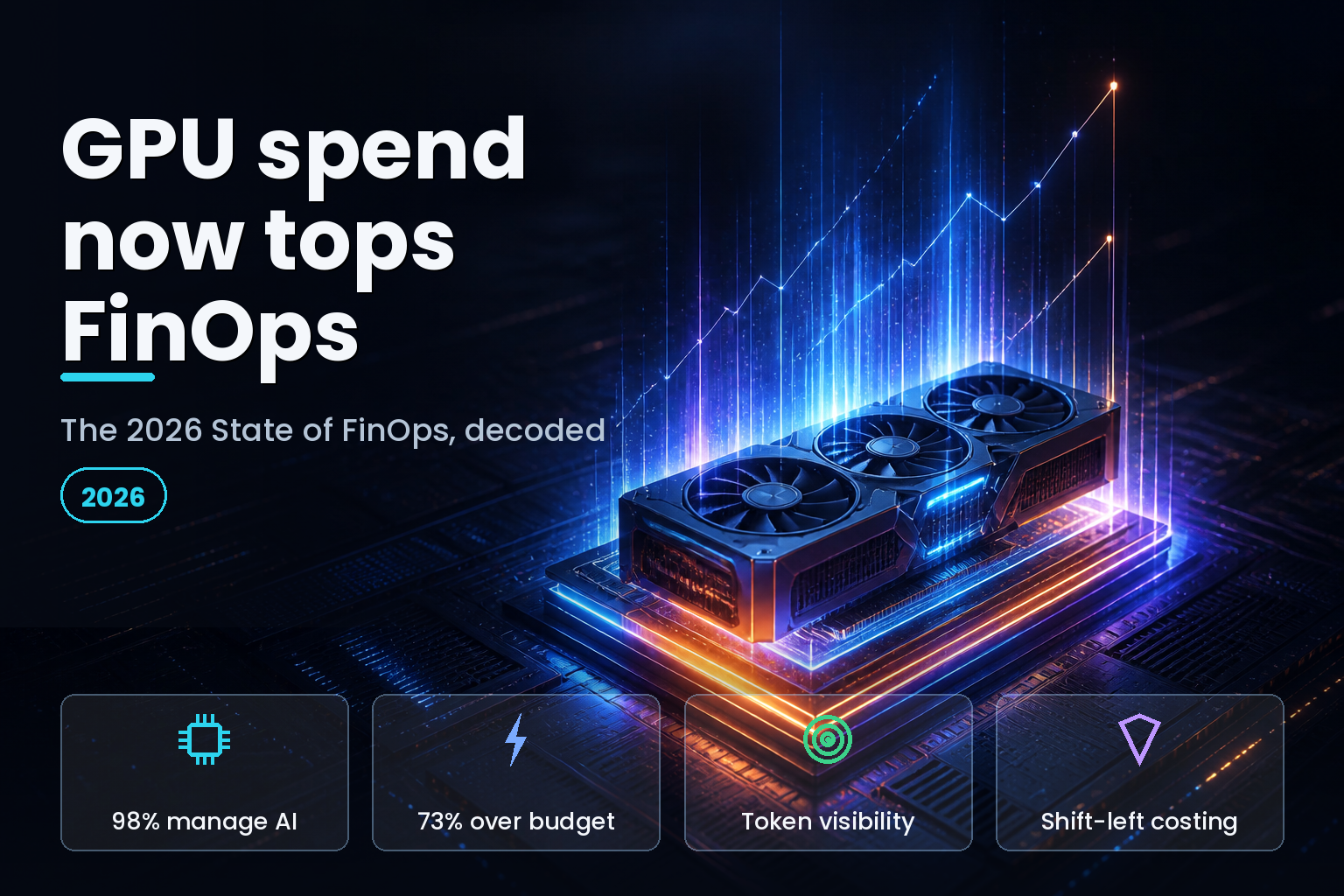
GPU spend is now the #1 FinOps concern: what the 2026 State of FinOps means for your cloud bill
In the 2026 State of FinOps, 98% of teams now manage AI spend and GPU cost has become the top concern. Here is what changed and how enterprises can regain control of the AI cloud bill.
Manu Shukla -
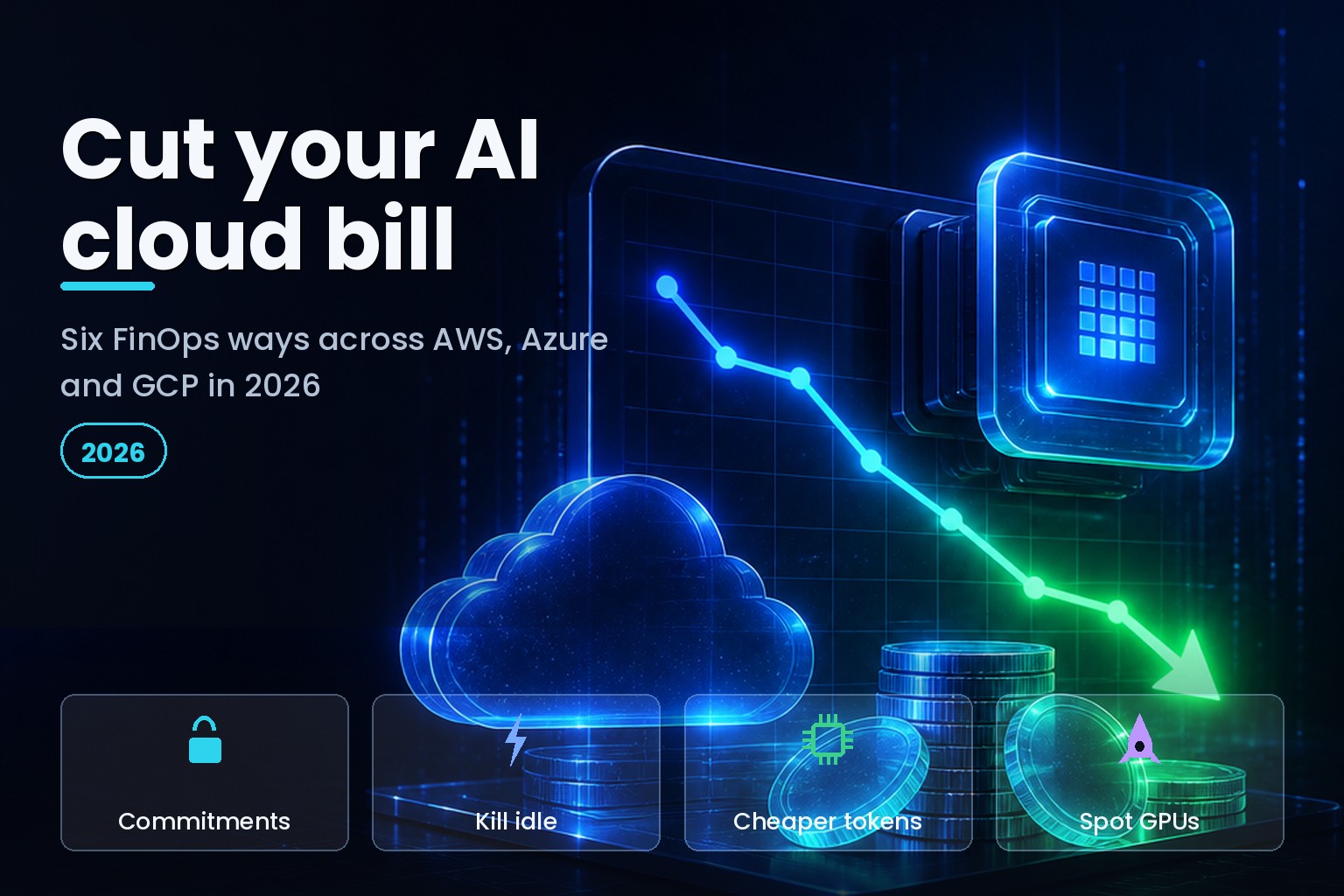
6 FinOps ways Indian teams cut AWS, Azure and GCP bills in 2026
Companies waste about 27% of cloud spend, and AI is now the fastest-growing line. Six FinOps ways Indian teams cut AWS, Azure and GCP bills in 2026, from commitment discounts to cutting the GPU and token bill.
Manu Shukla -
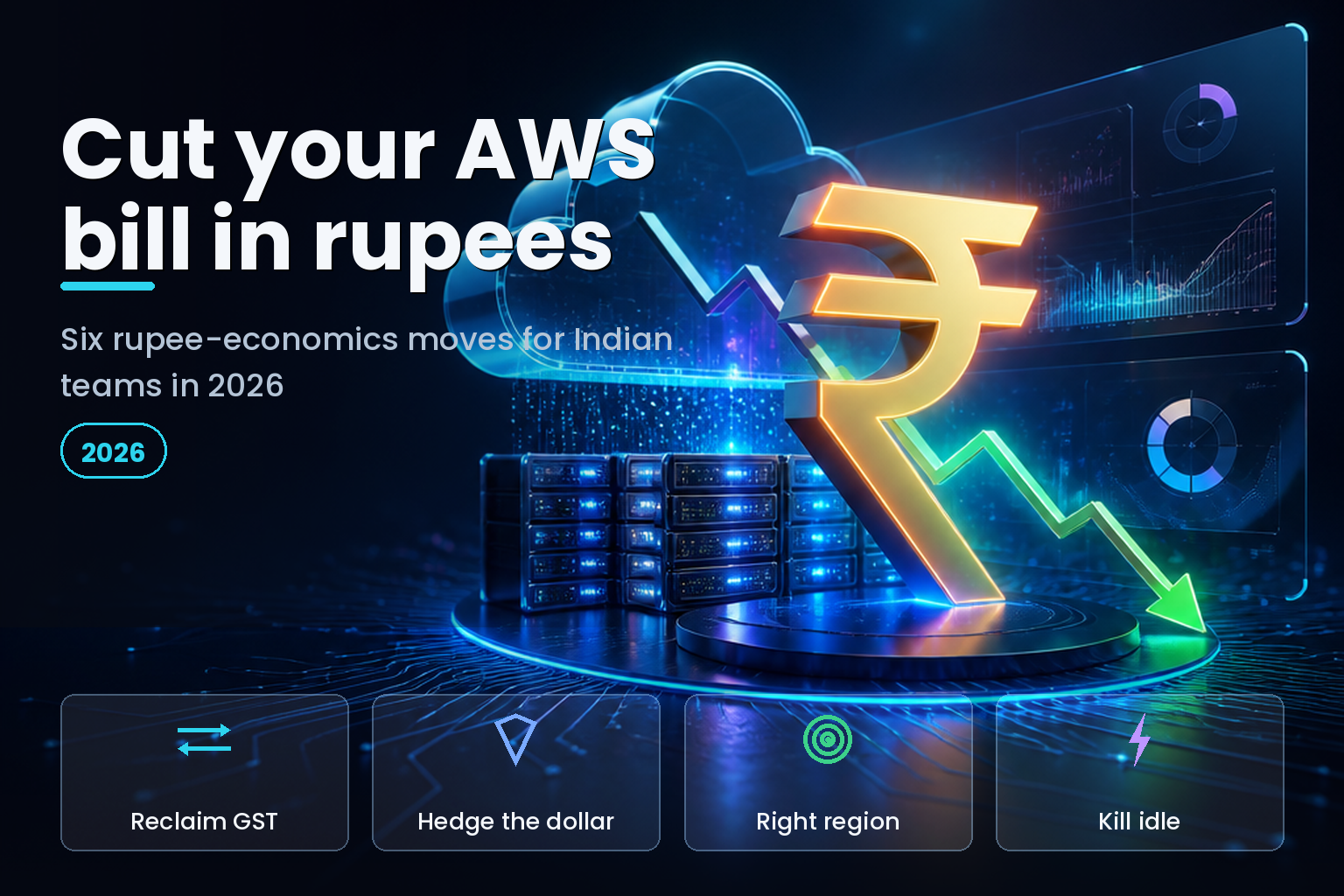
6 rupee-economics moves to cut your AWS bill in India in 2026
India's public cloud spend will hit $17.5 billion in 2026, and the bill is dollar-linked while revenue is in rupees. Six rupee-economics moves to cut your AWS bill, from GST input credit to commitment hedging.
Manu Shukla -
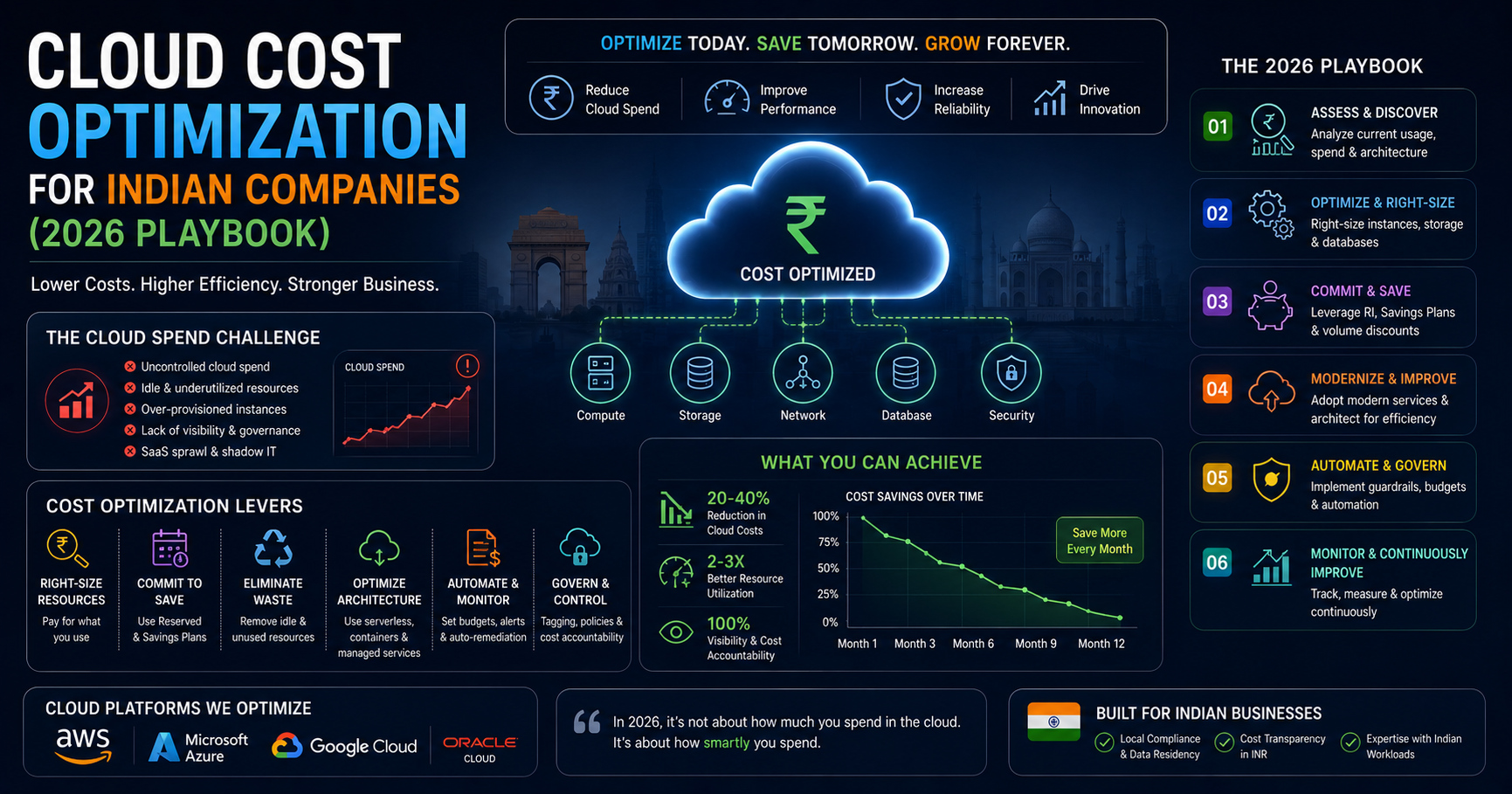
Cloud Cost Optimization for Indian Companies (2026 Playbook)
How Indian companies should approach cloud cost optimization in 2026 — AWS, Azure, GCP waste patterns, DPDP residency, FinOps, rupee economics, savings playbook.
Manu Shukla