On this page · 11 sections
- What changed, and when
- The forecast bands, and who they land on
- Supply is the constraint, and it is a 2027 problem
- The Amazon case, in both directions
- How to tell whether this is your problem
- What to change before the next quote
- India-specific considerations
- What is still unknown
- FAQ
- How eCorpIT can help
- References
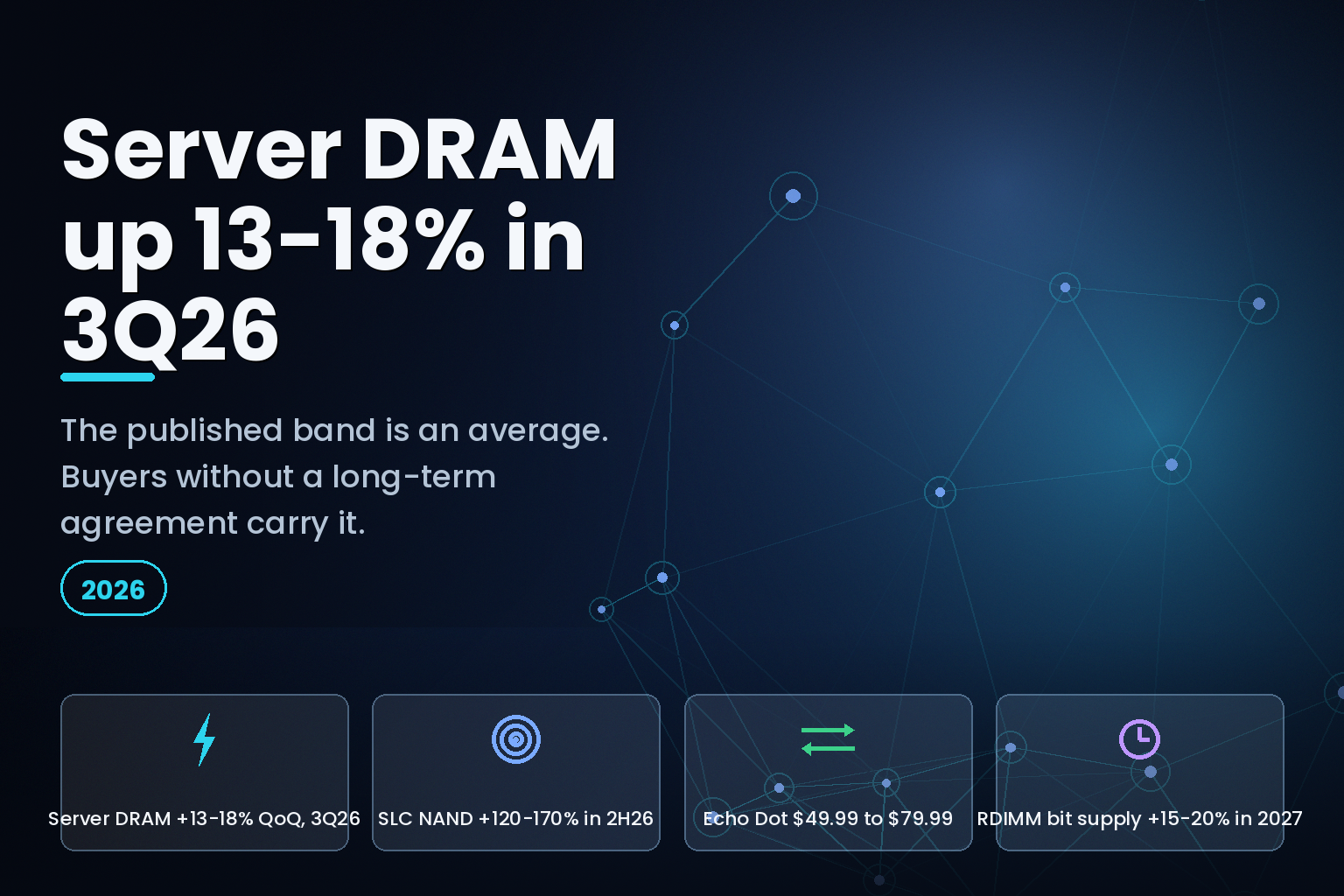
Summary. TrendForce forecast on 3 July 2026 that conventional DRAM contract prices would rise 13-18% quarter-over-quarter in 3Q26, with NAND Flash up 10-15%. Six days later, on 9 July, the same firm published the part that matters for anyone signing a hardware quote this month: several U.S.-based cloud service providers hold multi-year long-term agreements (LTAs) that restrict suppliers from raising their prices at all, so from 3Q26 the increase shifts onto customers without an LTA. The headline band is an average that almost nobody actually pays. Meanwhile SLC NAND contract prices are forecast up 120-170% in 2H26 versus 1H26, Amazon raised device prices by as much as 60% over the weekend of 21-24 August 2026 (the base Echo Dot went from $49.99 to $79.99), and Amazon's own 2026 capital expenditure guidance moved from roughly $200 billion to $220 billion partly because of higher memory costs. IDC has cut its 2026 global PC shipment forecast to a decline of 11.6%, and TrendForce expects global notebook shipments to fall 13.6% this year.
What changed, and when
Three dated forecasts published within a fortnight define the current picture.
On 3 July 2026 TrendForce said the DRAM market would stay extremely tight through 3Q26, but that weaker consumer demand and a higher comparison base would moderate contract price increases to 13-18% QoQ, with NAND Flash at 10-15%. The framing there is deceleration: prices still climb, but less violently than in previous quarters.
On 9 July 2026 TrendForce published a server-specific note with the same 13-18% band and a very different emphasis. Because some cloud service providers have already signed multi-year LTAs that suppliers cannot reprice, "beginning in the third quarter of 2026, the primary source of server DRAM price increases will shift toward customers without LTAs, as well as incremental supply sold outside LTAs to existing LTA customers." The same release warns that suppliers "may continue revising quotations upward throughout the remainder of this quarter" because the market is still undersupplied.
Read together, those two releases say something the individual headlines do not. If a meaningful share of the volume is contractually frozen, and the blended forecast is 13-18%, then the unfrozen share is being repriced by more than 18%. That is the number a mid-sized buyer sees on a quote, and it is not published anywhere.
On 13 July 2026 TrendForce added the sharpest figure of the three: SLC NAND contract prices up 120-170% in 2H26 against 1H26, driven by MLC-to-SLC migration and by demand from AI edge computing, networking gear and automotive electronics. Buyers in industrial and automotive segments are locked in by qualification requirements and fixed memory specifications, so they cannot simply buy less. SLC NAND is the boot medium for network switches and real-time systems, and it offers 100,000 program/erase cycles that MLC parts do not.
The forecast bands, and who they land on
| Component | Published 2026 movement | Which buyer carries it |
|---|---|---|
| Server DRAM (RDIMM) | 13-18% QoQ in 3Q26 | Buyers without an LTA, plus LTA holders on incremental volume |
| Conventional DRAM (all) | 13-18% QoQ in 3Q26 | PC OEMs, module makers, white-box assemblers |
| NAND Flash (contract) | 10-15% QoQ in 3Q26 | Client and enterprise SSD buyers |
| SLC NAND | 120-170% across 2H26 vs 1H26 | Industrial, automotive, networking, AI edge |
| LPDRAM | Continued increases in 3Q26 | Smartphone brands, passed to retail prices |
| Graphics DRAM (GDDR6/7) | Rising with broader DRAM trend | GPU and notebook builders |
Source for every row: TrendForce's 3 July and 13 July 2026 memory pricing surveys.
Supply is the constraint, and it is a 2027 problem
TrendForce's initial estimate for 2027 is that total RDIMM bit supply grows only 15-20% year-over-year, well below projected growth in server CPU shipments. A server DRAM shortage in 2027 is therefore already anticipated, which is why buyers that have covered 2H26 are still building inventory now.
Samsung, which supplies roughly a third of the world's memory chips, told investors on its Q2 2026 earnings call that frontier AI labs have been sharing medium- to long-term demand forecasts directly with the company to secure future supply, and that tight conditions run through 2027 and last until at least 2028. The company's semiconductor unit posted record sales in that quarter while its smartphone and TV divisions lost margin to the same component costs.
Jitesh Ubrani, research manager for IDC's Worldwide Mobile Device Trackers, put the recovery timeline plainly in the March 2026 forecast that cut the 2026 PC market to a 11.6% decline: "Memory shortages will persist well into 2027. While we anticipate some easing of prices beginning in 2028, the market is unlikely to return to the pricing levels seen in 2025."
That last clause is the planning input. This is not a spike that reverses.
The Amazon case, in both directions
Amazon is a useful example because it sits on both sides of the trade at once.
On the sell side, a Fortune review published 21 August 2026 found the company had raised first-party device prices overnight: the base Echo Dot from $49.99 to $79.99, the Echo Show 11 from $219.99 to $249.99, the 16 GB Kindle from $109.99 to $149.99, the 16 GB Kindle Paperwhite from $159.99 to $199.99, the Fire TV Stick HD from $34.99 to $39.99, the Fire TV Stick 4K Max from $59.99 to $84.99, the eero 7 mesh system from $349.99 to $399.99 and the eero Pro 7 from $699.99 to $799.99. Ring products were not repriced. An Amazon spokeswoman told Fortune the consumer electronics industry is "facing significant increases in memory and storage component costs. After absorbing these increases for as long as we could, we recently adjusted pricing across our product lines." The company gave TechCrunch the same statement on 24 August.
On the buy side, chief executive Andy Jassy told investors in late July 2026 that Amazon now expects to spend about $220 billion on capital expenditure in 2026, up from a prior estimate of $200 billion, with higher memory costs among the reasons. Even at that level he said Amazon will not "have enough capacity to meet all the demand we have in 2026. And I believe this dynamic will also be true in 2027, too." AWS reported $42.2 billion of second-quarter revenue, up 37% from $30.9 billion a year earlier.
Apple's Tim Cook described the same pressure to Fortune as a "100-year flood on memory pricing" when Apple raised Mac and iPad prices in June 2026. Microsoft raised Xbox console prices by $100 to $150 and stopped selling the 2 TB configuration. Dell, HP, Lenovo and Asus have raised prices or cut the memory shipped in their products. Roku raised device prices by up to $50 in July 2026.
| Vendor | Price action in 2026 | Reason given |
|---|---|---|
| Amazon | Devices up to 60% higher, 21-24 August | Memory and storage component costs |
| Apple | Mac and iPad prices raised in June | Tim Cook: a 100-year flood on memory pricing |
| Microsoft | Xbox consoles up $100 to $150; 2 TB configuration dropped | Memory costs |
| Roku | Device prices up by as much as $50 in July | Memory costs |
| Samsung | Galaxy phone and tablet prices raised | Higher internal component costs |
| Dell, HP, Lenovo, Asus | Prices raised or shipped memory reduced | Memory costs |
Sources: Fortune (21 August 2026), TechCrunch (24 August and 31 July 2026) and Engadget (22 August 2026).
How to tell whether this is your problem
| Signal in your estimate | What it means | Action this quarter |
|---|---|---|
| Refresh quote expires in under 30 days | You are being quoted against a moving contract price | Take the quote or accept a rebid at 3Q26 levels |
| Spec calls for 96 GB or 128 GB RDIMMs | TrendForce reports CSPs and OEMs shifting to 32 GB and 64 GB modules | Re-price the same total capacity in smaller modules |
| Fixed memory spec you cannot change | Industrial, automotive and networking parts are qualification-locked | Budget against SLC NAND at 120-170% over 1H26 |
| No long-term supply agreement | You sit in the segment carrying the 3Q26 increase | Move to reserved cloud capacity or lengthen the refresh cycle |
| Endpoint fleet refresh due in 2026 | IDC forecasts an 11.6% global PC shipment decline on price | Stagger the refresh across FY2027 |
| AI PC rollout with a 16 GB floor | Copilot+ PCs require at least 16 GB, which is the scarce part | Re-check the configuration before ordering |
What to change before the next quote
Four practical moves, all traceable to a dated source above.
Re-price capacity rather than modules. TrendForce reports that since 1H26, CSPs and OEMs have shifted some systems from 96 GB and 128 GB RDIMMs to 32 GB and 64 GB modules, and expects that mix change to show clearly in supplier shipments from 3Q26. The same total memory can cost less if the module count changes.
Treat any quote older than a quarter as void. The 9 July release explicitly says suppliers may keep revising quotations upward within the quarter. A number from June 2026 is not a number you can plan against in September.
Push the arithmetic into cloud commitments before hardware. If the memory increase lands on non-LTA hardware buyers, then reserved and committed cloud capacity, which is priced against the provider's LTA rather than yours, becomes relatively better value. That is a genuine change to the cloud FinOps decisions Indian teams are making this year, and it interacts directly with the capacity crunch behind the AWS commitment backlog.
Lengthen the endpoint refresh cycle deliberately, not by accident. The real cost here is usually the timing, not the parts.
India-specific considerations
India buys memory in dollars and pays for it in rupees, so the currency leg adds to the component leg. Bharath Shenoy, senior market analyst at IDC India, told Moneycontrol in March 2026 that DDR RAM prices had already risen roughly 2.5 to 3 times, pushing laptop and desktop prices up 10-12% at that point, with a further 8-10% expected that month and about another 10% over the following months. Entry-level laptops that sold at Rs 30,000 to Rs 35,000 were already moving toward Rs 45,000.
IDC recorded the India PC market's strongest year ever in 2025 at 15.9 million units, up 10.2% year-on-year, then forecast a 7-8% shipment decline in 2026 as prices bite, with the consumer segment worst hit. Smaller regional brands and white-box assemblers carry more of the shortage than HP, Lenovo, Dell, Acer or Asus, because scale buys supplier use. That is the same LTA dynamic, one tier down.
For teams weighing local hosting against imported hardware, the India data centre capacity picture for AI workloads is now a procurement question as much as a latency one.
What is still unknown
Three things are not settled and should not be presented as though they were.
The exact premium on non-LTA server DRAM is not published. TrendForce states the direction and the blended band; it does not break out the two populations. Anyone quoting a specific non-LTA percentage is inventing it.
The 2027 supply figure is preliminary. TrendForce describes the 15-20% RDIMM bit supply growth as an initial estimate built from suppliers' early guidance, and supplier guidance for a year out revises.
Whether cloud providers pass memory costs into instance pricing, and when, has not been announced by AWS, Microsoft or Google. Amazon's capex went up; its published EC2 rate card is a separate decision. Watch savings plan coverage targets rather than waiting for a price-change announcement.
FAQ
How eCorpIT can help
eCorpIT is a CMMI Level 5 and ISO 27001:2022 certified engineering organisation in Gurugram, and our senior engineering teams do capacity and cost work alongside build work. If a 2026 hardware refresh or a cloud commitment renewal is now sitting in front of you with a number that moved since the last board pack, we can rebuild the arithmetic against dated component forecasts rather than last year's assumptions. Ask us to review your infrastructure cost plan and we will tell you which line items the memory market actually touches.
References
- AI Server Demand Continues to Support Memory Prices in 3Q26, but Gains Moderate as Consumer Demand Weakens and High Base Effects Take Hold, TrendForce, 3 July 2026.
- Long-Term Agreements Cap Price Increases; Server DRAM Contract Prices Expected to Rise 13-18% QoQ in 3Q26, TrendForce, 9 July 2026.
- Niche Demand and MLC Migration to Drive SLC NAND Prices up 120-170% in 2H26, TrendForce, 13 July 2026.
- Apple's Across-the-Board Price Increases Add Uncertainty to Consumer Demand; Global Notebook Shipments Forecast to Decline 13.6% in 2026, TrendForce, 1 July 2026.
- Exclusive: Amazon quietly hiked prices on Echo, Fire TV, Kindle, and eero overnight to offset significant increases in memory costs, Fortune, 21 August 2026.
- Amazon hikes hardware prices by 60 percent, blaming memory shortage, TechCrunch, 24 August 2026.
- Amazon devices are the latest casualties of the memory shortage price hikes, Engadget, 22 August 2026.
- Samsung expects memory shortage to worsen through 2027 and last until 2028, TechCrunch, 31 July 2026.
- RAMaggedon not expected to ease this year as IDC cuts 2026 PC market forecast again, Engadget, 12 March 2026.
- Laptop prices in India could rise by up to 35% in 2026, 91mobiles, 12 March 2026.
Last updated: 25 August 2026.