On this page · 9 sections
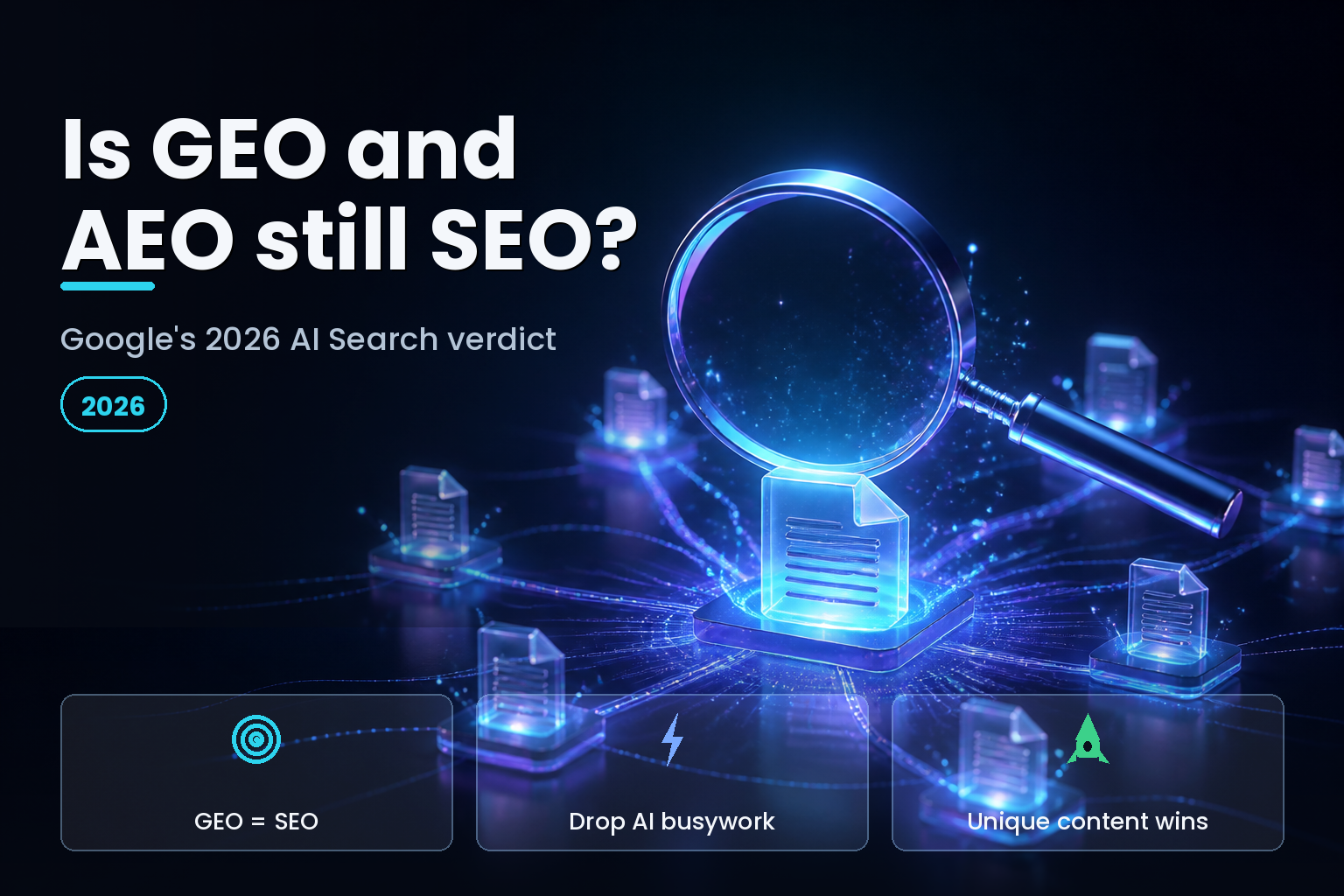
Summary. On 15 May 2026, Google published its first official guide to optimizing for generative AI features, covering AI Overviews and AI Mode, through Google Search Central. The one-line verdict: optimizing for AI search "is still SEO," and AEO and GEO are not separate disciplines. The guide calls four popular tactics unnecessary for Google: llms.txt files, content chunking, special schema.org markup for AI, and AI-specific rewriting. This lands as AI Overviews appear in roughly 55% of Google searches and cut top-position click-through rates by about 34.5%, while the global SEO services market crossed $100 billion for the first time in 2026. The practical answer for teams: keep doing strong SEO, drop the AI-only busywork, and put the effort into unique, first-hand content.
If you have spent the past year buying "GEO" and "AEO" tools and rewriting pages for large language models, Google's guidance is blunt. The company that runs the largest AI search surface says the work is the same work. This article walks through what the guide actually says, what to stop doing, and what to do instead.
What Google actually published
The document, titled "Optimizing your website for generative AI features on Google Search," went live on 15 May 2026 and was announced by Google's John Mueller through the Search Central blog, as Semrush and Search Engine Journal reported. It is Google's first official best-practice guidance for AI Overviews and AI Mode, and it sits at developers.google.com in the Search fundamentals section.
The framing matters. Google states that from Search's perspective, optimizing for generative AI search is optimizing for the search experience, and thus still SEO. Danny Sullivan, Google's Search Liaison, has made the same point in public: SEO for AI "is still SEO," and he frames optimization for AI-powered search as a subset of traditional SEO, the way local search, voice search, and mobile were subsets before it, per Search Engine Land. There is no separate "AI SEO" discipline in Google's telling.
For teams that have treated GEO and AEO as new departments, that is a real reframing. Our own AEO vs GEO vs SEO guide draws the same distinction: the acronyms describe surfaces, not separate playbooks.
The four tactics Google says you do not need
The most useful part of the guide is what it tells you to stop doing. Each of these has been sold hard over the past year.
| Tactic | What vendors claimed | What Google's 2026 guide says |
|---|---|---|
| llms.txt files | A file to feed your content to AI engines | Not needed for Google Search; its systems do not reference llms.txt for AI Overviews |
| Content chunking | Break pages into bite-sized blocks for LLMs | No requirement to chunk; systems understand multiple topics on one page |
| Special AI schema | Add new schema.org markup for generative AI | No special markup required; keep structured data for rich results |
| AI-specific rewriting | Rewrite pages in definition-heavy, LLM-friendly prose | Unnecessary; write for people, not for the model |
Sources: PPC Land, Search Engine Journal, and the Google AI optimization guide.
On llms.txt, the guide is direct: Google's systems do not reference the file when generating AI Overviews. If you have been maintaining one for Google, it does nothing there. Our note on whether llms.txt helps SEO reached the same conclusion earlier in 2026.
On chunking, Google says there is no requirement to break content into small pieces, because its systems can understand the nuance of multiple topics on a page and show the relevant piece to users. Danny Sullivan went further on 8 January 2026, warning that fragmenting content into bite-sized chunks focuses on manipulating ranking systems rather than serving readers, as covered by Search Engine Roundtable.
On structured data, the nuance is easy to misread. Google says no special schema is required for generative AI features, but it recommends continuing to use structured data as part of overall SEO, because it still drives rich-results eligibility. So keep your Article, FAQPage, and Product markup. Just do not invent AI-only schema.
How Google's AI search actually works
The reason the tactics above do not help is mechanical. Google's AI features are rooted in its core Search ranking and quality systems, not a separate AI index. Two mechanisms do the work.
Retrieval-augmented generation, which Google calls grounding, relies on core Search ranking to retrieve relevant pages from the Search index, then reads specific information from those pages to generate a response with clickable links, per DemandSphere. If your page cannot rank and be retrieved, it cannot be cited.
Query fan-out is the second mechanism. When a user submits a query, the system generates a set of related sub-queries to gather more data. A question like "how to fix a lawn full of weeds" fans out into "best herbicides for lawns," "remove weeds without chemicals," and more. Pages that comprehensively answer the sub-questions get pulled into more responses. We cover this pattern in depth in our guide to query fan-out and topic clusters.
Both mechanisms reward the same thing: content that ranks in classic Search and answers the real question well. There is no AI back door.
What actually moves the needle now
Google names one factor above the rest: creating valuable, unique, non-commodity content is the single most important thing for appearing in generative AI features. Around that, three areas matter.
First-hand experience content wins. Original data, real testing, and genuine expertise are hard for a commodity page to fake, and they map directly to Google's E-E-A-T signals. Multimodal assets help too, because AI features increasingly pull from images and video, not just text. Core technical hygiene stays table stakes: crawlability, fast pages, clean structure, and correct canonicals.
None of that is new. That is the point. The teams that were doing real SEO keep winning; the teams that bought AI-tactic shortcuts have been optimizing for a mechanism that does not exist. For a full refresher on the fundamentals, see our 2026 SEO guide.
A keep, stop, and start checklist
The guide reads as a permission slip to simplify. Here is the practical translation for a working team, built only from what Google stated in the 2026 document.
| Keep doing | Stop doing | Start or sharpen |
|---|---|---|
| Structured data for rich results (Article, FAQPage, Product) | Maintaining llms.txt for Google | Original, first-hand content with real data |
| Core technical hygiene: crawlability, speed, canonicals | Chunking pages into LLM-sized blocks | Multimodal assets: images and video |
| Classic keyword and intent research | Rewriting pages in definition-heavy AI prose | Comprehensive answers to fan-out sub-questions |
| Internal linking and clear site structure | Buying AI-only schema packages | Measuring AI impressions in Search Console |
The pattern is consistent. Everything in the "stop" column w-only invention; everything in the "keep" and "start" columns is ranking work that also feeds AI Overviews and AI Mode. If a vendor cannot point to a line in Google's guide that supports a tactic, treat it as unproven for Google's surfaces. Other engines such as Perplexity and ChatGPT Search may weigh signals differently, so test rather than assume, but do not pay a premium for techniques Google says it ignores. Our breakdown of why some pages rank yet win no clicks shows how to turn this checklist into measurable fixes.
India-specific considerations
For Indian businesses, the guidance removes a spending trap. The global SEO services market crossed $100 billion in 2026, and a share of that has been "GEO" and "AEO" retainers sold on the premise of new, AI-only techniques. Google's guide says those techniques are not required for its surfaces, so budget aimed at llms.txt maintenance, AI rewriting, and special schema is better spent on original content and technical health.
There is a measurement angle too. With AI Overviews appearing in roughly 55% of searches and cutting top-position click-through rates by about 34.5%, per 2026 SEO statistics reporting, Indian teams should track AI-driven impressions and clicks separately, not just classic rankings. Google Search Console's AI performance reporting is the honest place to see this; our walkthrough of the Search Console AI performance report shows how to read it. Under the Digital Personal Data Protection Act, 2023 (DPDP), also keep any first-party data you use for content research within your consent basis.
How eCorpIT can help
eCorpIT is a Gurugram-based, senior-led technology consultancy that runs SEO and AI-search programmes on evidence, not acronyms. We audit whether your current GEO and AEO spend maps to anything Google actually uses, cut the busywork, and redirect effort into unique content, technical health, and structured data that earns rich results and AI citations. If you want a clear read on what to keep and what to drop after Google's 2026 guide, talk to our team.
FAQ
References
_Last updated: 10 July 2026._