On this page · 13 sections
- The 2026 search landscape in numbers
- The three optimisation surfaces
- Foundations: technical SEO that still matters
- Content for 2026: depth, structure, originality
- Generative Engine Optimization in detail
- Links and authority in 2026
- Local SEO and AI search
- Measurement: what to track in 2026
- A 90-day SEO modernisation sprint
- Common SEO mistakes in 2026
- FAQ
- How eCorpIT can help
- References
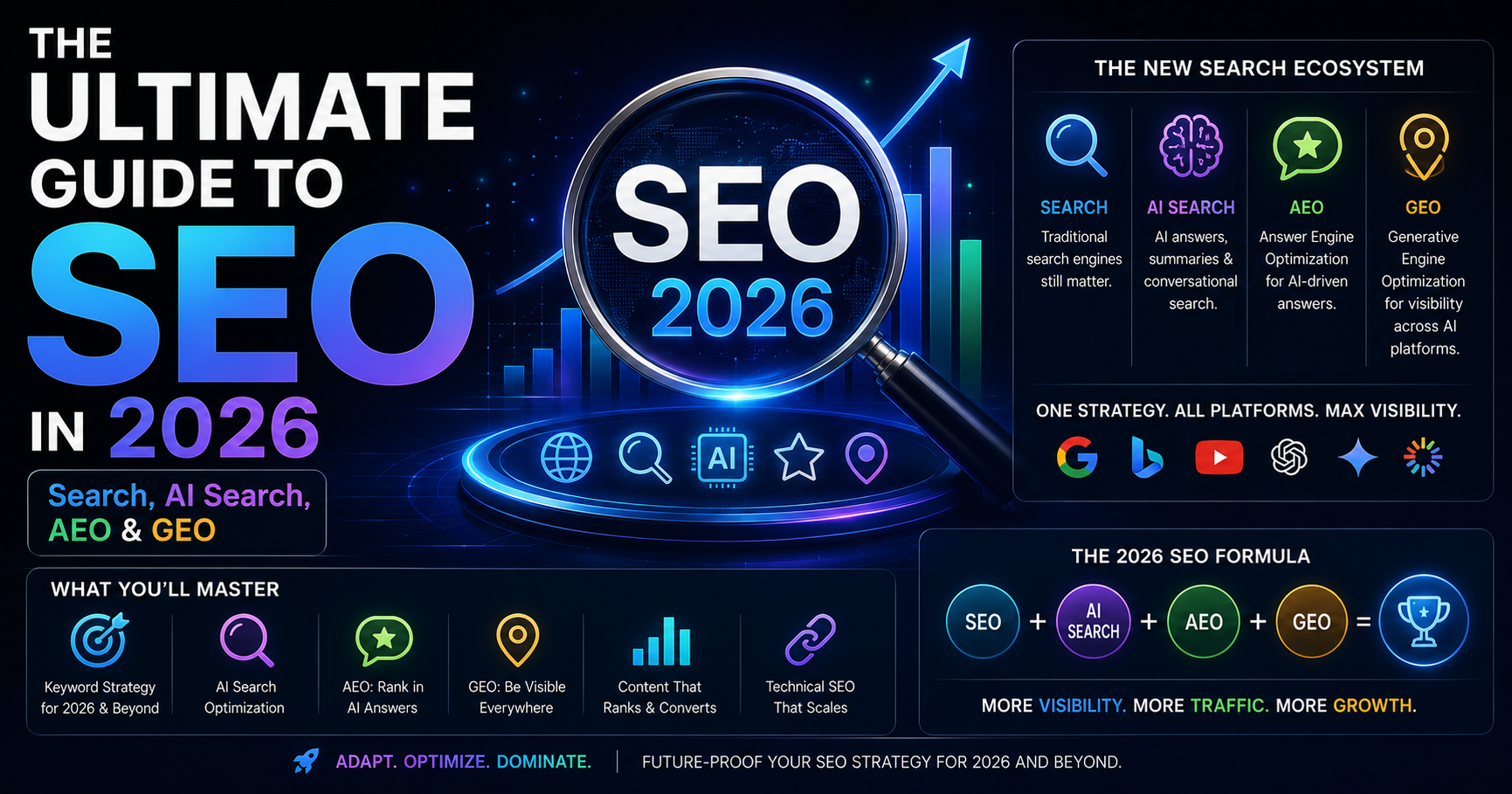
Summary. SEO in 2026 is a fundamentally different discipline from SEO in 2022. AI-powered search engines — Google's AI Overviews, ChatGPT Search, Perplexity, Claude — now mediate a meaningful share of high-intent queries, and traditional Google blue links continue to evolve under quality-update pressure. Three optimisation surfaces matter today: traditional SEO (Google's blue links and AI Overviews), AEO (Answer Engine Optimization — featured snippets, voice answers, structured Q&A), and GEO (Generative Engine Optimization — citations inside ChatGPT, Perplexity, Claude and Gemini). Only 2% of cited URLs appear across all major AI engines; 91% are cited in only one. Content depth, structured data, E-E-A-T signals and review presence are now the strongest correlates of AI citation. This pillar guide covers all three surfaces — what to do, in what order, with what evidence — for marketers, content leaders and founders building organic visibility in 2026.
The strategic point about SEO in 2026 is that the discipline has bifurcated. Traditional search optimisation still works. AI search optimisation is its own discipline with its own ranking factors and citation patterns. The companies that win organic visibility this year are running both — building content and technical foundations that satisfy Google's quality systems while also signalling the structure, authority and freshness that AI engines look for.
This guide is built for SEO leads, content marketers, growth leaders and founders running organic visibility programs. The depth is pillar-class because the topic justifies it. The companion pieces — eCorpIT's AEO vs GEO vs SEO Complete Guide and the B2B Performance Marketing Playbook 2026 — go deeper on specific aspects.
The 2026 search landscape in numbers
Five facts that anchor the rest of the guide.
AI search has real share. ChatGPT holds approximately 68% of generative AI search market share, Google Gemini around 21.5% and Perplexity around 2%. These shares shift monthly; the directional point is that AI search is no longer a niche use case.
Citations rarely overlap across engines. Industry research finds only 2% of cited URLs appear across AI Overviews, ChatGPT and Perplexity simultaneously. 91% of citations appear in only one AI engine. Each system weighs different signals.
E-E-A-T is now an AI inclusion criterion. Experience, Expertise, Authoritativeness and Trustworthiness are no longer just Google ranking factors. They function as inclusion criteria for AI engines deciding which sources to cite. Real experience proof — not claims — is what moves citations.
Schema markup correlates with AI visibility. Content with proper schema markup shows 30-40% higher AI visibility, and sites with complete schema see up to 40% more AI Overview appearances. Schema is no longer optional infrastructure.
Review presence dramatically lifts citation rate. Brands with no Trustpilot or similar review profile show a median 1% AI citation rate. Brands with even minimal profiles (1-13 reviews) jump to 53.5%. Third-party validation has become a primary signal.
The three optimisation surfaces
SEO in 2026 has three distinguishable surfaces, each with its own ranking and citation logic.
Traditional SEO. Google blue-link results, image and video pack results, news, local pack, shopping. Still the largest single source of organic traffic for most websites. Ranking factors continue to be a combination of relevance, authority, freshness, user experience and technical health.
Answer Engine Optimization (AEO). Featured snippets, People Also Ask, voice search results, knowledge panel content. Optimised for explicit question intent with structured answers. AEO content surfaces in both traditional Google results and AI Overviews.
Generative Engine Optimization (GEO). Citations and references inside AI-generated responses from ChatGPT, Perplexity, Claude, Gemini and Google AI Overviews. GEO is the discipline of getting your content cited by AI engines as the source for their answers, rather than getting your link clicked from a search results page.
The right approach in 2026 is integrated — content and technical foundations that satisfy all three surfaces simultaneously, with specific tactics layered on for each. Treating them as separate disciplines produces fragmented content strategy and missed visibility.
Foundations: technical SEO that still matters
Six technical foundations remain table stakes. AI search may downplay some traditional signals, but the technical health of a site continues to determine whether content can be reached at all.
Crawlability. Search engine bots and AI engine bots both need to access your content. Robots.txt should not block important content. JavaScript-rendered content needs to render server-side or be pre-rendered for crawlers. Important pages should be internally linked.
Core Web Vitals. Largest Contentful Paint (LCP) under 2.5 seconds, Interaction to Next Paint (INP) under 200 milliseconds, Cumulative Layout Shift (CLS) under 0.1. These remain Google ranking factors and proxy for user experience that AI engines also consider.
Mobile-first indexing. Google indexes the mobile version of your site primarily. Pages that work poorly on mobile lose ranking. Touch targets, font size, viewport configuration and mobile load speed all matter.
HTTPS and security. Active TLS certificate, no mixed content, security headers (Content Security Policy, Strict Transport Security, X-Frame-Options). Insecure sites are penalised in ranking and increasingly excluded from AI engine training data.
XML sitemaps and structured navigation. Submit sitemaps to Google Search Console and Bing Webmaster Tools. Internal linking should form clear hierarchies. Breadcrumbs should be consistent.
Schema markup. This now sits alongside the others as a fundamental technical foundation rather than an optimisation tactic. Five high-value schema types in 2026: Organization (entity foundation), Article or BlogPosting (editorial content), FAQPage (with post-March 2026 caveats — verify current Google guidance), Product (e-commerce), LocalBusiness (sites with physical locations). Schema gives both traditional search engines and AI engines the structured context they use to understand and cite content.
Content for 2026: depth, structure, originality
Three content disciplines distinguish high-visibility content from invisible content.
Depth that earns trust
GoodFirms research finds content depth — measured in sentence and word counts — matters most for AI citation. Traditional SEO metrics like raw traffic and backlinks are less predictive of AI citation than content depth itself.
What depth actually means: comprehensive coverage of the topic, original research or experience, specific numbers and statistics, named expert quotes, primary-source citations. A 4,000-word article that recombines existing material is not depth. A 2,500-word article with original analysis, specific data and named expert sources is.
The 2026 pattern that works: pillar articles 3,000-5,000 words on core topics; supporting articles 1,500-2,500 words on subtopics; news and analysis 1,200-2,000 words when timely. Length serves depth; depth is not synonymous with length.
Structure that AI engines parse
Q&A format is the highest-performing structure for AI search. Structured content with clear headings and lists is almost as effective for non-question queries. Dense paragraph-only writing performs worst.
Practical structure for AI-readable content: H1 with the primary topic clearly stated; H2s as the next-level structure; H3s where additional depth is warranted; short paragraphs (3-5 sentences); explicit FAQs sections where users actually ask questions; tables for comparative data; lists for enumerable content.
The same content can be structured for AI without sacrificing readability for humans. The discipline is being explicit about what each section answers, with the answer in the first sentence and the elaboration after.
Originality and E-E-A-T
E-E-A-T (Experience, Expertise, Authoritativeness, Trustworthiness) is now operating as both a Google ranking signal and an AI engine inclusion criterion.
Experience. Content created by people who have actually done the thing, not just researched it. First-person examples, specific anecdotes, evidence of working with the material described.
Expertise. Author bios that establish credentials. Subject-matter authors who write consistently in their area. Editorial review by qualified experts on technical content.
Authoritativeness. Recognition by other authoritative sources — citations, links, mentions in industry coverage, awards, speaking appearances.
Trustworthiness. Editorial standards, fact-checking, corrections policies, transparent ownership and sponsorship, clear contact information, no deceptive practices.
The 2026 pattern: every important article has a named, expert author with verifiable credentials. Review by a separate qualified reviewer is documented where possible. Sources are cited inline with primary references. Editorial standards are visible on the site.
Generative Engine Optimization in detail
GEO is the specific discipline of getting cited by AI engines. The mechanics are somewhat different from traditional SEO.
Each engine weighs different signals. Perplexity values recency and citation density. ChatGPT values authority and comprehensiveness. Google AI Overviews values structured data and E-E-A-T. A content piece can hit one and miss another. The 91% single-engine citation rate reflects this.
URL accessibility matters more than expected. AI engines need to access the URL during the retrieval phase. Paywalled content, JavaScript-rendered content that does not pre-render and aggressively rate-limited URLs all reduce citation likelihood.
Fan-out rank. The signal of how many sub-questions a piece of content answers from a single URL. Long, comprehensive content that answers a primary question plus several related questions outperforms short content focused on a single query.
Query-answer match. Whether the content explicitly answers the question being asked. Q&A formatted content wins on this dimension more often than information-dense paragraphs.
Intent-format match. Whether the format of the content matches the intent of the query. Comparison queries reward tables and lists. Definition queries reward concise direct answers in the first sentence. How-to queries reward numbered steps with intermediate validations.
Citation density. Inline citations to primary sources signal that the content is referenced and verifiable. AI engines preferentially cite content that itself cites primary sources well.
For deeper coverage, eCorpIT's AEO vs GEO vs SEO Complete Guide walks through specific tactics and measurement approaches.
Links and authority in 2026
Backlinks remain a Google ranking factor and a signal of authority that AI engines consider, though the weight has shifted.
Quality over quantity, more than ever. A single link from a recognised industry publication outperforms hundreds of low-quality directory links. Disavow files have become less important as Google has gotten better at ignoring spam, but unnatural link patterns can still trigger manual actions.
Digital PR as the working link-building tactic. Op-eds, expert quotes in industry coverage, data studies that get picked up by trade press, founder interviews. These produce both links and the E-E-A-T signal of being cited by authoritative sources.
Internal linking architecture. A well-architected internal linking structure helps Google distribute crawl priority and ranking authority appropriately. It also helps AI engines understand topical relationships within your domain. Pillar articles should link to subtopic articles; subtopics should link back to pillars.
Brand mentions without links. AI engines particularly consider brand mentions across the web — even without links. Establishing a recognised brand in your category produces citation lift across both traditional SEO and AI search.
Local SEO and AI search
For businesses serving local markets — including most Indian businesses operating regionally — local SEO has integrated with AI search in 2026 in two specific ways.
Google Business Profile remains foundational. Complete profile with all categories, services, photos, hours, posts and reviews is the basis for local-pack ranking and a strong signal for AI engines asked location-based questions.
Local entities in AI search. When a user asks Perplexity or ChatGPT "best Italian restaurant near me in [city]," the response combines web content with structured business data. Businesses with complete, well-reviewed Google Business Profiles, consistent NAP (Name, Address, Phone) across the web, and local schema markup appear more often.
For Indian businesses, this means Google Business Profile work — addressed in eCorpIT's GBP optimization guide — remains one of the highest-ROI local SEO investments.
Measurement: what to track in 2026
Six metrics that distinguish well-measured SEO programs from vanity-metric programs.
Organic traffic by surface. Traditional Google blue links, Google AI Overviews appearances, AI engine citations (where measurable through traffic referrals or branded search uplift). Most analytics dashboards still treat all organic the same; mature SEO programs separate.
Cited content inventory. Which of your URLs are cited by ChatGPT, Perplexity, Claude and Google AI Overviews. Tools like Profound, BrightEdge GEO module, Otterly and Ahrefs Brand Radar (used at eCorpIT) provide visibility.
Branded search velocity. Branded search volume is increasingly the cleanest signal of brand visibility in an AI-mediated environment. Steady growth in branded search correlates with citation lift.
Conversion by query intent. Commercial-intent queries (the keywords that lead to actual revenue) should have specific tracking. Vanity rankings on informational queries are not what funds the program.
Content half-life. How long published content continues to generate visibility. Strong evergreen content lifts the program over time; mediocre content decays fast. Track which content categories age well.
Position in AI engines. When AI engines cite multiple sources for a query, your position in that source list matters. Tools like Profound and BrightEdge are now showing this directly.
A 90-day SEO modernisation sprint
For SEO leaders ready to modernise their program for the 2026 landscape, a sprint pattern that consistently produces results.
Weeks 1-3: Audit and prioritise. Audit traditional SEO health (Core Web Vitals, crawlability, schema, internal linking). Inventory current AI citation footprint. Pick the 10-15 highest-priority pages for modernisation. Run a competitor citation audit to identify where competitors are appearing in AI engines and you are not.
Weeks 4-6: Content modernisation. Rewrite the priority pages for depth, structure, E-E-A-T signals. Add explicit FAQs sections, Q&A formatting, schema markup, inline citations to primary sources. Establish or strengthen named-author byline and editorial review.
Weeks 7-9: Authority and links. Run a Digital PR push — op-eds, expert quotes, data study, founder interviews. Build review presence on category-relevant platforms (Trustpilot, Clutch, G2, Capterra for B2B SaaS). Strengthen internal linking architecture around pillar topics.
Weeks 10-13: Measure and iterate. Set up the measurement stack (separating traditional / AI Overviews / AI engine citations). Establish baseline metrics. Identify the next 10-15 priority pages for the second round.
The output of a successful 90-day sprint is a measurable lift in AI engine citation rate, improved coverage of priority commercial-intent queries, and a documented playbook the team can apply across the rest of the site.
Common SEO mistakes in 2026
Six patterns that consistently waste budget.
Treating AI search and traditional SEO as the same. They share foundations but have distinct ranking and citation logic. Programs that optimise only for Google miss AI engine visibility; programs that optimise only for AI miss traditional traffic.
Producing content without depth. AI-generated thin content has become abundant and largely invisible. Depth (original analysis, specific data, named experts, primary citations) is the differentiator.
Ignoring schema markup. Schema is no longer optional. The 30-40% AI visibility lift it enables is too significant to leave on the table.
Skipping review presence. A 53.5% citation rate gap between sites with no review profiles and sites with even minimal profiles is the most underused lever in 2026 SEO.
Optimising vanity metrics. Ranking on informational queries that do not convert is not the goal. Commercial-intent queries are.
Treating E-E-A-T as a checklist. E-E-A-T is a combined signal pattern across the whole site, not a set of meta-tags. Real expert authors, real editorial review, real first-hand experience visible in the content. The checklist approach produces content that fails the underlying signal.
FAQ
How eCorpIT can help
eCorpIT runs SEO, AEO and GEO programs for clients across India, the US and the UK. Our work covers technical SEO audits, content strategy and production, schema implementation, E-E-A-T signal development, Digital PR for link and citation building, AI citation measurement and reporting.
If you are modernising your SEO program for 2026, our team can help. Reach us at ecorpit.com/contact-us/ or contact@ecorpit.com.
References
- eCorpIT — "AEO vs GEO vs SEO: The Complete Guide": ecorpit.com
- eCorpIT — "B2B Performance Marketing Playbook 2026": ecorpit.com
- eCorpIT — "Google Business Profile Optimization": ecorpit.com
- GoodFirms — "AI SEO Statistics 2026: 35+ Verified Stats": goodfirms.co
- Position Digital — "150+ AI SEO Statistics for 2026": position.digital
- Jasper — "What is Generative Engine Optimization? GEO vs AEO vs SEO Guide 2026": jasper.ai
- Enrich Labs — "Generative Engine Optimization (GEO): The Complete 2026 Guide": enrichlabs.ai
- eSEOspace — "How Google AI Overviews Impact SEO in 2026": eseospace.com
- Adobe Business — "SEO in 2026: How AI is reshaping the fundamentals of search": business.adobe.com
- Search Engine Journal — "5 Key Enterprise SEO And AI Trends For 2026": searchenginejournal.com
- Whitehat SEO — "How SEO really works in 2026": whitehat-seo.co.uk
- Stackmatix — "Structured Data AI Search: Schema Markup Guide (2026)": stackmatix.com
Last updated 8 June 2026 by the eCorpIT Editorial team.