On this page · 10 sections
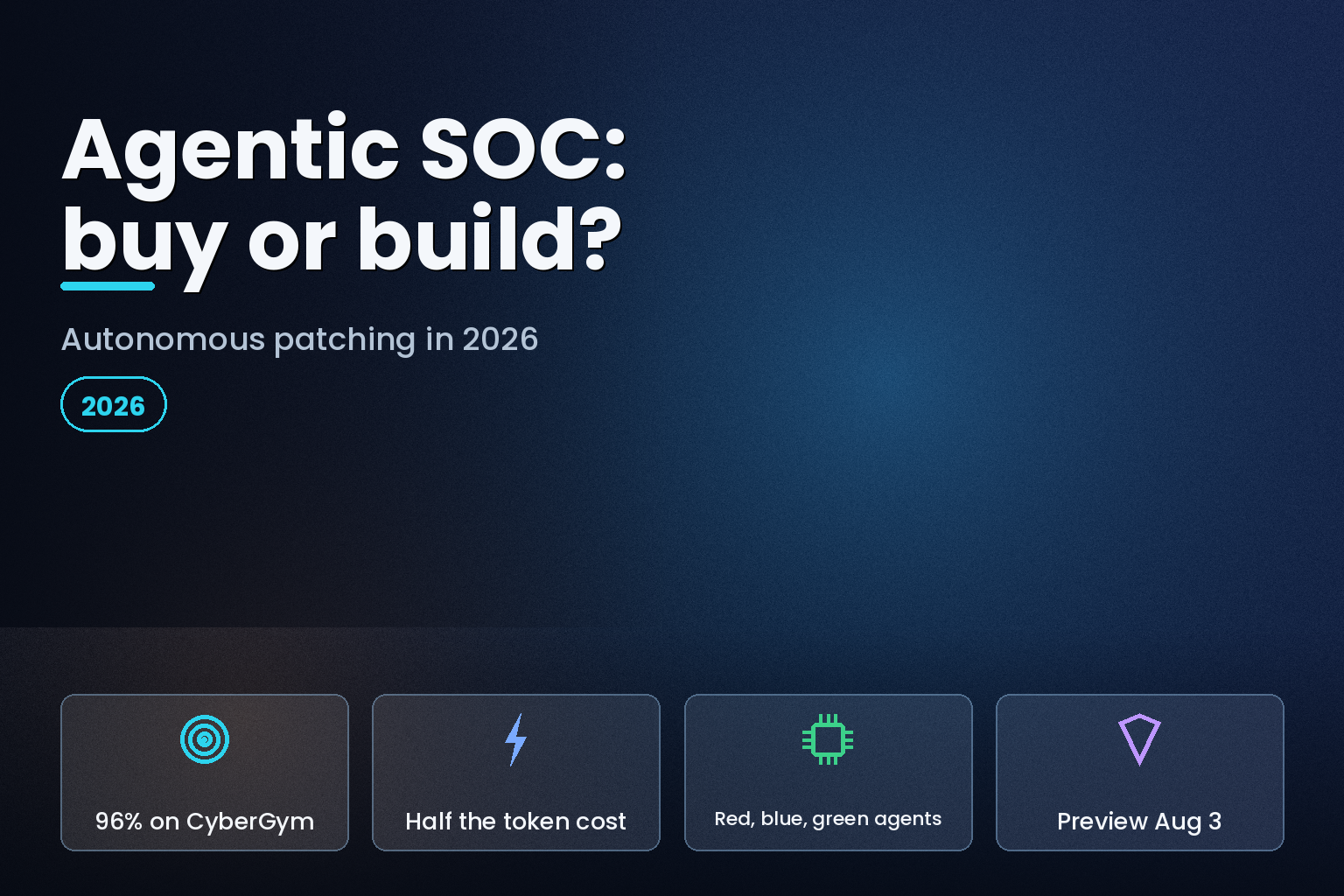
Summary. On August 3, 2026, Microsoft puts Project Perception into public preview: a system of red, blue, and green team AI agents that find weaknesses, rank them, and remediate them with limited human input. It draws on MAI-Cyber-1-Flash, Microsoft's first security model, which the company reports scores 96% on CyberGym, 12 points above the next model, at 50% of the token cost of its earlier setup. The launch lands on a market already in motion. The 2026 SANS AI Survey found security teams using AI rose from 50% to 78% in a year, yet only 27% call their deployment mature production. With the average breach at USD 4.44 million (IBM, 2025) and a provisioned Security Compute Unit listed at USD 4 per hour, the question for a CISO in 2026 is not whether agents belong in the security operations center, but whether to buy a system like this or build your own. Here is the decision, with the numbers.
The security operations center has spent three years bolting AI onto existing work: a copilot that summarizes an alert, a model that drafts a KQL query, a classifier that scores a phishing report. Project Perception is a different claim. It puts agents in the loop that take action, and it arrives with a specialist model and a pricing meter attached. That combination forces a decision most teams have deferred.
What Microsoft actually shipped
Two things landed together on July 27, 2026, and it helps to keep them separate.
The first is MAI-Cyber-1-Flash, a compact security model derived from Microsoft's MAI-Thinking-1 lineage. It runs inside MDASH, the multi-agent vulnerability identification and remediation harness Microsoft first described in May 2026. Microsoft reports that MDASH with MAI-Cyber-1-Flash reaches 96% on CyberGym, the benchmark for reasoning over large codebases to find real vulnerabilities, and that the combined system costs 50% less than its previous best configuration of GPT-5.4, GPT-5.4 mini, and GPT-5.3 codex. The design point is cost: the small model is built to handle up to 90% of tasks, and the harness escalates only the hardest 10% to a larger model.
The second is Project Perception, the agentic security system that sits on top. Microsoft describes it as red team agents that expose weaknesses, blue team agents that investigate and triage, and green team agents that fix and harden, running in continuous loops. Microsoft's own framing draws a line between the two products it now sells here: Security Copilot assists, Project Perception acts. Mustafa Suleyman, chief executive of Microsoft AI, and Hayete Gallot wrote in the launch note that "the old model of security, where you scan occasionally and patch eventually, is now obsolete."
Perception enters public preview worldwide on August 3, 2026 for business customers already testing the MDASH harness. It is priced the way Security Copilot is priced, in Security Compute Units, with different agents drawing SCUs at different rates depending on how much compute a task needs. Microsoft's stated advantage is data: more than 100 trillion security signals a day across 1.6 million customers, a corpus no new entrant can assemble.
The benchmark, read carefully
A 96% score on a vendor's own benchmark, run on the vendor's own harness, is a marketing number until an independent team reproduces it. Read it for what it is.
The 96% is a system result, not a single model. It combines MAI-Cyber-1-Flash for the routine 90% of tasks with a larger model, GPT-5.4, for the hardest 10%. Microsoft's chart puts MAI-Cyber-1-Flash plus GPT-5.4 at 95.95% and the four comparison models between 83.2% and 85.6%. The 12-point gap over the next model is the headline, and it is plausible given the training data Microsoft holds. It is also the number most likely to compress once other labs tune for CyberGym, the way benchmark gaps usually narrow within a quarter.
For a buyer, the honest reading is that Microsoft has a genuine data and harness advantage on vulnerability discovery, and that the specific percentage matters less than two operational facts: the small model is cheap enough to run continuously, and the system remediates, not just reports. Continuous is the word that changes the economics. Occasional scanning was priced per scan. An agent that reads every commit and every signal is priced per hour of compute, which is why the SCU meter, not the benchmark, is the number to model.
Buy versus build: the real decision
Almost no mid-market enterprise should build a foundation security model. The build-versus-buy decision is narrower than that. It is about the agent layer: the orchestration, the playbooks, the guardrails, and the integration with your existing detection stack. You can buy that layer from Microsoft, or you can assemble it from your security information and event management platform, an orchestration framework, and API or open-weight models reached through the Model Context Protocol.
The trade is the usual one, sharpened by how young this category is.
| Decision vector | Buy a vendor agentic SOC | Build on your own SIEM |
|---|---|---|
| Time to first value | Days to weeks in preview; agents ship pre-built | Months; you write detection-as-code, playbooks, and evals |
| Upfront cost | Metered from day one (SCUs at USD 4 per hour, provisioned) | Engineering time plus model tokens; no per-hour floor |
| Signal and training data | Vendor's cross-tenant corpus (100 trillion daily signals) | Only your own telemetry, unless you buy threat feeds |
| Maintenance and updates | Vendor retrains and patches the model and agents | Your team owns model drift, eval decay, and prompt rot |
| Control and lock-in | Workflows and pricing tied to one vendor's stack | Portable across models and clouds; higher operating burden |
| Governance and audit | RBAC, tenant isolation, and audit logs built in | You design approval gates, logging, and rollback yourself |
| Best fit | Microsoft-heavy estates wanting fast coverage | Teams with strong platform engineering and multicloud signals |
The pattern that holds up in practice: buy the agent layer when your estate is already Microsoft-centric and your SOC is understaffed, because the integration and the cross-tenant signal are worth more than the control you give up. Build when your detection logic is a competitive asset, your signals span clouds a single vendor cannot see, or your regulator wants the decision logic to live in systems you fully control. Most teams will end up hybrid: a bought agent layer for common workflows, a built one for the detections that are specific to their business. That is the same conclusion reached in our guide to scoping AI agents from pilot to production, and it is why the framework matters more than the vendor.
What the three agent teams do
The red, blue, and green split is a useful mental model, and it also maps to where the risk sits. Green is where the promise and the danger both live, because green is the team that changes your systems.
| Agent team | What it does | The risk to manage |
|---|---|---|
| Red | Simulates attacks and surfaces exploitable paths before an attacker finds them | False confidence if coverage is partial; scope creep into production |
| Blue | Detects, investigates, and triages, then ranks what needs attention | Alert automation that hides a wrong prioritization inside a clean summary |
| Green | Fixes and remediates, including writing and deploying patches | An autonomous change that breaks a working system faster than a human could |
Red and blue automate work that already had a human safety net: a bad triage produced a missed alert, which teams are built to catch. Green removes the net. An agent that writes and deploys a patch is making a production change, and a production change that goes wrong is an outage you caused yourself. That is the line every deployment plan has to draw explicitly, and it is the reason the governance question below is not optional.
The costs nobody puts on the launch slide
The benchmark is free to quote. The meter is not. Security Compute Units are the unit of spend, and continuous agents consume them continuously.
| Item | Figure (2026) | Source |
|---|---|---|
| Provisioned Security Compute Unit | USD 4 per SCU per hour | Microsoft Security Copilot pricing |
| Overage SCU (usage spikes) | USD 6 per SCU per hour | Microsoft Security Copilot pricing |
| One SCU running continuously | About USD 35,000 per year | Derived from the hourly rate |
| Microsoft's suggested evaluation size | Three SCUs, about USD 105,000 per year | Reported SCU pricing guides |
| Average cost of a data breach | USD 4.44 million | IBM, 2025 |
Set those two currency figures side by side. A three-SCU evaluation runs near USD 105,000 a year before overage, and the event it is meant to prevent averages USD 4.44 million. The economics can work. They only work if the agents actually reduce breach frequency or containment time, and if your usage stays near the provisioned floor rather than living in overage. Model the meter against a real workload, not the demo, and budget for the overage rate, because a noisy environment is exactly when agents run hottest and exactly when you can least afford a surprise bill. The build path has no per-hour floor, but it trades that for engineering salaries and the slow cost of maintaining evals so the agents do not quietly degrade, a failure mode covered in our note on silent failures in AI agent evals.
Governance: an agent that patches production can break production
The 2026 SANS AI Survey put the tension plainly: adoption is outpacing governance. Use rose from 50% to 78% of teams in a year, while only 27% describe their deployment as mature production, and the survey's own framing calls out the gap between the two. Tines' Voice of Security 2026 report found 99% of SOCs now use AI in some form. The tools are everywhere; the controls are not.
Autonomous remediation needs the controls that change management already knows, applied to a non-human actor. Four are non-negotiable. First, an approval gate on any production change, with a human in the loop for anything above a defined blast radius, and full autonomy reserved for low-risk, reversible actions like isolating a test host. Second, a rollback path for every automated action, so a bad patch is a two-minute reversal rather than an incident. Third, scoped permissions through role-based access control and tenant isolation, so a compromised or confused agent cannot reach beyond its lane; Microsoft ships these in MDASH, and a build has to design them. Fourth, an audit trail that records what each agent decided and why, because when a regulator or a board asks who approved a change, "the model did" is not an answer.
The prompt-injection surface deserves its own line. An agent that reads untrusted input, an alert description, a commit message, a threat feed, can be steered by an attacker who plants instructions in that input. The defenses are the same ones any production agent needs, covered in our guide to prompt-injection guardrails for AI agents: treat all tool input as untrusted, constrain what actions an agent can take without confirmation, and log every tool call. This is also where the broader discipline of AI agent governance layers earns its keep, because an agentic SOC is a governed agent deployment before it is anything else. For the wider pattern of putting enterprise AI agents into production, the SOC is simply the highest-stakes instance.
India-specific considerations
For an Indian enterprise, three factors shift the math. The first is data. Security telemetry is thick with personal data: usernames, device identifiers, IP addresses, and email content in phishing samples. Under the Digital Personal Data Protection Act 2023, that telemetry is personal data, and sending it to a cross-tenant model raises processing and localization questions a build on your own infrastructure can sidestep. If your agents run inside your own cloud tenancy, you keep control of where signals go.
The second is cost in local terms. A three-SCU evaluation near USD 105,000 a year converts to roughly ₹85 to ₹90 lakh at current exchange rates, before overage, which is a real line item against the salary of a mid-market SOC. The third is talent. India's security engineering pool is deep enough to build and run an agent layer in-house, which tilts more Indian teams toward the build path than the global average, provided they invest in the governance controls above rather than treating the agents as fire-and-forget.
FAQ
How eCorpIT can help
eCorpIT helps enterprises make the buy-versus-build call on agentic security operations without betting the SOC on a preview. We scope a pilot against your real telemetry, design the approval gates, rollback paths, and audit trails that autonomous remediation needs, and integrate agents with the SIEM and cloud signals you already run. As an ISO 27001:2022 certified organisation, we build these workflows aligned with DPDP Act 2023 requirements and your own governance model. To pressure-test your agentic SOC plan with a senior engineering team, contact us.
References
- Introducing MAI-Cyber-1-Flash inside MDASH — Microsoft AI, July 27, 2026
- Rethinking security for the age of AI — The Official Microsoft Blog, July 27, 2026
- What's new in Microsoft Security: July 2026 — Microsoft Security Blog
- Project Perception — Microsoft Security
- Microsoft built an agentic security system with red, blue, and green team AI agents; it enters public preview August 3 — The Next Web
- Microsoft's Latest Security Play: Project Perception — Directions on Microsoft
- AI use in cybersecurity jumped from 50% to 78% in a year — SANS Institute, 2026 SANS AI Survey
- AI isn't replacing SOC teams; it's elevating them — Tines, Voice of Security 2026
- Microsoft Security Copilot pricing — Microsoft Security
_Last updated: August 2, 2026._