On this page · 15 sections
- The shift, in plain numbers
- What each acronym actually means
- Side by side: what differs, what stays the same
- How AI engines actually pick what to cite
- What changed in Google's 2026 guidance
- The AEO playbook: snippets, voice, AI Overviews
- The GEO playbook: ChatGPT, Claude, Perplexity, Gemini
- The AIO playbook: brand, entity, knowledge graph
- The technical foundation nobody can skip
- Measuring when clicks are no longer the only signal
- The common mistakes we see, especially in Indian SME content
- Putting it together: the integrated 2026 playbook
- FAQ
- How eCorpIT can help
- References
Summary. SEO gets you indexed and ranked. AEO gets you picked as the answer. GEO gets you cited by ChatGPT, Claude, Gemini and Perplexity. AIO is the brand and entity work that makes all three easier. In 2026 you need all four, and the order matters: technical SEO first, then snippable structure for AEO, then citation-worthy depth for GEO, then entity work for AIO. The numbers explain the urgency. AI Overviews now appear on about 48% of Google searches in early 2026, up from roughly 31% a year earlier, and Gartner expects organic traffic to commercial sites to fall 25% by 2026 as people shift to AI answers. ChatGPT still leads generative AI with about 54.7% of chatbot visits, but its share has slipped from 87% in early 2025 while Google Gemini climbed past 27% and Perplexity grew around 370%. AI-referred visitors also convert far better, near 14.2% against 2.8% for traditional organic. Skip the foundation and the rest collapses. This guide is refreshed for June 2026.
You do not have to learn four disciplines from scratch. The same content asset, built well, can serve all four at once. What changes is the checklist you hold it against. This guide gives you that checklist, the data behind it, and the order to do the work in.
The shift, in plain numbers
A few data points set the table.
AI Overviews now trigger on roughly 48% of Google searches in early 2026, up from about 31% a year earlier, and the rate swings hard by topic: around 88% of healthcare queries and 83% of education queries show one, against about 37% for entertainment. When an AI Overview appears, Ahrefs measured a 34.5% drop in click-through rate for the number-one organic result across 300,000 keywords. Zero-click behaviour is now the norm, with SparkToro finding 58.5% of US Google searches end without a click even before AI Overviews are counted.
The generative engines have reshuffled fast. ChatGPT still leads with about 54.7% of visits across the largest gen-AI chatbots, but its share of generative AI web traffic fell from 87% in early 2025 to roughly 57% by March 2026, while Google Gemini surged from about 6% to over 25% and Perplexity grew around 370% to establish itself as a citation-first search engine. Different engines, different rules. The two engines barely overlap in the domains they cite, Wikipedia supplies close to half of ChatGPT's top citations, and Reddit is the single largest source Perplexity draws on.
The money has moved with the attention. AI-referred visitors convert at roughly 14.2% against about 2.8% for traditional organic, and Gartner expects organic search traffic to commercial sites to decline 25% by 2026. Lower volume from AI, much higher intent. If your strategy is still "rank for keywords and wait for clicks," you are competing for a shrinking slice. The pie is still growing. You need a new map.
What each acronym actually means
The space is full of loose jargon. Here is the version we use with clients.
SEO, search engine optimization, is the work that gets a page indexed and ranked on traditional results. It is keywords, on-page structure, internal links, page speed, mobile, backlinks, and technical hygiene. SEO is the foundation everything else sits on.
AEO, answer engine optimization, is the work that gets a page chosen as the answer: Google's featured snippets, the answer box, voice answers from Siri or Alexa, and the short summary in an AI Overview. AEO is about being the cleanest, most extractable answer to a specific question.
GEO, generative engine optimization, is the work that gets your brand and URLs cited inside generative AI answers from ChatGPT, Claude, Perplexity, Gemini and Copilot. GEO uses different signals from SEO. The first peer-reviewed paper on it came from a Princeton-led team at KDD 2024 and is still the most cited academic work in the space.
AIO, AI optimization, is the umbrella discipline: the brand and entity work that makes your company recognisable and well-described inside AI systems. AIO covers your Wikipedia presence, your Wikidata entry, mentions on independent sites, schema across your site, and how models describe your brand when asked.
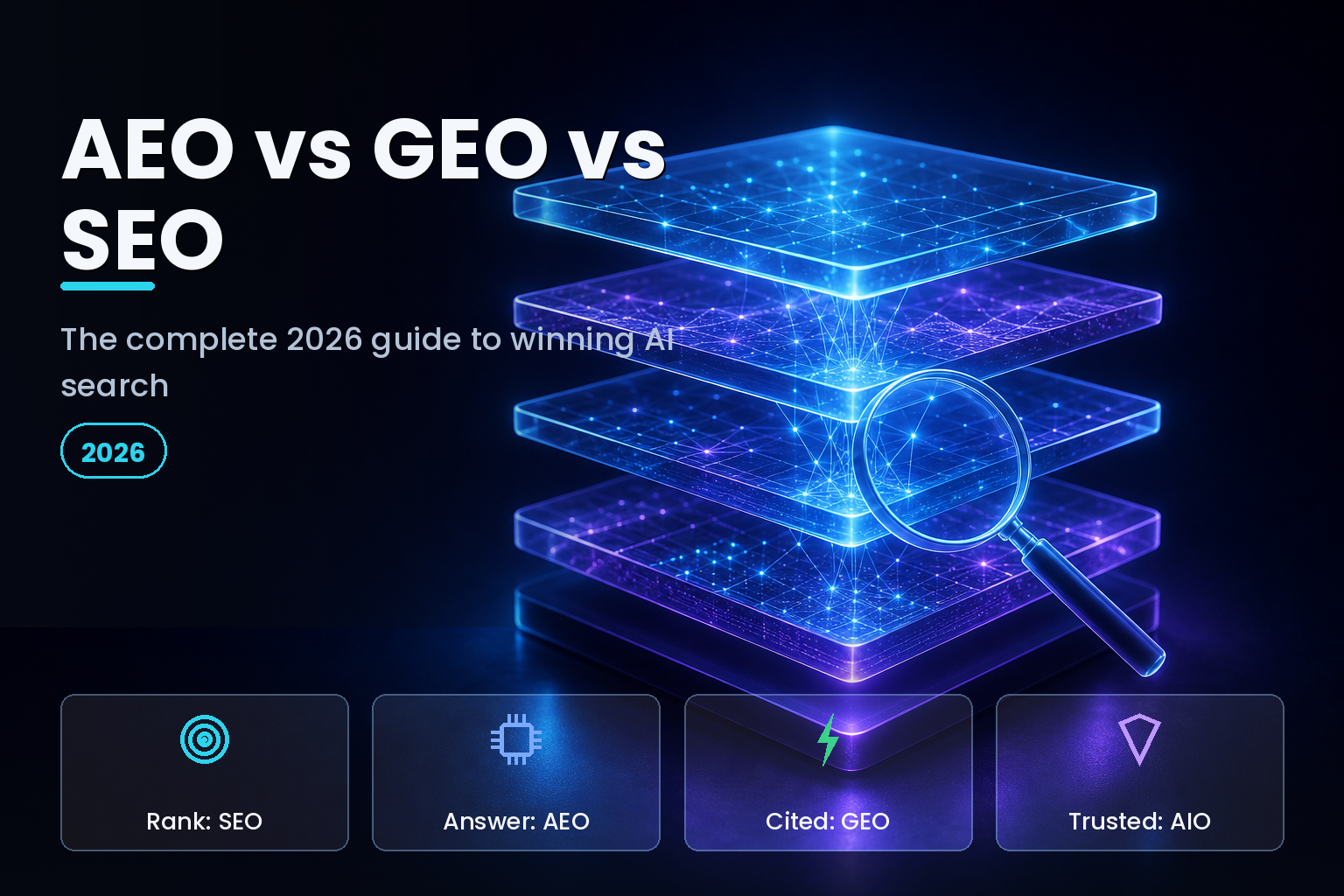
Same direction, different aim. SEO gets you found. AEO gets you read. GEO gets you cited. AIO gets you trusted.
Side by side: what differs, what stays the same
| Dimension | SEO | AEO | GEO | AIO |
|---|---|---|---|---|
| Goal | Rank on results pages | Be the chosen answer | Get cited by AI engines | Be recommended by AI |
| Main surfaces | Google, Bing | AI Overviews, snippets, voice | ChatGPT, Perplexity, Claude, Gemini | All of the above |
| Primary unit | Page | Passage (about 134 to 167 words) | Source citation | Brand entity |
| Key signals | Backlinks, content, technical SEO | Direct answers, schema, clarity | Statistics, third-party citations, entity strength | Wikipedia and Wikidata, brand mentions |
| Measurement | Rankings, organic clicks | Snippet share, AI Overview inclusion | Citation share in AI answers | Knowledge-graph completeness |
| Conversion intent | Mixed | Higher | High | Very high |
The same content can serve all four. A well-written pillar with a clean FAQ, a stats table, accurate schema and a named author can rank on Google, get pulled into an AI Overview, be cited by Perplexity, and reinforce your brand inside ChatGPT. That is the whole game in one sentence.
How AI engines actually pick what to cite
Here is where most articles wave their hands. Be specific instead.
The Princeton GEO paper tested nine optimisation methods across thousands of queries and found that adding statistics increased AI citation visibility by up to 41%. Adding direct quotations and credible third-party citations produced large gains too. Stylistic tweaks alone produced almost nothing. An analysis by Wellows of more than 15,000 AI Overview citations found semantic completeness was the single biggest predictor: content scoring high on completeness was several times more likely to be cited, and the engines favour self-contained passages of roughly 134 to 167 words that fully answer the query.
Two findings surprise SEO veterans. First, a large share of AI Overview citations now come from pages that rank below position five on Google, so clarity, structure and depth beat raw domain authority more often than they did two years ago. Second, citations are unstable. Recent GEO research finds that 40% to 60% of cited sources change month to month across Google AI Mode and ChatGPT, and pages that are not refreshed regularly fall off a three-month citation cliff. Freshness is not a nice-to-have. It is a ranking input.
If you take one practical thing from this section, take this: self-contained, statistic-rich passages of around 134 words, with named sources, are the unit AI engines reward.
What changed in Google's 2026 guidance
Google's 2026 updates pushed the Experience leg of E-E-A-T harder than any previous signal. Content that shows real, hands-on experience now outperforms content that is merely accurate. First-person observation, original screenshots, data you collected yourself, and named authors with verifiable credentials all carry more weight than a year ago.
Three specifics matter. Google officially accepts AI-assisted content as long as it is substantially edited by a human expert with original perspective; the penalty is on low-effort generic text, not on AI as a tool. Google has retired FAQ rich results from standard search, yet FAQ schema is more useful than ever, because AI engines crawl, extract and cite FAQ structured data heavily even when Google no longer shows the rich result. And schema accuracy is now actively checked: AI engines compare your structured data against the visible page, and mismatches get ignored or penalised. Nesting FAQPage schema inside Article schema produces a compound signal that improves extraction confidence.
The AEO playbook: snippets, voice, AI Overviews
AEO pays back fastest. Write an answer-first opening for every section, because AI engines extract the first one or two sentences to test whether the section answers the query. If your opening is throat-clearing, the engine moves on.
Format answers as short, self-contained units: about 40 to 60 words for the direct answer, then expand underneath. Lists, tables and short paragraphs get picked over prose blocks. A practical checklist we use: put the question in the H2 or H3 the way people search it; give a 40 to 60 word answer in the first two sentences; mirror that answer in schema with nothing fabricated in the JSON-LD; add a supporting table, list or statistic within 200 words; and add one internal link to a deeper page. For voice assistants, write at a seventh-grade reading level and answer in complete sentences, because a line that cannot stand on its own when read aloud will not get used.
The GEO playbook: ChatGPT, Claude, Perplexity, Gemini
GEO is newer and noisier, and most of what is published about it is opinion. The peer-reviewed work points to a short list of moves that actually produce gains.
Add statistics to your prose, specific numbers with sources, in the body text rather than footnotes; the Princeton team measured a 41% lift from this alone. Cite credible third parties, government data, academic studies and named industry reports, because self-citation to your own product pages does almost nothing. Quote named experts with their title and organisation, since attributed quotes outperform paraphrase. Build entity strength by being mentioned, by name, on independent sites your audience trusts, because engines build a "this brand is associated with these topics" map from mentions across the web, not from your own site.
Match the platform. ChatGPT leans on Wikipedia, so a missing entry your competitors have is a real disadvantage there. Perplexity leans on Reddit, so a genuinely useful thread from a real team member can out-cite another blog post, as long as you contribute honestly and never spam, because communities ban brands fast. And refresh quarterly, because the three-month citation cliff is real. A thirty-minute review that updates one statistic, adds one example and tweaks the FAQ is usually enough to keep the citation.
The AIO playbook: brand, entity, knowledge graph
AIO is the slowest of the four and compounds the most. Claim and clean your knowledge-graph entry: check that the description, founders, founding date, headquarters and services are correct, and fix your Wikidata entry if you have one. Earn a Wikipedia entry the right way by securing independent, third-party coverage first; do not write your own, because self-promotional drafts get rejected and damage your standing with editors.
Standardise how you describe the company everywhere: same name, same one-line description, same founding year, same headquarters. Inconsistent details blur your entity signal. Add full Organization, Person and Service schema across the site, connect founders and services to the organisation, and use sameAs to link your verified profiles. Then become quotable: publish original research, original data and named frameworks, because a named idea gets attached to the brand that named it.
The technical foundation nobody can skip
Whatever acronym you favour, the technical layer is the same: a crawlable site, server-side rendering or proper hydration, fast Core Web Vitals, a clean robots.txt, an XML sitemap, HTTPS, mobile-first layout, and internal links with descriptive anchors. None of it is new and all of it still matters.
A few additions for 2026. Decide which AI crawlers you allow and say so explicitly in robots.txt; the major ones are GPTBot from OpenAI, ClaudeBot from Anthropic, PerplexityBot, Google-Extended, and CCBot from Common Crawl. Block what you do not want trained on, allow what you want cited. Consider an llms.txt file, a Markdown list of your key resources proposed by Jeremy Howard of Answer.AI in September 2024; adoption is still patchy and no major provider has confirmed reading it in production, but it is cheap, harmless, and positions you well if support spreads. Use JSON-LD rather than Microdata for schema, since all major AI engines extract from it and an analysis by Frase found pages with proper schema are about 2.5 times more likely to be selected for AI citations. Implement only the schema types you need: usually Article, FAQPage, Organization, Person and BreadcrumbList.
Measuring when clicks are no longer the only signal
If you track only organic clicks, you are blind to most of what is happening. Track featured-snippet share of voice for target queries, AI Overview inclusion rate sampled against a fixed query basket, direct citation counts in ChatGPT, Perplexity, Claude and Gemini for branded and unbranded prompts, brand mentions across independent media as a proxy for entity strength, and conversion rate from AI-referred traffic kept separate from organic. The hardest thing to measure is how an AI engine describes your brand when asked. Run a fixed prompt set against the major engines every month and store the answers. It is imperfect, and it is the best signal available.
The common mistakes we see, especially in Indian SME content
The same five patterns show up over and over. Writing for Google only, when a page that ranks first there is not automatically cited by ChatGPT; plan for both from the brief. Stuffing keywords into headings, when AI Overviews reward clarity, so "how small businesses in India choose a CRM" gets cited where "best CRM software India 2026" gets demoted. Ignoring entity work, when most Indian SMEs have no Wikidata entry and no canonical one-line description, leaving them invisible to AI as entities. Treating the FAQ as filler and removing it after Google dropped the rich result, when AI engines now use FAQ data more than ever. And publishing once, then ignoring it, when a quarterly refresh is the cheapest high-impact tactic available.
Putting it together: the integrated 2026 playbook
One sequence to follow. Run a technical SEO audit and fix crawlability, indexability and Core Web Vitals. Decide which AI crawlers you allow, update robots.txt, and publish an llms.txt. Audit your top pages for snippable structure and add 40 to 60 word direct answers under each H2 and H3. Add nested FAQPage and Article schema where it matches visible content. Add at least three credible third-party statistics with citations to every pillar page. Strengthen your entity signal by cleaning your knowledge panel and Wikidata and earning independent press. Build a citation-tracking dashboard for AI Overview inclusion and ChatGPT and Perplexity citations. Then refresh every pillar quarterly with one new statistic, one new example and one FAQ update. It is not glamorous. It works. The same discipline underpins any serious enterprise generative AI strategy, and the governance side is covered in our guide to AI agent governance.
FAQ
How eCorpIT can help
eCorpIT is a CMMI Level 5 technology organisation in Gurugram whose senior teams run combined SEO, AEO, GEO and AIO programmes for clients in India, the UK and the US. We rebuild snippet structure on your top pages, add accurate nested FAQPage and Article schema, strengthen your entity signal, and set up citation tracking across AI engines, with a quarterly refresh built in. You can read more about eCorpIT and its director Manu Shukla. To scope an AI-search audit, contact our team.
References
_Last updated: 21 June 2026._