On this page · 10 sections
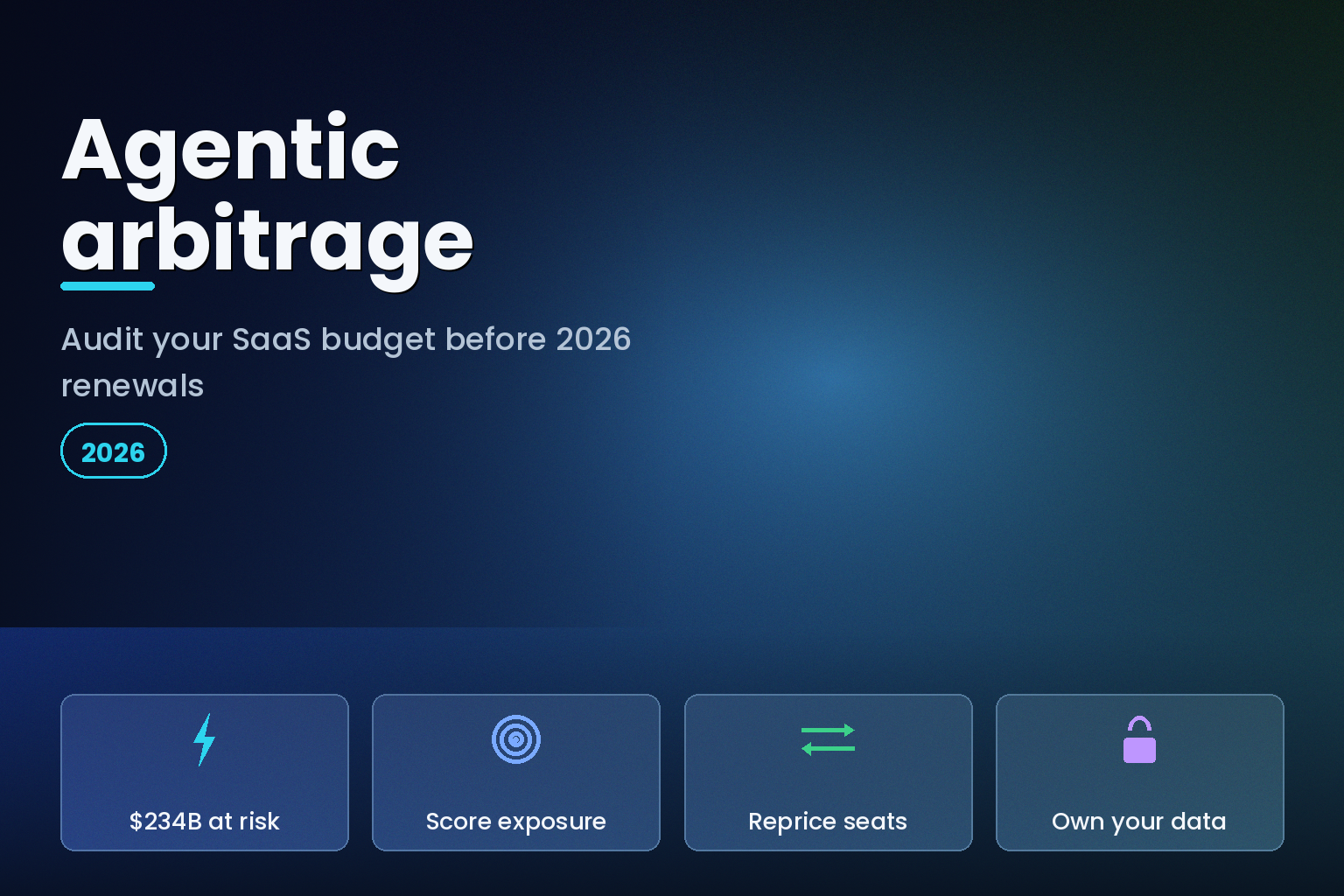
Summary. On 1 July 2026 Gartner put a number on a shift that CIOs had been feeling for a year: up to $234 billion of enterprise application software spend is exposed to "agentic arbitrage" between now and 2030, about 20% of enterprise application SaaS spend. The pressure is already priced in by vendors. A Cruxy survey of 300 SaaS CEOs in April 2026 found 97% plan to retire seat-based pricing within two years, and Kyle Poyar's 2026 State of B2B Monetization report shows hybrid pricing jumping from 25% to 37% of the market in twelve months. Salesforce now sells Agentforce at $2 per conversation or $0.10 per action. The renewals you sign in 2026 set your cost baseline for the next five years. This guide gives you a scoring framework to find the exposed line items in your stack and the contract terms to fix before you sign.
What "agentic arbitrage" actually means
Agentic arbitrage is the gap that opens when an AI agent does work across several systems, so a person no longer opens each application to do it by hand. The seat you paid for goes quiet. The work still happens, but the vendor's pricing was built on human logins, and those are falling.
Gartner defined the mechanism plainly. "Agentic AI changes the economics of software. Agentic systems deliver outcomes directly, bypassing traditional user experience (UX)-heavy applications and making the software invisible. This breaks the link between user growth and revenue growth for many enterprise software vendors," said George Brocklehurst, Managing Vice President at Gartner, in the 1 July 2026 press release.
The $234 billion figure is not a prediction that software disappears. It is the slice of application spend where the value is delivered through an interface a human sits in front of, and where an agent can now reach the same data and complete the same task. Gartner expects that by 2030 at least 40% of enterprise SaaS spend will move to usage, agent, or outcome-based models, and seat-based revenue share will fall from 21% to 15%, according to CIO Dive's reporting on the same research.
For a buyer this is good news, if you act on it. The vendor's problem, a broken link between logins and revenue, is your opening to renegotiate. The risk is signing a three-year seat renewal in 2026 at 2024 assumptions and locking your own budget to a model the vendor already expects to abandon.
Why per-seat pricing is breaking
The vendor side of this is not quiet resignation. It is an active repricing. Cruxy's April 2026 survey of 300 SaaS CEOs, reported by The Drum and CFOtech, found that 97% plan to retire seat-based pricing within two years even though 94% said seat pricing still matches their product's value today. In the same survey 85% called AI a threat to their business model and 82% said customers had already asked for AI-related price cuts.
The market data confirms the move is underway, not theoretical. Kyle Poyar's 2026 State of B2B Monetization report, based on 230 software and AI companies, found roughly three in four vendors changed pricing in the past year, and hybrid pricing rose from 25% to 37% of the market in twelve months. Poyar's read is that hybrid pricing has already won the AI era: a predictable base subscription with variable consumption on top, the model GitHub and Zapier already use.
Salesforce is the clearest worked example. Agentforce is sold at $2 per conversation, or through Flex Credits at $0.10 per action, where each action consumes 20 credits and a pack of 100,000 credits costs $500, per Salesforce's pricing page. A voice action costs 30 credits, and Salesforce Foundations includes 200,000 Flex Credits at no cost on Enterprise Edition and above. None of that is priced per seat. Here is how the models compare for a buyer.
| Pricing model | How you pay | Best when | Agentic arbitrage exposure |
|---|---|---|---|
| Per-seat | Fixed fee per named user per month | Human-driven work, stable headcount | High: agents cut logins, seats sit idle |
| Usage / consumption | Per API call, action, or unit processed | Work volume is variable and measurable | Low: cost tracks the work, not the seat |
| Outcome-based | Per resolved case or conversation | The outcome is countable and attributable | Low, but audit how an outcome is defined |
| Per-action credits | Prepaid credit pool drawn per action | Mixed automated and human workloads | Low: aligns with agent execution |
| Hybrid | Base subscription plus metered overage | Most 2026 enterprise deals | Medium: base can still hide dead seats |
The table matters at renewal. If your vendor is moving to hybrid, a large fixed base with a small usage allowance can carry the same idle-seat problem inside a new label. Read the base, not just the meter.
Which of your SaaS categories are most exposed
Not every tool is equally at risk. Exposure tracks one question: can an agent reach the underlying data and complete the task without a human in the interface? Categories built on data entry, logging, and simple retrieval score highest. Systems that run precise, repeatable transactions where consistency is mandatory score lower, because current models are not reliable enough to own a financial ledger or a clinical record end to end. Built In's analysis of the disruption maps the same fault line.
| SaaS category | Why exposed | Exposure | First CIO action |
|---|---|---|---|
| CRM data entry and logging | Agents capture and update records automatically | High | Move to usage terms; keep system of record |
| Project and task tracking | Status updates and tickets are agent-generated | High | Cap seat count to true editors |
| BI and dashboards | Agents query data and answer in natural language | High | Renegotiate viewer seats; keep governed data |
| Marketing automation | Campaign steps run as agent workflows | Medium | Shift to outcome or send-volume pricing |
| ITSM and service desk | Routine tickets auto-resolve; complex stay human | Medium | Split licensed agents from human approvers |
| Financial and clinical systems of record | Transactions need audited, deterministic execution | Low | Keep; treat as protected core |
The pattern to notice: the systems most exposed on price are often the ones you least want to remove, because they hold the governed data your agents depend on. The play is rarely to rip the tool out. It is to stop paying for hundreds of viewer or occasional-user seats that an agent has quietly replaced, while keeping the data platform underneath.
The CIO audit: a scoring framework
An audit needs a repeatable score, not a hunch. Rate every application in your top 20 by spend on four vectors, one to three points each, then total. A higher score means higher exposure and a more urgent renewal.
The four vectors are login decay, task automatability, data reachability, and contract lock-in. Login decay asks whether monthly active users are falling against seats paid. Task automatability asks whether the core job is data entry and retrieval or genuine judgement. Data reachability asks whether an agent can already get the underlying data through an API. Contract lock-in asks how long until the next renewal window and whether the terms restrict agent access.
| Vector | 1 point (low) | 2 points | 3 points (high) |
|---|---|---|---|
| Login decay | MAU steady vs seats | MAU down 10 to 30% | MAU down over 30% |
| Task automatability | Judgement-heavy work | Mixed | Data entry and retrieval |
| Data reachability | No usable API | Partial API | Full API access today |
| Contract lock-in | Locked over 24 months | 12 to 24 months | Renews within 12 months |
A tool scoring 9 or above is a priority: the work is automatable, the seats are decaying, the data is reachable, and you can act at the next renewal. Score your stack before your next three renewal cycles, because 2026 is the window when repricing is on the table and vendors expect the conversation. Pair the score with AI agent unit economics and cost per task so you compare the agent's real running cost against the seats you would retire.
Renewal tactics for 2026
Once you know which tools are exposed, the use is in the contract, not the sticker price. Gartner's guidance to CIOs, reported by CIO.com, is direct: audit existing contracts for clauses that restrict autonomous API or agent access, make API completeness a procurement criterion, negotiate agent-access and data-portability terms before renewals, and clarify who owns the operational knowledge that agents generate.
Four terms deserve ink in every 2026 renewal. First, agent access: the right for your own or third-party agents to call the vendor's API without a per-seat license for the agent. Second, data portability: the right to export your data and its structure so an agent, or a replacement tool, can use it. Third, knowledge ownership: written confirmation that the workflows, prompts, and operational data your agents produce belong to you. Fourth, transition pricing: a path from seats to usage written in now, so you are not renegotiating from zero in 2028.
A useful framing in the room, from Baytech Consulting's renewal guidance, is to name the trajectory out loud: the analyst consensus says seat-based pricing is declining, so you want a contract that reflects that path with transition terms written today. Vendors already expect this, per SoftwareSeni's account of how renewals are changing. Avoid the multi-year seat lock, because it hands the vendor the one thing the arbitrage takes away from them: a guaranteed seat count.
Whether you keep a tool, reprice it, or replace it with an agent is a build-versus-buy call. The economics differ by category, and comparing them properly is its own exercise, covered in HubSpot Agent Hub versus custom RevOps agents and, for the agent platforms themselves, Agentforce versus Copilot Studio pricing. The vendor-side view of why these prices are moving sits in AI vendor revenue and pricing risk.
India-specific considerations
For Indian enterprises and the global capability centres based here, two points sharpen the audit. Data portability is not only commercial use, it is a compliance lever. Under the Digital Personal Data Protection (DPDP) Act 2023, the ability to move personal data cleanly between systems supports your obligations when you change or consolidate vendors, so write portability into the same renewal where you negotiate agent access.
Second, currency and procurement scale. Many mid-sized Indian enterprises run dozens of SaaS products, much of the bill charged per seat in dollars and paid from a rupee budget. A seat audit that trims decayed viewer and occasional-user licenses often returns cash faster than any single migration project, and it protects that budget against a weakening seat model. GCCs consolidating tooling across a parent group are well placed to run this audit once and apply the scoring across every entity, which is the kind of enterprise agent work covered in enterprise AI agents in production.
What to do this quarter
The action is not dramatic. Pull your top 20 applications by spend. Score each on the four vectors. Flag every renewal landing in the next 12 months. For anything scoring 9 or above, open the agent-access, data-portability, knowledge-ownership, and transition-pricing conversation before you sign. The repricing is happening on the vendor's terms already. An audit puts it on yours.
FAQ
How eCorpIT can help
eCorpIT is a senior-led engineering organisation in Gurugram, founded in 2021 and certified for CMMI Level 5, MSME, and ISO 27001:2022. We run SaaS exposure audits, score your stack against agentic arbitrage, and build the custom agents that let you retire decayed seats while keeping your governed systems of record intact. We design integrations aligned with DPDP Act requirements and work with AWS, Microsoft, and Google platforms. To audit your software budget before your next renewal, contact our team.
References
- Gartner, Gartner Says $234 Billion in Enterprise Application Software Spend Is at Risk from Agentic AI, 1 July 2026.
- CIO Dive, Agentic AI to disrupt $234B in SaaS spending: Gartner, 2026.
- Salesforce, Agentforce pricing, accessed August 2026.
- Salesforce, Salesforce Introduces New Flexible Agentforce Pricing, 15 May 2025.
- The Drum, Cruxy's Carrie Osman says seat-based pricing is on borrowed time, 2026.
- CFOtech, SaaS chiefs expect pricing shift as AI threatens sales, 2026.
- Kyle Poyar, Growth Unhinged, The 2026 State of B2B and AI Monetization, 2026.
- Kyle Poyar, Revenue Creator, Why hybrid pricing already won the AI era, 2026.
- Baytech Consulting, SaaS pricing shift: how to negotiate AI-driven renewals, 2026.
- SoftwareSeni, SaaS pricing is shifting from per-seat to usage and outcome, 2026.
- Built In, AI agents are disrupting SaaS: what it means for enterprise, 2026.
Last updated: 2 August 2026.