On this page · 10 sections
- The short answer: rankings and clicks have split apart
- Reason 1: the AI Overview answers the query above your link
- Reason 2: the rest of the results page buries your link
- Reason 3: your audience is asking AI instead of searching
- The GEO fixes that actually win
- A practical order of work
- India-specific considerations
- FAQ
- How eCorpIT can help
- References
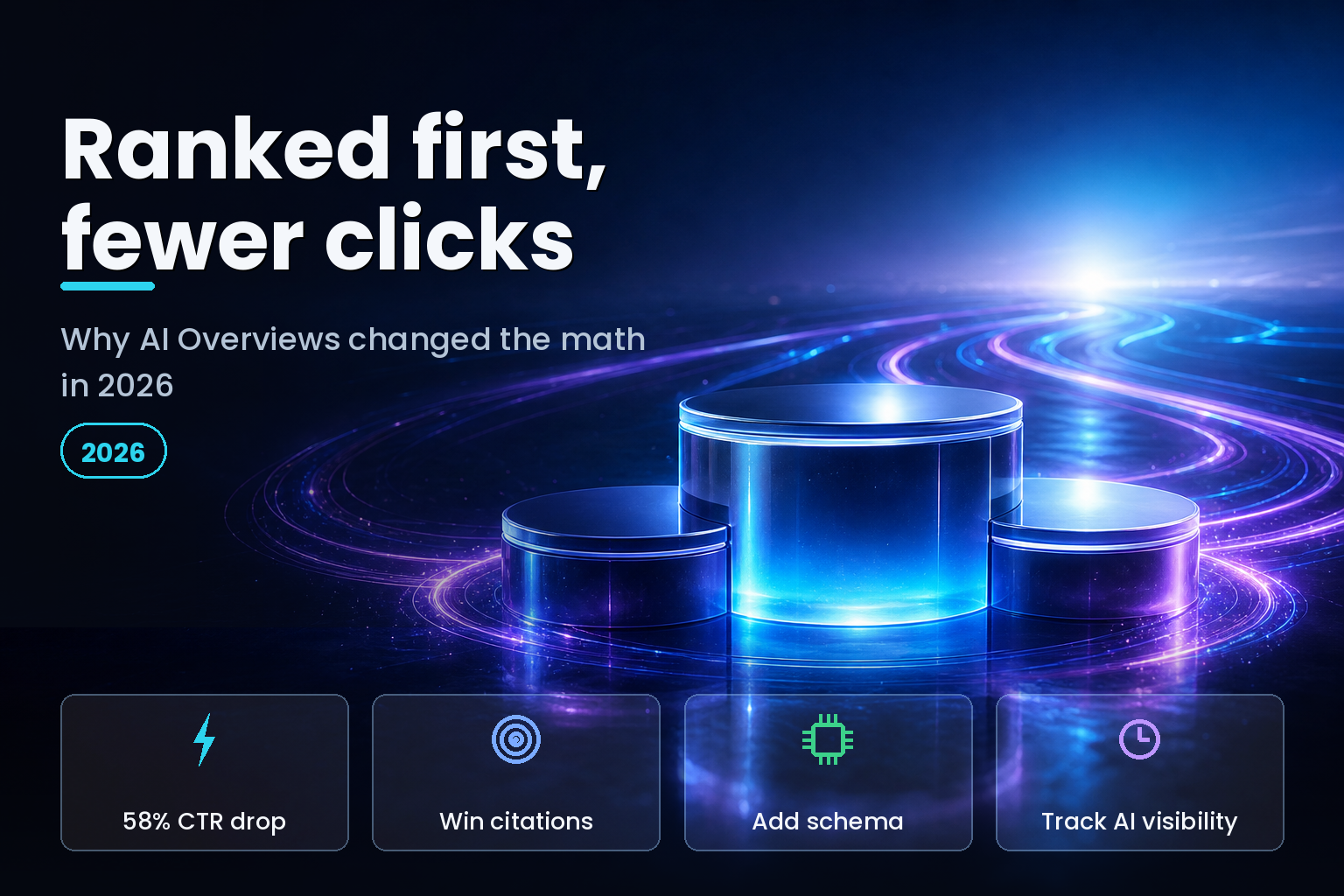
Summary. A number one organic ranking on Google used to be the prize. In 2026 it wins far fewer clicks than it did. Ahrefs, studying 300,000 keywords with December 2025 data, found that when an AI Overview appears the top-ranking page loses about 58% of its click-through rate; average position one CTR on those queries fell from 0.073 in December 2023 to 0.016 in December 2025. That is up from a 34.5% loss Ahrefs measured in April 2025. Pew Research Center saw the same pattern from the user side: people clicked a normal result in 8% of searches that showed an AI summary, against 15% without one, and clicked a link inside the summary just 1% of the time. Google says AI Overviews now reach more than 2.5 billion monthly users and AI Mode more than 1 billion, and the CMA valued UK search advertising alone at £10 to £20 billion in 2024. This is not a ranking problem, it is a visibility problem. Below are the three reasons your top spot leaks clicks, and the GEO fixes (generative engine optimisation) that win the visibility back.
The short answer: rankings and clicks have split apart
For fifteen years SEO ran on one assumption: rank higher, get more clicks. That link is breaking. Ryan Law, Director of Content Marketing at Ahrefs, put the December 2025 finding bluntly: "For every 100 clicks you could historically earn for a top-ranking page, Google now keeps 58." The page still ranks. The click goes to Google's own answer. So the work shifts from winning the ranking to winning the citation inside the answer, plus the placements around it. Here is why, reason by reason.
Reason 1: the AI Overview answers the query above your link
When an AI Overview appears, it sits at the very top of the page and often resolves the question before the reader reaches any blue link. Ahrefs quantified the cost by position, using aggregated Google Search Console data across 300,000 keywords.
| Organic position | CTR change when an AI Overview is present | What it means |
|---|---|---|
| 1 | -58.0% | The top spot loses most of its clicks |
| 2 | -50.8% | Second place falls almost as far |
| 3 | -46.4% | Third place loses nearly half |
| 5 | -32.6% | Mid-page results are hit less hard |
| 10 | -19.4% | The lowest positions had little left to lose |
Seer Interactive reached a similar range, reporting in its September 2025 analysis that organic CTR on AI Overview queries fell 61%, from 1.76% to 0.61%. Ahrefs also found that about 9% of AI Overviews appear below position one, so even pages that are not first can sit under an answer box.
Reason 2: the rest of the results page buries your link
Even with no AI Overview, the modern results page pushes organic listings down. Ahrefs frames AI Overviews as the newest in a long line of features that resolve a query without a click: the Local Pack, Top Stories, Featured Snippets, People Also Ask, shopping units, and video carousels all take vertical space above or around the ten blue links. A number one position can now sit halfway down a phone screen. This is why click-through rates fell for years before AI Overviews existed, and why zero-click search was already the default.
| Signal | With an AI Overview or summary | Without |
|---|---|---|
| Top organic CTR (Ahrefs, Dec 2025) | 58% lower | Baseline |
| Clicked any normal result (Pew, Mar 2025) | 8% of searches | 15% of searches |
| Clicked a link inside the summary (Pew) | 1% of searches | Not applicable |
Both views point the same way. The click that a top ranking used to earn is now split between Google's answer, the SERP features, and, increasingly, a different surface altogether.
Reason 3: your audience is asking AI instead of searching
The third reason is off Google's results page entirely. A growing share of the questions that used to become searches now go straight to AI assistants. Google's own AI Mode passed 1 billion monthly users and AI Overviews reach more than 2.5 billion, and people ask these tools longer, more specific questions than they typed into a search box. ChatGPT, Perplexity, and Gemini answer the same way. For a content-led acquisition team, that means a rising portion of demand never reaches your rank tracker. You are either named in the answer or you are invisible.
The GEO fixes that actually win
The counter to all three reasons is one shift: stop optimising only to rank, and start optimising to be the source the answer quotes. That is generative engine optimisation. Google's guidance for AI Search points the same way, favouring unique, non-commodity content that is well organised, with high-quality images and clear structure. Five fixes matter most.
| Fix | What to do | Why it works |
|---|---|---|
| Be the source AI quotes | Publish original data, benchmarks, and named expert quotes | AI answers cite specific, sourced facts, not generic summaries |
| Structure for extraction | Add FAQ and Article schema, 40-60 word answers, and comparison tables | Machines pull clean, labelled blocks into answers and snippets |
| Build entity authority | Earn third-party mentions on Reddit, YouTube, and industry sites; keep Organization schema consistent | AI weighs what others say about you, not only your own pages |
| Answer the whole question | Cover the who, what, why, and how of a topic on one page | Comprehensive pages are likelier to be selected as the citation |
| Keep it fresh | Refresh important pages on a quarterly cycle | Stale pages lose citations as answers regenerate |
Measure the right thing while you do it. Track AI visibility, not only rank. Google Search Console's new AI-impression report, part of the same June 2026 update that added the AI opt-out toggle, shows which pages appear in AI responses and where. Rank trackers such as Ahrefs flag which of your keywords trigger an AI Overview. Classic rank tracking alone will now miss most of the story. For the wider playbook, our guide to how AEO, GEO and SEO differ and our 2026 SEO guide go deeper.
A practical order of work
Start by finding the damage. Pull your top organic pages, mark which of their queries now trigger an AI Overview, and sort by lost clicks. Take the worst offenders first. On each, add one thing an AI answer cannot copy from a competitor: a fresh statistic, an original benchmark, a named quote, a clear definition in the opening lines. Then make the page machine-readable with schema and direct answers, and get the brand cited somewhere off-site that AI models read. Re-check the AI-impression report a month later. This is slow, compounding work, not a switch, and it is the work that keeps a top ranking earning visits.
India-specific considerations
The click compression is not a US-only story. Ahrefs notes AI Overviews have rolled out to more countries and more languages since 2025, and Indian teams competing for English or Hindi informational queries face the same top-spot erosion. Google's AI opt-out toggle is a UK-only test as of July 2026, so an Indian site cannot even choose to leave AI answers yet. That makes GEO the only real lever here. The good news is that its ingredients travel well: original data, clean schema, and third-party mentions work across borders and across engines, whether the answer is served by Google AI Overviews, ChatGPT, or Perplexity. For Indian brands billing on content-led pipeline, the cost of waiting is measured in the queries where a rival gets cited and you do not.
FAQ
How eCorpIT can help
eCorpIT helps content-led teams win the citation, not just the ranking. Our senior engineering teams audit where AI Overviews already answer your queries, rebuild pages with the schema, original data, and structure that AI engines quote, and track AI visibility next to classic rankings. To turn a slipping top spot into durable AI-search visibility, talk to eCorpIT.
References
Last updated: July 7, 2026.