On this page · 10 sections
Summary. No, llms.txt does not help your Google rankings. Google confirmed on the record that Search does not use the file, and its AI optimization guide, updated on 15 June 2026, states plainly that you do not need special machine-readable files to appear in Google Search or its AI features. Gary Illyes said the same at Search Central Live in July 2025. So if "SEO" means Google, the answer is settled. The nuance is everything else: Perplexity and Anthropic's Claude both retrieve llms.txt today, coding agents like Cursor and GitHub Copilot depend on it, and companies including Stripe, Cloudflare, and Anthropic ship one. Yet adoption is still niche, at 10.13% of 300,000 domains in one 2026 study. The file was proposed by Jeremy Howard of Answer.AI on 3 September 2024, and it costs almost nothing to publish. The real question is not whether it helps Google, but whether your audience uses the tools that read it, a decision worth weighing against Indian GEO retainers of 75,000 to 350,000 rupees a month ($1,500 to $25,000 globally). This guide gives the plain answer and the situational one.
If you have been sold an "AI SEO" package that leads with an llms.txt file, read the vendor answer first, then read who actually reads the file. The two are not the same thing, and the gap is where money gets wasted.
What is llms.txt?
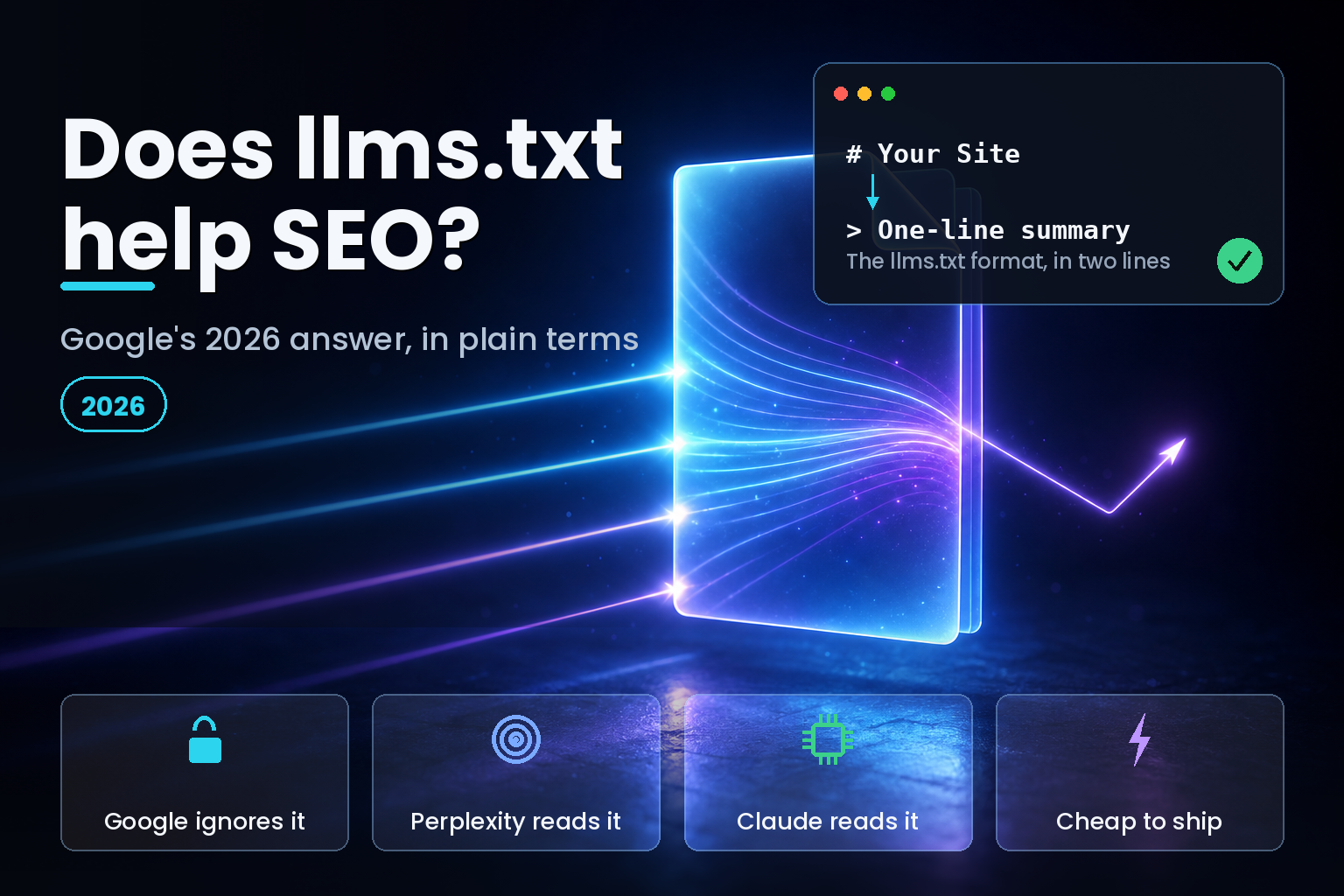
llms.txt is a plain-text Markdown file placed at the root of a site, at /llms.txt, that lists a site's key pages with short descriptions so a large language model can find and use the important content without parsing full HTML. Jeremy Howard, co-founder of Answer.AI and previously co-founder of fast.ai, proposed it on 3 September 2024, and the specification is maintained at llmstxt.org.
The problem it targets is real. LLM context windows are too small to hold most complete websites, and converting HTML pages full of navigation, ads, and JavaScript into clean text is slow and error-prone. The file addresses that with a fixed structure: an H1 with the site name, a blockquote summary, and sectioned lists of links with one-line descriptions. Howard's proposal also defined an optional companion, /llms-full.txt, which holds the full content of the site in a single Markdown document for tools that want everything in one fetch.
It is worth being clear about what llms.txt is not. It is not a ranking signal, not a schema markup format, and not a replacement for a sitemap or robots.txt. A sitemap tells search crawlers which URLs exist. robots.txt tells crawlers what they may access. llms.txt is a curated reading list for language models, and reading it is entirely voluntary on the part of each AI system.
| File | Purpose | Who reads it |
|---|---|---|
| robots.txt | States which paths crawlers may access | Search and AI crawlers that choose to obey |
| sitemap.xml | Lists all URLs for discovery and indexing | Google, Bing, and other search engines |
| llms.txt | Curated Markdown reading list for LLMs | Some AI assistants and coding agents, voluntarily |
| llms-full.txt | Full site content in one Markdown file | AI tools that want the whole corpus in one fetch |
Does Google use llms.txt?
No, and Google has been unusually direct about it. Gary Illyes, an analyst on the Google Search team, said at Search Central Live in July 2025 that Google does not support llms.txt and is not planning to. John Mueller, a Search Advocate at Google, called the idea speculative and compared it to the old meta keywords tag, the discredited signal that spammers stuffed and Google eventually ignored. Mueller also noted that llms.txt appeared on some Google properties only because an internal content system added support for it and some teams had not removed it, not because Search consumes it.
The clearest statement is in Google's own documentation. Its AI optimization guidance, updated on 15 June 2026, reads: "You don't need to create new machine readable files, AI text files, markup, or Markdown to appear in Google Search (including its generative AI capabilities), as Google Search itself doesn't use them." That covers AI Overviews and AI Mode, not just the classic ten blue links. Google's position is that the same fundamentals that earn ordinary rankings, original useful content, crawlable pages, and clear structure, are what feed its AI surfaces too.
Mueller's most practical point is easy to miss. The most basic form of agent optimization, he suggested, is making sure AI agents are not blocked from reaching your site at all. For many publishers, an accidental block in robots.txt or a bot-management rule does far more damage than the absence of an llms.txt file ever could. If you want AI visibility, check what you are blocking before you add new files. Our guide to controlling AI Overviews in Search Console covers the access side of that in detail.
Then which AI systems actually use it?
This is where the honest answer diverges from the Google answer. Several AI systems do read llms.txt, and two have confirmed it publicly.
Perplexity retrieves llms.txt and uses it to help prioritize which pages to pull into an answer. Anthropic's Claude respects llms.txt directives in its retrieval workflows across Claude.ai and Claude Desktop. OpenAI has not confirmed support for ChatGPT, though teams that publish the file report correlated shifts in how ChatGPT's search feature cites them, which is suggestive rather than proof. The strongest, least ambiguous use is in developer tooling: Cursor, Windsurf, Claude Code, GitHub Copilot, Cline, and Aider all look for /llms.txt and /llms-full.txt when pointed at a documentation site, and a well-curated file is the difference between a coding agent generating a working API integration and one hallucinating an endpoint that does not exist.
| AI system | Uses llms.txt? | How it uses it |
|---|---|---|
| Google Search and AI Overviews | No, confirmed | Does not consume the file at all |
| Perplexity | Yes, confirmed | Retrieves it to prioritize page selection |
| Anthropic Claude | Yes, confirmed | Respects directives in retrieval workflows |
| OpenAI ChatGPT | Unconfirmed | Not officially supported; some observed correlation |
| Coding agents (Cursor, Copilot, others) | Yes | Read it to pull accurate docs and API references |
That table is the real answer to "does it help." It helps precisely where your audience uses Perplexity, Claude, or AI coding tools, and it does nothing where they use Google.
So does llms.txt help SEO or not?
The word "SEO" is doing too much work in that question. Split it.
For traditional search ranking on Google, and for Google's AI Overviews and AI Mode, llms.txt does nothing. It is not a signal, positive or negative. Publishing one will not raise or lower your position, and Google says so directly. If your visibility goal is Google, spend the effort on content quality, crawlability, and structured data instead. Our complete guide to AEO, GEO, and SEO lays out where each of those actually moves the needle.
For visibility inside AI assistants and developer tools, llms.txt can help, situationally. If a meaningful share of your audience asks Perplexity or Claude about your product, or builds against your API with an AI coding assistant, a clean llms.txt gives those systems a curated, accurate path to your best content. The upside is concentrated in documentation, developer tools, and API products, which is exactly why Stripe, Vercel, Cloudflare, Anthropic, Coinbase, Pinecone, and Cursor ship one, and why adoption is far lower among general content sites.
The cost side makes the decision easy. A basic llms.txt is cheap to generate and maintain, so the downside of shipping one is small even though the Google upside is zero. The mistake to avoid is paying a premium for it as a headline "AI SEO" deliverable, or believing it will influence Google. Treat it as documentation hygiene for AI tools, not as a ranking play.
Who should ship an llms.txt, and who should not
Match the file to your audience, not to the hype cycle. Adoption sat at 10.13% across 300,000 domains in a 2026 study, and that low number is rational: most sites do not have an audience that reads the file.
| Site type | Ship llms.txt? | Why |
|---|---|---|
| Developer tool or API product | Yes | Users build with AI coding agents that read it |
| Technical documentation site | Yes | Improves accuracy of AI answers about your docs |
| SaaS with a technical audience | Worth testing | Some users query Perplexity and Claude about you |
| Content or media site chasing Google | Low priority | Google ignores it; effort is better spent on content |
| Local or small business site | No real need | Audience rarely uses the tools that read it |
For most eCorpIT-style clients, the split is clean. If you sell to developers, ship a curated llms.txt and keep it current. If you sell to consumers and your visibility depends on Google, skip it and invest in the fundamentals that Google actually rewards. Our AI Overview content strategy guide covers those fundamentals for the Google side.
What to do instead for AI search visibility
Because Google folds AI Overviews and AI Mode into ordinary Search, the work that earns AI citations is mostly the work that earns rankings, done well. Publish original, specific, sourced content that an AI engine can quote. Keep pages crawlable and fast, with clear headings and a logical structure. Add valid schema where it fits, such as Article, FAQPage, and Organization markup. Answer real questions directly and early on the page, because that is what both featured snippets and AI answers lift. And make sure nothing in robots.txt or a bot-management layer is quietly blocking the AI crawlers you want to reach.
None of that is llms.txt. All of it is what actually moves visibility across Google, Perplexity, and ChatGPT at once. The ultimate guide to SEO in 2026 walks through the full checklist.
India-specific considerations
For teams buying services in India, llms.txt is where "AI SEO" pitches get tested. GEO and AEO retainers in the Indian market run from 75,000 to 125,000 rupees a month at the lower band, 150,000 to 250,000 in the middle, and up to 350,000 for the top tier with original research and schema work at scale, against $1,500 to $25,000 for comparable global agencies. That pricing sits roughly 1.8 to 3 times traditional SEO, and about 40% to 60% below US agencies for the same scope.
If a vendor's headline deliverable is "we will add an llms.txt file," that is a few minutes of work that Google ignores, and it should never anchor a five- or six-figure retainer. Ask instead what the retainer does for content depth, citation tracking across Perplexity, ChatGPT, and Google, technical crawlability, and schema, because those are what shift AI citation share. Data protection still applies to whatever content you expose: an llms.txt or llms-full.txt should point only to content you are comfortable publishing openly, and it should never surface personal data covered by the Digital Personal Data Protection Act 2023.
FAQ
How eCorpIT can help
eCorpIT is a CMMI Level 5, Gurugram-based digital and engineering organisation that builds AI search visibility on fundamentals, not on files Google ignores. We audit what your site actually exposes to AI crawlers, ship a curated llms.txt when your audience uses tools that read it, and put the real budget into the content, structure, and schema that move citation share across Google, Perplexity, and ChatGPT. If a vendor is selling you llms.txt as an SEO fix, talk to our team for a straight assessment of what will and will not help.
References
_Last updated: 7 July 2026._