On this page · 14 sections
- The three numbers everyone quotes, and why they disagree
- The zero-click backdrop that makes this urgent
- What the Ahrefs 23x number actually measures
- Why AI-search visitors convert better
- The multiplier you should actually budget with
- What this means for your GEO budget
- How to measure the multiplier on your own site
- What earns an AI citation in practice
- A worked budget example
- Common mistakes with the 23x number
- India-specific considerations
- FAQ
- How eCorpIT can help
- References
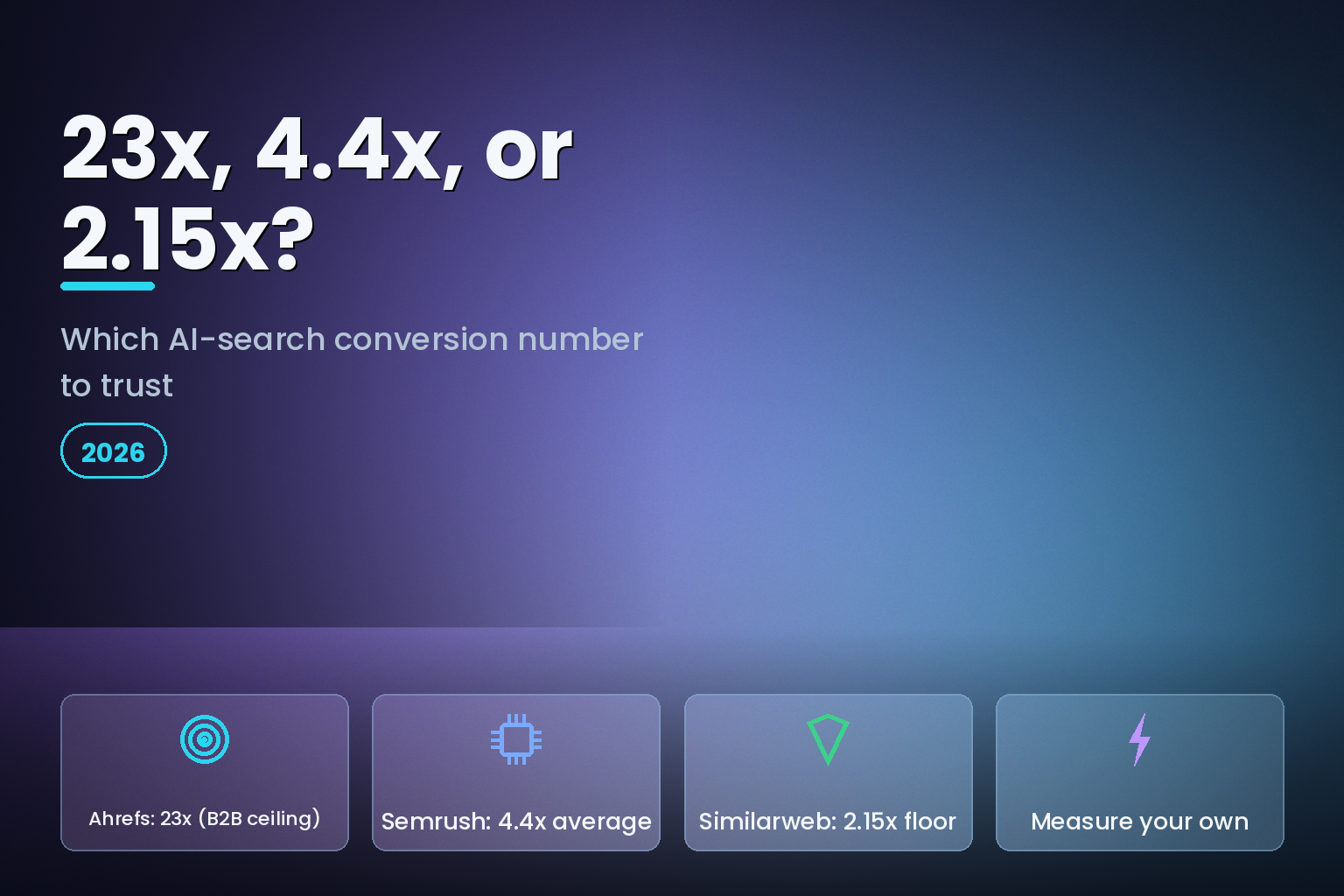
Summary. Three widely-cited studies say visitors who arrive from AI search convert better than traditional organic visitors, and they disagree by an order of magnitude. Ahrefs found that AI referrals were 0.5% of its traffic but drove 12.1% of signups, a 23x higher conversion rate, in a study published on June 16, 2025. Semrush's 2026 data puts the cross-industry advantage at 4.4x. Similarweb's 2026 panel puts it at 2.15x, or 11.4% versus 5.3%. The 10x spread is about method, not magic: Ahrefs measured one B2B SaaS company, Semrush averaged across industries, and Similarweb used a conservative traffic panel. This matters because the multiplier you believe sets your budget. Say your content budget is $20,000 a month; a 23x belief and a 2.15x belief point to very different GEO allocations. AI Overviews now appear on 48% of Google searches, up from 34.5% in December 2025, so the traffic you lose to zero-click and the traffic you gain from AI citations are both growing. This article shows what each number measures and which one to plan with.
The headline "23x" has been quoted in dozens of marketing decks since mid-2025, usually without the sentence that follows it. Used carelessly, it either oversells GEO to a finance team that will later feel misled, or it gets dismissed as hype and the real, defensible case for generative-engine optimisation gets thrown out with it. Both mistakes are avoidable once you know what sits behind each figure.
The three numbers everyone quotes, and why they disagree
The studies are not contradicting each other so much as measuring different things. Here is what each one actually reported.
| Source | Reported conversion advantage | What was measured |
|---|---|---|
| Ahrefs (June 2025) | 23x (0.5% of traffic, 12.1% of signups) | One B2B SaaS company, its own analytics, 30-day window |
| Semrush (2026) | 4.4x | Average across many industries |
| Similarweb (2026) | 2.15x (11.4% versus 5.3%) | Cross-site traffic panel, conservative attribution |
| Visibility Labs | ChatGPT referrals converted 31% higher | Referral-source comparison |
| RankScience | 14.2% versus 2.8% for organic | Site-level conversion comparison |
Read down the right-hand column and the spread stops looking like a mystery. A single high-consideration B2B SaaS product with a long research cycle is exactly the case where AI pre-qualification helps most, so Ahrefs sits at the top of the range and works as a ceiling for that category, not a universal benchmark. A cross-industry average like Semrush's 4.4x blends high-intent B2B with impulse retail and lands lower. A conservative panel like Similarweb's dilutes it further to 2.15x. None is wrong; they answer different questions.
The zero-click backdrop that makes this urgent
The conversion-quality debate only matters because the top of the funnel is leaking. AI Overviews now sit on 48% of Google searches, up from 34.5% in December 2025. Pew Research found users clicked a result in only 8% of visits when an AI Overview appeared, versus 15% of visits without one. Ahrefs measured a 58% lower click-through rate for the top-ranking page when an AI Overview was present.
Put those together and the picture is clear: even a page that ranks first now surrenders roughly half its clicks to the answer box above it. In that environment, the clicks you still win have to carry more revenue than they used to. A channel that sends fewer but far higher-converting visitors is not a bonus; it is the compensating mechanism for the clicks the AI Overview took. That is the real reason the AI-conversion studies are being quoted so heavily in 2026, and why reframing generative-engine optimisation as a conversion-quality play rather than a traffic play is the right mental model.
What the Ahrefs 23x number actually measures
Ahrefs published the figure on its own blog under a plain title: 0.5% of visitors drove 12.1% of signups. The company looked at traffic from ChatGPT, Perplexity, Copilot and similar engines over a 30-day window using its own privacy-focused web analytics, and compared how that cohort converted against traditional organic search.
Two facts keep the number honest. First, it is a single-company case study of a B2B SaaS product, which Ahrefs itself frames as a high-consideration purchase. Second, AI referrals were a tiny slice of total traffic at 0.5%, so the 23x rides on a small absolute number of signups. That does not make it fake. It makes it a category ceiling. If you sell a considered B2B product, 23x is a plausible best case for the AI-referral cohort. If you run a high-volume, low-consideration store, it is not your number, and planning against it will overstate the return.
The useful takeaway is the shape of the finding, which every study agrees on: AI traffic is small today but converts well above its share of visits. For a wider read on how citation visibility maps to outcomes, our analysis of ranking versus AI Overview citation data tracks the same signal from a different angle.
Why AI-search visitors convert better
The mechanism is the same across all five studies, and it explains why the direction of the effect is reliable even when the size is not. AI engines answer the early stages of a buying journey inside the chat window. A user asks the model to research, compare and narrow, and the model does that work silently. By the time the user clicks a cited link, they have already read a summary, formed a shortlist and arrived with a specific need.
Traditional organic search sends you the whole funnel, including the casual browsers and definition-seekers who were never going to buy. AI search filters those out before the click. What lands on your page is a smaller, later-stage, higher-intent visitor. Similarweb's own framing put AI referrals at just 0.13% of total visits on average in 2026, yet AI search traffic grew 527% year over year between January 2024 and May 2025 while organic growth stayed roughly flat. Small base, steep curve, high intent. That combination is why the conversion multiple is high and why the absolute volume is still modest.
The multiplier you should actually budget with
Borrowing someone else's multiplier is the core mistake. The right number depends on what you sell and how considered the purchase is. Use the table below as a starting posture, then replace it with your own measured figure as soon as you have enough AI-referral conversions to be credible.
| Your situation | Multiplier to plan with | Why |
|---|---|---|
| High-consideration B2B SaaS | 4x to a 23x ceiling | Matches the Ahrefs case; long research cycle benefits most from AI pre-qualification |
| Cross-industry or mixed catalogue | About 4.4x | Semrush's blended average is the safest general planning figure |
| Conservative or finance-led forecast | About 2.15x | Similarweb's panel is the defensible floor for a cautious model |
| Low-consideration or impulse retail | Near parity to 2x | Little research to offload to AI, so the pre-qualification effect is small |
| New or unmeasured site | 2x, then measure | Assume a modest premium until your own data replaces the guess |
The discipline here is simple. Plan with the conservative end of the range, treat the 23x as an upside case you have to earn, and re-forecast against your own analytics within a quarter. A conservative multiplier that survives contact with your finance team beats an aggressive one that collapses at the first review. Our content strategy for AI Overviews covers the work that actually earns those citations.
What this means for your GEO budget
If AI traffic converts at several times the rate of organic and is growing 527% a year off a small base, the reallocation logic is straightforward, but the size of the move should follow the conservative multiplier, not the headline.
Fund citation-earning work, not just ranking work. Being cited inside an AI Overview or a chatbot answer is the new entry ticket, and it does not always require a top-ten ranking. Structured, quotable, well-sourced content that answers a specific question is what engines extract. Shifting a defined slice of the content budget toward that format is the highest-return move for most teams.
Do not abandon classic SEO. AI Overviews sit on 48% of searches, but the other half still behave like traditional search, and AI engines frequently cite pages that also rank well. GEO and SEO overlap more than they compete. The right framing is reallocation inside one budget, not a new line item that cannibalises the old one, a point we make in detail in the complete guide to SEO in 2026.
Weight the reallocation by conversion value, not by traffic. Because AI visitors are later-stage, a small volume can carry outsized revenue. Track signups and sales by source, not sessions, or you will underfund the channel that quietly drives conversions. Off-site presence matters too; earning mentions on third-party sources that AI engines trust is covered in our guide to off-site GEO and third-party AI citations.
How to measure the multiplier on your own site
The whole point of the study spread is that you should not inherit any of these numbers permanently. Measure yours.
Start by segmenting AI-referral traffic in your analytics. Referrals from chatgpt.com, perplexity.ai, copilot.microsoft.com, gemini.google.com and similar hosts can be grouped into an AI-search channel. Traffic surfaced through Google AI Overviews is harder to isolate, since it still arrives as Google organic, so treat your AI-channel figure as a floor.
Then compare conversion rate, not sessions, between that channel and traditional organic over a window long enough to accumulate real conversions. Divide one by the other and you have your multiplier, grounded in your funnel rather than someone else's. Re-run it quarterly, because the AI-referral share is climbing fast enough that a stale number misleads. Teams that rank well but see few clicks should read our fixes for ranking first while getting no clicks.
What earns an AI citation in practice
The reallocation only pays off if the content actually gets cited, so it helps to know what the engines extract. A few patterns recur across ChatGPT, Perplexity, Gemini and Google AI Overviews. Lead each page with a direct, self-contained answer in the first 40 to 60 words, so a model can lift it cleanly without stitching sentences together. Use specific, dated, sourced numbers instead of adjectives, because engines prefer verifiable claims they can attribute to you. Present comparisons as tables, which AI engines parse and reproduce more readily than paragraphs. Add a question-and-answer section that mirrors how people actually phrase prompts, since that maps onto the query the engine is trying to satisfy.
Two deeper habits separate the pages that get cited from the ones that get skipped. Keep author and organisation identity explicit, with credentials and contact details, because engines weight source trust when they decide whom to quote. And keep the facts current and primary-sourced, since a page citing an original vendor document or a named study is a safer citation for the engine than one summarising other summaries. None of this discards SEO fundamentals. It sharpens them for extraction, which is why GEO and SEO belong in one budget rather than two.
A worked budget example
Apply the different multipliers to the same traffic share and the stakes of the belief become obvious. If AI referrals are 0.5% of your visits and merely matched organic conversion, they would drive 0.5% of conversions. At Similarweb's 2.15x they would drive about 1.1% of conversions. At Semrush's 4.4x, about 2.2%. At the Ahrefs 23x, 12.1%, which is exactly the signup share Ahrefs reported. Same traffic slice, wildly different contribution, entirely because of the multiplier.
Now attach a budget. Say your content programme costs $20,000 a month and you are deciding whether to move $5,000 of it toward citation-earning work that lifts AI referrals from 0.5% to 1.5% of traffic. At 4.4x or 23x that reallocation pays back quickly, because each point of AI-referral traffic carries several points of conversions. At 2.15x it still pays back, just more slowly. The multiplier does not decide whether you fund GEO. It decides how aggressively you fund it and how soon you expect the return, which is precisely the conversation to have with a finance team before you commit the spend.
Common mistakes with the 23x number
Five errors recur when teams act on these studies. First, quoting 23x to leadership without the caveat that it is one B2B SaaS company's ceiling, which sets an expectation the channel cannot meet for most businesses. Second, budgeting on a borrowed multiplier instead of measuring your own, when your funnel is the only one that matters. Third, counting sessions rather than conversions, which hides the entire point that AI traffic is small but high-value. Fourth, treating GEO and SEO as rival budgets when they overlap, since AI engines frequently cite pages that also rank. Fifth, ignoring assisted and offline conversions, which undercounts a channel whose visitors often finish through a call, a form, or a chat rather than a self-serve signup.
India-specific considerations
For Indian businesses the pattern holds, with two local wrinkles. First, AI-search adoption and the mix of engines differ by market, so a multiplier borrowed from a US-centric study travels even less well here; measure against your own Indian traffic before you set a rupee budget. Second, later-stage AI visitors often convert through WhatsApp, phone, or a form rather than a self-serve signup, so instrument those offline and assisted conversions or you will undercount the channel's value. The direction is the same everywhere: AI search sends fewer, better-qualified visitors, and the teams that measure it on their own data will fund it correctly while competitors argue over whether the number is 23x or 2x.
FAQ
How eCorpIT can help
eCorpIT is a Gurugram-based technology and digital marketing organisation, certified for CMMI Level 5, MSME, and ISO 27001:2022, and our senior teams build generative-engine optimisation programmes that earn citations in AI Overviews and chatbots rather than chasing rankings alone. We instrument AI-referral conversions on your own analytics so you plan with a real multiplier, not a borrowed headline, and reallocate content budget by conversion value. To build a measurable GEO programme, contact us.
References
_Last updated: 2 August 2026._