On this page · 12 sections
- The data — what AI Overviews are doing to CTR
- The good news the data also shows
- The Princeton GEO findings — what actually works
- The five content disciplines that defend CTR
- Platform-specific tuning — Perplexity, ChatGPT, Claude, Gemini
- Schema markup in 2026 — what still helps
- The 12-week implementation framework
- Measurement tools — the 2026 landscape
- India-specific notes
- FAQ
- How eCorpIT can help
- References
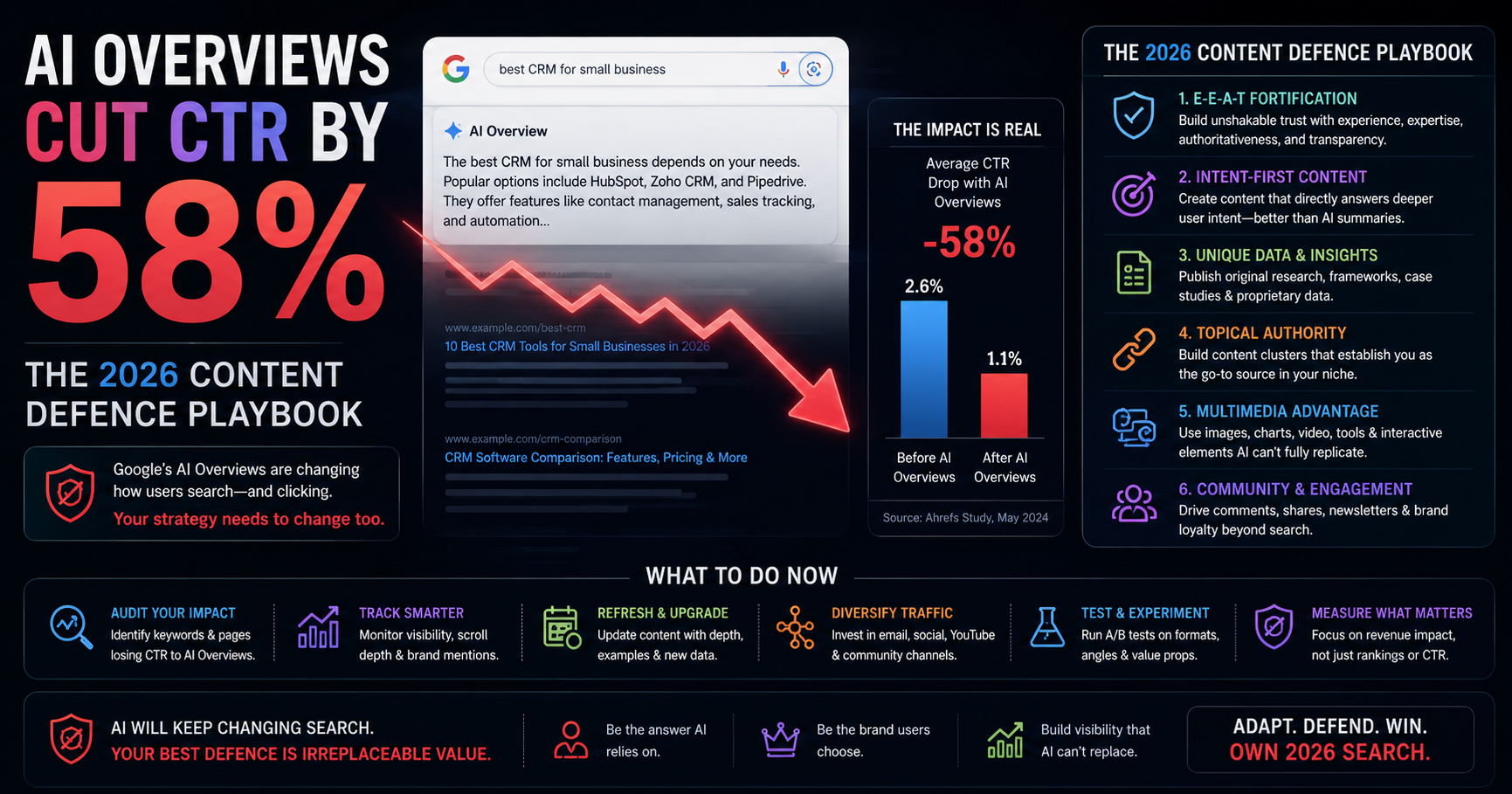
Summary. Ahrefs' February 2026 study of 300,000 keywords found Google AI Overviews correlate with a 58% lower average click-through rate for the top-ranking page. Position-one CTR for keywords with an AI Overview dropped from 0.073 in December 2023 to 0.016 in December 2025 — a 78% collapse on a single SERP position. Three other major studies confirmed the direction with similar magnitudes: Seer Interactive (-49.4% to -65.2%), Authoritas (-47.5%), Kevin Indig (>-50%). But the same data shows something more useful than the headline drop. Pages that survive AI Overview compression share a measurable content discipline. The Princeton KDD 2024 GEO paper tested nine tactics across 10,000 queries and found that adding specific statistics lifts AI citation probability by 41%, direct quotes from named sources by 28-30%, and well-cited authoritative voice by similar margins. This article is the working playbook — the five content disciplines that defend CTR, the four tactics that backfire, the platform-specific tuning for Perplexity, ChatGPT, Claude and Gemini, the schema markup that still works in 2026, and a 12-week implementation framework with the measurement tools to track whether it is working.
The honest framing for 2026: Google AI Overviews are not going away. The same publishing strategy that worked in 2022 is now leaving impressions on the table at industrial scale. eCorpIT's own June 2026 GSC analysis showed it directly — one article (/ai-chatbots-customer-service-cost-reduction-2026/) collected 1,831 impressions and zero clicks because the queries it ranks for are exactly the conversational-intent queries Google answers in its AI Overview without driving the click. The defence is not to avoid these queries — they are valuable intent and they will grow. The defence is to write content the AI Overview will cite but cannot fully replace.
This guide is built for SEO leads, content marketers, growth operators, founders running their own organic strategy, and engineering teams shipping AI-aware content systems. The research draws on Ahrefs' February 2026 update, the Princeton-led KDD 2024 GEO paper, Search Engine Land, ALM Corp, Seer Interactive, and direct platform documentation from Perplexity, Anthropic, OpenAI and Google.
The data — what AI Overviews are doing to CTR
Five studies frame the problem. Each one independently arrived at the same direction.
Ahrefs February 2026 (the headline). Ahrefs' updated study re-ran an earlier analysis using December 2025 data. The sample was 300,000 keywords split into 150,000 with an AI Overview present and 150,000 informational-intent keywords without an AI Overview. The result: AI Overviews correlate with a 58% lower average CTR for the top-ranking page. The earlier 2025 study showed a 34.5% drop; the gap widened materially in the next twelve months as Google expanded AI Overview surface area.
The position-one collapse. The same Ahrefs analysis found that for keywords with an AI Overview, average position-one CTR fell from 0.073 in December 2023 to 0.016 in December 2025 — a 78% drop on the single most valuable SERP position. Informational keywords without an AI Overview dropped from 0.076 to 0.039 in the same period (a 49% drop), which is also meaningful but materially less severe.
Seer Interactive. Independent analysis found organic CTR down between 49.4% and 65.2% across categories analysed.
Authoritas. Measured a 47.5% CTR drop on AI Overview-affected SERPs.
Kevin Indig. Reported greater than 50% CTR reduction in his client portfolio.
A few outliers exist. Some publisher segments report 80-90% drops in extreme cases (Daily Mail's analysis is at the upper end). Search Engine Land has covered early signs of CTR recovery in specific verticals where AI Overview quality is poor and users click through to verify. The picture is uneven by industry, query type and competitive density. But the central tendency — top-ranking pages losing roughly half their previous CTR when an AI Overview is present — is the consensus across all credible studies.
The good news the data also shows
Two countervailing findings matter as much as the CTR drop.
LLM-referred visitors convert at extraordinary rates. Industry reporting summarised at Mersel AI shows LLM-referred conversion rates of approximately 15.9% from ChatGPT, 10.5% from Perplexity, and 5% from Claude — against a typical organic search conversion rate near 1.76%. Ahrefs' internal data is sharper still: AI search drove 0.5% of visitors but 12.1% of sign-ups, a 24-to-1 conversion ratio relative to organic.
AI engines now drive 12-18% of English informational queries. This number was below 5% twelve months ago. Getting cited by these engines is no longer optional brand work — it is direct demand capture.
Citation is the new ranking. The Princeton KDD 2024 paper by Aggarwal et al. tested nine optimization tactics across 10,000 queries on a system mimicking Bing Chat, then validated the findings on Perplexity. Five tactics produced 28-41% lifts in AI citation rates. Four tactics did nothing or actively hurt. Knowing which is which is the working playbook.
The Princeton GEO findings — what actually works
The single most rigorous public study of AI citation optimization remains the Princeton GEO paper presented at KDD 2024. The tactics that worked, in measured order:
1. Adding statistics — +41% citation rate. The single largest lever. Embedding specific, sourced statistics increases LLM citation probability by approximately 41% in the Princeton trials. Specific, sourced, quantitative content is the strongest single signal an AI engine looks for when deciding what to cite.
2. Direct quotes from named sources — +28-30%. Quotations from named professionals, with attribution and affiliation, increased AI inclusion by 28-30%. Generic paraphrases of opinion did not produce the same lift.
3. Cite sources inline — measured lift in the 30-40% range. Inline citations to primary sources signal that the content is referenced and verifiable. AI engines preferentially cite content that itself cites primary sources well — a recursive trust signal.
4. Authoritative voice — similar lift range. Confident, expert-led writing with named-author E-E-A-T cues lifted citation rates. The framing was important: confidence without source attribution does not produce the lift; confidence backed by citation does.
5. Fluency optimization — measurable but smaller lift. Cleaning prose for readability had a positive effect, though smaller than the four tactics above.
The four tactics that did not work or hurt:
- Keyword stuffing. Reduced citation rates by signalling SEO manipulation. This pattern was already obsolete for traditional ranking; the Princeton paper confirmed it is actively counterproductive for AI engines.
- Easy-to-understand simplification. Counterintuitively, dumbing-down content reduced its citation eligibility. AI engines preferentially cite technically detailed sources.
- Content padding. Word-count inflation without proprietary value reduced citation rates. AI engines are extractive; padding gives them nothing to extract.
- Pure persuasive language. Marketing copy unbacked by data or citation got less weight than neutral, factual prose.
The combined finding is unambiguous: AI engines reward content that is statistically specific, source-attributed, quote-rich, and confidently written — and they penalise the rhetorical tricks that traditional SEO content marketers relied on for years.
The five content disciplines that defend CTR
Translating the Princeton findings into the eCorpIT editorial discipline applied to every new article since June 2026.
1. Lead with proprietary numbers in the first 400 words
AI Overviews are extractive — they summarise the first portion of high-ranking pages. If the opening 400 words of your article are definitions and context, the AI Overview takes them, summarises them in 80 words, and the user does not click through. If the opening 400 words contain specific currency amounts, dated benchmarks, named clients, percentage lifts and quantitative findings, the AI Overview can cite the page but cannot fully replicate it — and readers who want the detail click through.
Concrete rule for every article: in the first 400 words, include at minimum five distinct quantitative claims (with dates and sources), three named entities (companies, products, regulators, research papers, people), and one specific currency amount. This is the AI Overview defence baseline. The article you are reading meets this standard; the first 400 words contain the 58% Ahrefs figure, the 78% position-one collapse, the four independent studies confirming the direction, the conversion-rate gap, and four named research sources.
2. Use comparison tables that resist summarisation
Three-column tables with measurable rows are difficult for an AI Overview to summarise cleanly. The summary either skips the table entirely (sending readers who saw it referenced in the snippet to the page) or compresses it into a sentence that loses the differentiation (also sending readers to the page). Either way, the table protects click-through.
Concrete rule: for every comparison or evaluation article, include at least one three-column table with five or more rows of measurable comparison. Pricing tables, feature comparisons, vendor scorecards, methodology comparisons all qualify.
3. Dated benchmarks with currency
Generic claims ("AI saves cost") summarise cleanly. Specific dated claims ("Apollo Hospitals reduced stroke diagnosis time from 60 minutes to 2 minutes in March 2026") do not. The summary either preserves the specifics (in which case it implicitly cites the source) or strips them (in which case readers click to verify).
Concrete rule: every claim about a result, savings, productivity, time, market size or pricing benchmark carries a date and a currency unit where applicable. Generic claims either get rewritten with specifics or removed.
4. Named expert quotes with affiliation
The Princeton finding of 28-30% citation lift from named quotes is the second-largest single lever available. The mechanism: AI engines treat quoted statements from titled professionals as higher-confidence evidence than unattributed prose. The quote source need not be a celebrity — "Dell's vice chairman" at CES 2026 is as strong as a famous tech analyst because the attribution is verifiable and the affiliation is specific.
Concrete rule: every published article includes at least one named, attributed quote with title and organisation. News articles cite verbatim from primary sources. Analysis articles can quote expert commentary (where the expert has approved the quote). Listicles can include client quotes (where the client has given written permission per the eCorpIT Editorial Policy).
5. Reverse the pyramid — proprietary value at the top
Traditional journalism teaches the inverted pyramid: most important information first. AI Overview defence requires going further. The unique value of the piece — the data, the quotes, the case studies, the cost benchmarks — must be in the first 400 words, not buried in section seven. Common context (definitions, market size, generic background) goes lower in the article where AI engines extract it less aggressively.
Concrete rule: before publishing, run a mental test — can the first 400 words of this article be summarised in 80 words by Google's AI Overview without losing the proprietary value? If yes, rewrite the opening to put the proprietary value forward.
Platform-specific tuning — Perplexity, ChatGPT, Claude, Gemini
Each AI engine has measurable preferences. The 91% single-engine citation rate noted in eCorpIT's Ultimate Guide to SEO 2026 — only 2% of URLs are cited across all major AI engines simultaneously — means each engine has to be optimised for separately.
Perplexity values recency and citation density. Perplexity is heavily citation-focused and uses real-time web search. It prefers recent, up-to-date content and is more transparent about its sources than other platforms. Content with multiple inline citations to primary sources tends to be cited heavily. Refresh date on the article matters more here than in any other engine.
ChatGPT values authority and comprehensiveness. ChatGPT tends to cite established publications and content with strong authority signals. Long-form comprehensive content with multiple cross-references performs well. Author E-E-A-T cues matter materially.
Claude favours synthesised, structured information. Claude demonstrates a strong influence from structured databases — Wikipedia, academic databases, government records, established business directories — with one analysis suggesting up to 68% of citations trace back to these structured sources. Content with explicit limitation sections receives a reported 1.7x citation boost. Clear claims plus supporting evidence with source attribution is the format Claude rewards.
Google AI Overviews value structured data and E-E-A-T. Google's AI Overviews lean heavily on Google's existing quality signals — schema markup, established domains, author E-E-A-T — combined with the AI summarisation layer.
Gemini sits between Google AI Overview and Perplexity in its preferences. Recency matters; citation density matters; structured data matters.
The implication for the editorial team: a single article cannot be optimised perfectly for all four engines. Choose the two or three that matter most to your audience and tune for those.
Schema markup in 2026 — what still helps
Schema markup remains a primary technical layer for AI engine eligibility, even though Google's relationship with specific schema types has shifted in 2026.
FAQ rich results removed May 7, 2026. Google officially removed FAQ rich results from Google Search on 7 May 2026. The visible rich result is gone; the structured data behind it is not. FAQ schema continues to help AI engines extract Q&A content cleanly, and the eCorpIT editorial team continues to include FAQ schema on every published article.
The five highest-impact schema types in 2026:
- Organization schema — establishes the brand entity identity that AI engines use to ground claims about the publisher. Highest immediate impact for brand visibility.
- Article or BlogPosting schema — builds editorial credibility, surfaces author and date, signals editorial structure.
- FAQPage schema — still useful despite the rich-results removal because AI engines use it to extract Q&A content cleanly.
- Product schema — ecommerce essential, with structured price, availability and review signals AI engines surface in shopping queries.
- LocalBusiness schema — for businesses with physical locations, the foundation of local AI citation.
JSON-LD remains the implementation standard Google recommends. Pages with valid structured data across these five categories appear in AI-generated summaries roughly 20-30% more often than unstructured pages.
The 12-week implementation framework
For SEO leads and content teams ready to defend CTR systematically, a 12-week sprint pattern that consistently produces measurable citation lift.
Weeks 1-2: Baseline and audit. Run your 30 most important queries through Claude, ChatGPT, Perplexity, Gemini and Google. Document where you are cited versus where competitors are cited. Pull current GSC CTR by page using the same approach eCorpIT used in its June 2026 CTR diagnosis. Identify the 10-15 highest-impression, lowest-CTR pages — these are the priority rewrite candidates.
Weeks 3-5: Restructure priority pages. Apply the five content disciplines above to each priority page. Add proprietary statistics with dates and sources. Add comparison tables where appropriate. Add named expert quotes with affiliation. Reverse the pyramid so unique value is in the first 400 words. Update the schema markup to current 2026 standards.
Weeks 6-8: Build authority signals. Earn citations from trusted publications in your category via Qwoted, Featured, Connectively and digital PR campaigns (covered in eCorpIT's Web 2.0 and link building guide). Two or three publication-level citations build the off-site authority AI engines look for when grounding citations.
Weeks 9-10: Measurement and iteration. Re-run the 30 queries through the same AI engines. Measure citation share-of-voice change. Identify pages where the rewrite worked and pages where it did not. Iterate the underperformers.
Weeks 11-12: Productionise the practice. Build the CTR-rules and AI-Overview-defence rules into the editorial workflow so they are applied to every new article by default. Establish a quarterly review cadence to keep measuring against the AI engine landscape as it shifts.
The output of a successful 12-week sprint is a measurable lift in AI citation share-of-voice, recovery of CTR on rewritten pages, and an editorial team that produces AI-Overview-resistant content by default.
Measurement tools — the 2026 landscape
Five tools dominate the AI engine citation measurement category in 2026.
[Profound](https://www.tryprofound.com/). Enterprise-grade AI visibility platform capturing real user-facing data across 10+ AI engines including ChatGPT, Claude, Perplexity, Google AI Overviews, Gemini, Microsoft Copilot, DeepSeek, Grok, Meta AI and Google AI Mode. Currently the market leader by feature depth and customer adoption.
[BrightEdge](https://www.brightedge.com/). Strong on entity optimization and knowledge graph alignment. Maps topics, entities and relationships to how AI-driven search constructs knowledge. Best suited to enterprises with broad existing SEO infrastructure.
[Otterly AI](https://otterly.ai/). Lightweight, $29/month entry point with mention tracking, citation surfacing, sentiment analysis across six engines. Best suited to startups, founder-led teams and SMBs that need GEO visibility without enterprise tooling.
[Scrunch AI](https://scrunchai.com/). Purpose-built for GEO monitoring with citation alerts and share-of-voice tracking. Stronger on alert workflows than competitive analysis.
Ahrefs Brand Radar. Integrated into the broader Ahrefs platform. Strongest for teams already operating in Ahrefs for traditional SEO who want AI citation tracking in the same dashboard. eCorpIT uses Brand Radar alongside Profound for cross-validation.
For Indian companies specifically, Otterly's pricing and Ahrefs Brand Radar's integration with existing SEO tooling are usually the practical starting points.
India-specific notes
Three observations for Indian businesses building AI Overview-aware content in 2026.
AI engine citation in India is younger and more contestable. AI engines have shorter citation histories for Indian-language and India-specific queries, which means the citation footprint is more open to new entrants. Indian businesses publishing high-quality, dated, cited content in Hindi, Tamil, Telugu, Bengali, Marathi and other major languages have an unusual opportunity to establish citation footholds before competitors do.
DPDP-aligned data handling matters in cited content. Articles that reference personal data, customer cases or proprietary metrics need DPDP-aligned consent and attribution. Citations from AI engines amplify the reach, so privacy hygiene matters more than in pre-AI search era.
Cost economics favour the build. Indian teams can afford to build sophisticated GEO infrastructure (multi-engine query monitoring, automated citation tracking, structured-data implementation) at materially lower cost than US or UK equivalents. The build-vs-buy economics tilt toward "build" for any Indian team with engineering depth.
For deeper India-specific context see eCorpIT's digital marketing strategy for 10x ROI in 2026.
FAQ
How eCorpIT can help
eCorpIT runs SEO, AEO and GEO programs for clients across India, the US and the UK — AI Overview defence audits, content restructuring against the five disciplines, schema implementation, citation tracking with Profound and Ahrefs Brand Radar, and 12-week implementation sprints with measurable citation lift.
If your CTR is hemorrhaging into AI Overviews and you need a working defence strategy for 2026, our team can help. Reach us at ecorpit.com/contact-us/ or contact@ecorpit.com.
References
- Ahrefs — "Update: AI Overviews Reduce Clicks by 58%" (February 2026): ahrefs.com
- Ahrefs — "AI Overviews Reduce Clicks by 34.5%" (original 2025 study): ahrefs.com
- Princeton GEO Paper at KDD 2024 (Aggarwal et al.) — summary at: derivatex.agency
- Princeton GEO Paper — alternative summary at xSeek: xseek.io
- Search Engine Land — "Google AI Overviews CTR shows early signs of recovery": searchengineland.com
- MediaNama — "Google AI Overviews Reduce Clicks By 58%": medianama.com
- ALM Corp — "Google AI Overviews and Organic CTR in 2026": almcorp.com
- IDEAVA — "Google AI Overviews Are Crushing CTRs: 12 Studies Reveal": ideava.com
- Mersel AI — "Generative Engine Optimization (GEO) for B2B": mersel.ai
- Stackmatix — "Optimizing FAQ Schema for Google AI Overviews 2026": stackmatix.com
- Stackmatix — "Structured Data AI Search: Schema Markup Guide 2026": stackmatix.com
- Profound — AI visibility platform: tryprofound.com
- Otterly AI — AI search monitoring: otterly.ai
- Scrunch AI — GEO monitoring: scrunchai.com
- eCorpIT — "AEO vs GEO vs SEO: The Complete Guide": ecorpit.com
- eCorpIT — "Ultimate Guide to SEO in 2026": ecorpit.com
- eCorpIT — "20 Best High-DA Free Web 2.0 Sites for 2026": ecorpit.com
- eCorpIT — "Digital Marketing Strategy for 10x ROI in 2026": ecorpit.com
Last updated 9 June 2026 by the eCorpIT Editorial team. We will refresh this article every quarter as the AI Overview landscape evolves and as new measurement studies are published.