On this page · 13 sections
- The short answer
- What the citation-overlap data shows
- Where AI Overviews actually pull citations now
- The click-through reality
- The decoupling, and the upside of being cited
- Google's position versus the independent data
- So does ranking #1 still matter?
- What actually drives citations in 2026
- A 2026 playbook for AI search visibility
- India and global considerations
- FAQ
- How eCorpIT can help
- References
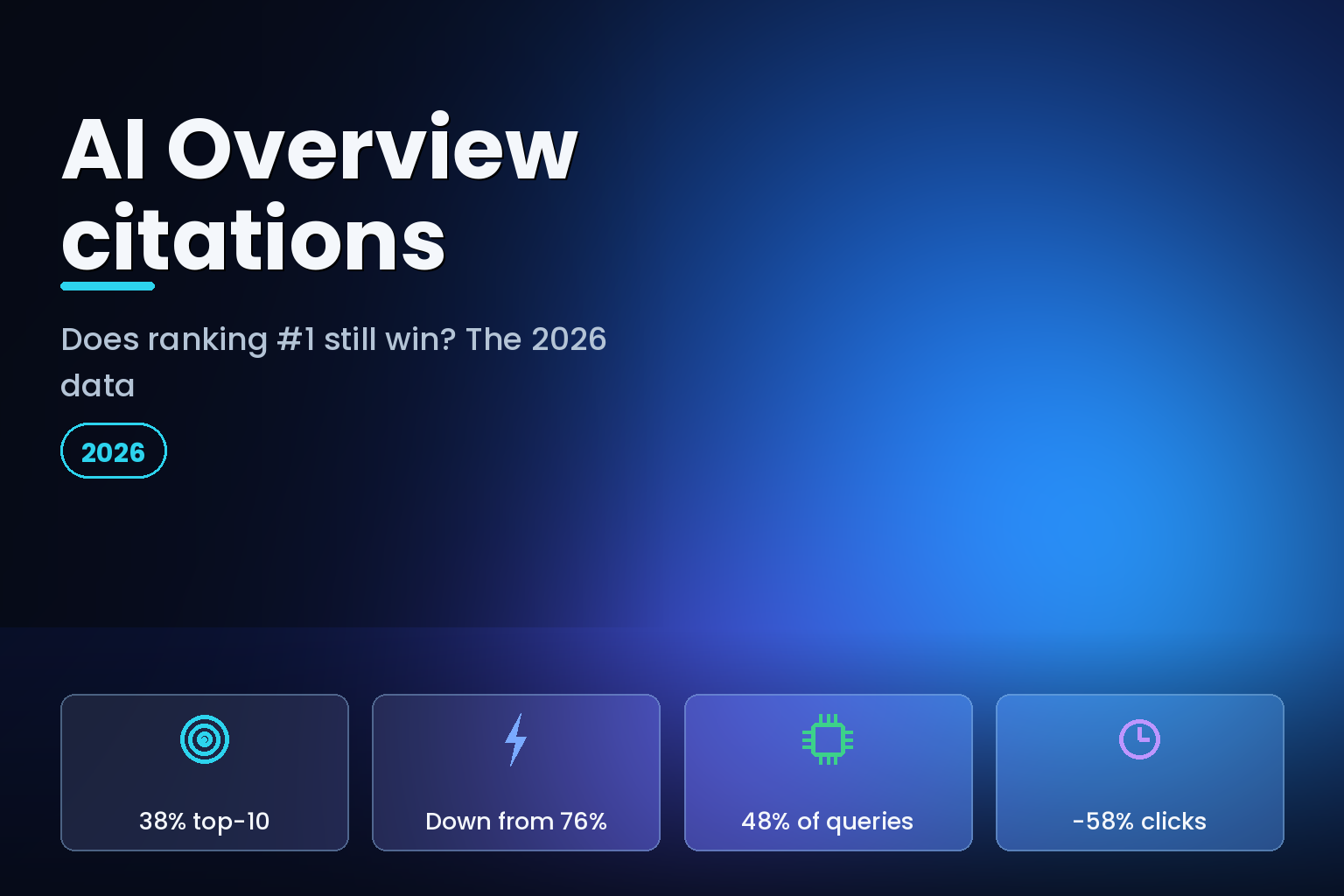
Summary. The link between a number-one ranking and an AI Overview citation is breaking. Ahrefs analysed 863,000 keyword SERPs and 4 million AI Overview URLs in March 2026 and found that only 38% of cited pages also rank in the top 10, down from 76% just seven months earlier. The rest split almost evenly: 31.2% sit in positions 11-100 and 31.0% rank beyond position 100. AI Overviews now appear on about 48% of queries, are powered by Gemini 3 since January 2026, and correlate with a 34.5% to 58% drop in clicks to the top organic result. This matters because Google Search drew $198.1 billion in 2024 revenue on a model that assumed ranking led to clicks. The honest answer for marketers in 2026: ranking #1 still helps your odds, but it is no longer necessary or sufficient to be cited. This article shows what the data says and what to do about it.
For a decade, the SEO contract was simple. Rank in the top three, earn the clicks. AI Overviews rewrote that contract. Google's generative answers now sit above the organic results, summarise them, and cite a handful of sources that the user may never click. The question every content lead is asking is whether the old playbook, ranking first, still buys a seat in that citation box. The data gives a clear and uncomfortable answer.
The short answer
Ranking still correlates with citation, but the correlation is weakening fast, and a top-10 position is now a minority of citations rather than the default. A page that ranks first is more likely to be cited than a random page on the web, because top-ranked pages are relevant and authoritative. But Google's AI Overviews increasingly pull from sources the classic SERP never surfaced, including pages deep in the index and user-generated content. The strategy that follows is not "rank first and wait." It is "be the most citable source on the topic, everywhere the model looks."
What the citation-overlap data shows
The headline trend is a steep decline in how often AI Overview citations come from page-one results. Different vendors measure it differently, and the numbers disagree, which is itself the point: the overlap is unstable and falling.
| Study | Date | Top-10 overlap with AIO citations |
|---|---|---|
| Ahrefs (search rankings vs citations) | July 2025 | 76% |
| BrightEdge (16 months of AIO) | October 2025 | ~54% |
| Originality.AI | Late 2025 | 52% |
| BrightEdge | February 2026 | ~17% |
| Ahrefs (863K SERPs, 4M URLs) | March 2026 | 38% |
The studies use different samples and definitions, so treat the exact figures as a range, not gospel. What is consistent across Ahrefs, BrightEdge and Originality.AI is direction: the share of AI Overview citations coming from the traditional top 10 has fallen sharply across 2025 and into 2026. The era when a page-one ranking all but guaranteed a citation is over.
Where AI Overviews actually pull citations now
Ahrefs' March 2026 study is the most granular. It found that Google selects far fewer pages straight from the original SERP and leans more on sources that surface through "query fan-out," the sub-queries Gemini runs behind a single search.
| Position band | Share of citations | What it means |
|---|---|---|
| Top 10 | 38% | Still over-represented, but now a minority |
| Positions 11-100 | 31.2% | Deep SERP pages get a real shot |
| Beyond position 100 | 31.0% | Long-tail and niche pages cited directly |
Two structural shifts explain the spread. First, AI Overviews are user-generated-content-first. BrightEdge found roughly 17.5% of Google AI Overview citations come from UGC platforms, about 35 times higher than ChatGPT, and a single video platform accounts for around 10.6% of all AI Overview citations. YouTube is now the single most-cited domain. Second, authoritative publisher sites account for a smaller slice than many assume, near 9.5% in BrightEdge's citation-pattern analysis. The model rewards relevance and presence, not just domain authority.
The click-through reality
Even when you are cited, the traffic math has changed. The same AI Overview that cites you also answers the query, so fewer users click through at all.
| Study | Date | Click impact when AIO present |
|---|---|---|
| Ahrefs (300K keywords) | April 2025 | 34.5% lower CTR for top-ranking page |
| Ahrefs (update) | December 2025 | 58% lower CTR for top-ranking page |
| Seer Interactive | September 2025 | Organic CTR fell from 1.76% to 0.61% |
| Zero-click rate | 2026 | ~83% on AIO queries vs ~60% without |
Sources: Ahrefs, its 58% update, and CTR analysis compiled by ALM Corp. The pattern is consistent: when an AI Overview appears, the top organic result loses a third to nearly two-thirds of its clicks, and roughly eight in ten of those searches end without a single click to any site. Across the top 500 publishers, AdExchanger reports Google traffic down about 27%, a loss measured in billions of dollars of ad revenue.
The decoupling, and the upside of being cited
Ahrefs calls the wider pattern the great decoupling: impressions keep rising while clicks fall, because users see your page inside the overview without clicking through. That sounds like pure loss, but there is a measurable upside to being the cited source. Brands cited in AI Overviews earn about 35% more organic clicks than uncited competitors on the same query, per ALM Corp's CTR analysis. Citation is becoming its own goal: a branded impression that builds recognition and trust even on the searches that never produce a session.
The squeeze is uneven by content type. Informational and news content feels it first and hardest, because those answers are summarised inside the overview before a user has a reason to visit. Commercial and transactional queries, where users still need to act, retain more of their clicks. The takeaway for planning is to know which of your queries are answerable inside the overview and which still require a visit, and to weight effort accordingly.
Google's position versus the independent data
Google disputes the gloom. Liz Reid, vice-president and head of Google Search, wrote that "average click quality has increased and we're actually sending slightly more quality clicks to websites than a year ago," defining quality clicks as those where users do not quickly bounce back, in the company's official rebuttal.
The independent measurement community is unconvinced on volume. Ryan Law, director of content marketing at Ahrefs, summarised the gap bluntly after Google claimed AI Overviews lift click-through rates: logic disagreed, and so did the data, which showed a 34.5% CTR decline on affected keywords. Both can be partly true. Total clicks can fall while the clicks that remain are better qualified. For planning, assume fewer clicks and treat any quality uplift as a bonus.
So does ranking #1 still matter?
Yes, with two caveats. A top-10 position is still over-represented in citations relative to its share of the indexable web, so ranking is a strong positive signal, not a dead one. But ranking first is neither a guarantee of citation nor a requirement for it, because a third of citations now come from beyond position 100. The job has widened from "rank the page" to "make the topic un-ignorable across the sources Google fans out to." If you want the conceptual map of how classic search, generative engines and answer engines differ, our guide to AEO, GEO and SEO lays out the three disciplines and where they overlap.
What actually drives citations in 2026
The factors that move AI Overview visibility are no longer purely on-page ranking signals.
Relevance beats placement. BrightEdge's analysis found that a brand mentioned naturally inside a useful explanation carries more weight than a bare link, because the model reads for meaning, not just references. Frequency builds entity recognition. When a brand recurs across articles, forums, guides, reviews and expert discussions, the model starts treating it as a trusted entity for that topic. Format matters. Because AI Overviews lean UGC-first, a clear video or a well-structured community answer can be cited where a polished blog post is not. Intent shapes mentions. Commercial-intent language drives 4 to 8 times more brand mentions than informational queries, per the same BrightEdge research, so the query you optimise for changes your odds.
There is also a cross-engine pattern worth planning around. BrightEdge found that AI engines often cite different sources yet converge on recommending the same brands, and that ChatGPT mentions brands about 3.2 times more often than it formally cites them. In other words, a brand can shape an answer without ever being the clickable link. That makes off-page brand-building, the reviews, comparisons and expert mentions that teach a model who the credible players are, a direct input to on-engine visibility rather than a soft branding exercise.
The practical translation: publish genuinely citable, specific, well-structured content; earn mentions off your own site; cover the long-tail sub-questions a model will fan out to; and match content format to how the engine sources that topic.
A 2026 playbook for AI search visibility
Start by measuring citation share, not just rank. Track which queries trigger an AI Overview in your category and whether you are cited, using a rank tracker that records AI Overview presence. Then write for the fan-out: build clusters that answer the narrow sub-questions behind a head term, since a third of citations come from deep pages answering exactly those. Add structured, extractable answers, the 40-to-60-word definitions and comparison tables that models lift cleanly. Invest in off-site presence and UGC, because YouTube and community platforms are where Google increasingly looks. Finally, keep ranking. A top-10 position remains the single strongest controllable signal, and it still earns the largest single slice of citations.
India and global considerations
For marketers serving Indian and global audiences, two points sharpen the strategy. First, video is disproportionately powerful. YouTube is the single most-cited domain in Google AI Overviews and accounts for roughly 10.6% of all citations, and YouTube's reach in India is among the largest in the world, so a clear, well-titled video can earn citations that a text page cannot. Second, the UGC-first behaviour of AI Overviews rewards presence on community and review platforms, which in India means regional-language forums and local review sites as much as global ones. The mechanics are identical to the global picture, only the sources differ. A team optimising for AI search in India should build the same query-fan-out clusters and extractable answers, then add the regional video and community footprint the model actually pulls from. The deeper framing of how generative and answer engines rank sources sits in our AEO, GEO and SEO guide.
FAQ
How eCorpIT can help
eCorpIT is a Gurugram-based technology organisation with senior-led content and engineering teams that help marketers win visibility in AI Overviews, not just classic rankings. We audit citation share against your target queries, restructure content for query fan-out and extractable answers, and build the off-site presence that drives entity recognition. Founded in 2021 and assessed at CMMI Level 5, we treat SEO and AI search optimisation as one programme. To audit your AI search visibility, contact our team.
References
_Last updated: 26 June 2026._