On this page · 9 sections
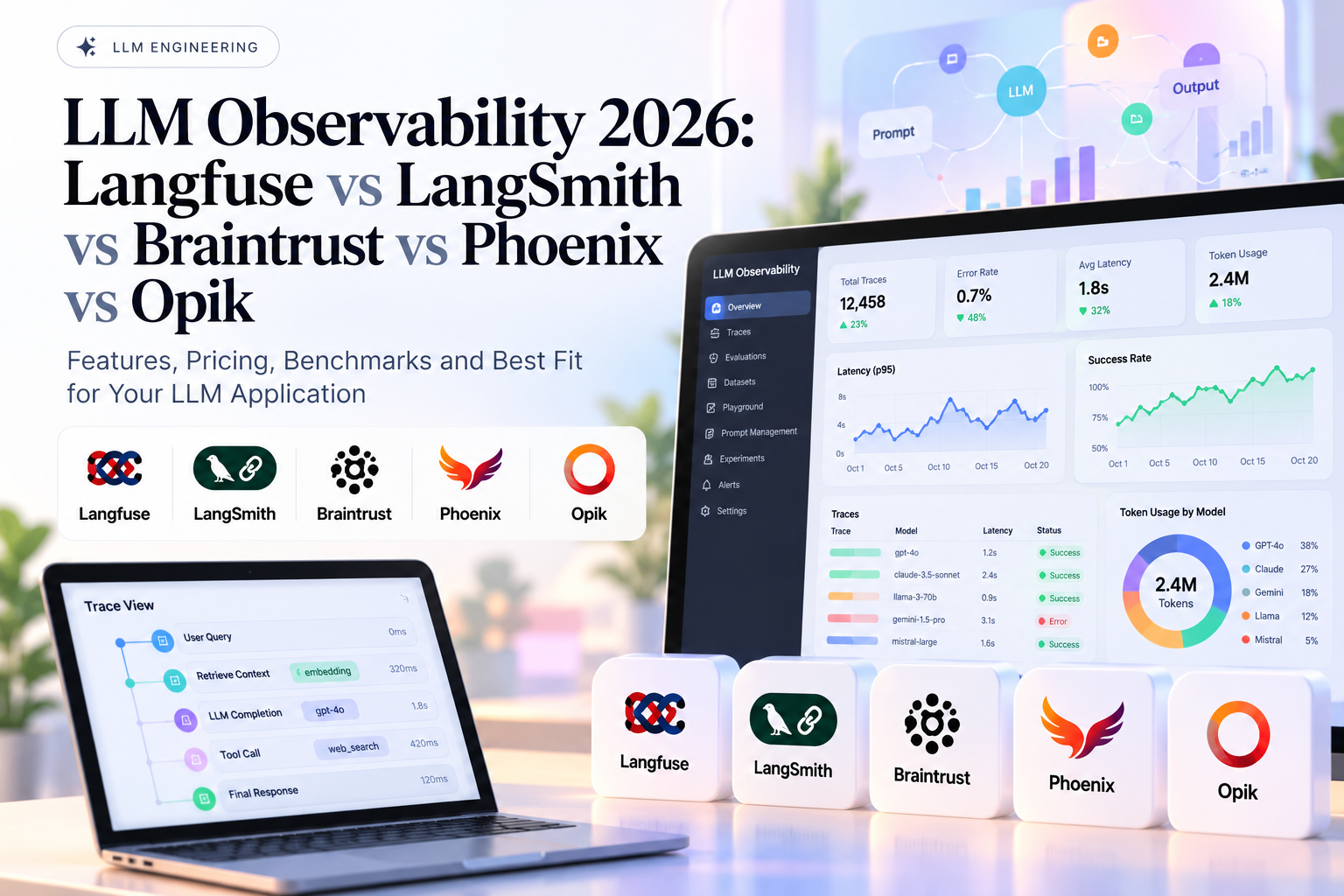
Summary. No single tool wins: the pick depends on licence, hosting and the shape of your traces. Langfuse (MIT core, acquired by ClickHouse on 16 January 2026) is the safest default for teams that want to self-host or pay little: Cloud Core is $29 a month with 100,000 units, then $8 per 100,000, falling to $6 above 50 million. LangSmith suits LangGraph teams: Plus is $39 a seat with 10,000 base traces, then $0.005 a trace, and self-hosting needs Enterprise. Braintrust is eval-first and bills on gigabytes ingested and scores rather than per span: Starter is free with 1 GB and 10,000 scores, Pro is $249 a month. Arize Phoenix is free to self-host under the Elastic License 2.0, while Arize AX (Pro $50 a month) now belongs to Dynatrace, which closed the deal on 1 October 2026. Opik by Comet is the only one fully under Apache-2.0, with Pro Cloud at $19 a month for 100,000 spans, then $5 per 100,000. For 2 million traces and 16 million spans a month, list prices run from $747 (Braintrust Pro) to $10,840 (LangSmith Plus), and $13,068 if you apply Arize AX Pro's published overage. None offers an India SaaS region, so Indian teams with residency rules should self-host.
About this article. Prices, licences and features were checked against vendor pages and documentation on 22 October 2026. Vendors change pricing often, so re-check before you commit. No vendor paid for inclusion or placement. Researched with AI assistance and reviewed by our editorial team.
What changed in 2026, and why it matters now
Every vendor here shipped a major ownership, pricing or product change this year, so a 2025 shortlist is stale.
| Date (2026) | Change | Why buyers should care |
|---|---|---|
| 16 Jan | ClickHouse acquired Langfuse alongside a $400M Series D | The LICENSE is now copyright ClickHouse, Inc.; Langfuse says licensing is not changing |
| 17 Feb | Braintrust raised an $80M Series B | In March it announced an EU data plane and a usage-based Starter plan for new sign-ups |
| 20 Apr | Opik 2.0 released | New UI; the prompt library followed in June |
| 5 May | OpenTelemetry moved the GenAI semantic conventions to their own repository | Every document there is still at Development status, so attribute names can change |
| Late Jul | LangSmith's base trace rate doubled to 0.005 LangChain Standard Units ($0.005) | Existing self-serve customers moved to the new plans from 1 October |
| 13 Aug / 1 Oct | Dynatrace agreed to buy Arize for $915 million, then completed the deal | Phoenix and AX continue; Arize will be folded into Dynatrace over time |
| 17 Aug | Langfuse v4 went GA | Langfuse Cloud becomes v4-only on 16 November 2026 |
| 14 Sep | LangSmith capped SaaS extended retention at 180 days, down from 400 | Teams relying on 400-day retention need an export plan |
The Langfuse deal was announced with ClickHouse's Series D, and Langfuse's own post says: "There are no planned changes to licensing." Braintrust's round was followed by its Starter plan, which existing Free organisations can ignore, and an EU region for the data plane. Opik 2.0 appears in Comet's self-host changelog as release 2.0.3 on 20 April. The GenAI conventions now live in their own OpenTelemetry repository. Dynatrace announced the Arize purchase on 13 August and closed it on 1 October, saying Arize will keep supporting both Phoenix and AX. Langfuse v4 went GA on 17 August, and self-hosted v3 gets security patches through January 2027. LangSmith's retention cap took effect on 14 September.
With two of the five now owned by larger companies, get the contracting entity, data terms and roadmap commitments in writing.
The five tools, one by one
Langfuse
What it is. An open-source, framework-agnostic platform for tracing, prompt management, LLM-as-judge and code evaluators, annotation queues, datasets, experiments and dashboards, with Python and JS SDKs and an OpenTelemetry endpoint.
Licence. Everything outside the ee/ directories is MIT. Self-hosted Enterprise features, including audit logs, data retention policies and SCIM, need a licence key.
Deployment. Self-hosting runs web and worker containers plus PostgreSQL, ClickHouse, Redis or Valkey, and S3-compatible storage. The published minimums are 2 CPU and 4 GiB each for web, worker and Postgres, 1 CPU and 1.5 GiB for Redis, and 2 CPU and 8 GiB for ClickHouse, with at least 16 GiB recommended for larger deployments. Docker Compose is for local use and testing; production runs on Kubernetes with Helm or on AWS, Azure or GCP with Terraform.
Cloud pricing:
- Hobby: free, 50,000 units a month, 30 days of data access, 2 users.
- Core: $29 a month, 100,000 units, 90 days, unlimited users.
- Pro: $199 a month, 100,000 units, 3 years of data access, SOC 2 and ISO 27001 reports and a BAA. The Teams add-on (enterprise SSO, SSO enforcement, fine-grained RBAC) is $300 a month.
- Enterprise: $2,499 a month with audit logs, SCIM and SLAs.
- Overage: $8 per 100,000 units from 100,000 to 1 million, $7 to 10 million, $6.50 to 50 million and $6 beyond.
A billable unit is any trace, observation (span, event or generation) or score, including those created by Langfuse's own LLM-as-a-Judge, annotation queues and experiments. Cloud regions are US (Oregon), EU (Ireland), Japan (Tokyo) and a separate HIPAA region in Oregon.
Limits. OpenTelemetry ingest is HTTP only, with no gRPC. Per-observation billing makes deep agents expensive. The v4 Cloud cut-over on 16 November also needs Python SDK 4.7.0 or JS/TS SDK 5.4.0 or later, and trace-level LLM-as-judge evaluators must move to observation targets.
Best for teams that want a permissive licence, free self-hosting and a cheap managed option.
LangSmith
What it is. LangChain's closed-source platform for tracing, evals, prompt management, a playground and annotation queues, sold alongside LangSmith Deployment, Fleet, Engine, Sandboxes and an LLM Gateway.
Licence. The platform is proprietary; the langsmith SDK is MIT. LangChain is not required: the @traceable decorator and wrap_openai trace plain code, and LangSmith accepts OpenTelemetry traces at /otel, mapping gen_ai.* attributes to its own fields.
Pricing:
- Developer: $0 for 1 seat and 5,000 base traces a month.
- Plus: $39 a seat a month, up to 10,000 base traces and one free small serverless deployment.
- Enterprise: custom, with self-hosted and hybrid options, custom SSO, ABAC and RBAC, and a support SLA.
The plan table shows only a pay-as-you-go note for usage; the rates sit in a tooltip. A base trace costs 0.005 LangChain Standard Units, and 1 LSU is $1, so $0.005 a trace; upgrading a trace to extended retention adds 0.0025 LSU. That base rate is double the $0.0025 LangSmith charged from February to July 2026. Enterprise lists a flat 0.0075 LSU a trace with no retention surcharge.
A trace is one execution of your application, up to 25,000 runs, so a long agent loop costs the same as a single call. Base traces keep 14 days and extended traces 180. New online evaluators and automation rules upgrade traces to extended retention by default, which you can switch off. Plus allows 500,000 trace events and 5 GB of payload an hour.
Deployment. Cloud regions are GCP US, GCP EU, GCP APAC in Sydney (added May 2026) and AWS US in Ohio. Self-hosted LangSmith is an Enterprise add-on on Kubernetes with ClickHouse, PostgreSQL, Redis and blob storage.
Best for LangGraph teams that want tracing, evals and agent deployment from one vendor, with many steps per trace.
Braintrust
What it is. An eval-first platform: experiments, versioned datasets, LLM-as-judge and code scorers, online scoring with sampling rules, playgrounds, human review, the Loop agent, and CI gating through a GitHub Action or the bt eval CLI.
Licence. The platform is proprietary; the autoevals scorer library is MIT and the Python SDK Apache-2.0.
Pricing:
- Starter: $0 with 1 GB of processed data (then $4/GB), 10,000 scores (then $2.50 per 1,000), 14-day retention and unlimited users.
- Pro: $249 a month with 5 GB (then $3/GB), 50,000 scores (then $1.50 per 1,000) and 30-day retention, extendable to 180 days at $0.50 per GB a month.
- Enterprise: custom, with up to 365-day retention, SAML SSO, a BAA and on-premises or hosted deployment.
Processed data covers inputs, outputs, metadata, traces and spans, measured at ingestion, so deleting data does not reduce it. You pay by the gigabyte, not per span or trace. Braintrust sets usage alerts rather than hard spending caps.
Deployment. Braintrust always runs the control plane. The data plane is SaaS in the US or the EU, chosen when the organisation is created, or BYOC or self-hosted on Enterprise. Its OTLP endpoint is https://api.braintrust.dev/otel, with a separate EU endpoint, and requests carry an x-bt-parent header naming the project.
Best for teams that gate releases on evals, want product managers and engineers in one tool, and prefer billing by bytes over span count.
Arize Phoenix and Arize AX
What it is. Phoenix is Arize's tracing and evaluation tool, built on OpenTelemetry and Arize's OpenInference conventions, with LLM-as-judge evals, datasets, experiments, prompt management and a playground. Since version 15.10.0 (15 May 2026) it converts gen_ai.* attributes to OpenInference as spans arrive.
Licence. Elastic License 2.0. You may use, modify and self-host Phoenix, and Arize says there are no feature gates, but you may not offer it to third parties as a hosted or managed service. ELv2 is usually classed as source-available rather than OSI-approved open source.
Deployment. SQLite by default and PostgreSQL 14 or later for production, via Docker, Kubernetes or Helm. Authentication is off by default; set PHOENIX_ENABLE_AUTH=true before exposing it.
Arize AX pricing:
- AX Free: 25,000 spans a month, 1 GB of ingestion, 15-day retention.
- AX Pro: $50 a month, 50,000 spans, 10 GB, 30-day retention, then $0.0008 per extra span and $3 per extra GB.
- AX Enterprise: custom, SaaS or self-hosted.
AX SaaS runs in the US, EU and Canada on every tier, and HIPAA is Enterprise only. At $0.0008 a span, AX Pro's overage is far above the others here, so production-scale AX is in practice a negotiated Enterprise deal.
Best for free self-hosted tracing and evals for internal use, or an upgrade path into Dynatrace.
Opik (Comet)
What it is. Comet's open-source platform for tracing, 43 built-in eval metrics (including G-Eval and LLM juries), datasets, experiments, a prompt library, online evaluation rules, an Agent Optimizer and Test Suites. Guardrails are available only in self-hosted deployments.
Licence. The whole repository, backend included, is Apache-2.0. The self-hosted build lacks user management.
Pricing:
- Free Cloud: $0, 25,000 spans a month, 60-day retention, up to 10 team members.
- Pro Cloud: $19 a month, 100,000 spans, 60-day retention, up to 50 team members. Extra spans cost $5 per 100,000, and extending retention from 60 to 400 days costs $29 per 100,000 spans.
- Enterprise: custom, with flexible deployment, SSO and SLAs.
The same page's FAQ says all plans include unlimited team members, so confirm seat limits with Comet.
Deployment. Self-hosting uses ClickHouse with Zookeeper, MySQL, Redis and MinIO. The local install is not production-ready; Kubernetes is. OpenTelemetry ingest is HTTP only and accepts traces, not metrics or logs. Opik Cloud runs in the US, with custom regions on Enterprise.
Best for teams whose legal review requires Apache-2.0, and small teams wanting the cheapest managed entry price.
Head-to-head comparison
| Langfuse | LangSmith | Braintrust | Phoenix / Arize AX | Opik | |
|---|---|---|---|---|---|
| Licence | MIT core, ee/ licensed separately |
Proprietary (SDK MIT) | Proprietary (autoevals MIT) | Phoenix ELv2; AX proprietary | Apache-2.0 |
| Owner, Oct 2026 | ClickHouse | LangChain | Braintrust | Dynatrace | Comet |
| Free tier | 50k units, 30 days, 2 users | 5k base traces, 1 seat | 1 GB, 10k scores, 14 days | AX: 25k spans, 1 GB, 15 days | 25k spans, 60 days |
| Entry paid plan | Core $29/mo | Plus $39/seat/mo | Pro $249/mo | AX Pro $50/mo | Pro $19/mo |
| Billing unit | Traces + observations + scores | Traces (plus retention upgrades) | GB processed + scores | Spans + GB | Spans |
| Published overage | $8 to $6 per 100k units | $0.005 per base trace | $3-4/GB, $1.50-2.50 per 1k scores | $0.0008 per span, $3/GB | $5 per 100k spans |
| Retention on entry plan | 90 days | 14 days base, 180 extended | 30 days | 30 days | 60 days |
| Free self-host | Yes | No (Enterprise add-on) | No (Enterprise) | Yes (Phoenix) | Yes |
| SaaS regions | US, EU, JP, HIPAA US | US, EU, APAC (Sydney) | US, EU | US, EU, Canada | US |
| OTLP ingest | HTTP, no gRPC | Yes, /otel |
Yes, /otel |
Yes, OpenInference | HTTP, traces only |
| Compliance the vendor publishes | SOC 2 Type II, ISO 27001, BAA on Pro and above | SOC 2 Type II, ISO 27001, HIPAA, GDPR | SOC 2 Type II, BAA on Enterprise | SOC 2 Type II, ISO 27001, PCI DSS, HIPAA on Enterprise | SOC 2 Type 2, ISO 27001; HIPAA on Enterprise |
The compliance row reflects each vendor's own statements: Langfuse's HIPAA page, LangSmith's regions FAQ, Braintrust's security page, Arize's trust centre and Comet's trust centre. Request the reports under NDA before relying on them. Langfuse's HIPAA page makes Pro customers in the HIPAA region eligible for a BAA, while its pricing table shows the HIPAA region only under Enterprise, so confirm in writing.
Decision table: pick X if…
| Pick | If this describes you |
|---|---|
| Langfuse (self-hosted) | Traces must stay in your VPC or an Indian region, you want MIT licensing, and someone can run ClickHouse |
| Langfuse Cloud | You want low managed cost for millions of short traces, plus prompt management |
| LangSmith | You build on LangGraph, want deployment and tracing from one vendor, and traces hold dozens of steps |
| Braintrust | Evals gate releases, product managers review outputs with engineers, and payloads are small relative to span count |
| Arize Phoenix | You want free self-hosted tracing and evals for internal use under ELv2 |
| Arize AX | You use Dynatrace or want ML and LLM monitoring on one contract |
| Opik | Legal requires Apache-2.0, or a small team wants a $19 managed plan |
| None of the five | You already pay for Grafana or Datadog and need only basic LLM spans |
For the last row, see our Grafana Cloud agent observability guide and our breakdown of Datadog LLM Observability pricing.
Worked cost example: 2 million traces a month
Scenario (eCorpIT assumptions). A support agent produces 2,000,000 traces a month with 8 spans each (root, retrieval, three LLM calls, three tool calls): 16,000,000 spans. Payload averages about 6 KB per span, roughly 96 GB a month. 10% of traces get one LLM-as-judge score (200,000 scores). Ten engineers need access. Judge-model tokens are excluded.
Langfuse Cloud Core. Units = 2,000,000 + 16,000,000 + 200,000 = 18,200,000. The first 100,000 are included; 900,000 at $8 per 100,000 = $72; 9,000,000 at $7 = $630; 8,200,000 at $6.50 = $533. Usage $1,235 + $29 = $1,264 a month (Pro: $1,434).
LangSmith Plus. Seats 10 × $39 = $390. Base traces (2,000,000 − 10,000) × $0.005 = $9,950. Default evaluator retention upgrades 200,000 × $0.0025 = $500. Total $10,840 a month ($10,340 without upgrades). Enterprise pricing at this volume is negotiated.
Braintrust Pro. $249 + (96 − 5) GB × $3 = $273, + (200,000 − 50,000) ÷ 1,000 × $1.50 = $225. Total $747 a month with 30-day retention.
Arize AX Pro. $50 + (16,000,000 − 50,000) × $0.0008 = $12,760, + (96 − 10) GB × $3 = $258. Total $13,068 a month at list overage; at this volume, ask for an Enterprise quote.
Opik Pro Cloud. (16,000,000 − 100,000) ÷ 100,000 = 159 blocks × $5 = $795, + $19 = $814 a month. Comet does not say whether traces count as spans; if they do, add $100.
Trace shape changes the ranking:
| Monthly list price | Small: 100k traces × 8 spans, 3 users, 10k scores | Base: 2M traces × 8 spans, 10 users | Deep agents: 2M traces × 50 spans, 10 users |
|---|---|---|---|
| Langfuse Cloud Core | $93.80 | $1,264 | $6,463 |
| LangSmith Plus | $592 | $10,840 | $10,840 |
| Braintrust | $15.20 (Starter, 14 days) | $747 (Pro) | $2,259 (Pro, 600 GB) |
| Arize AX Pro | $650 | $13,068 | $81,780 |
| Opik Pro Cloud | $54 | $814 | $5,014 |
Deep-agent arithmetic: Langfuse 102.2 million units cost $72 + $630 + $2,600 + $3,132 + $29; Opik 999 blocks × $5 + $19; Braintrust 595 GB × $3 + $225 + $249; Arize 99.95 million extra spans × $0.0008 + 590 GB × $3 + $50. LangSmith bills per trace, so its premium over Langfuse shrinks from about 8.6 times to 1.7 times. Size the judge-model spend on top with our LLM token counter.
Self-hosting (eCorpIT planning assumptions). Licence cost is $0. For the base scenario, plan two web and two worker containers at Langfuse's 2 CPU and 4 GiB minimum, PostgreSQL at 2 CPU and 4 GiB, Redis at 1 CPU and 1.5 GiB and ClickHouse at 4 CPU and 16 GiB: about 15 vCPU and 38 GiB, plus roughly 96 GB a month of raw events in object storage and ClickHouse disk for your retention window. Price that in your cloud provider's calculator, then add 2 to 4 engineer-days a month for upgrades, backups and disk management.
India, EU and US data residency
India. None of the five offers an India SaaS region as of October 2026; the nearest are LangSmith's Sydney region and Langfuse's Tokyo region. If contracts, a sector regulator or your DPDP Act assessment requires personal data to stay in India, self-host Langfuse, Phoenix or Opik in an Indian cloud region, or negotiate Enterprise BYOC or self-hosting with Braintrust, LangSmith or Arize. Mask personal data before export either way, in the SDK or an OpenTelemetry Collector processor.
EU. Langfuse, LangSmith, Braintrust and Arize offer EU regions. LangSmith's FAQ states it has no EU legal entity for customer contracting, and Braintrust's security page recommends BYOC or self-hosting in the EU for full GDPR compliance. Langfuse now has a US-headquartered owner, so check the contracting entity and sub-processors in its DPA.
US healthcare. Langfuse signs a BAA with Pro customers and above in its HIPAA region; Braintrust offers a BAA on Enterprise. Arize and Opik list HIPAA on their Enterprise tiers but publish no BAA terms. LangSmith's FAQ says it is HIPAA compliant, but we found no current public statement on which plan includes a BAA.
Implementation checklist
- Instrument with OpenTelemetry first so switching costs stay low. Our OpenTelemetry GenAI conventions guide explains why
gen_ai.*attributes are still unstable.
- Run a two-week bake-off on real traffic, fanning the same spans to two backends from an OpenTelemetry Collector:
            receivers:
  otlp:
    protocols:
      http: {}
processors:
  batch: {}
exporters:
  otlphttp/langfuse:
    endpoint: https://<your-langfuse-host>/api/public/otel
    headers:
      Authorization: ${env:LANGFUSE_AUTH_HEADER}
  otlphttp/braintrust:
    endpoint: https://api.braintrust.dev/otel
    headers:
      Authorization: ${env:BRAINTRUST_AUTH_HEADER}
      x-bt-parent: ${env:BRAINTRUST_PARENT}
service:
  pipelines:
    traces:
      receivers: [otlp]
      processors: [batch]
      exporters: [otlphttp/langfuse, otlphttp/braintrust]
- Measure real unit counts (spans per trace, bytes per span, scores per day) and rerun the cost table.
- Set retention deliberately, including LangSmith's default evaluator upgrade.
- Budget judge tokens separately and sample 5 to 10% of traffic for online scoring.
- Finish migrations on time. Langfuse Cloud needs Python SDK 4.7.0 or JS/TS SDK 5.4.0 or later before 16 November 2026.
- Wire evals into CI with a golden set; see our guide to AI agent evals in CI/CD, and our AI gateway comparison if you also need budgets and fallbacks.
How eCorpIT can help
eCorpIT is a Gurugram-based technology organisation, founded in 2021, assessed at CMMI Level 5 and MSME certified, with senior-led engineering teams working across AWS, Microsoft and Google platforms. Our AI evals and observability service sets up OpenTelemetry tracing, runs side-by-side tool trials on your own traffic, builds LLM-as-judge and CI eval gates, and deploys self-hosted Langfuse, Phoenix or Opik in your cloud account when data must stay in-region. Talk to us at /contact-us/.
Last updated: 22 October 2026.