On this page · 14 sections
- Try the free tool first
- Why token counting matters in 2026
- How LLM token counting actually works
- Comparison table 1 — LLM API pricing (2026)
- Comparison table 2 — Context window sizes (2026)
- Three worked cost examples
- Comparison table 3 — Tokenizer behaviour (same text, different counts)
- Comparison table 4 — Token counter tool comparison (2026)
- Five token-cost optimisations that work in 2026
- Common token counting mistakes that cost real money
- Try the tool
- FAQ
- How eCorpIT can help
- References
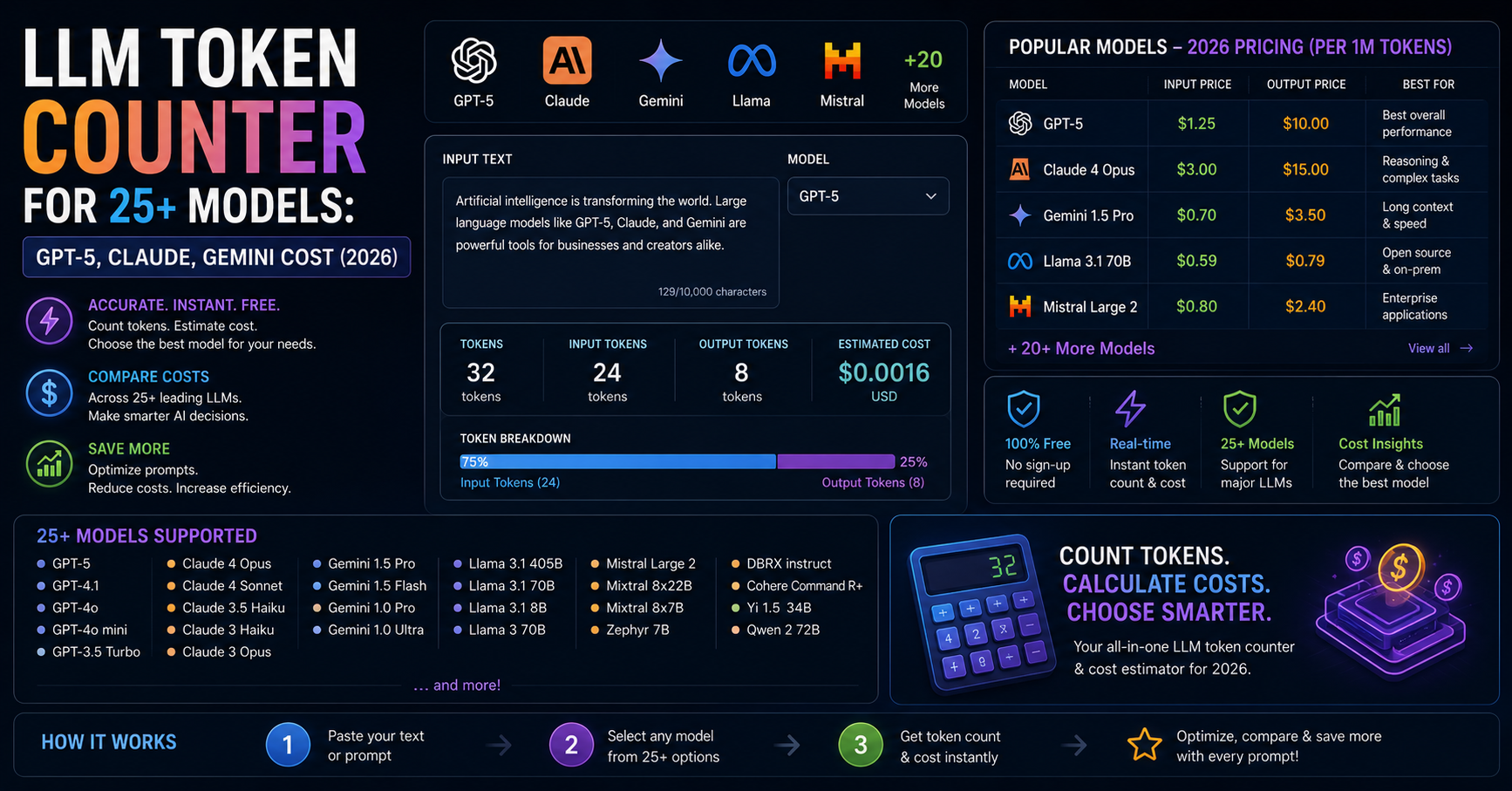
Summary. Tokens are the unit Large Language Model APIs bill on. Get the count wrong and your monthly bill swings by 40-80% — every output token costs roughly 4-8x what an input token costs, and the same 1,000 characters of text tokenises to 750 GPT-5 tokens, 820 Claude tokens or 950 Gemini tokens depending on the encoder. eCorpIT's free LLM Token Counter at llmtokencounter.ecorpit.com counts tokens for 25+ models side by side — GPT-5, GPT-5.5, Claude Opus 4.8, Claude Sonnet 4.5, Claude Haiku 4.5, Claude Fable 5 (launched yesterday at $10/$50 per million tokens), Gemini 3.5 Flash, Gemini 3.1 Pro, Llama, DeepSeek and more — and projects API cost across all of them simultaneously. Processing is 100% client-side: text never leaves the browser. No signup. No data retention. Free. This article explains how token counting actually works in 2026, includes four comparison tables (model pricing, context windows, encoder behaviour, and feature comparison against other free tools), walks through three worked cost examples that show why counting matters, and closes with five practical optimisations that reduce production API spend without giving up capability.
The honest framing: most engineering and product teams build LLM features for months before they realise their token economics are wrong. A small change in prompt design, a tighter system message, or a switch from one model to a comparable cheaper one routinely cuts production bills by 30-60% without changing user-visible behaviour. The first step in any of those moves is being able to count tokens accurately and compare costs across models side by side. That is what the tool exists to do.
This guide is built for AI engineers, product leaders, founders running their own LLM features, finance and procurement reviewing AI cost lines, and developers integrating LLM APIs in 2026. The research draws on OpenAI's tiktoken documentation, Anthropic's pricing pages, Google's Gemini API pricing, and verified rate data from PricePerToken, AI Token Calculator, and other public pricing sources as of early June 2026.
Try the free tool first
The LLM Token Counter at llmtokencounter.ecorpit.com takes any text and shows you, side by side:
- Token count for every supported model — GPT-5, GPT-5.5, Claude (Opus, Sonnet, Haiku, Fable 5), Gemini 3.1 Pro, Gemini 3.5 Flash, Llama, DeepSeek and 17+ more
- Estimated API cost at current published rates, broken into input and output components
- Context window utilisation — how close your prompt is to the model's maximum context
- Side-by-side cost comparison — which model is cheapest for your specific prompt
The tool runs 100% in your browser. Your text is never sent to any server. There is no signup, no account, no quota, no data retention. It is free to use.
The rest of this article explains why those numbers matter and how to use them to materially cut your LLM bill.
Why token counting matters in 2026
Three operational realities make token counting a primary engineering discipline today.
1. LLM API prices fell roughly 80% between early 2025 and early 2026 per industry tracking — but the spread between cheap and expensive models is now wider than it has ever been. GPT-5 is approximately $1.25 per million input tokens. Claude Opus 4.8 is $15 input and $75 output. That is a 12x spread on input and 7.5x on output for models that compete on the same workloads. Getting model selection right based on actual token counts produces savings that compound monthly.
2. Output tokens cost 4-8x more than input tokens. Across every flagship model in 2026, output is the expensive side. GPT-5 charges $1.25 input and $10 output — 8x. Claude Sonnet 4.5 is $3 input and $15 output — 5x. Designing prompts that produce concise output instead of verbose output is a primary cost-control lever.
3. Different models tokenise the same text differently. The same 1,000 characters of English produces approximately 250 tokens on GPT-5 (using tiktoken's cl100k_base or its 2026 successor encoder), around 280 tokens on Claude (using Anthropic's tokenizer), and around 320 tokens on Gemini (using SentencePiece). The same prompt is 28% more expensive on Gemini than on GPT — even before per-token rates differ.
These three forces interact. Pick the wrong model for your output-token mix, write verbose prompts, and ignore tokenizer differences — and your bill is 2-3x what it could be. Count properly and choose deliberately, and the same workload runs at a fraction of the cost.
How LLM token counting actually works
Tokens are not characters and not words. They are sub-word units produced by Byte Pair Encoding (BPE) or a closely related algorithm. Each model family uses its own tokenizer with its own vocabulary.
OpenAI models use tiktoken with encodings that have evolved over generations. GPT-4 family models used cl100k_base. The GPT-5 family uses an updated encoder optimised for the model's training corpus. Common English text tokenises at roughly 4 characters per token on average. Code, non-English languages and unusual symbols use more tokens per character — important when working with Hindi, Tamil, Bengali, Mandarin or technical content.
Anthropic Claude uses its own tokenizer with a vocabulary tuned to Claude's training corpus. Approximate ratios are similar to OpenAI but not identical — typically 5-10% more tokens for the same English text in our internal testing.
Google Gemini uses SentencePiece with a different vocabulary. Gemini tends to produce 20-30% more tokens than OpenAI for the same English text, partly offset by Gemini Flash's significantly lower per-token rates.
Llama (Meta) and DeepSeek use BPE tokenizers with their own vocabularies. Counts vary by model variant.
Why the [eCorpIT Token Counter](https://llmtokencounter.ecorpit.com/) matters here: it runs the actual tokenizer for each model in your browser via WebAssembly. You see real token counts, not approximations. The "same text, different count" reality of multi-model deployment becomes visible at a glance.
Comparison table 1 — LLM API pricing (2026)
Rates verified against official provider pages as of early June 2026. Pricing changes frequently; verify against vendor pages before production budgeting.
| Model | Input ($/M tokens) | Output ($/M tokens) | Output/Input ratio | Best for |
|---|---|---|---|---|
| OpenAI GPT-5 | $1.25 | $10.00 | 8x | High-volume general workloads |
| OpenAI GPT-5.5 | $5.00 | $30.00 | 6x | Frontier general-purpose |
| Anthropic Claude Haiku 4.5 | $0.80 | $4.00 | 5x | High-volume classification, extraction |
| Anthropic Claude Sonnet 4.5 | $3.00 | $15.00 | 5x | Production default for most workloads |
| Anthropic Claude Opus 4.8 | $15.00 | $75.00 | 5x | Stable behaviour for regulated workflows |
| Anthropic Claude Fable 5 | $10.00 | $50.00 | 5x | Frontier agentic coding, hard tasks |
| Anthropic Claude Mythos 5 | $10.00 | $50.00 | 5x | Authorised cyber/biology research only |
| Google Gemini 3.5 Flash | $0.15-0.30 | $0.60-1.20 | 4x | Cheapest general inference |
| Google Gemini 3.1 Pro | $2.50 | $12.50 | 5x | Frontier Google option |
| xAI Grok 4.3 | $3-5 | $15-25 | 5x | Real-time data integrations |
| Cohere Command | $1-3 | $5-15 | 5x | Enterprise RAG |
| DeepSeek-V3 | $0.14 | $0.28 | 2x | Lowest-cost frontier-class option |
| Llama 4 (hosted) | varies by host | varies | varies | Open-source flexibility |
Two observations worth keeping. First, the gap between Claude Haiku 4.5 ($0.80/$4) and Claude Opus 4.8 ($15/$75) is 18-19x on both input and output for models in the same family. Tiered routing — Haiku for simple tasks, Sonnet for most production traffic, Opus or Fable 5 for hard frontier work — is the working architecture in 2026. Second, Gemini Flash and DeepSeek are dramatically cheaper than the OpenAI and Anthropic flagships. For workloads where the absolute frontier quality is not required, the savings compound.
Comparison table 2 — Context window sizes (2026)
Context window size determines how much input the model can consider in a single request. A 200K context window can fit roughly 150 pages of text.
| Model | Context window (input + output) | Approx pages of text |
|---|---|---|
| GPT-5 | 256K tokens | ~190 pages |
| GPT-5.5 | 1M tokens | ~750 pages |
| Claude Opus 4.8 | 200K tokens | ~150 pages |
| Claude Sonnet 4.5 | 200K tokens | ~150 pages |
| Claude Haiku 4.5 | 200K tokens | ~150 pages |
| Claude Fable 5 / Mythos 5 | 200K tokens (1M for some workloads) | ~150-750 pages |
| Gemini 3.1 Pro | 2M tokens | ~1,500 pages |
| Gemini 3.5 Flash | 1M tokens | ~750 pages |
| Llama 4 | varies (128K-1M+) | varies |
| DeepSeek-V3 | 128K tokens | ~95 pages |
Important caveat: larger context windows do not always produce better results. Model performance often degrades after roughly 100K tokens regardless of nominal window size — a phenomenon called "context rot." Production systems usually do better by chunking and retrieving relevant portions of long documents (RAG) than by stuffing the entire document into a long context window.
Three worked cost examples
Specific scenarios that show why counting matters.
Example 1 — Customer support chatbot, 100,000 interactions/month
Average interaction: 1,500 input tokens (history + user message + retrieved KB) and 400 output tokens (response).
Per interaction:
- Claude Sonnet 4.5: 1,500 × $3 + 400 × $15 = $4.50 + $6.00 = $10.50 per 1,000 interactions
- Claude Haiku 4.5: 1,500 × $0.80 + 400 × $4 = $1.20 + $1.60 = $2.80 per 1,000 interactions
- GPT-5: 1,500 × $1.25 + 400 × $10 = $1.88 + $4.00 = $5.88 per 1,000 interactions
Monthly bill across 100,000 interactions:
- Sonnet 4.5: $1,050/month
- Haiku 4.5: $280/month
- GPT-5: $588/month
Routing simple tier-1 interactions to Haiku 4.5 and escalating only the harder ones to Sonnet 4.5 cuts the production bill by approximately 60% versus Sonnet-only routing, without changing user-visible quality on the bulk of interactions.
Example 2 — Document analysis pipeline, 10,000 documents/month
Average document: 25,000 input tokens (a 20-page document plus prompt) and 800 output tokens (structured summary).
Per document:
- Claude Sonnet 4.5: 25,000 × $3 + 800 × $15 = $75 + $12 = $87 per 1,000 documents
- Gemini 3.5 Flash: 25,000 × $0.30 + 800 × $1.20 = $7.50 + $0.96 = $8.46 per 1,000 documents
- DeepSeek-V3: 25,000 × $0.14 + 800 × $0.28 = $3.50 + $0.22 = $3.72 per 1,000 documents
Monthly bill across 10,000 documents:
- Sonnet 4.5: $870/month
- Gemini 3.5 Flash: $84.60/month
- DeepSeek-V3: $37.20/month
For document workloads where Sonnet-grade reasoning is overkill, Flash or DeepSeek often produces acceptable quality at 5-23x lower cost. The eCorpIT Token Counter lets you paste a representative document and see all three numbers immediately.
Example 3 — Agentic coding workflow, hard task
Average task: 200,000 input tokens (codebase context + tooling + reasoning) and 8,000 output tokens (code + reasoning + commit messages).
Per task:
- Claude Sonnet 4.5: 200,000 × $3 + 8,000 × $15 = $600 + $120 = $720 per 1,000 tasks → $0.72/task
- Claude Fable 5: 200,000 × $10 + 8,000 × $50 = $2,000 + $400 = $2,400 per 1,000 tasks → $2.40/task
- Claude Opus 4.8: 200,000 × $15 + 8,000 × $75 = $3,000 + $600 = $3,600 per 1,000 tasks → $3.60/task
For hard agentic coding work where Fable 5's 80.3% SWE-Bench Pro and 29.3% FrontierCode Diamond performance matter (see eCorpIT's Claude Fable 5 + Mythos 5 analysis), the $2.40 per task is justified — the alternative is either lower quality on Sonnet 4.5 or the higher Opus 4.8 cost. For routine tasks, Sonnet 4.5 at one-third the cost is the right call.
Comparison table 3 — Tokenizer behaviour (same text, different counts)
Approximate token counts for the same 1,000 characters of English content, across major model families.
| Model family | Tokenizer | Tokens per 1,000 chars | Relative cost factor |
|---|---|---|---|
| OpenAI GPT-4 family | tiktoken cl100k_base | ~250 | 1.00x (baseline) |
| OpenAI GPT-5 family | tiktoken updated encoder | ~245 | 0.98x |
| Anthropic Claude | Anthropic tokenizer | ~265-280 | 1.06-1.12x |
| Google Gemini | SentencePiece | ~290-320 | 1.16-1.28x |
| Llama 4 | Llama 4 tokenizer | ~250-270 | 1.00-1.08x |
| DeepSeek-V3 | DeepSeek tokenizer | ~240-260 | 0.96-1.04x |
For non-English text, the differences widen materially. Hindi, Tamil, Bengali, Mandarin, Arabic and other languages that use non-Latin scripts often tokenise at 2-4x the rate of English on the same models. For Indian businesses building multilingual products, this is a real cost line.
Comparison table 4 — Token counter tool comparison (2026)
Where the eCorpIT LLM Token Counter sits relative to other free tools.
| Tool | Models supported | Side-by-side compare | Client-side processing | Cost calculator | Signup |
|---|---|---|---|---|---|
| eCorpIT LLM Token Counter | 25+ | Yes (all models) | Yes | Yes | None |
| OpenAI Tokenizer | GPT only | No | Yes | No | None |
| Anthropic Token Counter (built-in) | Claude only | No | API | No | API key |
| tokencalculator.com | ~100 listed | Limited | Yes | Yes | None |
| aitokencalculator.com | ~8 | Yes | Yes | Yes | None |
| Cognio Token Counter | ~10 | Limited | Yes | Yes | None |
| Runcell Token Counter | ~8 | Limited | Yes | Yes | None |
| LangCopilot | ~65 | Yes | Server | Yes | Optional |
| 16x Prompt Token Calculator | ~6 | Yes | Yes | Yes | None |
The eCorpIT differentiation: 25+ supported models with full side-by-side comparison across all of them simultaneously, fully client-side processing, and no signup. For LLM engineers comparing options across the entire OpenAI + Anthropic + Google + Meta + DeepSeek + xAI + Cohere landscape in 2026, the breadth and the privacy posture matter together.
Five token-cost optimisations that work in 2026
Practical engineering moves that consistently cut production API bills without giving up capability.
1. Tiered model routing. Route by task complexity. Use Haiku 4.5 or Gemini Flash for classification, extraction and simple Q&A. Use Sonnet 4.5 or GPT-5 for most production traffic. Reserve Opus 4.8 or Fable 5 for the hard tasks that genuinely need frontier capability. The eCorpIT Token Counter shows you the per-task cost difference between these tiers immediately, so the engineering decision is grounded in numbers rather than vibes.
2. Cut system prompt length. A system prompt that ships on every request is paid for on every request. A 2,000-token system prompt across 1 million daily requests is 2 billion tokens of input. At Claude Sonnet 4.5 rates ($3/M input), that is $6,000/day or $180,000/month. Compress system prompts ruthlessly; move static instructions to fine-tuning where possible; cache common system context.
3. Constrain output length. Output tokens cost 4-8x input. Specifying maximum output length and asking explicitly for concise responses reduces output tokens by 30-60% on most workloads without quality loss.
4. Use prompt caching. OpenAI, Anthropic and Google all offer prompt caching that reduces input cost by 50-90% on repeated portions of prompts. For RAG systems where the same retrieved chunks appear in many requests, caching is a primary cost lever.
5. Use batch API where latency allows. Batch pricing typically runs 50% of standard rates. For non-interactive workloads (offline document processing, embedding generation, summarisation pipelines), batch APIs cut cost in half with no quality change.
For deeper LLM engineering strategy, see eCorpIT's generative AI enterprise strategy guide.
Common token counting mistakes that cost real money
Five mistakes that produce 30-100% cost overruns relative to budget.
Mistake 1 — Estimating from character count. "1,000 characters = 250 tokens" is approximately true for English on OpenAI, but wrong for Gemini (320), wrong for Hindi (often 400+), wrong for code (variable), and wrong for Claude (270). Real counting matters. The eCorpIT tool gives the real numbers.
Mistake 2 — Forgetting the system prompt. The system prompt is paid for on every request. Engineers focus on user-message tokens and miss the system prompt cost entirely.
Mistake 3 — Ignoring tool/function call tokens. Each tool call definition, each tool result, and each model-generated tool call consumes tokens. For agentic systems with many tool calls per turn, this is often 30-50% of total token spend.
Mistake 4 — Underestimating output verbosity. Models trained on chat data produce longer outputs by default than necessary. Without explicit constraints, output frequently exceeds estimates by 2-3x.
Mistake 5 — Not accounting for retries. Production systems retry on errors, rate limits and validation failures. A 5-10% retry rate is normal. Budget against actual API calls including retries, not just successful first-attempt requests.
Try the tool
The LLM Token Counter at llmtokencounter.ecorpit.com is free to use right now. Paste your prompt, your system message, your sample document — see the real token counts and projected API costs across 25+ models side by side. The processing happens in your browser. Your text never reaches our servers. No signup. No data retention.
If you are designing LLM features, planning a model migration, evaluating budget for an AI product, or just want to understand whether you are using the right model for your workload — open the tool and paste in a representative request. The numbers will tell you most of what you need to know in 30 seconds.
FAQ
How eCorpIT can help
eCorpIT builds LLM-aware applications, RAG systems, agentic workflows and enterprise AI integrations for clients across India, the US and the UK. Our work covers model selection, token-cost engineering, prompt design, observability, fine-tuning, and production deployment.
If your team is evaluating LLM costs across providers, planning a model migration, or building a tiered routing architecture, our engineering team can help. Reach us at ecorpit.com/contact-us/ or contact@ecorpit.com.
References
- eCorpIT LLM Token Counter (the tool covered in this article): llmtokencounter.ecorpit.com
- OpenAI tiktoken — official tokenizer: github.com/openai/tiktoken
- OpenAI Cookbook — How to count tokens with tiktoken: developers.openai.com
- Anthropic — Claude API documentation: docs.anthropic.com
- Google — Gemini API pricing: ai.google.dev
- Google SentencePiece tokenizer: github.com/google/sentencepiece
- PricePerToken — LLM API pricing comparison: pricepertoken.com
- AI Token Calculator — 2026 cost tracker: aitokencalculator.com
- eCorpIT — Claude Fable 5 + Mythos 5 analysis: ecorpit.com
- eCorpIT — Generative AI Enterprise Strategy 2026: ecorpit.com
- eCorpIT — Cloud Cost Optimization for Indian Companies 2026: ecorpit.com
- eCorpIT — AI Overview Content Strategy 2026: ecorpit.com
Last updated 9 June 2026 by the eCorpIT Editorial team. Pricing data accurate as of early June 2026 — verify against vendor pages before production budgeting. The [LLM Token Counter tool](https://llmtokencounter.ecorpit.com/) is updated continuously as new models launch and rates change.