On this page · 10 sections
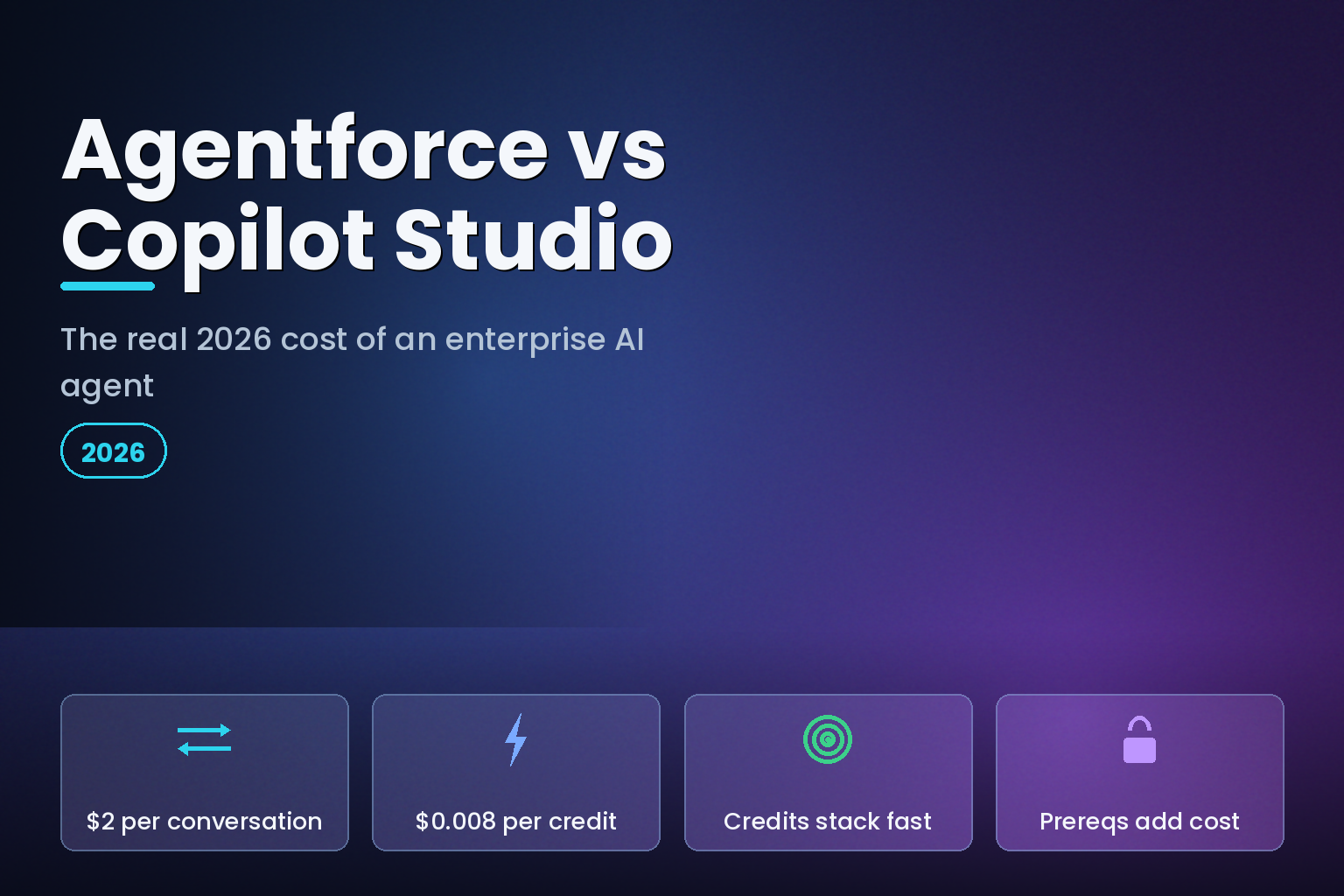
Summary. Salesforce Agentforce and Microsoft Copilot Studio price the same job, an enterprise AI agent, in units that do not compare on paper. Agentforce charges $2 per conversation, or 20 Flex Credits ($0.10) per action, or $125 to $150 per user per month for a named license. Copilot Studio charges in Copilot Credits: $200 for a 25,000-credit pack ($0.008 each) prepaid, or $0.01 each pay-as-you-go through Azure. At a moderate interaction, Copilot Studio can land near $0.18 while an Agentforce conversation stays at $2.00, roughly an 11x gap. That headline reverses once you count prerequisites: Agentforce usually needs Service Cloud plus a Data Cloud subscription that lists around $60,000 a year, while Copilot Studio assumes you already pay for the Microsoft 365 and Power Platform tenant it runs on. Gartner expects more than 40% of agentic AI projects to be canceled by the end of 2027, and cost surprises are a named reason. This guide gives you the break-even math, a cost-at-scale table, and the fine print each vendor buries.
The unit mismatch is the whole problem. A buyer who compares "$2" against "$0.008" and stops there will pick the wrong platform. The right question is not which sticker is smaller. It is: at your interaction volume and complexity, and given what you already license, which billing model produces the lower and more predictable annual bill? That answer changes at a specific break-even point, and both vendors have a strong incentive to keep you from finding it.
This piece sits inside our work on enterprise AI agents in production. If you are still deciding whether to build the agent yourself or licence a platform at all, start with the build versus buy math for an AI support agent; this article assumes you have decided to buy and are choosing between the two dominant suites.
Two pricing philosophies, not two price tags
Agentforce prices the outcome. Salesforce meters a "conversation" or an "action," the unit a business person recognises, and the pitch is that you pay for digital labour that resolves a case. Copilot Studio prices the machinery. Microsoft meters a "credit" that is consumed by the specific operations an agent performs, so a simple answer is cheap and a grounded, multi-step action is not.
Neither approach is wrong. They optimise for different buyers. Conversation pricing is easy to forecast and easy to expense, which suits a customer-experience leader who wants one number per resolved case. Credit metering rewards architectural discipline, which suits an engineering team that can keep interactions lean. The trap is assuming your organisation behaves like the buyer the pricing was designed for.
Gartner's Anushree Verma, Senior Director Analyst, put the risk plainly when the firm published its 2027 forecast: "Most agentic AI projects right now are hype-driven experiments or proof of concepts." Pilots hide cost behaviour. A demo runs a handful of clean interactions; production runs millions of messy ones, and the billing unit you chose in the pilot decides whether that scale is affordable.
What Agentforce actually costs in 2026
Salesforce runs three concurrent pricing models for Agentforce, and they coexist on purpose so a buyer can pick the shape that matches their usage.
The first is conversation pricing at $2 per conversation. This model is the easiest to budget and remains available in 2026, purchased through standard Salesforce contracting rather than a self-serve meter. A "conversation" is a bounded exchange that resolves an intent, however many steps it takes inside.
The second is Flex Credits, a consumption model. A standard Agentforce action costs 20 Flex Credits and a voice action costs 30, and credits sell at $500 per 100,000. That works out to $0.005 per credit, so a standard action is $0.10 and a voice action is $0.15. The official Salesforce Flex Credits rate card is dated 21 April 2026, which is the number to quote in a contract, not a blog estimate.
The third is per-user licensing, framed by Salesforce as "digital labour." Agentforce add-ons start around $125 to $150 per user per month, and the higher Agentforce 1 editions list at $550 or more per user per month. This is a flat-fee alternative for teams that dislike usage-based billing entirely.
The number that decides between the first two models is simple. Twenty actions in Flex Credits cost 20 × $0.10 = $2.00, exactly one conversation. So if your average conversation runs fewer than 20 billable actions, Flex Credits are cheaper; if it runs more, conversation pricing wins. Most well-scoped service agents sit below that line, which is why Salesforce introduced Flex Credits as the flexible default.
Then there is the part that does not appear on the agent pricing page. Agentforce is a layer on the Salesforce platform, and useful agents generally need Service Cloud Enterprise Edition or higher, plus Data Cloud (now branded Data 360) to unify the records the agent reasons over. The Data 360 Starter SKU lists around $60,000 a year and routinely grows into six figures as data volume rises. Salesforce has loosened the hard requirement so basic agents can run on standard CRM data, but a production customer-service agent that grounds on unified profiles is a different story. Add a systems integrator at $50,000 to $150,000 for the build and a 5.5 to 11 month rollout, and the "$2 a conversation" headline is only the marginal cost on top of a substantial platform commitment.
| Agentforce model | Unit and 2026 rate | Best fit |
|---|---|---|
| Conversation | $2.00 per conversation | High-step conversations, simple budgeting |
| Flex Credits | 20 credits ($0.10) per action; $500 per 100,000 credits | Lean agents under 20 actions per conversation |
| Per-user (digital labour) | $125 to $150 per user per month; Agentforce 1 from $550 | Fixed headcount, predictable flat fee |
| Data 360 prerequisite | Data 360 Starter about $60,000 per year | Grounding on unified customer data |
| Implementation | Systems integrator $50,000 to $150,000; 5.5 to 11 months | First production rollout |
What Copilot Studio actually costs in 2026
Microsoft renamed the Copilot Studio billing unit from "messages" to "Copilot Credits" on 1 September 2025, and the shift matters because credits are spent per feature, not per message. You buy capacity two ways: a prepaid pack of 25,000 credits for $200 a month, which prices a credit at $0.008, or pay-as-you-go through Azure at $0.01 per credit with no upfront commitment. There is also a licensed-user carve-out: internal agents used by people who already hold a Microsoft 365 Copilot licence consume no credits for classic answers, generative answers, grounding, or actions inside Teams and SharePoint.
The cost of a single interaction depends entirely on what the agent does. Microsoft's published consumption rates make the mechanics concrete.
| Copilot Studio operation | Copilot Credits | Cost at $0.008 |
|---|---|---|
| Classic (scripted) answer | 1 | $0.008 |
| Generative answer | 2 | $0.016 |
| Agent action | 5 | $0.040 |
| Microsoft Graph tenant grounding | 10 | $0.080 |
| Generative answer + grounding + 2 actions | 22 | $0.176 |
| AI tools, standard | 1.5 per 1,000 tokens | $0.012 per 1K tokens |
| Content processing | 8 per image or page | $0.064 |
Read the fifth row carefully, because it is where budgets break. A scripted answer costs 1 credit. The moment an interaction becomes genuinely agentic, one generative answer that grounds on Microsoft Graph and fires two actions, it costs 22 credits, 22 times more. Microsoft states that a single interaction can consume anywhere from 1 to 200 or more credits depending on architecture. That variance is the real Copilot Studio pricing story: the platform is cheap when agents are simple and stops being cheap the instant they do the work you actually bought them for.
The cost-at-scale comparison
Here is the same workload priced across both platforms. The assumptions are stated so you can re-run them with your own numbers: an "external interaction" is one resolved customer conversation; the Copilot Studio interaction is modelled as one generative answer, one Microsoft Graph grounding, and two actions (22 credits, $0.176 prepaid or $0.22 pay-as-you-go); the Agentforce Flex interaction is modelled as 10 billable actions ($1.00); the Agentforce conversation rate is the flat $2.00. Prerequisite costs are listed separately because they do not scale per interaction.
| Annual external interactions | Agentforce conversation ($2.00) | Agentforce Flex ($1.00) | Copilot Studio prepaid ($0.18) | Copilot Studio PAYG ($0.22) |
|---|---|---|---|---|
| 100,000 | $200,000 | $100,000 | $17,600 | $22,000 |
| 1,000,000 | $2,000,000 | $1,000,000 | $176,000 | $220,000 |
| 10,000,000 | $20,000,000 | $10,000,000 | $1,760,000 | $2,200,000 |
| Recurring prerequisite | Data 360 about $60,000/yr + Service Cloud seats | Same | Existing Microsoft 365 / Power Platform tenant | Same |
| First-year setup | Integrator $50,000 to $150,000 | Same | Lower if the tenant already exists | Same |
On usage alone, Copilot Studio is dramatically cheaper per interaction, and the gap widens with volume. That is real, and for a high-volume, well-architected agent it is the single most important number in this article. But three caveats decide whether the table reflects your reality.
First, the Copilot Studio figure assumes disciplined architecture. If your agents grow to 60 or 120 credits per interaction, which the 1-to-200 range explicitly allows, the prepaid column triples or sextuples and the gap to Agentforce narrows fast. Second, Agentforce buys depth that a raw credit count does not capture: native grounding on unified CRM data through Data 360, and a supported path from case to resolution inside Service Cloud. Third, the prerequisite rows are not symmetric. Agentforce adds a Data Cloud line item most teams did not budget for; Copilot Studio leans on Microsoft 365 licences a large enterprise usually already pays, which can make its true marginal cost near zero for internal, licensed-user agents.
The hidden costs each vendor does not lead with
The sticker price is the part both vendors will quote you. The bill is the part they will not.
For Agentforce, the buried cost is the platform underneath it. Data 360 at roughly $60,000 a year is the common surprise, followed by Service Cloud seat counts and a systems-integrator engagement measured in months, not weeks. None of that shows up next to "$2 per conversation," yet it dominates year-one spend. If your organisation is not already a committed Salesforce customer, Agentforce is a platform decision wearing an agent's clothes.
For Copilot Studio, the buried cost is credit stacking and prediction. Because features accumulate inside one interaction, the difference between a 1-credit answer and a 22-credit action is invisible until the invoice arrives, and it is driven by design choices your builders make, not by a plan you selected. Grounding on Microsoft Graph alone is 10 credits, more than a full generative answer with two actions minus the grounding. Teams that treat grounding as free will overspend. This is exactly the failure Gartner flagged: agentic projects canceled because escalating, unforecast cost outran unclear business value.
There is also a governance cost neither pricing page mentions. An enterprise agent that touches customer records needs guardrails, evaluations, and an audit trail regardless of platform, which is why we treat enterprise AI agent governance layers as part of the total cost rather than an afterthought. Budget for it on either platform or pay for it in incidents.
Which platform fits which buyer
The decision is less about price per unit and more about where your organisation already lives and how complex your interactions are.
Choose Agentforce if Salesforce is already your system of record, your agents resolve high-value cases where a predictable $2 per conversation is easy to expense, and you want the agent grounded natively on unified CRM data without building the plumbing yourself. The prerequisite cost is real, but for an existing Service Cloud shop much of it is already paid.
Choose Copilot Studio if your organisation runs on Microsoft 365, many of your agents are internal and used by licensed employees (where interactions can cost nothing), and your builders can keep interactions architecturally lean. The credit model rewards that discipline with the lowest usage cost in this comparison. It punishes teams that cannot enforce it.
Choose neither, yet, if you have not modelled your real interaction complexity. The wider enterprise AI agent platform landscape includes options from Amazon and Google, and the underlying model choice, covered in our comparison of the models that power enterprise agents, affects both cost and quality. A one-week measurement of steps-per-interaction on a real workload is cheaper than a year on the wrong meter.
India-specific considerations
Both platforms price in US dollars for Indian buyers, so the per-conversation and per-credit rates above apply directly; the lever Indian teams control is implementation cost, not licence cost. A systems-integrator engagement built and run from India typically lands well below equivalent US rates, which materially lowers the Agentforce first-year setup line without changing the recurring platform fee.
Data residency and the Digital Personal Data Protection Act 2023 shape the build more than the bill. An agent that grounds on customer records is processing personal data, so consent, purpose limitation, and breach handling under the DPDP Act apply to whichever platform you choose. Confirm the region where Data 360 or the Power Platform tenant stores and processes data before you sign, and design the agent's data flows aligned with DPDP requirements from the first sprint rather than retrofitting them after go-live.
FAQ
How eCorpIT can help
eCorpIT is a Gurugram-based, ISO 27001:2022-certified engineering organisation that helps enterprises cost, build, and govern AI agents on both Salesforce and Microsoft stacks. We run a short measurement engagement first, sampling your real interaction complexity so the pricing model you pick matches how your agents actually behave, then design the data flows aligned with DPDP Act 2023 requirements. If you want a vendor-neutral read before you sign, our senior teams can model your Agentforce and Copilot Studio bills side by side and take the winning design from pilot to production. Talk to us through our contact page.
References
- Salesforce Agentforce Pricing — Salesforce, accessed July 2026.
- Agentforce Flex Credits Rate Card, 21 April 2026 (PDF) — Salesforce.
- Salesforce Introduces New Flexible Agentforce Pricing — Salesforce Newsroom.
- Flexible Pricing is a Full Circle Moment for Salesforce — Salesforce blog.
- Salesforce Agentforce setup cost: 2026 pricing breakdown — eesel AI (Data 360 prerequisite and rollout).
- Microsoft 365 Copilot pricing: Copilot Studio — Microsoft.
- Copilot Studio pay-as-you-go pricing — Microsoft Azure.
- Microsoft Copilot Studio Pricing in 2026: Credits, Plans, and Cost at Scale — CloudZero (credit consumption rates).
- Copilot Studio Licensing Guide: Credits, Costs, Agents — SAMexpert (September 2025 credits rename).
- Gartner Predicts Over 40% of Agentic AI Projects Will Be Canceled by End of 2027 — Gartner (Anushree Verma quote).
_Last updated: 31 July 2026._