On this page · 10 sections
- The two launches that reset the question
- Pricing: what each model costs to run an agent
- Agentic performance: the benchmarks that matter
- Availability and enterprise procurement
- Governance: the part that decides production
- How to choose: a working framework
- India-specific considerations
- How eCorpIT can help
- FAQ
- References
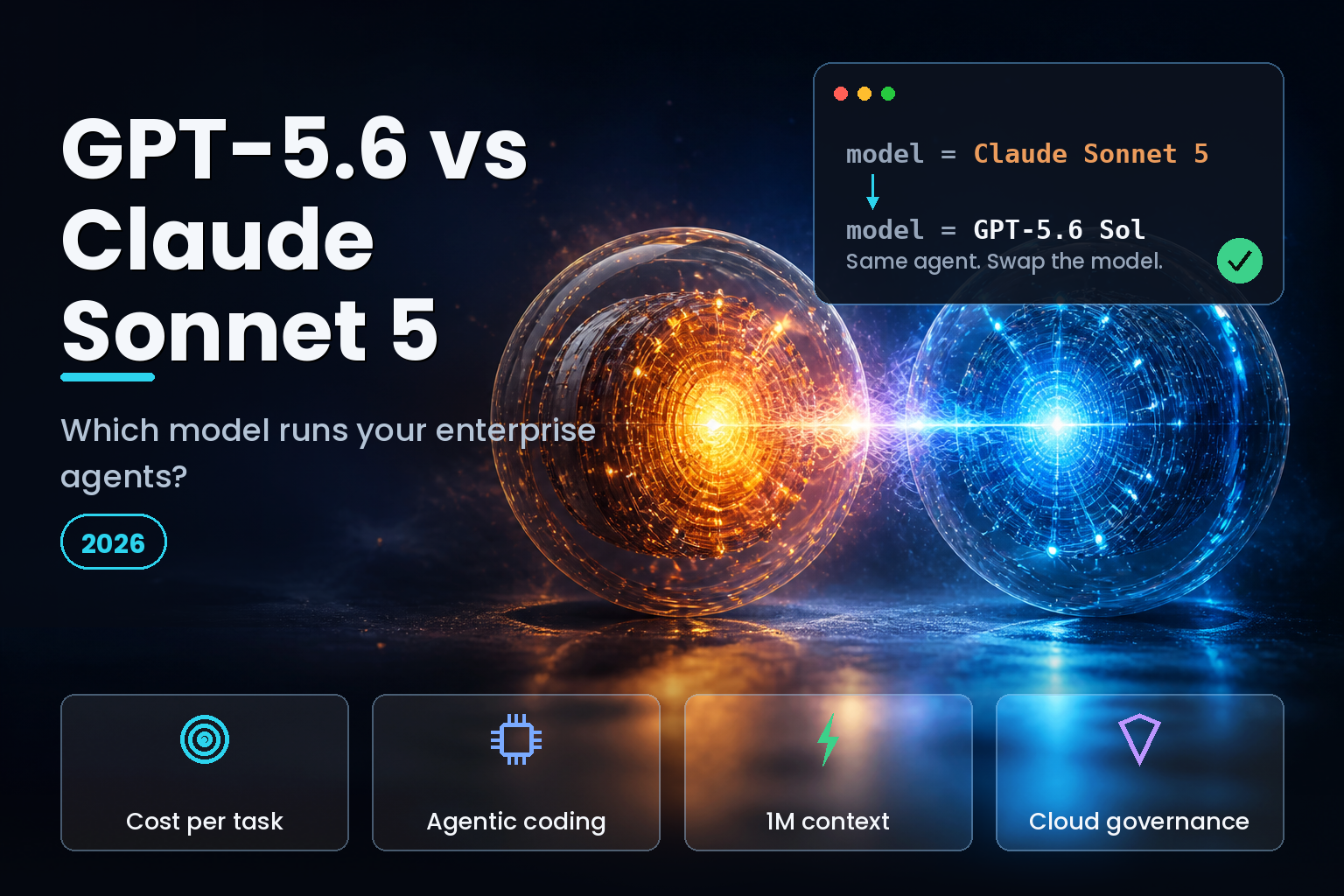
Summary. Two model families landed nine days apart. Anthropic released Claude Sonnet 5 on 30 June 2026 at $2 per million input tokens and $10 per million output tokens (introductory, through 31 August 2026), rising to $3 and $15 from 1 September. OpenAI made GPT-5.6 generally available on 9 July 2026 in three tiers: Sol at $5/$30 per million tokens, Terra at $2.50/$15, and Luna at $1/$6. Both are the most agentic models their makers have shipped. Claude Sonnet 5 scores 85.2% on SWE-bench Verified; GPT-5.6 Sol scores 88.8% on Terminal-Bench 2.1. For enterprise teams running production agents, the decision now turns on cost per task, availability inside your cloud, and the governance controls around each model, not on a single leaderboard number.
If you run AI agents at any scale, the token bill and the procurement path matter more than a benchmark victory lap. This comparison sets out what each model costs, how each performs on agentic work, where you can actually deploy it today, and how to choose. Every figure below is dated and sourced.
The two launches that reset the question
The timing was tight. Anthropic shipped Claude Sonnet 5 on 30 June 2026 and described it as its most agentic Sonnet-class model, an upgrade to Sonnet 4.6 that narrows the gap to the larger Opus 4.8 on reasoning, tool use, and coding, as TechCrunch reported. Nine days later, on 9 July 2026, OpenAI moved GPT-5.6 to general availability after a US government security review, as CNBC covered.
GPT-5.6 had an unusual path to launch. OpenAI previewed it on 26 June 2026 and, at the request of US officials, limited early access to roughly 20 vetted organisations before the broad rollout, according to VentureBeat. That history matters for planning: a model that was gated to a handful of partners two weeks ago is a different procurement risk from one that has been broadly available for months.
Both vendors point the same way. The headline is no longer raw intelligence; it is running long, tool-using agents cheaply and safely enough to put in front of customers. For a fuller picture of that shift, see our guide to enterprise AI agents in production.
Pricing: what each model costs to run an agent
Agents are token-hungry. A single autonomous task can chain dozens of model calls, so the per-token rate compounds fast. Here is the published API pricing as of July 2026.
| Model and tier | Input ($ / million tokens) | Output ($ / million tokens) |
|---|---|---|
| Claude Sonnet 5 (introductory, to 31 Aug 2026) | $2.00 | $10.00 |
| Claude Sonnet 5 (standard, from 1 Sep 2026) | $3.00 | $15.00 |
| GPT-5.6 Sol | $5.00 | $30.00 |
| GPT-5.6 Terra | $2.50 | $15.00 |
| GPT-5.6 Luna | $1.00 | $6.00 |
Sources: Anthropic and Finout.
The raw rates only tell part of the story. Claude Sonnet 5's introductory price sits below GPT-5.6 Sol and matches the mid-tier Terra closely, but the effective cost depends on how many tokens a task consumes. Anthropic's own move to adaptive thinking with selectable effort levels means an agent can burn more output tokens when it reasons harder. Independent testing bears this out: Artificial Analysis, reported by TechCrunch, measured an average task at $2.29 on Sonnet 5 at standard pricing, against roughly $1.20 for the older Sonnet 4.6 and $1.97 for the more expensive Opus 4.8. A cheaper per-token rate can still produce a higher per-task bill if the model thinks longer.
GPT-5.6 adds cost controls that favour heavy agent workloads. It introduced more predictable prompt caching with explicit cache breakpoints and a 30-minute minimum cache life; cache reads keep the 90% cached-input discount, while cache writes bill at 1.25 times the uncached input rate, as documented by MarkTechPost and Simon Willison. For an agent that reuses a large system prompt across many calls, caching can cut the real bill well below the sticker rate. If you want a method for measuring this, our note on free tools to track LLM spend walks through per-task accounting.
Agentic performance: the benchmarks that matter
Coding and long-horizon tool use are the workloads most enterprise agents actually do. The two families trade wins depending on the test.
| Benchmark | Claude Sonnet 5 | GPT-5.6 Sol |
|---|---|---|
| SWE-bench Verified | 85.2% | Not the headline metric |
| SWE-bench Pro | 63.2% | Not published at launch |
| Terminal-Bench 2.1 (agentic coding) | Not the headline metric | 88.8% (base); 91.9% (Sol Ultra) |
| Agents' Last Exam (55 professional fields) | Not published at launch | 53.6 |
| Context window | 1,000,000 tokens with compaction | Large, tiered by model |
Sources: llm-stats, OpenAI, and MarkTechPost.
Read the table with care, because the two vendors report different headline tests. Claude Sonnet 5 leads with SWE-bench: 85.2% on SWE-bench Verified, 63.2% on SWE-bench Pro, and 78.3% on SWE-bench Multilingual, per llm-stats. GPT-5.6 Sol leads with Terminal-Bench 2.1, where the base model scored 88.8% and the Sol Ultra configuration reached 91.9%, edging Claude Mythos 5 at 88.0%, as OpenAI and Simon Willison documented. On Agents' Last Exam, a test of long-running workflows across 55 professional fields, GPT-5.6 Sol set a high of 53.6.
The practical read: both models clear the bar where a year ago you needed a far larger, costlier model. Claude Sonnet 5's 1M-token context with context compaction suits agents that carry long histories or large codebases. GPT-5.6's programmatic tool calling in the Responses API and its native multi-agent pattern, which lets the model spin up subagents for parallel work, suit orchestration-heavy designs. Pick the benchmark that matches your workload rather than the bigger poster number.
Availability and enterprise procurement
Where you can run the model, and under whose billing and governance, often decides the contract faster than any benchmark. This is where the two diverge most.
Claude Sonnet 5 reached general availability in Microsoft Foundry on 1 July 2026, so teams can call it through an existing Azure account with Azure-native authentication via Entra ID, billing, networking, and data controls, per the Microsoft Foundry blog. Steve Sweetman, an Azure product lead at Microsoft, framed the reason plainly: most enterprise AI projects stall because of "everything around the model: procurement, governance, networking, and data." Running a frontier model inside your existing cloud tenancy removes a large part of that friction.
There is a regional catch. Reporting from InfoQ noted that the Foundry general availability did not immediately extend deployment to European enterprises, so buyers in the EU should confirm regional availability before they commit.
GPT-5.6 reaches most teams through OpenAI's own channels. In ChatGPT, Plus, Pro, Business, and Enterprise users can select GPT-5.6 Sol at medium and higher effort settings, Pro and Enterprise users can pick Sol Pro for the hardest tasks, and Free and Go users get Terra. The three-tier API gives developers a clear cost-versus-capability dial.
| Procurement dimension | Claude Sonnet 5 | GPT-5.6 |
|---|---|---|
| First-party API | Anthropic API | OpenAI API |
| Major cloud marketplace | GA in Microsoft Foundry (1 Jul 2026) | OpenAI channels; check your cloud |
| Native cloud auth and billing | Azure Entra ID and Azure billing via Foundry | OpenAI account; enterprise agreements |
| Access history | Broad since launch | Gated to ~20 partners 26 Jun to 9 Jul 2026 |
| Regional gaps to check | EU deployment via Foundry pending | Staged global rollout from 9 Jul 2026 |
Sources: Microsoft Foundry, InfoQ, and VentureBeat.
Governance: the part that decides production
Most agent pilots stall before production, and the blocker is rarely the model. It is evaluation gaps, integration cost, and governance friction. Both models give you material to build controls around, but the shape differs.
For GPT-5.6, the practical guidance from administrators and security teams is to allow the model only through controlled pilots, approved use cases, logging, data restrictions, human review, and rollback plans, as covered in enterprise rollout reporting. That advice reads as common sense, but the government-gated launch history makes a staged rollout more than a formality here.
For Claude Sonnet 5, Anthropic reported an overall lower rate of undesirable behaviours than Sonnet 4.6 and said the model is generally safer to use in agentic contexts. Deploying through Microsoft Foundry also means your existing Azure governance, logging, and network controls apply, which shortens the security review. Either way, the model is one component; the guardrails around tool access and data are where the real work sits. Our guide to prompt-injection guardrails for AI agents covers the failure modes that matter once an agent can touch real systems.
How to choose: a working framework
Skip the leaderboard war and answer four questions in order.
First, where must it run? If your data and compliance posture keep you inside Azure, Claude Sonnet 5's Foundry general availability is a strong reason to start there, subject to the EU deployment check. If you are already standardised on OpenAI, GPT-5.6's tiered family fits without new vendor onboarding.
Second, what does a task cost end to end? Do not compare sticker rates. Run your own agent on a representative task and measure tokens and dollars per completed job, including caching. GPT-5.6's caching design rewards agents that reuse large prompts; Claude Sonnet 5's adaptive thinking can raise per-task cost when it reasons harder.
Third, what is the workload shape? Long-context, codebase-heavy agents map well to Claude Sonnet 5's 1M-token window. Orchestration-heavy designs with parallel subtasks map well to GPT-5.6's native multi-agent and programmatic tool calling.
Fourth, what is your risk tolerance on newness? GPT-5.6 went broadly available on 9 July 2026 after a gated preview; Claude Sonnet 5 has been openly available since 30 June 2026. Neither is old. Stage both behind evaluation harnesses before you route production traffic. For the strategic context around these choices, see our generative AI enterprise strategy guide.
India-specific considerations
For teams in India, two factors sharpen the decision. The first is cost in local terms: at Claude Sonnet 5 introductory pricing, a workload that consumes one million input and one million output tokens costs about $12, roughly ₹1,000 at mid-2026 exchange rates, before caching. Agent workloads that loop many times turn small per-call figures into meaningful monthly bills, so per-task measurement is not optional.
The second is data governance under the Digital Personal Data Protection Act, 2023 (DPDP). If your agents process personal data of Indian users, the deployment path matters as much as the model. Running Claude Sonnet 5 inside a governed Azure tenancy, or GPT-5.6 under an enterprise agreement with clear data-handling terms, makes the compliance story easier to defend than calling a consumer endpoint. Confirm data residency and retention terms with the vendor before you move any regulated workload.
How eCorpIT can help
eCorpIT is a Gurugram-based, senior-led technology consultancy that builds and ships production AI agents, not proof-of-concept demos. We run model bake-offs on your real workloads, measure cost per completed task across Claude Sonnet 5 and GPT-5.6, and stand up the evaluation harnesses and guardrails that decide whether a pilot reaches production. If you are choosing a model for enterprise agents, talk to our team and we will help you test both against your own data before you commit.
FAQ
References
_Last updated: 10 July 2026._