On this page · 12 sections
- Why uniform governance is the wrong starting point
- Layer 1: Accountability and the operating model
- Layer 2: Agent inventory and risk classification
- Layer 3: Identity and least-privilege access
- Layer 4: Threat and security controls
- Layer 5: Data governance and privacy
- Layer 6: Observability, logging, and audit
- Layer 7: Human oversight and lifecycle control
- India-specific considerations
- FAQ
- How eCorpIT can help
- References
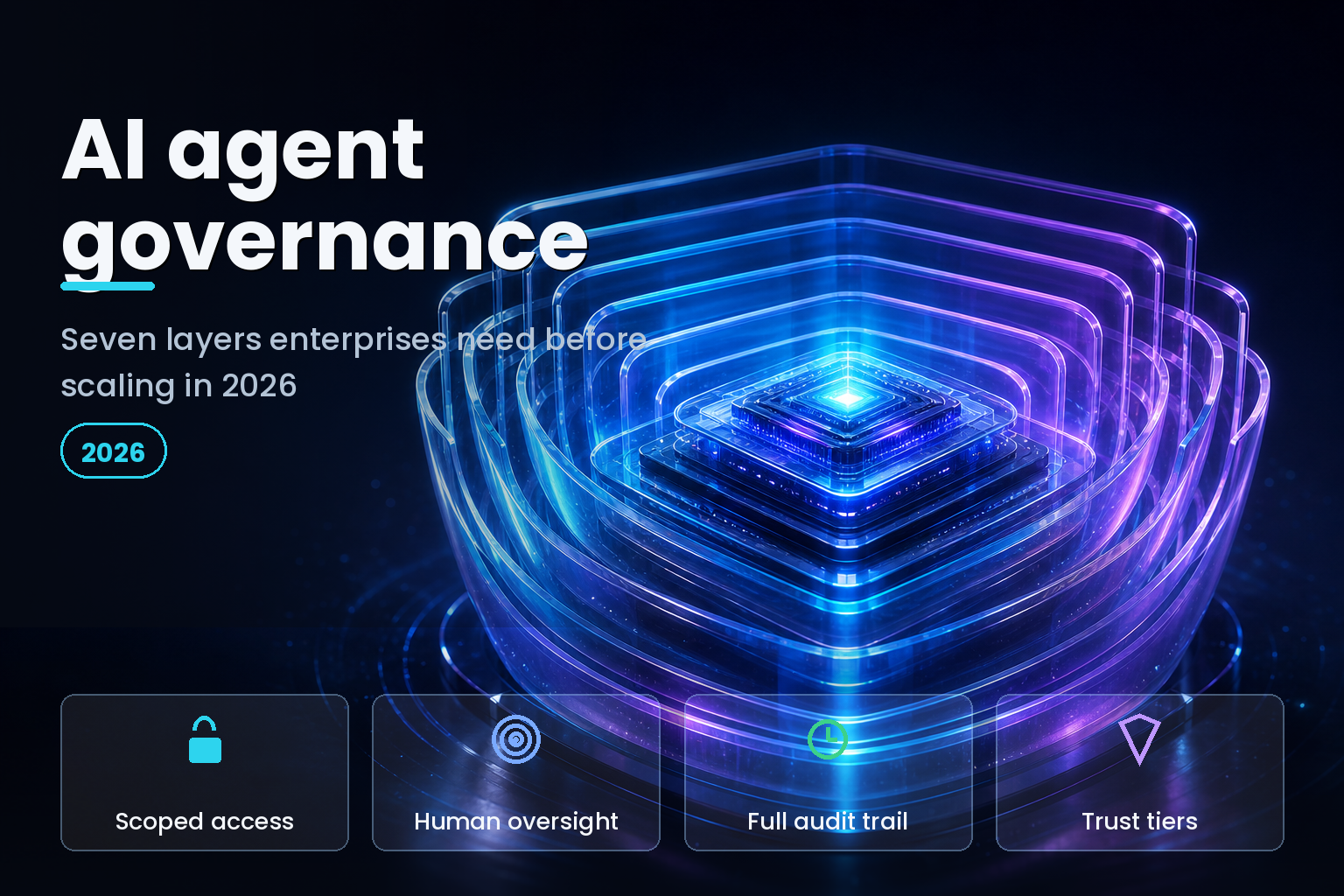
Summary. Enterprises are pushing AI agents into production faster than the controls around them. Gartner expects more than 40% of agentic AI projects to be canceled by the end of 2027 on cost, unclear value, or weak risk controls, even as it forecasts 40% of enterprise applications will embed task-specific agents by the end of 2026, up from under 5% in 2025. The gap between those two numbers is governance. By 2027, Gartner also expects 40% of enterprises to demote or decommission autonomous agents after governance gaps surface in production. Identity is already stretched: CyberArk counted 82 machine identities for every human in October 2025, and 42% of them hold privileged or sensitive access. Regulators have set dates. EU AI Act obligations for high-risk systems apply from 2 August 2026, with fines up to €35 million or 7% of global turnover. India notified its Digital Personal Data Protection Rules on 13 November 2025, with penalties up to ₹250 crore. This guide sets out seven governance layers, each tied to a current framework, that an enterprise needs in place before it scales agents.
An AI agent is software that plans, calls tools, and takes actions toward a goal with limited human input. That autonomy is the point, and it is also the risk. A chatbot returns text. An agent can write to a database, send an email, move money, or change a configuration. When an agent acts on the wrong instruction, the damage is real, not a bad paragraph.
The market is moving anyway. Gartner's February 2026 research puts spending on AI governance platforms at roughly $492 million in 2026, on a path past $1 billion by 2030, as regulation pushes controls from optional to mandatory. The companies that scale agents safely in 2026 are the ones treating governance as engineering, not paperwork.
Why uniform governance is the wrong starting point
The common mistake is to write one agent policy and apply it to everything. Gartner's May 2026 analysis is blunt about where that leads. "Enterprises are treating AI agent governance as binary, either locked down or fully trusted, and that is the root cause of failure," said Shiva Varma, Senior Director Analyst at Gartner. Identical controls over-restrict simple agents, which slows delivery and pushes teams into shadow projects, and under-restrict autonomous ones, which raises operational, security, and compliance risk.
The fix is to classify each agent by what it can actually do, then size the controls to match. A read-only agent that summarizes documents does not need the same gates as an agent that can execute payments. The seven layers below are the structure. Adaptive trust tiers, covered in layer two, are how you apply each layer at the right strength.
The cost of skipping this is documented. Anushree Verma, Senior Director Analyst at Gartner, notes that "most agentic AI projects right now are early stage experiments or proof of concepts that are mostly driven by hype and are often misapplied." Weak governance is how a misapplied experiment becomes a production incident, and a production incident is how a useful agent gets switched off.
Here is the full stack at a glance.
| Governance layer | What it governs | Anchor standard or regulation |
|---|---|---|
| 1. Accountability and operating model | Ownership, policy, and decision rights | NIST AI RMF (Govern), ISO/IEC 42001 |
| 2. Agent inventory and risk classification | Which agents exist and how risky each is | EU AI Act risk tiers, Gartner trust tiers |
| 3. Identity and least-privilege access | What systems and data each agent may reach | OWASP ASI, CyberArk machine identity guidance |
| 4. Threat and security controls | Prompt injection, tool misuse, code execution | OWASP Top 10 for Agentic Applications 2026 |
| 5. Data governance and privacy | What data agents use, store, and expose | India DPDP Rules 2025, EU AI Act |
| 6. Observability, logging, and audit | A record of every action an agent takes | EU AI Act logging, NIST AI RMF (Measure) |
| 7. Human oversight and lifecycle control | Approval, kill switches, and decommissioning | NIST AI RMF (Manage), Gartner guidance |
Layer 1: Accountability and the operating model
Governance starts with a name on the risk. Before any agent reaches production, the enterprise needs a clear owner for agent decisions, a written policy on what agents may and may not do, and a body that signs off on high-impact use. This is the Govern function of the NIST AI Risk Management Framework, which NIST published as version 1.0 in January 2023 and extended with a Generative AI Profile, NIST-AI-600-1, on 26 July 2024. The Generative AI Profile maps risk categories specific to generative systems onto the framework's Govern, Map, Measure, and Manage functions.
For organisations that want a certifiable system rather than a checklist, ISO/IEC 42001:2023 is the first international standard for an AI management system. It uses the same harmonised structure as ISO 27001 and ISO 9001, so it slots into management systems a company already runs, and it supports third-party certification through a two-stage audit. An enterprise that adopts NIST AI RMF is building toward ISO 42001 at the same time, because a published crosswalk pairs the two.
The practical output of layer one is short. Who approves a new agent? Who can shut one down? Which committee reviews agents that touch customers, money, or regulated data? Without those answers, every later control has no one to enforce it. This is the same operating-model discipline that strong enterprise generative AI strategy programmes apply to models, extended to agents that act.
Layer 2: Agent inventory and risk classification
You cannot govern agents you have not counted. The second layer is a live inventory of every agent in the organisation, with an owner, a purpose, the tools it can call, the data it can read, and a risk rating. The rating drives everything downstream.
Two classification schemes matter in 2026, and they work together. The EU AI Act sorts systems into prohibited, high-risk, limited-risk, and minimal-risk tiers, and obligations for high-risk systems apply from 2 August 2026. If an agent makes or supports decisions in areas the Act treats as high-risk, the documentation, risk management, and human oversight requirements attach to it. Gartner's adaptive trust tiers sort agents by autonomy, which is the operational view that decides how tight the controls should be.
| Trust tier | What the agent can do | Minimum controls |
|---|---|---|
| Observe | Read-only access to defined data; output to the requesting user | Scoped data access, user authentication, usage logging, security testing |
| Advise | Generates drafts, recommendations, or proposed actions; a human executes | Above, plus output review and source citation |
| Execute with approval | Writes data, sends messages, or changes configuration after explicit human approval per action | Above, plus per-action approval and full audit trail |
| Autonomous | Acts without per-action approval inside set boundaries | Above, plus hard guardrails, rate limits, and automated kill switches |
Mapping each agent to a trust tier turns governance from a debate into a lookup. An Observe agent ships with light controls. An Autonomous agent does not ship until the heavy controls in layers three through seven are in place and tested.
Layer 3: Identity and least-privilege access
An agent that calls APIs and holds credentials is a non-human identity, and non-human identities now dominate the enterprise. CyberArk's 2025 Identity Security Landscape report, released in October 2025, counted 82 machine identities for every human, and found that 42% of them carry privileged or sensitive access while 88% of organisations still define a privileged user as a human only. That blind spot is where agent risk concentrates.
The control is least privilege, applied to agents the way it is applied to people, then tightened. Each agent gets a distinct identity, scoped to the specific systems and data its job needs, with short-lived credentials rather than standing secrets. The OWASP Agentic Security Initiative lists identity and privilege abuse among its top agentic risks for 2026, because an over-permissioned agent that is hijacked inherits everything it was allowed to touch.
The market is reacting. Palo Alto Networks completed its acquisition of CyberArk in 2026 and, in May 2026, extended that technology to machine and agentic identities. The signal for enterprises is plain: agent identity is now a core security category, not an afterthought, and scoping access per agent limits the blast radius when something goes wrong.
Layer 4: Threat and security controls
Layer four is the security stack built for how agents actually fail. The reference is the OWASP Top 10 for Agentic Applications, published in December 2025 as the first peer-reviewed framework aimed at autonomous AI, developed with more than 100 security experts and endorsed by NIST, Microsoft, and NVIDIA. It spans ten risks, from agent behaviour hijacking and prompt injection through tool misuse, identity abuse, unexpected code execution, memory poisoning, insecure inter-agent communication, and rogue agents.
Prompt injection sits at the center. Help Net Security reported in June 2026 that prompt injection still drives most agentic AI security failures in production. The attack is simple to describe and hard to stop: an attacker hides instructions inside data the agent reads, a web page, a document, an email, and the agent follows them, redirecting its tools or leaking what it can see.
The controls are concrete. Validate and constrain what enters the agent's context. Sandbox every tool call and every code execution so a compromised step cannot reach the host. Authenticate agent-to-agent messages so one agent cannot impersonate another. Add circuit breakers to multi-agent workflows so a cascading failure stops instead of spreading. None of this is exotic, but it has to be designed in before scale, not bolted on after the first incident.
Layer 5: Data governance and privacy
Agents read and move data, which puts them squarely inside privacy law. For any enterprise touching Indian residents, the reference is the Digital Personal Data Protection Rules, which India notified on 13 November 2025 and published in the Gazette the next day. The rules phase in: the Data Protection Board stood up immediately, consent-manager provisions take effect from 13 November 2026, and the broader compliance obligations apply from 13 May 2027.
For agents, four DPDP duties bite hardest. Collect and use only the personal data the task needs. Apply reasonable security safeguards, the failure of which carries the top penalty of ₹250 crore. Notify affected people within 72 hours of a breach. Erase personal data once its purpose ends, which means agents cannot hoard context indefinitely. Significant data fiduciaries also face a yearly independent audit and a data protection impact assessment, so an agent that processes personal data at scale needs its data flows documented from day one.
The same discipline satisfies the EU AI Act's data governance expectations for high-risk systems and reduces what an injected or rogue agent could expose. The rule of thumb: an agent should reach the minimum data required, for the minimum time, with every access logged.
Layer 6: Observability, logging, and audit
If you cannot see what an agent did, you cannot govern it. Layer six is full observability: a tamper-resistant record of every prompt, tool call, data access, and output, tied to the agent's identity and the user who triggered it. The EU AI Act makes logging an explicit requirement for high-risk systems from 2 August 2026, and the Measure function of the NIST AI RMF expects continuous monitoring against defined metrics.
Logging is the floor. The ceiling is detection. Enterprises scaling agents in 2026 are adding anomaly detection on agent behaviour, so an agent that suddenly calls a tool it never used, or reads ten times its normal data volume, raises an alert. Rate limits and circuit breakers turn that alert into an automatic stop. This is also where the AI governance platform spending Gartner tracked, around $492 million in 2026, is going: tools that inventory, monitor, and evidence agent behaviour for auditors and regulators.
Good observability pays for itself the first time an agent misbehaves. The difference between a contained incident and a headline is whether you can answer, within minutes, what the agent did, what it touched, and whether anyone's data left the building.
Layer 7: Human oversight and lifecycle control
The final layer keeps a person in command. High-impact actions, anything touching money, customers, or regulated data, need a human approval gate, matched to the trust tier from layer two. Every autonomous agent needs a kill switch that an operator can trigger without a code deploy. And every agent needs a lifecycle: an approval to launch, a schedule for review, and a clean path to decommission when it drifts or its job ends.
This is where Gartner's warning lands hardest. By 2027, it expects 40% of enterprises to demote or decommission autonomous agents because governance gaps showed up only after production incidents. The enterprises that avoid that outcome treat decommissioning as a designed feature, not an emergency. An agent that cannot be cleanly switched off should not be switched on.
Human oversight is not a brake on the whole programme. Applied through trust tiers, it is heavy where the agent can do harm and light where it cannot, which is exactly the proportionate model that keeps simple agents fast and risky agents safe.
India-specific considerations
For Indian enterprises and global companies serving Indian users, the DPDP Rules 2025 reset the baseline. The phased timeline gives a real planning window: consent-manager rules from 13 November 2026 and substantive obligations from 13 May 2027, with the ₹250 crore ceiling for safeguard failures concentrating attention. Most enterprise privacy programmes need 9 to 12 months to run a gap assessment, build controls, and reach audit readiness, so agent data flows should be mapped well before 2027.
The practical move is to fold agent governance into the DPDP programme rather than run it separately. An agent that processes personal data is a processing activity like any other, and the same consent, minimisation, retention, and breach-notification rules apply. Indian organisations that are likely to be named significant data fiduciaries should assume their agents will be in scope for the yearly audit. Pairing a recognised framework such as NIST AI RMF or ISO/IEC 42001 with DPDP gives one defensible control set across both regulators.
FAQ
How eCorpIT can help
eCorpIT is a CMMI Level 5 technology organisation in Gurugram with senior engineering teams that design AI systems aligned with NIST AI RMF, ISO/IEC 42001, the EU AI Act, and India's DPDP Rules. We help enterprises inventory their agents, set adaptive trust tiers, and build the identity, security, and observability controls each tier needs before scale. You can read more about eCorpIT and its director Manu Shukla. To scope an AI agent governance review, contact our team.
References
_Last updated: 21 June 2026._