On this page · 7 sections
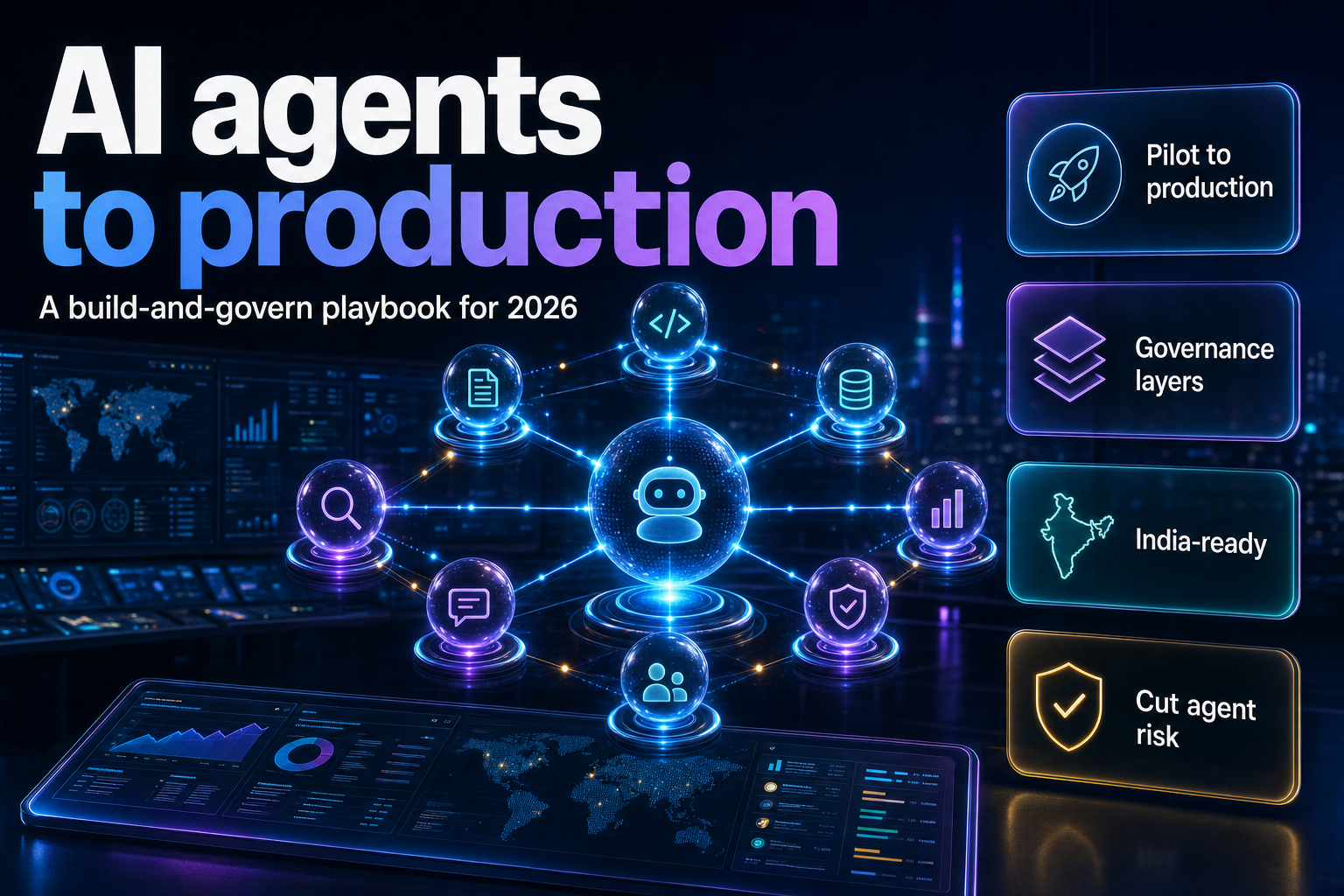
Summary. Indian enterprises are among the fastest in the world at moving AI agents into production. The OutSystems 2026 State of AI Development report, a survey of 1,879 IT leaders, found 97% of organisations globally are exploring agentic strategies, 49% have moved more than half of their agentic projects from pilot to full production, and India posts one of the highest transition rates. The problem is governance: only 36% of organisations have a centralised approach to agent governance, and Gartner predicts that by 2027, 40% of enterprises will demote or decommission autonomous AI agents because of governance gaps found only after production incidents. Demand is not the constraint. Gartner forecasts India public cloud spending at $17.5 billion in 2026, up 28.1%, with infrastructure-as-a-service growing 40% to $6.26 billion. This playbook shows how to move an agent from pilot to production: govern by autonomy level with Gartner's four-level model, clear a production-readiness checklist, and meet India's data-protection duties under the DPDP Act 2023. It is for CTOs and heads of AI whose pilots work in a demo but stall before launch.
Why agent pilots stall before production
A pilot proves an agent can complete a task. Production asks a harder question: can it do so reliably, safely and affordably at scale, under real data and real users. That is where programs get stuck. In the OutSystems survey, over 40% of leaders named legacy fragmentation and integration difficulties as top blockers, and 38% cited legacy systems as the primary reason agentic projects stalled outright. Governance is the other half of the problem, and Gartner is blunt about the cause.
"Enterprises are treating AI agent governance as binary, either locked down or fully trusted, and that is the root cause of failure," said Shiva Varma, Senior Director Analyst at Gartner. Applying one uniform set of controls to every agent produces two failure modes: over-restriction of simple agents, which slows delivery and pushes teams into shadow development, or under-restriction of autonomous agents, which raises operational, security and compliance risk. The fix is proportional governance matched to what each agent is allowed to do.
For teams still deciding whether to build agents in-house or adopt a platform, our guide to the AI customer support agent build vs buy decision covers the cost side of that call.
Govern by autonomy level
Gartner recommends classifying agents into four autonomy levels, each a different trust boundary with its own controls. This is the backbone of a governance plan.
| Autonomy level | What the agent does | Access | Core controls (Gartner) |
|---|---|---|---|
| 1. Observe | Summarises, retrieves, explains | Read-only; output to the requesting user | Scoped data access, user authentication, usage logging, basic functional and security testing |
| 2. Advise | Drafts, recommends, proposes; a human executes | Read-only, no write | Level 1 plus accuracy and hallucination testing, domain quality evaluations, user training on reliance |
| 3. Act with approval | Writes data, sends messages, changes configs after explicit approval | Write, gated by human approval per action | Strong security testing, approval workflows with audit trails, agent-specific incident response |
| 4. Act autonomously | Executes independently within guardrails | Write, within defined guardrails | Continuous monitoring, enforced guardrails, rapid rollback, circuit breakers, clear ownership |
The practical point: a document-summarising Observe agent should not carry the overhead meant for an autonomous Act agent, and an autonomous agent must never inherit the light controls that suit a read-only one. Match the control weight to the autonomy level. Our deeper treatment of enterprise AI agent governance layers expands each of these into concrete engineering controls.
The production-readiness checklist
Governance decides what an agent may do. Engineering decides whether it holds up. These are the dimensions that separate a pilot from a production service.
| Dimension | Pilot | Production |
|---|---|---|
| Evaluation | Manual spot checks | Automated evals in CI/CD, regression gates on every change |
| Observability | Console logs | Tracing, token and latency metrics, per-step audit trail |
| Access scope | Broad, for convenience | Least-privilege, scoped per tool and data source |
| Reliability | Happy-path demo | Retries, timeouts, fallbacks, tested failure modes |
| Human-in-the-loop | Ad hoc | Defined approval points for write actions |
| Cost control | Unmetered | Budgets, token caps, routing to cheaper models where safe |
| Rollback | None | Circuit breakers and one-command rollback |
The two dimensions that most often block launch are evaluation and access scope. Without automated evaluation, silent quality regressions ship unnoticed; our write-up on AI agent evals in CI/CD shows how to catch them. Without least-privilege access and input hardening, an agent becomes an attack surface, which is why prompt-injection guardrails belong in the build, not a later patch. Both fit the broader pattern in our guide to enterprise AI agents in production.
India-specific considerations
Three factors shape agent production in India. Data protection first: an agent that reads or writes personal data of Indian users falls under the Digital Personal Data Protection Act 2023 (DPDP), so purpose limitation, consent, and the region where data is processed must be designed in, not retrofitted. Cost second: with IaaS in India growing 40% to $6.26 billion in 2026, inference and orchestration spend adds up quickly, so token budgets and model routing belong in the production plan. Momentum third: India leads all surveyed countries in the OutSystems report on IT development and productivity ROI at 50%, and Gartner forecasts the worldwide AI platforms and models market to grow 63% in 2026, so competitors are moving fast. The winners will be the teams whose governance lets them ship safely, not the teams that lock everything down or skip controls entirely.
FAQ
How eCorpIT can help
eCorpIT is a Gurugram-based, CMMI Level 5 and ISO 27001:2022 certified engineering organisation, founded in 2021, and a partner of AWS, Microsoft and Google. Our senior-led teams take AI agents from a working pilot to a governed production service: classifying each agent by autonomy level, building automated evaluation and observability, hardening access and inputs, and designing data flows aligned with DPDP Act 2023 requirements. We work to your stack and your risk profile, with an engagement model scoped to the agent's autonomy level rather than a one-size template. If a pilot is stuck before launch, talk to our team for a production-readiness review.
References
Last updated: 27 July 2026.