On this page · 12 sections
- Why the platform decision matters now
- The three platforms at a glance
- AWS Bedrock AgentCore: consumption, assembled by you
- Google Gemini Enterprise: a governed seat, then usage
- OpenAI Presence: the vendor runs it
- Pricing compared
- Governance, identity and lock-in
- How to choose
- India-specific considerations
- FAQ
- How eCorpIT can help
- References
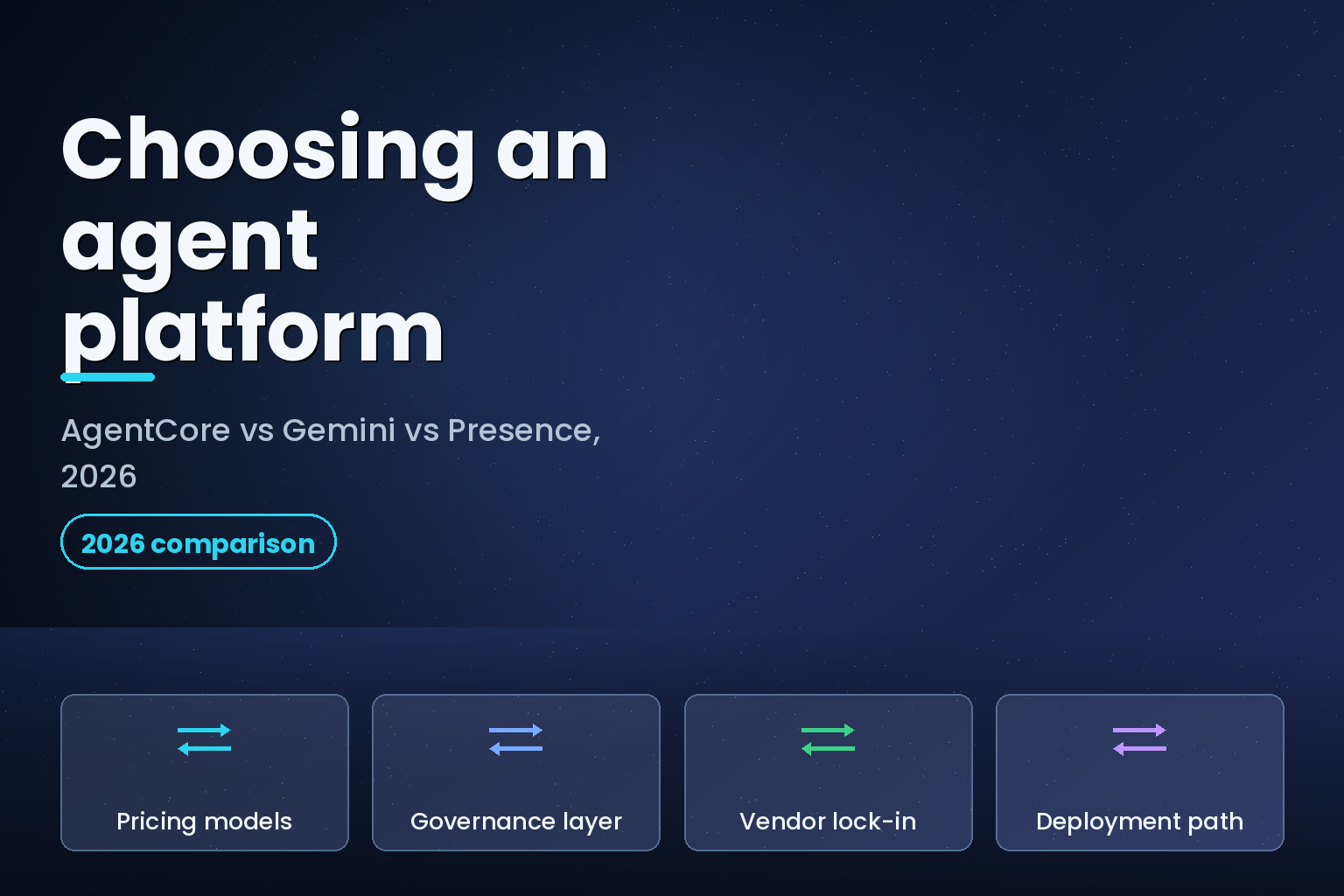
Summary. By July 2026 the three biggest AI vendors sell three different answers to the same question: how do you run agents in production without losing control of cost or data? AWS Bedrock AgentCore meters 12 components on consumption, with Runtime at $0.0895 per vCPU-hour and $0.00945 per GB-hour in us-east-1. Google Gemini Enterprise pairs a $21 per seat per month floor with usage billing and went generally available on April 22, 2026. OpenAI Presence, launched July 22, 2026, has no public price and no self-serve path: every install ships with Forward Deployed Engineers. Gartner projects 40% of enterprise applications will embed task-specific agents by the end of 2026, up from under 5% in 2025, yet the same firm expects more than 40% of agentic AI projects to be cancelled by the end of 2027 on cost and governance failures. The platform you pick decides which side of that number you land on. This guide compares the three on pricing, governance, deployment and lock-in.
Why the platform decision matters now
The agent gold rush has a governance problem. A 2026 OutSystems survey of about 1,900 IT leaders found 97% of organisations exploring agentic AI, but only 36% with a centralised approach to governance and just 12% running a central control plane. Forrester expects 25% of planned enterprise AI spending in 2026 to slip into 2027 as finance teams ask for return-on-investment evidence and security teams flag open governance gaps.
That is the backdrop for the platform layer. A raw model API gives you a chat completion. An agent platform is supposed to give you the parts that keep an agent safe in production: identity for the agent itself, memory that persists across sessions, a gateway to tools, observability, evaluation, and a policy boundary that decides what the agent may do. AWS, Google and OpenAI now sell that layer, and they price and govern it in very different ways.
The choice is rarely greenfield. Most buyers already run one hyperscaler for the bulk of their workloads, so the honest comparison is not "which platform is best" in the abstract but "what does each cost, lock in, and demand of my team." For the wider build decision, our enterprise AI agents production guide covers the use cases that actually reach production.
The three platforms at a glance
| Attribute | AWS Bedrock AgentCore | Google Gemini Enterprise | OpenAI Presence |
|---|---|---|---|
| Home cloud | AWS | Google Cloud | OpenAI (model-hosted) |
| General availability | 2026, consumption GA | April 22, 2026 | July 22, 2026 (limited GA) |
| Pricing model | Pure consumption, 12 metered components | $21+ per seat per month plus usage | Not published, scoped per customer |
| Self-serve | Yes | Yes | No, engineer-led only |
| Multi-model | Yes, Bedrock model choice | Yes, 200+ models incl. Claude | OpenAI models only |
| Best fit | AWS-native engineering teams | Google Workspace and multi-model shops | Buyers who want the vendor to run it |
Three products, three philosophies. AgentCore is infrastructure you assemble. Gemini Enterprise is a governed platform with a seat licence. Presence is a managed service with humans attached.
AWS Bedrock AgentCore: consumption, assembled by you
AgentCore is the most granular of the three. It meters across 12 distinct components: Runtime, Browser, Code Interpreter, Gateway, Identity, two Memory tiers, Observability, Evaluations, Payments, Search, and the underlying model spend. Those fall into five billing patterns: per-session active consumption, per-request, per-record, pass-through, and free or preview.
The headline mechanic is active-use billing. AgentCore Runtime charges $0.0895 per vCPU-hour and $0.00945 per GB-hour based on active CPU and peak memory over the session, priced in us-east-1 as of June 2026. When an agent calls a model and waits five seconds for the response, AgentCore bills almost nothing for that idle wait. A general-purpose serverless function bills the full rate for the same five seconds. For agents that spend most of their wall-clock time waiting on model output or tool calls, that difference compounds across millions of invocations.
The trade is assembly. You wire Runtime, Gateway, Identity, Memory and Observability together yourself, and each meters separately, so cost forecasting means modelling five to twelve lines rather than one. In us-east-1 through mid-2026, Runtime duration and long-term Memory are the dominant lines for most production agents. Teams that already run on AWS and treat cost engineering as a discipline get the most out of this model. Our note on AgentCore production observability and scaling walks through the operational side.
Google Gemini Enterprise: a governed seat, then usage
Google took the platform-plus-licence route. Gemini Enterprise, the Agent Platform that succeeded Vertex AI, went generally available on April 22, 2026 and bundles Agent Studio, agent-to-agent orchestration, an Agent Registry, Agent Identity, an Agent Gateway and Agent Observability. Model Garden exposes more than 200 models, including Google's Gemini line and Anthropic's Claude, so a single platform can route across vendors.
Pricing starts at $21 per seat per month for the Business edition, with Standard and Plus tiers from $30, then consumption charges beyond quota. Those usage lines are specific. Agent runtime bills $0.0864 per vCPU-hour plus $0.0090 per GiB-hour on top of per-token inference. Web grounding costs $45 per 1,000 grounded prompts, while grounding against your own data runs $2.50 per 1,000 requests. Memory Bank storage is $0.30 per GiB-month. The billing surface is still moving: Agent Gateway billing began on July 13, 2026, and Memory Bank and Sessions billing on the Agent Platform start September 1, 2026, so any 2026 cost model needs a recheck against Google's live pricing page. Our Gemini Enterprise cost breakdown tracks those lines in detail.
The multi-model support matters for lock-in. Because Model Garden carries Claude and other third-party models alongside Gemini, you can standardise on Google's governance and identity layer without committing every workload to Google's models.
OpenAI Presence: the vendor runs it
Presence is the outlier. OpenAI announced it on July 22, 2026 as a governed platform for deploying voice and chat agents with policy controls, identity verification, simulation testing and a human sign-off between every change and production. There is no self-serve tier and no published price. Deployments are led by OpenAI Forward Deployed Engineers and a set of selected global systems integrators, and each engagement is scoped per customer.
Forward Deployed Engineer is a title OpenAI borrowed from Palantir, where it describes staff embedded in a customer's operations for months. The delivery model is the real story: the largest AI lab now sells senior-led implementation rather than raw API access. OpenAI runs Presence on its own support line and reports resolving 75% of inbound calls without human escalation, which gives buyers a live reference case rather than a slide.
The catch is portability. Presence runs OpenAI models only, and the value sits in a managed governance layer you do not operate. That suits buyers who would rather buy an outcome than staff a platform team, and it worries buyers who want to keep the control plane in-house. For teams weighing the managed route against building on OpenAI's own primitives, we compared Presence against the Realtime API separately.
Pricing compared
The three price on different axes, so a like-for-like table needs care. The figures below are list prices retrieved in June and July 2026; verify against each vendor's live pricing before you budget.
| Cost line | AWS Bedrock AgentCore | Google Gemini Enterprise | OpenAI Presence |
|---|---|---|---|
| Entry commitment | None, pay per use | $21 per seat per month (Business) | Custom engagement, engineer-led |
| Compute | $0.0895 per vCPU-hour, $0.00945 per GB-hour | $0.0864 per vCPU-hour, $0.0090 per GiB-hour | Bundled into engagement |
| Grounding or search | Metered Search component | $45 per 1,000 grounded prompts; $2.50 per 1,000 on own data | Included in scope |
| Memory | Two metered tiers | $0.30 per GiB-month (Memory Bank) | Included in scope |
| Model spend | Pass-through Bedrock tokens | Per-token inference on top of seat | OpenAI models, in engagement |
| Price transparency | Full, published per component | Full, published, still changing | None published |
Two patterns stand out. First, AgentCore and Gemini Enterprise price compute almost identically, within a fraction of a cent per vCPU-hour, so raw runtime is not the differentiator. The difference is everything around it: seats, grounding, memory and the model bill. Second, Presence removes pricing from the buyer's control entirely. You are paying for an outcome and a team, which is easy to approve and hard to benchmark.
A worked illustration helps. For an agent that runs 2 vCPU and 4 GB for 200 active hours a month, AgentCore Runtime alone is roughly 200 x (2 x $0.0895 + 4 x $0.00945), about $43.42 before memory, gateway, search and model spend. The same compute on Gemini Enterprise runs about 200 x (2 x $0.0864 + 4 x $0.0090), about $41.76, before the seat licences, grounding and inference that a real deployment adds. The lesson is that Runtime is the small line. Grounding, memory, seats and tokens are where the monthly bill actually forms, which is exactly why the cloud FinOps discipline applies to agents as much as to any other workload.
Governance, identity and lock-in
Governance is where these platforms earn their keep, because the failure mode is not a bad answer, it is an agent with standing access acting faster than anyone can watch. AI agents hold persistent access to email, calendars, CRM systems and internal APIs, and behave as non-human insiders operating at machine speed, which traditional identity frameworks built for sequential human action were never designed to police.
| Governance axis | AWS Bedrock AgentCore | Google Gemini Enterprise | OpenAI Presence |
|---|---|---|---|
| Agent identity | Dedicated Identity component | Agent Identity built in | Identity verification in platform |
| Policy and sign-off | You compose it | Platform governance controls | Human sign-off before production |
| Observability | Metered Observability component | Agent Observability built in | Managed by OpenAI |
| Multi-model | Bedrock model choice | 200+ models incl. Claude | OpenAI only |
| Portability if you leave | Standards-based, AWS-tied | GCP-tied, models portable | Low, vendor-run |
Analyst caution centres on expectations, not capability. Lian Jye Su, chief analyst at Omdia, said Presence is "unlikely to increase the threat of job displacement because companies have used similar customer-support automation from vendors such as Genesys, NiCE, Five9 and AWS for years." The platform layer is new; the automation underneath it is not.
Lock-in is the axis buyers underweight and regret later. AgentCore ties you to AWS operationally but keeps models swappable within Bedrock. Gemini Enterprise ties the control plane to Google Cloud while keeping models portable through Model Garden. Presence ties you to OpenAI for both the platform and the models, in exchange for not having to run any of it. There is no wrong answer, only a cost you should price in before signing. Our guide to agent governance layers covers the controls each platform expects you to own.
How to choose
Match the platform to how your team wants to spend its time, not to a benchmark. Pick AWS Bedrock AgentCore if you already run on AWS, have engineers who treat cost modelling as a first-class task, and want the cheapest active-use compute with full control of every component. Pick Google Gemini Enterprise if you want a governed platform out of the box, value multi-model routing through Model Garden, and can absorb a per-seat licence on top of usage. Pick OpenAI Presence if you would rather buy an outcome than build a platform team, need voice and chat agents live quickly, and accept vendor-run governance and single-vendor models as the price of that speed.
The one choice that fails predictably is deploying agents with standing access and no central control plane, which is the position 88% of the OutSystems respondents were still in. Whichever platform you choose, the governance layer is not optional.
India-specific considerations
For Indian enterprises the maths shifts on two fronts: cost and data residency. A $21 per seat per month Gemini Enterprise licence is roughly ₹1,800 per seat at mid-2026 exchange rates, so a 200-seat rollout carries an annual licence floor near ₹43 lakh before any usage, which changes the build-versus-buy calculus against a senior-led in-house team. Presence engagements, priced as consulting, tend to sit above Indian salary benchmarks for the same delivery, so the value has to come from speed and risk transfer rather than raw cost.
Data residency is the harder constraint. The Digital Personal Data Protection Act, 2023 (DPDP) and its 2025 Rules govern how agents may process personal data, and RBI localisation norms require payment system data to stay in India. An agent platform that grounds on customer records is processing personal data by definition, so the region an agent runs in, where its memory persists, and which sub-processors touch the data all become compliance questions before they are architecture questions. eCorpIT designs applications aligned with DPDP requirements, and the residency review belongs at the start of a platform choice, not after the pilot.
FAQ
How eCorpIT can help
eCorpIT is a CMMI Level 5 and ISO 27001:2022 certified engineering organisation in Gurugram that helps enterprises pick and deploy the right agent platform rather than the loudest one. Our senior-led teams run the platform selection, cost model and DPDP-aligned residency review across AWS Bedrock AgentCore, Google Gemini Enterprise and OpenAI Presence, then build and operate the agents on the choice that fits your stack. If you are weighing these three platforms for a production rollout, talk to our engineering team.
References
- Amazon Bedrock AgentCore production operations guide — hidekazu-konishi.com
- Bedrock AgentCore pricing: 12 components, 2 cost drivers — Factual Minds
- Gemini Enterprise Agent Platform pricing — Google Cloud
- Gemini Enterprise pricing 2026, explained — Coworker AI
- OpenAI tries the consulting path with Presence — The Register
- OpenAI Presence connects AI agents to enterprise data with built-in guardrails — Help Net Security
- AI agent adoption in 2026: what the analysts' data shows — Joget (Gartner, IDC data)
- 2026 enterprise AI agent report — OutSystems
- Forrester's 2026 technology and security predictions: enterprises will defer 25% of planned AI spend to 2027 — Forrester Research
_Last updated: July 31, 2026._