On this page · 9 sections
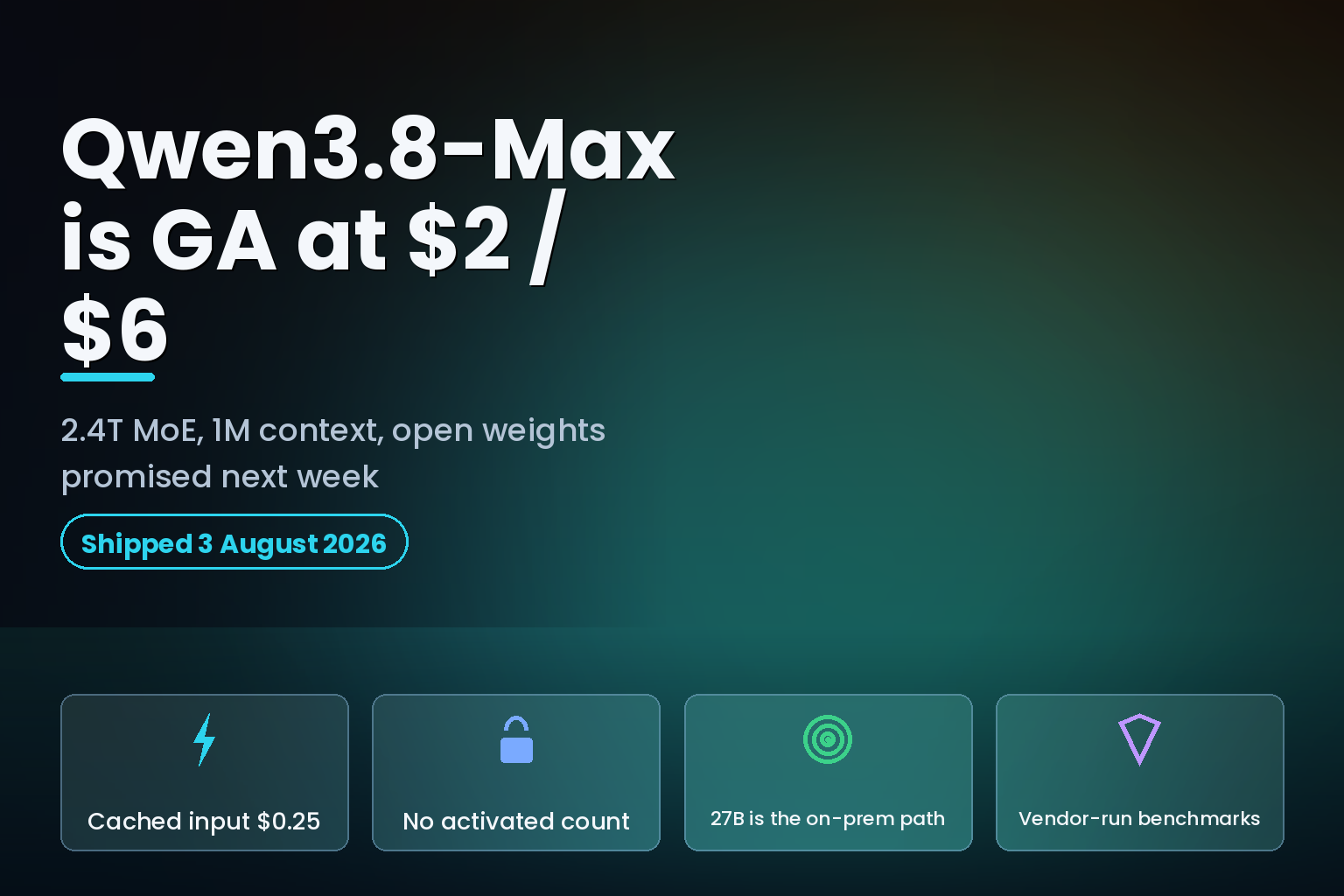
Summary. Alibaba's Qwen team made Qwen3.8-Max generally available on 3 August 2026. It is a 2.4-trillion-parameter mixture-of-experts model with a 1M-token context, priced at $2.00 per million input tokens and $6.00 per million output tokens, with implicit cache reads at $0.25. Open weights for Qwen3.8-Max and a second checkpoint, Qwen3.8-27B, are promised for next week. The number nobody is putting next to the launch price is Qwen3.7-Max's, which lists at $2.50 and $7.50 but is currently running at a 50% discount to $1.25 and $3.75. Measured against what you would actually pay today, the new flagship is 60% more expensive on input and 60% more on output than the model it replaces. The operational upgrade is real, though: requests per minute jump from 600 to 15,000, maximum output from 65,530 to 131,000 tokens, and the input modality widens from text only to text, image and video. Whether to move depends on which of those two facts governs your workload.
What shipped, and what did not
Qwen3.8-Max is now broadly available on QwenCloud. The model page, last modified 4 August 2026, lists it as a 2.4-trillion-parameter MoE flagship accepting image, text and video input and returning text. (QwenCloud model page)
The hosted API is the part you can use today. It is DashScope and OpenAI compatible, so adopting it is a base URL and model ID change rather than an integration project. The DashScope sample on the model page points at https://dashscope-intl.aliyuncs.com/api/v1 with model='qwen3.8-max'.
What has not shipped is the thing that made the preview interesting. Alibaba has confirmed open weights for both Qwen3.8-Max and Qwen3.8-27B, but "next week" as of 3 August 2026. Two things are still missing that make any serving-cost model impossible to build: Alibaba has not disclosed the activated-parameter count for the 2.4T MoE, and no license has been published. Without an activated-parameter figure there is no way to size GPU memory or estimate tokens per second, and without a license there is no way to know whether commercial self-hosting is permitted at all.
Asif Razzaq, CEO of Marktechpost Media Inc., put the practical conclusion plainly in his 3 August write-up: "The 27B checkpoint, not the flagship, is the realistic on-premise deployment path." (MarkTechPost)
That is the honest answer to the self-hosting question this week. A 2.4-trillion-parameter checkpoint is a multi-node datacentre artefact regardless of how sparse the activation turns out to be. If your plan for Qwen3.8 involved running it on your own hardware, the model you are actually planning to run is Qwen3.8-27B, and it is not out yet either.
The pricing comparison everyone is skipping
Both models are priced on the same vendor page, which makes this easy to check and hard to argue with.
| Rate, per 1M tokens | Qwen3.8-Max | Qwen3.7-Max list | Qwen3.7-Max, current 50% off |
|---|---|---|---|
| Input | $2.00 | $2.50 | $1.25 |
| Output | $6.00 | $7.50 | $3.75 |
| Input, implicit cache | $0.25 | $0.50 | $0.25 |
| Explicit cache creation | $2.50 | $3.125 | $1.5625 |
| Explicit cache read | $0.17 | $0.25 | $0.125 |
Sources: the Qwen3.8-Max and Qwen3.7-Max model pages, read 4 August 2026.
Read the first two columns and Qwen3.8-Max looks like a price cut: a 20% reduction on both input and output against the previous flagship's list rate. Read the first and third and it is a 60% increase on both.
No discount is shown on the Qwen3.8-Max page. Whether one appears later is guesswork, so plan against the posted rate. The correct framing for a budget conversation this week: moving a workload from Qwen3.7-Max to Qwen3.8-Max raises the token bill by roughly 60% at current rates, and you should be able to justify that from the capability gain rather than from an assumption that newer means cheaper.
What a real monthly bill looks like
Take an agentic coding workload at 400M input and 80M output tokens a month, with no caching, then the same workload with 70% of input served from implicit cache.
| Scenario | Qwen3.8-Max | Qwen3.7-Max at current rates |
|---|---|---|
| 400M in, 80M out, no cache | $1,280 | $800 |
| 400M in (70% cached), 80M out | $790 | $520 |
| Cache saving | $490 | $280 |
The cache column is where the interesting behaviour is. On Qwen3.8-Max, implicit cache reads are $0.25 against $2.00 fresh input, so cached tokens cost one eighth of uncached ones. That ratio changes what you optimise for. Prompt length stops being the main cost driver and prefix stability takes over. A repository-scale coding agent that keeps a stable system prompt and file preamble across a session pays a fraction of what an agent that reshuffles its context on every turn pays, for identical token counts.
Explicit cache is priced differently again: $2.50 to create, $0.17 to read. Creation costs more than fresh input, so explicit caching only pays back when the same prefix is read many times. On Qwen3.8-Max the break-even against fresh input is a little over one read; against implicit cache, which you get without doing anything, it takes many more. Unless you have a genuinely fixed, heavily reused prefix, implicit cache is the better default.
Engineering for the 8x cache ratio
If cached input costs one eighth of fresh input, the highest-return work on this model is not prompt compression. It is making the front of your context byte-identical from call to call.
Four changes do most of the work, and none of them is exotic.
Put everything stable first and everything volatile last. System prompt, tool definitions, few-shot examples and any fixed document preamble go at the top in a fixed order. The user turn, timestamps, request IDs and retrieved chunks go at the bottom. A single injected timestamp near the top of a prompt invalidates the prefix for every call that follows it.
Freeze the serialisation. Tool schemas serialised from a dictionary can reorder between processes, and a reordered JSON object is a different prefix even though it is the same data. Sort keys explicitly and pin the serialiser, or you will see cache-hit rates that vary by deployment for no visible reason.
Batch by prefix rather than by arrival. If ten requests share a system prompt and two do not, sending the ten together keeps them on a warm prefix. Round-robin dispatch across a worker pool destroys this quietly, because each worker starts cold.
Measure the hit rate rather than assuming it. The bill is the instrument here: cached and uncached input are separate line items, so the ratio between them is your real hit rate. On the 400M-input example above, the difference between a 40% and a 70% hit rate is roughly $210 a month on the same traffic. Teams routinely believe they are caching and are not, because one field near the top of the prompt moves.
The same discipline transfers to any provider with prefix caching, so it is not wasted work if you later move off Qwen.
The operational gap between 3.7 and 3.8 is larger than the price gap
This is where the upgrade earns its money, and it is not visible in a benchmark table.
| Property | Qwen3.7-Max | Qwen3.8-Max |
|---|---|---|
| Requests per minute | 600 | 15,000 |
| Tokens per minute | 1M | 2M |
| Context | 1M | 1M |
| Max input | 991.80K | 991K |
| Max output | 65.53K | 131K |
| Max output, thinking | 65.53K | 131K |
| Max reasoning budget | not listed | 262K |
| Input modalities | text | image, text, video |
| Built-in tools | code_interpreter, web_extractor, web_search | those three plus t2i_search and i2i_search |
A 25-fold increase in requests per minute, from 600 to 15,000, is the single largest change here and it is the one that decides architecture. At 600 RPM, a fan-out agent workload needs queueing, backoff and probably a second provider. At 15,000 RPM it does not. If your team built rate-limit plumbing around Qwen3.7-Max, a good part of that code becomes dead weight, and the engineering saving may well exceed the 60% token premium.
The doubling of maximum output from 65,530 to 131,000 tokens matters for a narrower set of jobs: long document generation, full-file code rewrites, and anything that was previously truncated and stitched. The separate 262K reasoning budget is new as a published figure and lets you bound thinking spend explicitly rather than inferring it.
The modality change is the other structural one. Qwen3.7-Max is text in, text out. Qwen3.8-Max accepts image and video input, which removes a whole class of two-model pipelines where a vision model fed a text model. We covered the cost side of that pattern in the Qwen3.7-Flash versus Gemini Flash-Lite vision agent comparison; the flagship now closes the same gap at the top of the range.
Read the benchmarks with three caveats
Alibaba published a benchmark table with the release. The headline numbers, as reported alongside the launch: 86.6 on Terminal-Bench 2.1, ahead of Claude Opus 4.8 and Claude Fable 5 at 84.6 and behind GPT-5.6 Sol at 88.8; 93.0 on PaperBench; 82.8 on IFBench; 92.6 on GPQA Diamond. On the software engineering rows it trails: 67.7 on SWE-bench Pro against Fable 5's 80.0, and 73.5 on FrontierSWE against Fable 5's 88.8. Vision is where it leads most consistently, with OSWorld-Verified at 86.1, Parametric CAD Bench at 91.5 and OmniDocBench 1.5 at 92.1.
Three caveats belong on every one of those numbers.
The first is provenance. These are the vendor's own published results. As of 4 August 2026 no independent evaluation has been published, so treat the table as a claim rather than a measurement until third parties reproduce it.
The second is the comparison baseline. The multimodal section of Alibaba's table benchmarks against Qwen3.7-Plus rather than Qwen3.7-Max, which makes the generational jump look larger than a like-for-like comparison would. The generational gains on the agentic rows are large either way, with DeepSWE 1.1 moving from 21.6 to 56.6, FrontierSWE from 40.7 to 73.5 and JobBench from 31.3 to 53.4, but the multimodal delta is measured against a different tier.
The third is what the reasoning numbers actually say. GPQA Diamond moved from 92.4 on Qwen3.7-Max to 92.6, which is noise. The gains here are agentic and multimodal, not reasoning. If you are choosing a model for hard reasoning, this release does not change your answer.
There is one more number worth knowing, and it comes from Alibaba's own materials rather than a critic: the published reinforcement-learning scaling curve peaks at 0.725 near 4,000 training environments and then declines to 0.719 and 0.689. A vendor publishing its own diminishing-returns curve is unusual and worth reading as a signal about where this scaling approach is heading.
A note on the coverage rather than the model: the MarkTechPost write-up of the GA release states in its body that "Alibaba published a full benchmark table with this release" and then carries a key-takeaway bullet reading "No benchmark table, license, or activated-parameter count has been published." The first is correct for benchmarks and the second is correct for the license and the activated-parameter count. If you are citing that piece, cite the specific claim rather than the bullet.
So do you move?
Three cases, and the answer differs in each.
You are on Qwen3.7-Max for text-only work at moderate volume. Stay for now. You are paying $1.25 and $3.75 while the discount holds, GPQA barely moved, and the SWE-bench Pro and FrontierSWE rows still favour Western frontier models. Revisit when the discount ends or when the open weights land with a license.
You are rate-limited or you need vision or video in the loop. Move. The jump from 600 to 15,000 requests per minute and from text-only to image and video input is worth 60% more per token, because the alternative is a second provider and a pipeline to stitch two models together. Model the saved engineering time, not just the token delta.
You were planning to self-host the flagship. Wait. No activated-parameter count, no license, no weights yet. There is nothing to size and nothing to price. Watch for Qwen3.8-27B instead, which is the checkpoint that fits ordinary on-premise GPU hardware. Our open-weight self-host decision framework covering Kimi K3, DeepSeek V4 and GLM 5.2 sets out the break-even maths to apply the moment those numbers exist, and the Kimi K3 self-host versus API cost analysis is the closest worked example.
For the broader frontier comparison, the Gemini 3.5 Pro, GPT-5.6 and Claude Fable 5 head-to-head is the pillar to read alongside this, and the Chinese open models enterprise cost picture covers the procurement questions that come after the technical ones.
India-specific considerations
Two points for teams building from India.
Data residency is the first and it is not a footnote. The QwenCloud entity on the model page is Intelligent Cloud Computing (Singapore) Private Limited, and the DashScope endpoint in the sample code is dashscope-intl.aliyuncs.com. If your prompts carry customer data, that is a cross-border transfer and it falls under the Digital Personal Data Protection Act 2023. Establish the lawful basis, the notice and the retention position before a pilot becomes production, not after. This is the single most common reason we see an otherwise sound model choice reversed late.
Cost discipline is the second. A dollar-denominated token bill against a rupee revenue line rewards the cache work described above more than it rewards model shopping. On the 400M-input example, moving 70% of input to implicit cache saves $490 a month on Qwen3.8-Max, which is a larger effect than most model swaps produce. Our hybrid routing and API spend decision framework covers when to route between tiers rather than standardising on one, and the budget LLM tier cost comparison covers the cheaper end that most workloads should be sitting on anyway.
FAQ
How eCorpIT can help
eCorpIT is a Gurugram-based technology consultancy founded in 2021, with senior engineering teams working across AI integration, cloud and application development. We are CMMI Level 5, ISO 27001:2022 certified and MSME registered. If you are weighing a move to Qwen3.8-Max, we model the token bill against your real traffic including cache-hit behaviour, run a scored evaluation against your own tasks rather than a public leaderboard, and design the data-residency position before anything leaves your network. We also handle private LLM deployment for teams that need the model inside their own boundary. Talk to us at /contact-us/.
References
- Qwen3.8-Max model page, QwenCloud: $2.00 input, $6.00 output, $0.25 implicit cache, $2.50 explicit cache creation, $0.17 explicit cache read; 1M context, 991K max input, 131K max output, 262K max reasoning, 2M TPM, 15K RPM; image, text and video input; five built-in tools. Last modified 4 August 2026.
- Qwen3.7-Max model page, QwenCloud: $2.50 and $7.50 list with a 50% discount to $1.25 and $3.75; 600 RPM, 1M TPM, 65.53K max output, text-only input. Last modified 31 July 2026.
- Alibaba Qwen Releases Qwen3.8-Max, MarkTechPost: Asif Razzaq, 3 August 2026, for the GA confirmation, the open-weights timing, the benchmark figures, the Qwen3.7-Plus baseline caveat and the RL scaling curve.
- Alibaba Previews Qwen3.8-Max, MarkTechPost: the 19 July 2026 preview coverage this article updates.
- Qwen3.8-Max announcement, Qwen: Alibaba's own release post for the model.
- Qwen research index: the Qwen team's research listing, carrying the Qwen3.8-Max coding and cowork post.
- Qwen3.8 Max analysis, Artificial Analysis: the independent evaluation page to watch for third-party numbers.
- Qwen3.7 Max analysis, Artificial Analysis: the predecessor's independent evaluation page for comparison.
- Context cache documentation, QwenCloud: the implicit cache behaviour the cost modelling in this article depends on.
- Pricing, QwenCloud docs: QwenCloud's general billing model, including tiered long-context pricing.
- Function calling, QwenCloud docs: the tool-use capability listed on the model page.
- Model releases changelog, QwenCloud: the release feed to watch for the Qwen3.8-27B open-weights drop.
Last updated: 4 August 2026.