On this page · 11 sections
- The Gemini 3.5 Pro reality check
- Pricing: what you actually pay in 2026
- Benchmarks: coding vs long-horizon agents
- Why price-per-token is the wrong first question
- Beyond the model: API features that change the build
- Which model wins your workload
- India and cost considerations
- What to watch when Gemini 3.5 Pro lands
- FAQ
- How eCorpIT can help
- References
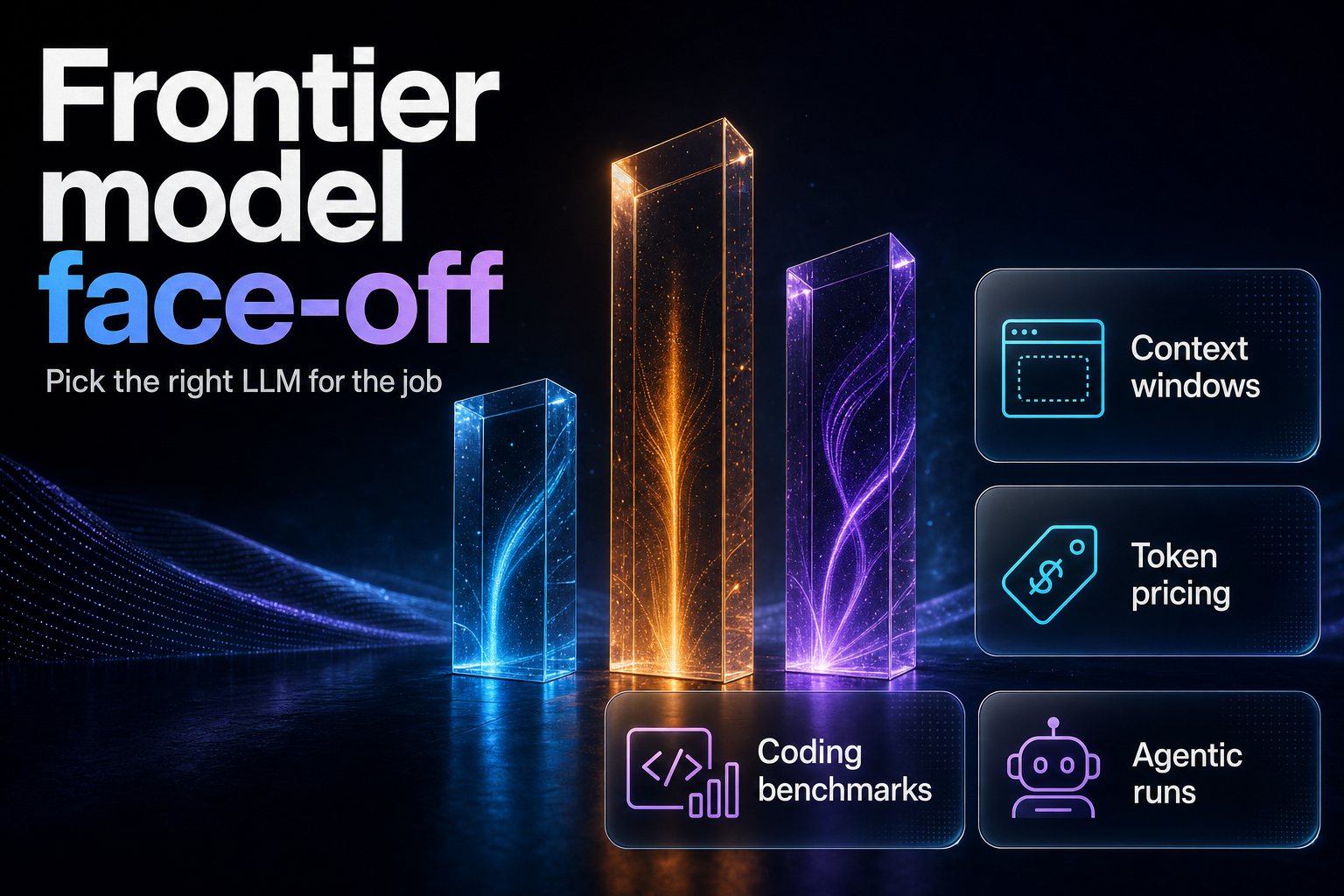
Summary. As of 18 July 2026, two of these three models are real and one is a rumour. OpenAI shipped the GPT-5.6 family (Luna, Terra, Sol) to general availability on 9 July 2026 at $1/$6, $2.50/$15, and $5/$30 per million input/output tokens. Anthropic's Claude Fable 5 sells at $10/$50 per million tokens and holds the coding lead at about 80% on SWE-Bench Pro, against 64.6% for GPT-5.6 Sol. Google's Gemini 3.5 Pro, the model most of the internet is comparing, has no official launch post, no model card, and no published price. Google DeepMind's own site still lists Gemini 3.1 Pro as the current Pro model with a "3.5 Pro coming soon" banner. This guide compares what you can actually deploy today, with first-party numbers, and tells you what to watch when 3.5 Pro lands.
If you searched for this comparison, you were probably shown a confident table pitting Gemini 3.5 Pro against GPT-5.6 and Claude Fable 5, complete with a 2-million-token context window and benchmark scores. Nearly all of it traces back to two blog posts and unnamed sources. Google has confirmed none of it. So the useful comparison in July 2026 is not the one everyone is publishing. It is this one: three vendors, two shipping flagships, one honest verdict per workload, and a clear read on the model that has not arrived.
We build production systems on these models at eCorpIT, so this is written for the CTO or senior engineer choosing where to send real traffic and a real budget, not for a leaderboard screenshot.
The Gemini 3.5 Pro reality check
Start here, because it changes the whole comparison. Google announced the Gemini 3.5 family at I/O on 19 May 2026 and shipped Gemini 3.5 Flash that day. The larger Pro model slipped from June to a reported 17 July target after Google scrapped a build and restarted part of pretraining. As of 18 July 2026, there is no official Google announcement, no model card, and no gemini-3.5-pro entry in the public Gemini API. Google DeepMind's Gemini Pro model page still shows Gemini 3.1 Pro as the current model, marked Preview, with a "3.5 Pro coming soon" note.
Every widely repeated 3.5 Pro spec, the 2-million-token context window, the pricing near $15/$60, the benchmark wins, comes from third-party reporting rather than Google. TechTimes summarised the situation plainly: every specific claim, including the date, is unconfirmed. Planning a system around those numbers means planning around a leak.
So the fair Google entry in this comparison is the model you can call today: Gemini 3.1 Pro. Its official card lists a 1-million-token input window, 64,000-token output, and a January 2025 training cutoff, with strong published benchmarks. We use those below and flag where 3.5 Pro is expected to move the line.
Pricing: what you actually pay in 2026
Token price is where the three diverge hardest. These are first-party numbers: GPT-5.6 from OpenAI's launch, reported by Simon Willison, and Claude Fable 5 from Anthropic's pricing page.
| Model | Input / output ($/1M tokens) | Context | Max output | Status (18 Jul 2026) |
|---|---|---|---|---|
| GPT-5.6 Luna | $1 / $6 | 1M | 128k | GA, 9 Jul 2026 |
| GPT-5.6 Terra | $2.50 / $15 | 1M | 128k | GA, 9 Jul 2026 |
| GPT-5.6 Sol | $5 / $30 | 1M | 128k | GA, 9 Jul 2026 |
| Claude Fable 5 | $10 / $50 | 1M | Not published | GA, since June 2026 |
| Gemini 3.1 Pro | See Google AI Studio / Gemini API | 1M | 64k | Preview (current Google Pro) |
| Gemini 3.5 Pro | Not published | Reported 2M | Unknown | Not officially released |
Read that table and the strategy writes itself. GPT-5.6 Luna at $1/$6 is priced for volume. Claude Fable 5 at $10/$50 is the most expensive frontier model on the market, ten times Luna on input and more than eight times on output. Sol sits in the middle of OpenAI's own range and undercuts Fable 5 by half on input.
One trap hides in that table. Claude Fable 5 uses a newer tokenizer that Anthropic says produces roughly 30% more tokens for the same text than its older models. A $10/$50 sticker on Fable therefore buys fewer words per dollar than the raw rate suggests. Price-per-token is a starting point, not the bill.
Benchmarks: coding vs long-horizon agents
The headline fight is coding, and the honest answer is that it depends which benchmark you trust. On SWE-Bench Pro, a diverse agentic coding test, the self-reported single-attempt numbers line up like this.
| Model | SWE-Bench Pro (Public) | Source |
|---|---|---|
| Claude Fable 5 | ~80% | Anthropic self-report |
| GPT-5.6 Sol | 64.6% | OpenAI, via launch coverage |
| Gemini 3.1 Pro | 54.2% | Google DeepMind model card |
| Gemini 3.5 Pro | Not published | Expected to exceed 3.1 Pro |
Fable 5 leads coding by a wide margin, about 15 points over GPT-5.6 Sol on this test. But OpenAI published an audit the day before its launch arguing SWE-Bench Pro is partly broken, estimating that roughly 30% of its tasks are flawed. Read the coding gap with that caveat: Anthropic is clearly ahead on this benchmark, and both vendors dispute how much the benchmark means.
Flip to long-running agentic work and the ranking inverts. OpenAI's own benchmark of choice is Agents' Last Exam, covering long professional workflows across 55 fields. There, GPT-5.6 Sol posts 53.6 and beats Claude Fable 5 by 13.1 points, and OpenAI claims Terra and Luna beat Fable at roughly one-sixteenth the cost. Google's Gemini 3.1 Pro, meanwhile, leads a different set: 80.6% on SWE-Bench Verified and 94.3% on GPQA Diamond scientific reasoning, both from its official card. No single model wins every row.
Why price-per-token is the wrong first question
Simon Willison, who had early access to GPT-5.6 Sol, made the point that matters: "price-per-million tokens doesn't tell us much now that the number of reasoning tokens can differ so much between models for the same task." A cheaper per-token model that burns three times the reasoning tokens on your workload is not cheaper. OpenAI leaned on exactly this, claiming Sol beats Fable 5 on Agents' Last Exam at about one-quarter of the estimated cost despite a lower sticker input rate.
The practical consequence: benchmark the models on your own tasks and measure total tokens per completed job, not the rate card. We covered the same mistake in our note on how token pricing quietly drives agent cost, and a token counter helps you estimate before you commit. The pricing war itself, which pushed these rates down through 2026, is worth understanding as context for where rates go next; see our take on the OpenAI and Anthropic price war.
Beyond the model: API features that change the build
The model is half the decision; the API around it is the other half. GPT-5.6 shipped with capabilities that change how you build agents. Programmatic Tool Calling lets the model write and run JavaScript that orchestrates tool calls, which narrows the gap between a handful of tools and a full scripted workflow. A native multi-agent feature lets the model spin up subagents for parallel, focused work, moving the sub-agent pattern into the core API rather than your orchestration code. GPT-5.6 also added explicit prompt cache breakpoints, matching a control Anthropic already offered, so you decide exactly where caching happens instead of leaving it to automatic detection.
Claude Fable 5's platform strengths sit elsewhere: a full 1-million-token context at standard pricing, and prompt caching where a cache hit costs 10% of the standard input price, which pays off after a single reuse. Gemini 3.1 Pro leans on Google AI Studio integration, function calling, and code execution, plus native multimodal input across text, image, video, audio, and PDF. If your build depends on parallel subagents or code-orchestrated tools, GPT-5.6 is the most direct fit; if it depends on the deepest single-pass coding, Fable 5 leads; if it depends on multimodal inputs, Gemini is the natural home.
Which model wins your workload
Match the model to the job, not to the leaderboard.
| Workload | Best pick today | Why |
|---|---|---|
| Hardest coding and refactors | Claude Fable 5 | ~80% SWE-Bench Pro, the clear coding leader |
| Long-horizon autonomous agents | GPT-5.6 Sol | 53.6 on Agents' Last Exam, +13.1 over Fable |
| High-volume, cost-sensitive tasks | GPT-5.6 Luna or Terra | $1/$6 and $2.50/$15, near-Fable quality per OpenAI |
| Scientific and multimodal reasoning | Gemini 3.1 Pro | 94.3% GPQA Diamond; text, image, video, audio, PDF |
| Long-context retrieval and analysis | Any 1M-context model | GPT-5.6, Fable 5, and Gemini all offer 1M input |
The pattern is stable across price cuts and new releases: Anthropic owns the hardest coding, OpenAI owns cost-efficient agentic breadth, and Google owns multimodal and scientific reasoning. For most teams the answer is not one model but a router that sends coding to Fable, cheap bulk work to Luna, and multimodal to Gemini. Our guide to enterprise AI strategy covers how to build that routing layer instead of standardising on a single vendor.
India and cost considerations
For Indian teams the currency swing is real. Claude Fable 5 output at $50 per million tokens is roughly 4,200 rupees per million tokens at mid-2026 rates, against about 500 rupees for GPT-5.6 Luna. On a workload of a few hundred million tokens a month, that is the difference between a modest bill and a line item finance will question. Route the expensive model only to the tasks that need it.
Data routing matters as much as price. Under India's Digital Personal Data Protection Act 2023, where user prompts and outputs travel is a compliance question. All three vendors offer regional and enterprise deployment options; confirm the data path before you send personal data through any of them, and design the retrieval layer so sensitive prompts stay inside an approved boundary.
What to watch when Gemini 3.5 Pro lands
When Google publishes an official 3.5 Pro card, three things decide whether it changes this comparison. First, the context window: if the reported 2-million-token window is real, it doubles the practical ceiling for long-document work and pulls long-context retrieval toward Gemini. Second, an official SWE-Bench Pro number: 3.1 Pro sits at 54.2%, so 3.5 Pro needs a large jump to challenge Fable 5's ~80%. Third, price: Google has undercut rivals before, and a sub-$10 input rate with frontier coding would reset the table. Until that card exists, treat 3.5 Pro as unreleased and build on what ships.
FAQ
How eCorpIT can help
eCorpIT is a Gurugram technology consultancy, founded in 2021, with CMMI Level 5 certification and senior-led engineering teams that ship AI systems on OpenAI, Anthropic, and Google models. We benchmark these models on your actual workloads, build the routing layer that sends each task to the right one, and design data paths aligned with DPDP Act requirements so cost and compliance both hold. If you are choosing a model stack in 2026, talk to our team about a short evaluation against your own tasks.
References
- Claude pricing — Anthropic, July 2026
- The new GPT-5.6 family: Luna, Terra, Sol — Simon Willison, 9 July 2026
- GPT-5.6 — OpenAI
- Agents' Last Exam — benchmark of long-running professional workflows
- Gemini Pro model page — Google DeepMind
- Gemini 3.1 Pro model card — Google DeepMind
- Learn about Gemini 3.5 — Google
- Gemini 3.5 Pro targets July 17: every spec remains unconfirmed — TechTimes, 13 July 2026
- Introducing Claude Fable 5 and Claude Mythos 5 — Anthropic
_Last updated: 18 July 2026._