On this page · 9 sections
- The three models, and why this is a real decision now
- GPU footprint: what it actually takes to serve each one
- API price: the number that decides build versus buy
- The break-even: how many tokens before self-hosting wins
- Which one should you self-host?
- India-specific considerations
- FAQ
- How eCorpIT can help
- References
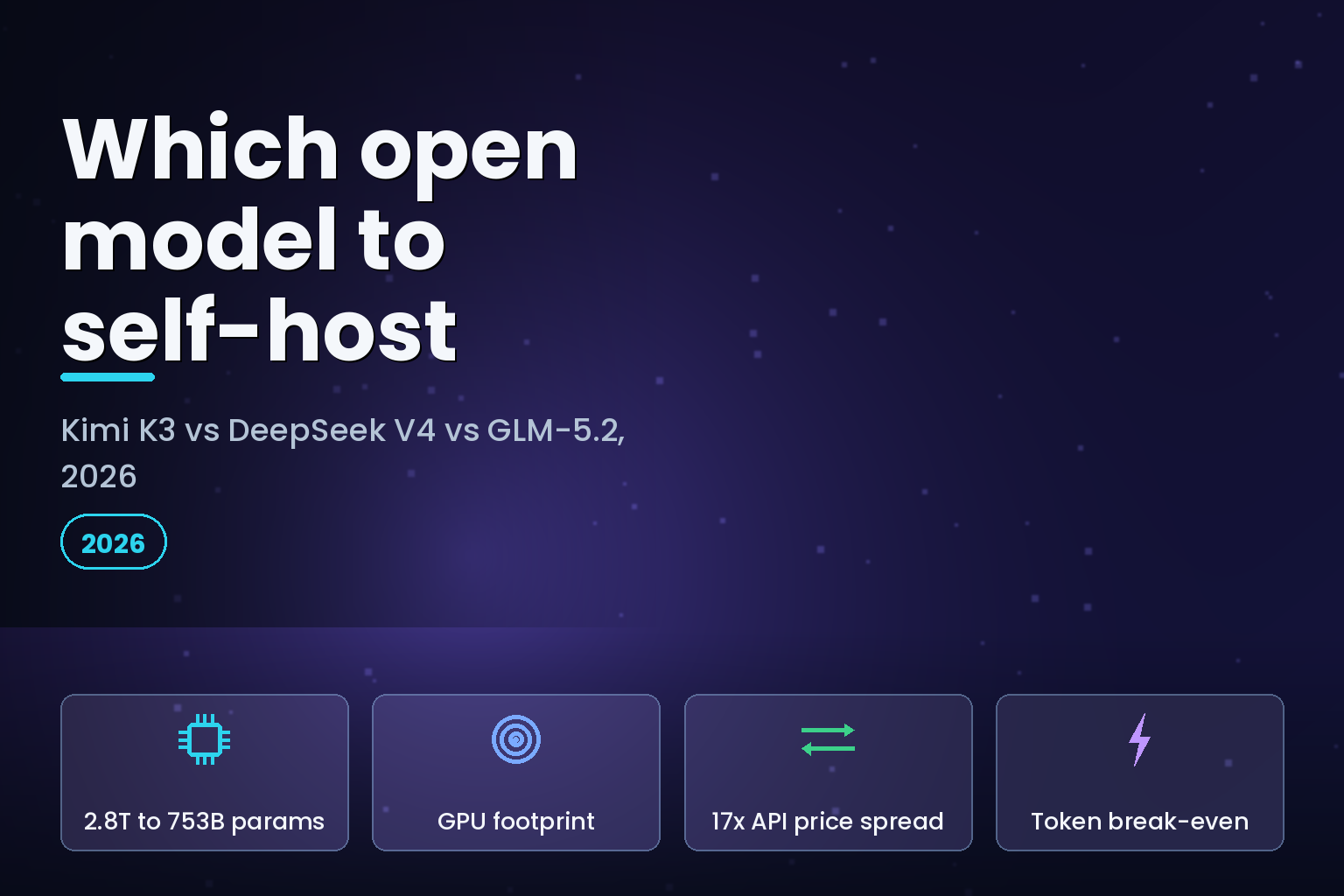
Summary. Three open-weight models now sit close to the closed frontier, and all three can be downloaded and run on your own hardware: Moonshot's Kimi K3 at 2.8 trillion parameters, DeepSeek V4-Pro at 1.6 trillion (49 billion active), and Z.ai's GLM-5.2 at 753 billion. Their API list prices differ by more than 17 times per output token, from $0.87 per million for DeepSeek V4-Pro to $15 per million for Kimi K3. That single fact decides most self-hosting questions. Against an on-demand 8-GPU node costing roughly $40,179 per month, you break even on Kimi K3 at about 2.7 billion output tokens a month, but not until about 46 billion for DeepSeek V4-Pro. This guide gives the specs, the footprint, and the break-even math so you can decide build versus buy per workload, not per hype cycle.
The three models, and why this is a real decision now
For two years, self-hosting a frontier-class model meant accepting a large capability gap against GPT and Claude. In 2026 that gap narrowed. DeepSeek V4-Pro scores 80.6% on SWE-bench Verified, the highest open-weights entry, per its NVIDIA NIM model card. Kimi K3 tops the Frontend Code Arena with an Elo of 1,679, per independent reporting. GLM-5.2 leads open-weights coding benchmarks such as Terminal-Bench 2.1. When the open models are this capable, the question shifts from "can we" to "should we, and which one."
All three ship permissive licenses. Kimi K3 is Apache 2.0; DeepSeek V4 and GLM-5.2 are MIT. All three offer roughly a 1-million-token context window. The differences that matter for a build-versus-buy decision are three: how much GPU you need to serve the model, how fast it runs, and what the alternative API costs. The rest is benchmark noise.
| Model | Total / active parameters | License | Open weights released | Context | Headline benchmark |
|---|---|---|---|---|---|
| Kimi K3 (Moonshot) | 2.8T / ~104B active | Apache 2.0 | July 27, 2026 | 1M | Frontend Code Arena Elo 1,679 |
| DeepSeek V4-Pro | 1.6T / 49B active | MIT | April 23, 2026 | 1M | SWE-bench Verified 80.6% |
| DeepSeek V4-Flash | 284B / 13B active | MIT | April 23, 2026 | 1M | LiveCodeBench 91.6 |
| GLM-5.2 (Z.ai) | 753B / ~40B active | MIT | June 13, 2026 | 1M | Terminal-Bench 2.1 81.0 |
GPU footprint: what it actually takes to serve each one
Parameter count sets the floor on GPU memory, and quantization sets the practical footprint. This is where the three models diverge sharply, because a 2.8T model and a 753B model do not live on the same hardware.
Kimi K3 is the heaviest. Its full weights are about 1.4 terabytes, and the MXFP4-quantized release is around 594 gigabytes. That MXFP4 build fits on a single 8-GPU H200 node; full precision needs roughly 64 H100-class GPUs across eight servers. DeepSeek V4-Pro at 1.6T runs in mixed FP4 and FP8 precision (MoE experts in FP4, other parameters in FP8) on NVIDIA H100, H200 and B200 hardware, per the NVIDIA model card, with an 8-GPU H200-class node as the practical single-node floor. GLM-5.2 is the most tractable: at 753B, its FP8 footprint is roughly 744 to 890 gigabytes, fitting an 8-GPU H200 or B200 node, and a 4-bit quant drops to about 176 to 180 gigabytes, which fits far fewer GPUs.
| Model | Practical quant | Approx. weight footprint | Minimum single-node serve |
|---|---|---|---|
| Kimi K3 | MXFP4 | ~594 GB (full ~1.4 TB) | 8x H200 (MXFP4); ~64x H100 full precision |
| DeepSeek V4-Pro | FP4 + FP8 mixed | large (1.6T MoE) | 8x H200-class node |
| DeepSeek V4-Flash | FP8 / 4-bit | 284B, much smaller | Single 8-GPU node, headroom to spare |
| GLM-5.2 | FP8 or 4-bit | ~744-890 GB (FP8); ~176-180 GB (4-bit) | 8x H200/B200 (FP8); 2-4 GPUs (4-bit) |
The engineering read: if you only have one 8-GPU node, GLM-5.2 and DeepSeek V4-Flash are comfortable, Kimi K3 fits only quantized, and DeepSeek V4-Pro is tight. Kimi K3 at full precision is a multi-node commitment that most teams should not make. There is a reason Moonshot notes Kimi K3 runs about four times slower than a comparable dense model while roughly matching Claude Fable 5 on coding at about a third of the per-token cost.
API price: the number that decides build versus buy
Self-hosting only saves money when it beats the API you would otherwise call. The three models sit at very different API list prices, and the spread is the whole story.
| Model | API list, input / output per 1M tokens | Source |
|---|---|---|
| DeepSeek V4-Flash | $0.14 / $0.28 | DeepSeek |
| DeepSeek V4-Pro | $0.435 / $0.87 | DeepSeek |
| GLM-5.2 | $1.40 / $4.40 | Z.ai list |
| Kimi K3 | $3.00 / $15.00 | OpenRouter |
DeepSeek V4-Pro at $0.87 per million output tokens is roughly 17 times cheaper per output token than Kimi K3 at $15. That gap does not reflect capability; DeepSeek V4-Pro is the strongest of the three on SWE-bench Verified. It reflects pricing strategy. And it means the self-host case is completely different for each model, because the API you are trying to beat is completely different.
The break-even: how many tokens before self-hosting wins
Here is the original math that a benchmark table cannot give you. Take an on-demand 8-GPU node as the reference cost. An AWS p5.48xlarge with 8 NVIDIA H100 GPUs lists at about $55.04 per hour in us-east-1, per public EC2 pricing, which is roughly $40,179 per month at 730 hours. To justify that node on cost alone, your monthly output-token volume has to exceed the point where API spend would have cost the same $40,179. Divide the node cost by each API's output price and you get the break-even volume.
| Model | API output price / 1M | Monthly output tokens to beat a $40,179 node |
|---|---|---|
| Kimi K3 | $15.00 | ~2.7 billion |
| GLM-5.2 | $4.40 | ~9.1 billion |
| DeepSeek V4-Pro | $0.87 | ~46 billion |
| DeepSeek V4-Flash | $0.28 | ~143 billion |
Read this as a build-versus-buy verdict. Kimi K3 is the easiest to justify self-hosting, because its API is expensive; if you push more than roughly 2.7 billion output tokens a month, your own node is cheaper, and you also get the MXFP4 weights on your infrastructure. DeepSeek V4-Pro is nearly impossible to beat on cost, because its API is so cheap you would need about 46 billion output tokens a month before an on-demand node pays off. For DeepSeek, self-hosting is a data-control decision, not a savings decision.
Two honest caveats keep this from being a spreadsheet fantasy. First, these thresholds assume 100% GPU utilization, which no real deployment hits, so effective break-even volumes are higher. Second, an 8-GPU H200 node, which Kimi K3 and GLM-5.2 actually need, costs more than the H100 node priced here, pushing their real thresholds up. A committed or reserved node, by contrast, lowers the monthly cost and pulls break-even down. Model the exact numbers against your own utilization before you buy hardware, the same discipline in our self-host versus API break-even analysis for Kimi K3 and the matching DeepSeek V4 GPU cost breakdown.
Which one should you self-host?
The choice follows the workload, not the leaderboard. Match the model to why you are self-hosting in the first place.
| If your priority is... | Self-host | Why |
|---|---|---|
| Lowest cost per token, no residency need | Neither; call DeepSeek V4 API | At $0.28-$0.87 per 1M output, the API undercuts your own node until tens of billions of tokens |
| Data residency or air-gapped control | DeepSeek V4-Pro or GLM-5.2 | MIT weights, strong benchmarks, single-node serve on GLM-5.2 |
| Coding and agentic workflows at scale | Kimi K3 | Tops Frontend Code Arena; expensive API makes self-hosting pay sooner |
| One 8-GPU node, best all-round | GLM-5.2 | FP8 fits a single node; 4-bit fits far less; strong coding scores |
| Cheap high-volume inference | DeepSeek V4-Flash | 284B / 13B active runs light and fast |
For teams standardizing their model layer, the practical answer is often two models, not one: a cheap high-volume API such as DeepSeek V4-Flash for routine calls, and one self-hosted model where control or coding performance justifies the cluster. That routing logic is covered in our LLM hybrid routing and API-spend framework, and the serving stack itself in our guide to local LLM production with vLLM. For where these sit against the closed frontier, see our Gemini 3.5 Pro vs GPT-5.6 vs Claude Fable 5 comparison.
India-specific considerations
For Indian teams, self-hosting these models means confronting GPU scarcity and cost directly. An 8-GPU H100 node at about $55.04 per hour is roughly ₹35 lakh per month on-demand at 730 hours and an exchange rate near ₹86 to the dollar in July 2026, before any committed-use discount. High-end H200 and B200 capacity is thin in Indian Regions, so many teams rent in Singapore or the United States, which adds latency and data-transfer cost to the model's raw economics.
The counterweight is data control. Where a workload processes personal data under the Digital Personal Data Protection Act 2023, keeping the model and its data inside infrastructure you control can simplify residency and consent handling, which is exactly the case where DeepSeek V4-Pro or GLM-5.2 on your own node beats a cheaper overseas API. eCorpIT is ISO 27001:2022 certified and designs deployments aligned with DPDP Act 2023 requirements, so the residency decision is made deliberately rather than by default.
FAQ
How eCorpIT can help
eCorpIT is a Gurugram-based, ISO 27001:2022 certified engineering organisation that helps teams decide and deliver open-weight model deployments. We model the break-even against your real token volume and utilization, size the GPU cluster, run the vLLM serving stack, and set up hybrid routing so cheap APIs handle routine calls while a self-hosted model carries the workloads that need control, all designed aligned with DPDP Act 2023 requirements. If you are weighing self-host versus API, talk to our senior engineering team.
References
- NVIDIA NIM, DeepSeek-V4-Pro model card, April 23, 2026.
- Hugging Face, DeepSeek-V4-Pro model card and license.
- OpenRouter, Kimi K3 pricing and specifications.
- Hugging Face, Kimi K3 model weights.
- daily.dev, Moonshot AI releases Kimi K3 weights, a 2.8T open-weight model that tops the Frontend Code Arena, July 2026.
_Last updated: July 29, 2026._