On this page · 9 sections
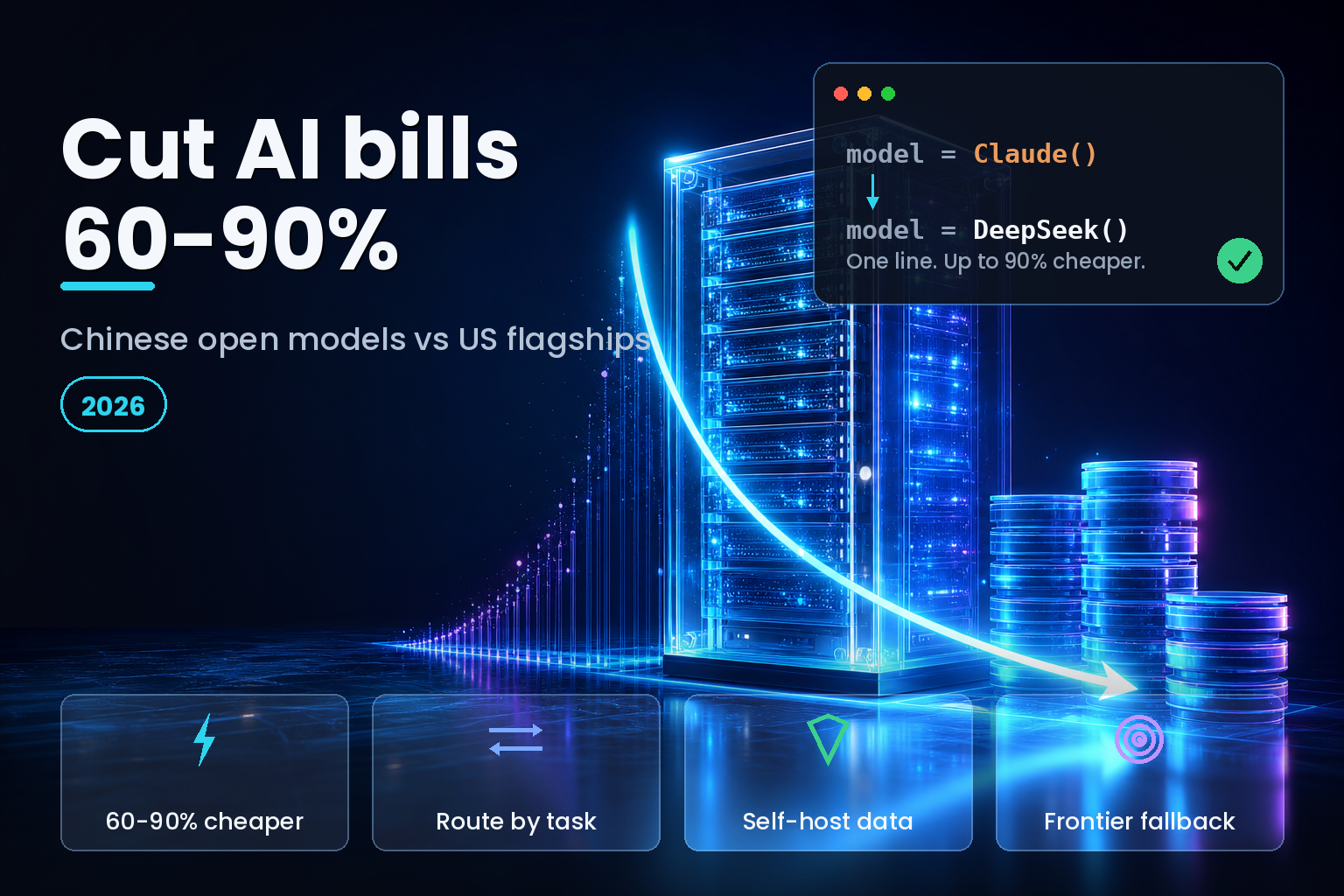
Summary. US companies routed more than 30% of their OpenRouter tokens to Chinese open models every week from February 8, 2026, and the figure touched 46%, up from a 12-month average near 11% and just 4.5% in the first half of 2025, according to CNBC on July 7, 2026. The reason is price: open-weight models from DeepSeek, Alibaba (Qwen) and Z.ai (GLM) run 60% to 90% cheaper than flagship models from OpenAI and Anthropic. DeepSeek V4 Flash lists at $0.14 per million input tokens; GPT-5.2 lists at $1.75. For CTOs and engineering leaders, the question is no longer whether these models are usable. It is which tasks to route to them, and how to run them without handing data to the wrong place.
What actually changed in 2026
For most of 2024 and 2025, US-hosted models owned developer traffic. That share has fallen from roughly 70% to about 30% over the past year on OpenRouter, a marketplace that routes API calls across providers. Chinese open-weight models absorbed the difference.
Two releases pushed the shift. Alibaba's Qwen family passed Meta's Llama to become the most downloaded model family on Hugging Face back in September 2025. Then Z.ai shipped GLM-5.2 in late June 2026. It saw the fastest adoption of any model Vercel tracked in 2026: daily token volume grew about 27x and the number of customers using it grew about 80x in its first full week.
Harpreet Arora, head of agentic infrastructure at Vercel, put the mechanism plainly to CNBC: "Price is doing the work here." He added that "when a task doesn't need the best model, teams are beginning to route it to the cheapest one that's good enough, and the recent wave of models coming out of China is winning that trade."
The clearest case study CNBC reported is Lindy, an AI automation startup that moved 100% of its traffic from Anthropic's Claude to DeepSeek and said the switch would save it millions. That is a full migration, not an experiment. Most teams will not go that far, and they should not.
The price gap, in numbers
Published API prices tell the story faster than any benchmark. The table below lists per-million-token rates as reported by pricing trackers and vendor documentation as of June to July 2026. Input and output are priced separately because output tokens usually dominate a real bill.
| Model (provider) | Input, $/1M | Output, $/1M | Origin |
|---|---|---|---|
| DeepSeek V4 Flash | $0.14 | $0.28 | open-weight, China |
| DeepSeek V4 Pro | $0.44 | $0.87 | open-weight, China |
| GLM-5.2 (Z.ai) | $1.40 | $4.40 | open-weight, China |
| Gemini 3.1 Pro (Google) | $2.00 | $12.00 | closed, US |
| GPT-5.2 (OpenAI) | $1.75 | $14.00 | closed, US |
| Claude Opus 4.8 (Anthropic) | $5.00 | $25.00 | closed, US |
Read the output column. A million output tokens on Claude Opus 4.8 costs $25.00; the same on DeepSeek V4 Flash costs $0.28. That is where the "60% to 90% cheaper" claim comes from, and on the cheapest pairings it is closer to 98%. Alibaba refreshed its lineup to Qwen3.7 Max and Qwen3.6 Plus on June 28, 2026; Qwen is priced competitively per tier on Alibaba Cloud, which is why it keeps topping download charts rather than winning on a single headline rate.
The real cost is rarely the code change. It is the evaluation work to prove the cheaper model holds quality on your tasks, plus the platform work to run it. Budget for both before you count the savings.
Are they actually good enough?
For a large share of production work, yes. Vendor and independent leaderboards through 2026 place GLM-5 and Qwen3 near the top of open-weight rankings, approaching closed frontier models on coding and agentic tasks. Z.ai's GLM-5 scales up to 744 billion parameters and leads open-weight models on several agentic and coding benchmarks. Qwen3 posts scores comparable to leading closed models on many public tests. DeepSeek remains the cost floor and a strong coder.
"Good enough" is task-specific, which is the whole point of Arora's comment. Summarizing tickets, classifying support messages, drafting first-pass code, extracting fields from documents and powering internal search rarely need a frontier model. Novel reasoning, safety-critical output, hard multi-step agent runs and anything a customer sees directly are where the top closed models still earn their premium. The winning pattern is a router, not a religion.
| Workload | Sensible default in 2026 | Why |
|---|---|---|
| Bulk classification, extraction | DeepSeek V4 Flash | Cheapest good-enough tier |
| First-draft code, refactors | GLM-5.2 or Qwen3 | Strong coding at a fraction of frontier price |
| Internal RAG and search | Qwen3 or DeepSeek | High volume, cost-sensitive |
| Customer-facing answers | Frontier closed model | Quality and brand risk justify the premium |
| Hard agentic or novel reasoning | Frontier closed model | Reliability on long chains still leads |
The real question is deployment, not the model
Here is the part most cost comparisons skip. A lower token price says nothing about data governance, security review, model behavior, support or vendor risk. And with Chinese models, one decision dominates all of those: how you run the model.
Security analysts through 2026 converge on a single insight. The data risk is set by deployment mode, not by who trained the weights. Self-hosted open weights send nothing back to the developer; calling a China-hosted API can place your data under Chinese law, because Chinese AI companies are subject to the country's National Intelligence Law and can be compelled to "support, assist and cooperate" with state intelligence work.
That splits the choice into three practical paths:
Run the open weights yourself, inside your own cloud or data center, so prompts never leave your control. This is the safer route for regulated or sensitive workloads, and it is why open weights matter more than a cheap hosted endpoint. The trade-off is real: you need high-performance GPUs, which are subject to US export controls, plus internal processes to patch fast when a vulnerability surfaces.
Use a Western host that serves the open weights, so you get the price without a China-hosted endpoint. This keeps procurement, logging and audit trails inside familiar vendors.
Call the China-hosted API directly. Cheapest and simplest, and acceptable for low-sensitivity, non-confidential tasks, but it is the wrong default for source code, customer records, controlled technical data or anything covered by contract or export rules.
For enterprises, the disciplined answer is usually the first or second path for anything sensitive, with request-level logging so you can inspect model behavior and prove compliance to an auditor. Our own view from delivery work is blunt: the model is a commodity, but the deployment decision is where the liability lives.
A routing strategy that works
Treat model choice as an operations problem. Put a routing layer in front of your models. Send each request to the cheapest model that clears your quality bar for that task, and reserve frontier models for the workloads that need them. Measure spend and quality per task type, not as one blended number, so a regression is visible before it reaches a customer.
Three controls keep this safe. First, an evaluation suite per task, run on every candidate model before it goes live. Second, a data-classification gate, so confidential prompts can never be routed to a China-hosted API. Third, a fallback, so a degraded or unavailable cheap model rolls up to a trusted one automatically. Teams that skip the evaluation step tend to trade a quality problem for a savings headline, then quietly roll back.
This is the same discipline behind sound generative AI enterprise strategy and behind measuring real LLM spend with the right tooling. It also pairs with FinOps for AI and cloud cost in Indian teams: the point is not the cheapest sticker price, it is the lowest total cost at an agreed quality.
India-specific considerations
For Indian enterprises, the cost case is sharper because AI budgets are quoted in rupees against dollar-denominated APIs. A workload that runs ₹8,00,000 a month on a frontier flagship can fall to a fraction of that on an open-weight model at similar quality for the right tasks, which is material for a services business protecting margin.
The governance case is also sharper. Under the Digital Personal Data Protection Act, 2023, and the DPDP Rules notified in November 2025, an organization processing personal data of people in India carries obligations on consent, security safeguards and breach reporting regardless of where the model runs. Routing personal data to a China-hosted API adds a cross-border and legal-exposure question on top of that. The clean pattern for Indian teams handling personal data is to self-host open weights, or use an approved Western host, and keep a data-classification gate in front of any external endpoint. That mirrors the caution behind enterprise export-control and model-governance planning, and it sits alongside the pricing pressure covered in our note on the OpenAI and Anthropic price war.
FAQ
How eCorpIT can help
eCorpIT is a Gurugram-based, CMMI Level 5 technology consultancy that helps founders and engineering leaders cut AI cost without cutting quality. We build model-routing layers, run per-task evaluation suites, and design self-hosted or approved-host deployments so sensitive data never lands on the wrong endpoint. If you want a routing and cost review across open-weight and frontier models, contact our team.
References
_Last updated: July 9, 2026._