On this page · 12 sections
- What Qwen3.7 Flash actually is
- The pricing that actually decides your bill
- Head to head: Qwen3.7 Flash vs Gemini 3.5 Flash-Lite vs GPT-5.6 Luna
- Worked example 1: a high-volume classification agent
- Worked example 2: the 1M-context cliff
- The levers that move the real bill
- Where each model fits
- The price war behind the numbers
- India-specific considerations
- FAQ
- How eCorpIT can help
- References
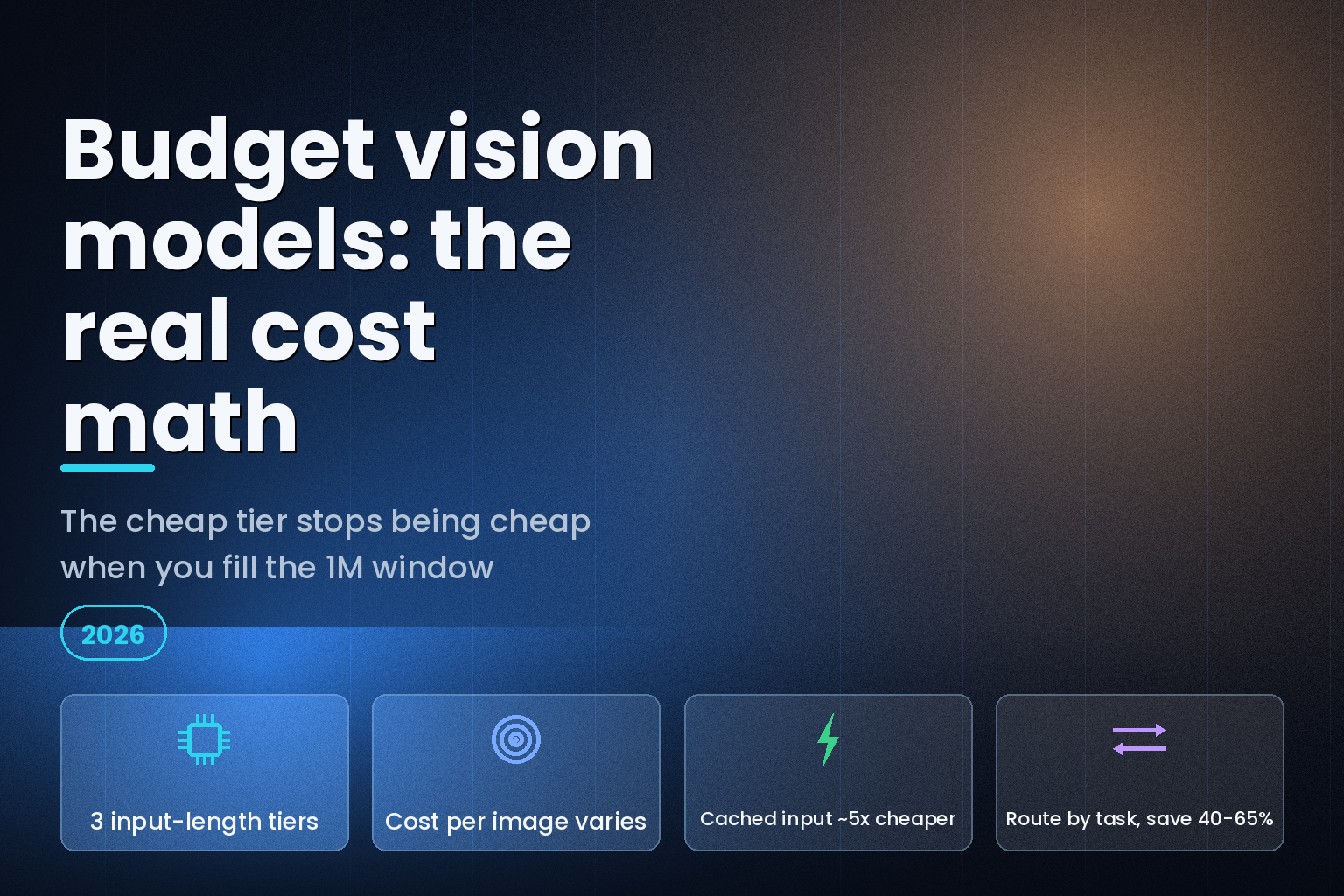
Summary. Alibaba released Qwen3.7 Flash on 27 July 2026 at $0.03 per million input tokens and $0.13 per million output tokens for requests up to 32K tokens, roughly 10x below Google's Gemini 3.5 Flash-Lite on input and 19x below it on output. That headline hides the number that decides real bills: Alibaba prices Qwen3.7 Flash in three input-length brackets, and the top 256K to 1M bracket costs about $0.20 input and $0.80 output, near 6x the entry rate. Gemini 3.5 Flash-Lite, released 21 July 2026, is a single rate of $0.30 and $2.50. GPT-5.6 Luna, cut 80% by OpenAI on 30 July 2026, now sits at $0.20 and $1.20. All three carry a 1M-token window and accept images. So the cheapest option on paper is not the cheapest option for every workload, and the crossover depends on how much of that window you actually use.
This piece works the numbers tier by tier, with two worked examples, so an engineering lead can pick the right model for a vision agent instead of trusting a single sticker price.
What Qwen3.7 Flash actually is
Qwen3.7 Flash is Alibaba Cloud's native vision-language model in the low-cost "Flash" line. Its model page on Alibaba Cloud Model Studio lists image, text, and video as input modalities and text as the only output. The context window is 1,000,000 tokens, with a maximum input length of 991,808 tokens and a maximum output of 65,536 tokens. Thinking mode allows up to 983,616 input tokens and a chain-of-thought budget of 262,144 tokens.
The API exposes function calling, structured outputs, web search, prefix completion, context caching, and batch inference. Fine-tuning is not offered. Alibaba's documentation describes the release plainly: "The Qwen3.7 native vision-language series Flash models comprehensively enhance multimodal understanding and Agent execution capabilities compared to 3.6-Flash," per Alibaba Cloud Model Studio's model page. Rate limits are generous for a budget tier, at 30,000 requests per minute and 5,000,000 tokens per minute on the Beijing endpoint, and 15,000 requests per minute on the Singapore endpoint.
One caveat for buyers who compare leaderboards: at launch Alibaba published no full public benchmark table for this Flash variant, so it sits unranked on several third-party indices. Independent vision evaluations have started to appear, but the case for the model is cost and modality, not a leaderboard position.
The pricing that actually decides your bill
Most write-ups quote Qwen3.7 Flash as "$0.03 in, $0.13 out" and stop. That is only the first of three brackets. Alibaba's own price sheet lists the model in Chinese yuan and tiers it by input length. Converted to US dollars at roughly 6.5 to 6.9 yuan per dollar, and cross-checked against third-party trackers, the Beijing rates line up as below.
| Input length bracket | Input (per 1M) | Output (per 1M) | Cached input (per 1M) |
|---|---|---|---|
| Up to 32K tokens | $0.03 (¥0.2) | $0.13 (¥0.8) | $0.006 (¥0.04) |
| 32K to 256K tokens | $0.10 (¥0.6) | $0.40 (¥2.4) | $0.02 (¥0.12) |
| 256K to 1M tokens | $0.20 (¥1.2) | $0.80 (¥4.8) | $0.04 (¥0.24) |
The pattern is the story. Input rises from $0.03 to $0.20 across the brackets, and output rises from $0.13 to $0.80, both close to 6x. A request that loads a long document plus several frames of video into the window pays the top bracket on every token in that request, not just the tokens above 256K. Gemini 3.5 Flash-Lite and GPT-5.6 Luna, as reported by Artificial Analysis and OpenAI's pricing for July 2026, publish one rate that does not step up with context length. That single design difference is what moves the crossover point.
Head to head: Qwen3.7 Flash vs Gemini 3.5 Flash-Lite vs GPT-5.6 Luna
All three models are cheap, multimodal, and carry a roughly 1M-token window, which is why teams shortlist them together for high-volume vision and agent work. The differences are in the price curve, the tokenizer, and the ecosystem.
| Attribute | Qwen3.7 Flash | Gemini 3.5 Flash-Lite | GPT-5.6 Luna |
|---|---|---|---|
| Released | 27 Jul 2026 | 21 Jul 2026 | 9 Jul 2026 |
| Input price (per 1M) | $0.03 to $0.20 (tiered) | $0.30 | $0.20 |
| Output price (per 1M) | $0.13 to $0.80 (tiered) | $2.50 | $1.20 |
| Context window | 1,000,000 | 1,000,000 | 1,050,000 |
| Image input | Yes | Yes | Yes |
| Video input | Yes | Yes (Gemini media) | Not the primary path |
| Context caching | Yes | Yes | Yes |
| Provider | Alibaba Cloud | OpenAI |
Read the price rows as ranges, not points. On a short request, Qwen3.7 Flash at $0.03 input is dramatically below Gemini at $0.30 and Luna at $0.20. On a request that fills the window, Qwen's $0.20 input meets Luna's $0.20 and undercuts Gemini's $0.30 by only about 1.5x on input. Output tells a similar story: Qwen's top-bracket $0.80 is well under Gemini's $2.50 but only a little under Luna's $1.20. The 10x and 19x gaps are real, and they are a property of short context, not of the model in general.
Worked example 1: a high-volume classification agent
Take a vision agent that classifies one image per call, at 1,000,000 calls per month, with about 1,300 input tokens and 200 output tokens per call. Each call sits inside the 32K bracket, so Qwen bills at its entry rate. To isolate the price effect, hold token counts equal across providers for this pass.
| Model | Input cost | Output cost | Monthly total |
|---|---|---|---|
| Qwen3.7 Flash (entry) | $39 | $26 | $65 |
| GPT-5.6 Luna | $260 | $240 | $500 |
| Gemini 3.5 Flash-Lite | $390 | $500 | $890 |
At short context, Qwen3.7 Flash runs about 7.7x cheaper than Luna and 13.7x cheaper than Gemini 3.5 Flash-Lite for the same token workload. For a support-triage bot, a moderation queue, or a receipts classifier that sees millions of small images, that gap is the difference between a $780 and a $10,680 annual line item.
The caveat that stops this from being the whole answer is tokenization. A 1024x1024 image is not the same token count on every provider. Independent testing by TokenMix puts a 1024x1024 image at about 258 tokens on Gemini, roughly 3x fewer than GPT-5.4 and 5x fewer than Claude, while many providers land near 1,300 tokens for the same image. If most of your 1,300 input tokens are the image itself, Gemini may count far fewer input tokens per call than the table assumes, which narrows its input disadvantage. Measure image-token counts on your own payloads before you trust any per-call estimate, including this one.
Worked example 2: the 1M-context cliff
Now run a retrieval-heavy agent that loads about 500,000 input tokens of documents and frames per request and returns 2,000 tokens. That request sits in Qwen's top 256K to 1M bracket, so it bills at $0.20 input and $0.80 output.
| Model | Per-request input | Per-request output | Per-request total |
|---|---|---|---|
| Qwen3.7 Flash (top bracket) | $0.100 | $0.0016 | ~$0.10 |
| GPT-5.6 Luna | $0.100 | $0.0024 | ~$0.10 |
| Gemini 3.5 Flash-Lite | $0.150 | $0.0050 | ~$0.155 |
At 500K context the ranking collapses. Qwen3.7 Flash and GPT-5.6 Luna land at about $0.10 per request, level with each other, and Gemini 3.5 Flash-Lite sits near $0.155, roughly 1.5x more rather than 10x. The entry-tier advantage that made Qwen look untouchable in example 1 has evaporated, because a long-context request pays the top bracket on all 500,000 tokens. The lesson for anyone budgeting a long-context vision agent is blunt. The real cost is set by how full you keep the window, not by the sticker price on the model card.
The levers that move the real bill
Three controls change the number more than the choice of model does.
Caching is the largest. Qwen3.7 Flash prices cached input at about $0.006 per 1M in the entry bracket, a fifth of the standard input rate, and Gemini and Luna both support context caching for repeated system prompts and documents. Agents that resend the same instructions, tools, and reference files on every step are the ones that benefit most, and that describes most production agents. Context engineering is cost engineering.
Batch inference is the second. Alibaba offers batch input and output at a discount to synchronous calls, and it is available on the Beijing endpoint for Qwen3.7 Flash. Overnight classification, back-catalogue tagging, and any workload that tolerates minutes of latency should run on the batch path.
Output discipline is the third and most overlooked. Output tokens cost 4x to 6x the input tokens on all three models, so a prompt that asks for a long explanation when a label would do is paying a multiple for nothing. Constrain the response with structured outputs or a token cap and the output line shrinks directly.
Where each model fits
Reach for Qwen3.7 Flash when requests are short and volume is high: image classification, moderation, receipt and document tagging, and per-frame vision checks that stay inside the 32K bracket. The entry price is hard to beat and the video input is a bonus for frame-level work.
Reach for GPT-5.6 Luna when requests run long or when you already sit inside OpenAI's tooling. Luna is OpenAI's cost-focused tier, positioned for high-throughput, low-latency tasks such as summarization, classification, routing, and lightweight real-time assistants, with a 1.05M window and image input. After the 30 July 2026 cut to $0.20 and $1.20, its flat curve makes it predictable at long context, where Qwen's top bracket catches up to it.
Reach for Gemini 3.5 Flash-Lite when latency and image-token efficiency matter more than the input sticker price. It runs near 490 output tokens per second and tokenizes images to roughly 258 tokens each, so a workload dominated by image input can end up cheaper on Gemini than the per-token table suggests, and Google Cloud integration is a real pull for teams already there.
The practical answer for most teams is not one model but a router. Send short, high-volume vision calls to Qwen3.7 Flash, long-context retrieval to Luna, and latency-sensitive or image-heavy traffic to Gemini. Task-based routing across providers has been measured to cut spend 40% to 65% versus sending everything to one model, and it maps cleanly onto the tier behaviour shown above. Our LLM hybrid routing decision framework sets out how to build that split without over-engineering it, and the budget LLM tier comparison tracks how these cheap tiers move against each other.
The price war behind the numbers
None of this pricing is stable. OpenAI cut Luna 80% on 30 July 2026, three weeks after the GPT-5.6 family launched on 9 July, dropping it from $1.00 and $6.00 to $0.20 and $1.20. VentureBeat framed the move as a shift in model competition toward cost, and reported that analysts were cooler on it, warning that cheaper tokens can lift usage volumes while straining the finances of labs that filed confidential listing paperwork in June 2026. Alibaba's tiered Flash pricing and Google's Flash-Lite rate are moves in the same contest. Any per-token figure in this article is a July 2026 snapshot, so re-check the vendor pages before you commit a budget. The behaviour that will not change as fast is the shape of the curve: tiered versus flat, and cached versus fresh. Model those, not the sticker.
For teams sizing a bigger AI bill around these tiers, our note on GPT-5.6 inference cost for enterprise AI and the head-to-head Gemini 3.5 Pro vs GPT-5.6 vs Claude Fable 5 put the budget tiers in the context of the frontier models they route work away from. The pattern where cheap tokens still produce a runaway bill is real: it is what pushed one large employer to cap its agentic coding usage after burning its 2026 budget early, a story covered in our piece on Microsoft, Uber and Claude Code token cost.
India-specific considerations
For Indian teams, the currency swing matters twice. Alibaba prices Qwen3.7 Flash in yuan, so the dollar figures here move with the yuan-dollar and rupee-dollar rates, and a monthly bill quoted at $65 can read differently in rupee terms across a quarter. Budget in the currency you are billed in and hold a buffer for exchange movement.
Data residency is the second point. Alibaba serves Qwen3.7 Flash from Beijing and Singapore endpoints, Google and OpenAI from their own regions. Where a vision agent processes personal data, the Digital Personal Data Protection Act 2023 (DPDP) obligations on where and how that data is handled apply regardless of which model is cheapest, so the endpoint region and the provider's data terms belong in the decision alongside the token price. A model that saves $800 a month is a poor trade if it routes regulated images through a region your data agreement does not cover.
FAQ
How eCorpIT can help
eCorpIT builds and cost-tunes multimodal AI agents for teams that need the bill to be predictable, not just low on the first invoice. We benchmark candidate models on your real payloads, measure image-token counts and context distribution, and set up routing, caching, and batch paths so each request runs on the tier that fits it. Our senior engineering teams, working from Gurugram and certified to CMMI Level 5 and ISO 27001:2022, design deployments aligned with DPDP Act requirements for data residency and handling. To scope a vision-agent build or a model-cost review, contact eCorpIT.
References
_Last updated: 1 August 2026._