On this page · 11 sections
- What Kimi K3 actually is
- The API side: cheap to start, priced per token
- The self-host side: a big fixed cost, then near-zero marginal
- The break-even, in tokens
- A worked monthly bill
- Data sovereignty is the real self-host argument
- India-specific considerations
- What teams get wrong
- How eCorpIT can help
- FAQ
- References
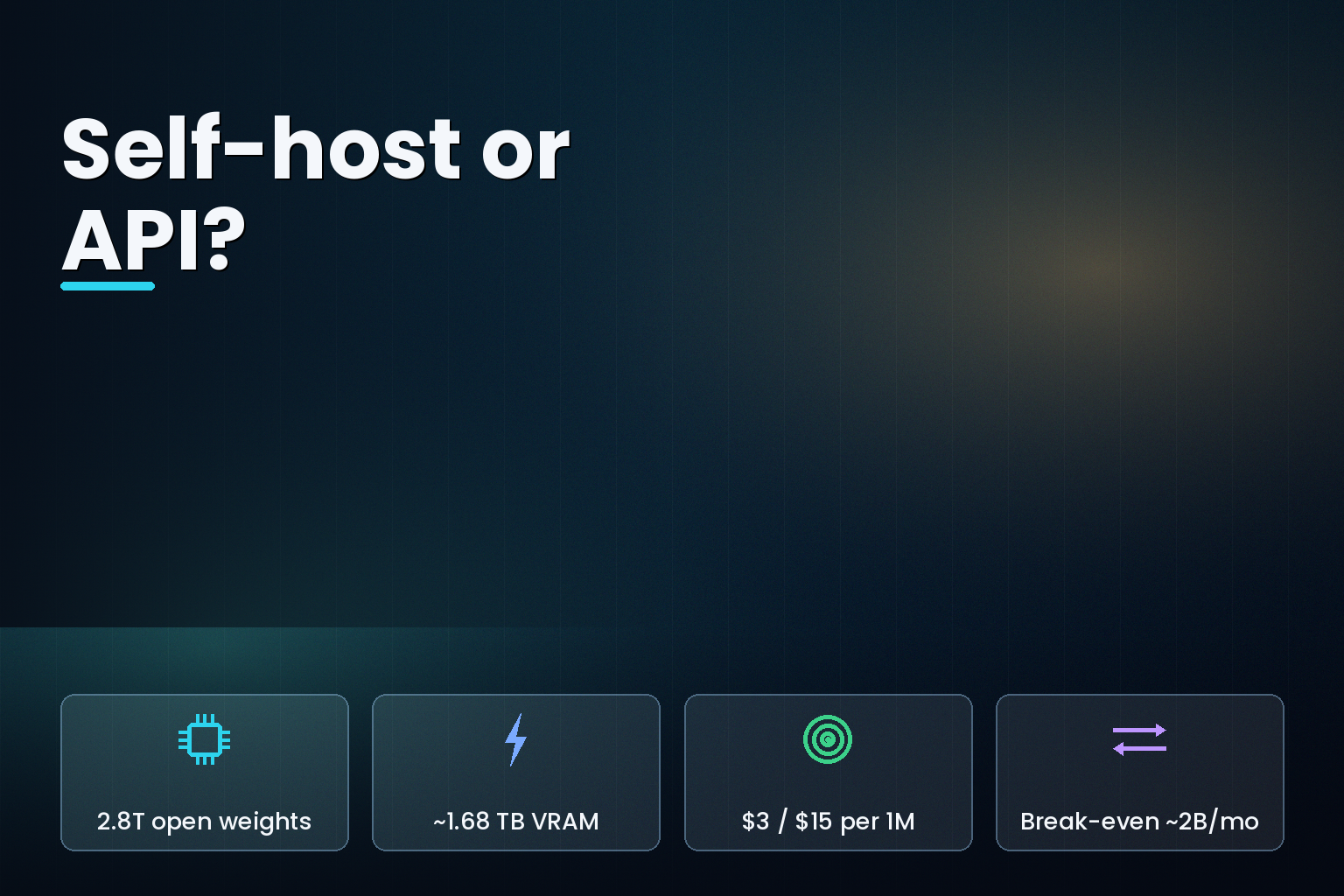
Summary. Moonshot AI released Kimi K3 on 16 July 2026 and published the open weights on Hugging Face on 27 July under a Modified MIT license, making it the largest open-weight model shipped to date at about 2.8 trillion total parameters, 104 billion active, with a 1M-token context window. The API lists at $3 per million input tokens and $15 per million output on OpenRouter. Self-hosting is a different order of commitment: the BF16 weights are 594 GB, the repository is 1.561 TB, and vLLM's metadata puts the minimum VRAM near 1,680 GB. Rent a single 8-way H200 node and you pay roughly $23,000 to $37,000 a month whether you send one token or a billion. That fixed cost is the whole decision. The break-even against the API sits near 2 billion output tokens a month, and below it the API wins on both cost and effort.
What Kimi K3 actually is
Kimi K3 is a mixture-of-experts model with roughly 2.8 trillion total parameters and about 104 billion active per token, which is why it can be strong at coding and long-horizon agent work without activating the full parameter count on every pass. It takes text and images, runs an always-on reasoning mode, and holds a 1,048,576-token context. OpenRouter describes its architecture as using KDA and Attention Residuals for computational efficiency. Moonshot lists it on its own platform with a cache-hit input price of $0.30 per million tokens, a 90% discount that matters for repetitive workloads.
For a buyer the specification that decides your infrastructure is not the benchmark score. It is the 594 GB of BF16 weights and the 1,680 GB minimum VRAM. That number, not the model quality, is what makes self-hosting expensive.
| Attribute | Kimi K3 | Note |
|---|---|---|
| Total / active parameters | ~2.8T / ~104B | Mixture-of-experts |
| Context window | 1,048,576 tokens | Flat price, no long-context surcharge |
| Modalities | Text and image in, text out | Always-on reasoning mode |
| License | Modified MIT | Open weights on Hugging Face, 27 Jul 2026 |
| API list price | $3 / $15 per 1M (in / out) | OpenRouter; Moonshot cache-hit input $0.30 |
| Weights size | 594 GB (BF16) | Repository 1.561 TB |
| Minimum VRAM to serve | ~1,680 GB | vLLM metadata estimate |
The API side: cheap to start, priced per token
The API is the low-commitment path. You pay $3 per million input tokens and $15 per million output, with zero fixed cost, and Moonshot's $0.30 cache-hit rate cuts the input bill by 90% on workloads that reuse a system prompt or a code repository. For a team sending, say, 200 million input and 50 million output tokens a month, the bill is on the order of a few thousand dollars, no engineers on call, no GPUs to babysit. You also inherit the provider's uptime and its data-handling terms, which is exactly the trade some buyers want to avoid.
The API's weakness is that the marginal cost never goes to zero. Every token costs the same as the last one, so at very high sustained volume you are effectively renting the model forever at list price, minus caching.
The self-host side: a big fixed cost, then near-zero marginal
Self-hosting inverts the economics. You pay a large fixed sum for GPUs and near-nothing per token after that. The catch is the size of that fixed sum. Kimi K3 cannot run on a Mac or a single GPU. You need a K3-enabled vLLM build (version 0.26 or newer) and a multi-GPU node, and the exact GPU count is where public guides disagree, because it depends on precision and how much of the 1M context you actually serve.
At full BF16 precision with the 1M window, guides point as high as 64 H100s across eight nodes. With MXFP4 quantization the same model fits a single node of eight H200s, and vLLM's own recipe references eight GB300-class GPUs. The honest planning number is the 1,680 GB minimum VRAM: that is roughly a dozen or more 80-to-141 GB accelerators before you add headroom for a long context. Most teams deploying locally start at 128k to 256k context, not the full million, precisely to keep the VRAM bill sane.
Then you rent the hardware. Using published 2026 on-demand rates, a single eight-GPU node runs like this on a 730-hour month, before storage and egress:
| Node (8 GPUs) | Rate per GPU-hour | Approx. monthly (24/7) |
|---|---|---|
| 8x B200, neo-cloud low end | $3.70 | ~$21,600 |
| 8x H200, neo-cloud | ~$4.00 | ~$23,400 |
| 8x B200, Lambda | $5.29 | ~$30,900 |
| 8x H200, CoreWeave | $6.31 | ~$36,900 |
| 8x B200, AWS on-demand | $14.24 | ~$83,200 |
Full-precision multi-node setups multiply that by the node count, which is how third-party estimates reach the low-to-mid six figures a month for the 64-GPU configuration. The point stands at any tier: you pay this whether the node is saturated or idle.
The rental rate is not the whole bill either. You store and move 1.561 TB of weights, which means object storage and egress charges, and you pay for the node around the clock even at 40% utilisation, so idle capacity is pure loss. Add the platform engineers who keep a K3-enabled vLLM build patched and the cluster healthy, and the true cost of ownership sits well above the GPU line item. Quantization is the main lever to shrink it: MXFP4 roughly quarters the weight footprint and lets the model fit a single 8x H200 node, but lower precision can move quality on the hardest tasks, so benchmark your own workload at the quantization you plan to ship rather than trusting the headline scores.
The break-even, in tokens
Put the two curves together. A single 8-way H200 node costs roughly $23,000 to $37,000 a month, fixed. Spend that same budget on the API at the $15-per-million output rate and it buys about 1.55 to 2.46 billion output tokens. So the crossover is near 2 billion output tokens a month, plus the proportional input.
Here is the reality check most cost posts skip. Two billion output tokens a month is about 770 tokens per second, sustained every second of every day. Your node has to actually produce that throughput at your latency target, or the fixed cost never amortises. If your real demand is bursty, or well under a billion tokens a month, the API is cheaper and you avoid an on-call rotation for a 1.68 TB inference cluster. Add Moonshot's $0.30 cache-hit input rate and the API's effective cost drops further on coding and agent workloads, pushing the break-even even higher in the API's favour.
| Dimension | Self-host Kimi K3 | Moonshot / OpenRouter API |
|---|---|---|
| Upfront and fixed cost | ~$21k–$83k+/month per node | $0 |
| Marginal cost per token | Near zero once running | $3 / $15 per 1M (in / out) |
| Break-even point | Above ~2B output tokens/month, saturated | Below that volume |
| Data residency | Full: your servers, your jurisdiction | Provider's terms and region |
| Ops burden | High: vLLM 0.26+, multi-GPU, on-call | Low: an API key |
| Best fit | Steady, very high volume or strict data rules | Most teams, variable demand |
The decision is not "which is cheaper" in the abstract. It is whether your sustained volume clears the break-even and whether you can keep a multi-GPU node busy. For nearly every team the honest answer in 2026 is the API, with self-hosting reserved for two cases: relentless high-volume inference, or a data-residency rule that the API cannot satisfy. For a broader view of how to split traffic instead of choosing one path, see our hybrid API routing to control spend framework, and for the deployment mechanics the self-hosting LLMs with vLLM guide.
A worked monthly bill
Numbers settle the argument. Take a team running an internal coding assistant that sends 200 million input and 50 million output tokens a month. On the API at list price that is $600 of input plus $750 of output, about $1,350 a month. Apply Moonshot's cache-hit rate to the repeated repository context, and the input can fall toward roughly $100, taking the bill under $900. No GPUs, no on-call.
Self-hosting the same workload means renting an 8x H200 node at roughly $23,000 a month, because the fixed cost does not care that you only used a fraction of the node. At this volume the API is well over an order of magnitude cheaper, and the team is more than thirty times below the break-even. The node only starts to pay when monthly output crosses about 2 billion tokens and stays there. Run your own version of this two-line calculation before any procurement conversation; it kills most self-host proposals in a spreadsheet.
Data sovereignty is the real self-host argument
For most buyers, cost is not the reason to self-host Kimi K3; jurisdiction is. Open weights let an organisation run the model on its own servers, in its own country, under its own data policies, which no API can fully match. That argument has structure the cost argument lacks: a bank or hospital that cannot send prompts to a third-party endpoint self-hosts because it must, and then absorbs the fixed GPU bill as the price of control. The trap is assuming sovereignty is free. It requires infrastructure sovereignty first, which is the 1.68 TB VRAM cluster and the team to run it.
India-specific considerations
For Indian teams two local factors sharpen the choice. First, high-end GPU capacity is scarcer and pricier here, and rupee budgets are tighter, so the fixed cost of an 8-way H200 or B200 node lands harder against a modest inference workload. Renting from a domestic AI cloud can help; our note on India GPU cloud rental pricing covers current H100 and B200 rates. Second, the Digital Personal Data Protection Act, 2023 gives the sovereignty argument teeth: an application processing personal data on-shore may prefer self-hosting to keep prompts and outputs inside Indian jurisdiction. For most Indian startups, though, the maths still favours the API until inference volume is both high and steady, with a smaller model or a routed mix handling the bulk of traffic and Kimi K3 reserved for the hard cases. Compare token economics across models in our B200 vs H100 inference cost per token analysis and the wider frontier-model comparison.
What teams get wrong
Three mistakes recur. The first is treating self-hosting as free after the GPUs are bought: the node bills 24 hours a day whether or not requests arrive, so low utilisation quietly doubles your real cost per token. The second is ignoring throughput. A node that cannot sustain the tokens per second your break-even assumes will never amortise, no matter how cheap the hourly rate looks. The third is over-provisioning context. Most workloads do not need the full 1M window, and serving 128k to 256k instead cuts the VRAM requirement and the GPU count sharply. A fourth, subtler error is skipping the cache: on repetitive coding and agent traffic, Moonshot's $0.30 cache-hit input rate changes the API economics enough to move the decision on its own. Measure utilisation, throughput and cache-hit rate on a real week of traffic before you commit capital, not after.
How eCorpIT can help
eCorpIT is a Gurugram-based technology company, founded in 2021, with CMMI Level 5 and ISO 27001:2022 certification and partnerships with AWS, Microsoft and Google. We help teams run the self-host versus API maths on their own numbers: measuring real token volume and throughput, sizing a vLLM cluster if the volume clears the break-even, and designing a routed setup so a frontier model like Kimi K3 handles only the requests that need it. If you are weighing an open-weight deployment against an API bill, contact us for a costed recommendation.
FAQ
References
- MoonshotAI: Kimi K3 — API pricing and benchmarks — OpenRouter model page.
- moonshotai/Kimi-K3 — model weights — Hugging Face.
- Deploy guide and hardware requirements for Kimi-K3 — Hugging Face discussion.
- Kimi K3 open weights: how to self-host the 2.8T model — DEV Community.
- Kimi K3 open weights arrive: self-hosting and data risk — Tech Times.
- NVIDIA AI GPU pricing guide: H100, H200, B200, B300 — IntuitionLabs.
- H200 cloud pricing: compare providers (2026) — GetDeploying.
- Kimi K3 API pricing (July 2026): $3/$15 — BenchLM.
- India DPDP compliance timeline and enforcement 2026-27 — India Briefing.
_Last updated: 1 August 2026._