On this page · 12 sections
- What actually changed: two fees instead of one
- The rate card, decoded
- New installs versus existing installs
- Billing choice: three paths, three cost profiles
- A worked example
- The programs: Apps Experience and Games Level Up
- Timeline: when your market changes
- What this means for Indian developers
- What to do now
- How eCorpIT can help
- FAQ
- References
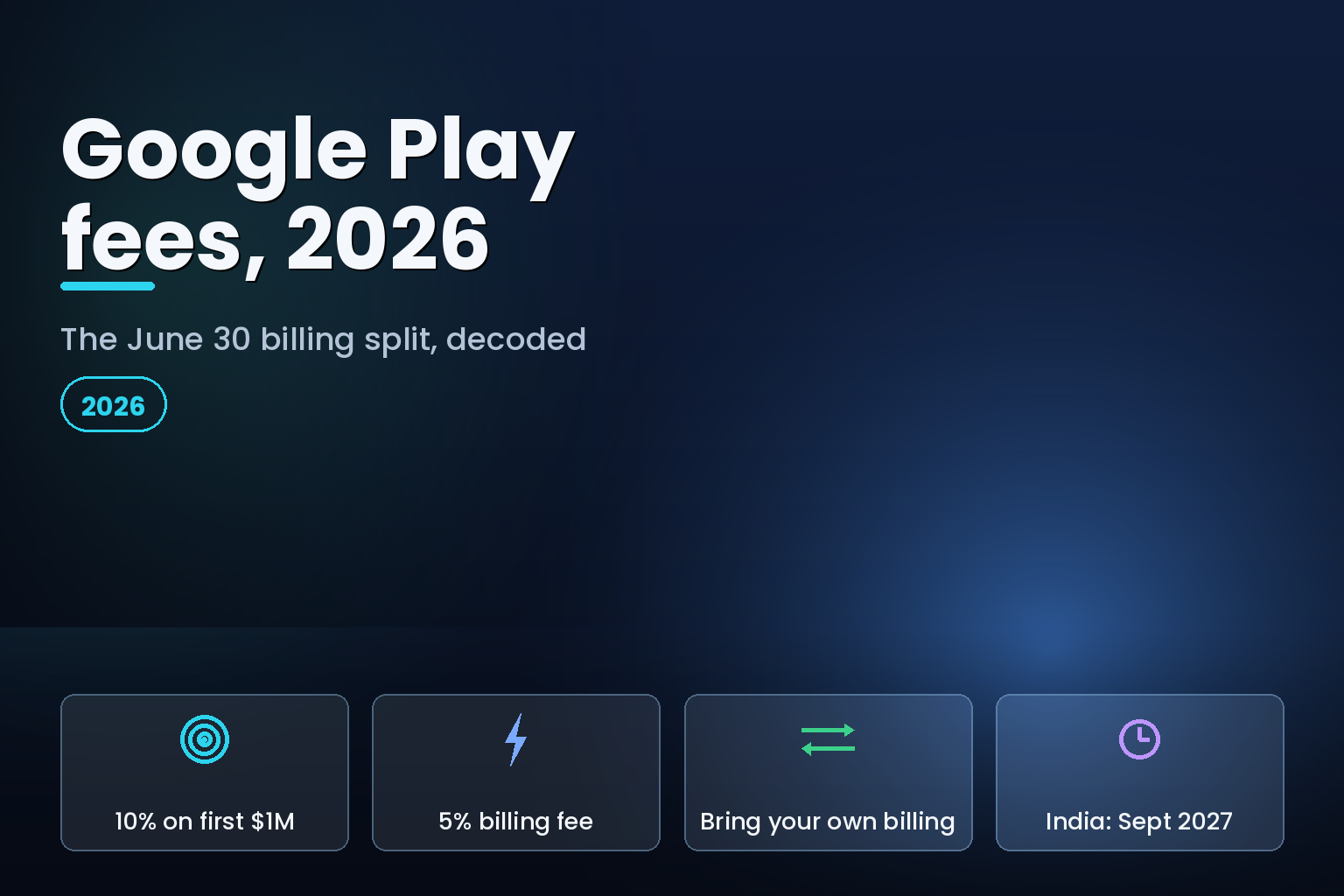
Summary. On June 30, 2026, Google Play started charging a service fee and a billing fee separately, beginning in the European Economic Area, the United Kingdom and the United States. The service fee starts at 10% on your first $1M (USD) in annual earnings and on all auto-renewing subscriptions, rising to a standard 20% on other one-time purchases from new installs. If you use Google Play's billing system, a 5% billing fee applies on top in those three regions; if you route payment through alternative billing or a link to your own website, that 5% does not apply. Two programs, the new Apps Experience and the revamped Games Level Up, cut the new-install rate to 15%, with program rate cards live from September 30, 2026. India sits in the "Rest of World" group and does not change until September 30, 2027. This guide decodes the rate card, works the math on a real transaction, and shows what to do now.
For a decade the Android question was simple and expensive: Google Play took 15% or 30%, and you had no choice about the checkout. That ended on June 30, 2026. Google Play, in a post by Paul Feng, Vice President of Google Play, now separates the service fee (what you pay for Android and Play) from the billing fee (what you pay for Google to process the payment), and lets you bring your own billing or send users to your website. The headline is lower fees and more flexibility. The reality is a rate card with enough branches, new installs versus existing, subscription versus one-time, Play billing versus alternative, that the number you actually pay is easy to get wrong. Getting it right is worth real money on every transaction.
What actually changed: two fees instead of one
Google Play used to bundle everything into one cut. Now there are two charges. The service fee is charged on every transaction "regardless of whether the transaction uses Google Play Billing, Alternative Billing or external web links," because it reflects the value of Android and Play themselves. The billing fee is charged only when Google processes the payment through Google Play's billing system. Split them apart and a new option appears: process the payment yourself and you skip the billing fee, keeping only the service fee.
Google's own framing is that the service fee "starts at 10% on your first $1M (USD) in annual earnings." That $1M threshold matters for smaller developers, because the bulk of indie and early-stage revenue now sits at a 10% service fee rather than the old 15% small-business rate. Above the threshold, and for standard one-time purchases, the rate climbs. The billing choice program is available to developers serving users in the UK and EEA, alongside programs in the US, and lets you offer alternative billing or link out to your own site, with a choice screen you can design to Google's UX guidelines.
The rate card, decoded
Here is what a single transaction costs in the US, UK and EEA for a new install under the standard rate card, before any program discount. "Service fee" is the Play cut; "billing fee" is 5% only when Google processes the payment.
| Transaction (US/UK/EEA, new install) | Service fee | Billing fee | Total |
|---|---|---|---|
| Auto-renewing subscription via Play billing | 10% | 5% | 15% |
| One-time in-app, first $1M/year, via Play billing | 10% | 5% | 15% |
| Standard one-time in-app via Play billing | 20% | 5% | 25% |
| Standard one-time via external web link | 20% | 0% | 20% |
| One-time in-app, Apps Experience rate, via Play billing | 15% | 5% | 20% |
| Standard paid app or game download | 20% | 5% | 25% |
Three things fall out of that table. Subscriptions are now a flat 10% service fee at any revenue level, which is the single biggest win for subscription apps. Routing a one-time purchase through your own website instead of Play billing saves the 5% billing fee, so a standard purchase is 20% by external link versus 25% in-app. And the first $1M of annual earnings sits at a 10% service fee across the board, which protects smaller developers.
New installs versus existing installs
The rate depends on when the user first got your app. Google sets the regional rollout date as the threshold: a "new install" is a user whose first install or first update from Play happened on or after that date, and an "existing install" is everyone before it. Existing installs carry higher standard rates on one-time in-app purchases.
| One-time in-app purchase (standard, US/UK/EEA) | Service fee | With Apps/Games program |
|---|---|---|
| New install, in-app | 20% | 15% |
| New install, external web link | 20% | 15% |
| Existing install, in-app | 25% | 20% |
| Existing install, external web link | 20% | 15% |
| Any install, subscription | 10% | 10% |
The practical read: an existing user buying a one-time item in-app costs you 25% plus the 5% billing fee, while the same purchase sent to your website costs 20% with no billing fee. That five-to-ten point gap is why the billing decision is now an economic decision, not just a UX one.
Billing choice: three paths, three cost profiles
The split means you now choose how payment is processed, and each path trades cost against effort.
| Billing path | Billing fee (US/UK/EEA) | What you take on |
|---|---|---|
| Google Play billing | 5% | Nothing extra: Play handles tax, refunds and 300+ payment methods across 195+ markets |
| Alternative billing (your own processor) | 0% | You integrate a payment service provider and own tax, refunds and disputes |
| External web link | 0% | You send users to your site to pay and handle the full commerce stack |
The 5% billing fee is not pure margin you claw back by leaving Play billing. Google Play's billing system handles tax calculation, compliance, subscription management and refunds across 195+ markets with 300+ local payment methods. Replace it and you inherit that work: a payment processor's own cut (often 2% to 3% plus fixed fees), tax registration, chargeback handling, and a checkout you must build and maintain. For a high-volume app the 5% saving can dwarf those costs; for a small one it rarely does. This is the same build-versus-integrate calculation we walk through for payment stacks in our fintech payments app development work.
A worked example
Take a $4.99 one-time in-app purchase from a new US user, standard rate, above the $1M threshold. Through Play billing you pay 20% service plus 5% billing, so 25%, leaving you $3.74. Route the same purchase through an external web link and you pay 20% service and no billing fee, keeping $3.99, but you now carry a payment processor charging roughly 3% plus $0.30, which on a $4.99 charge is about $0.45, so you net around $3.54 after the processor and still owe tax handling. On a single low-price item, Play billing often wins once you count the work you take on. Flip the numbers to a $79.99 annual subscription and the picture changes: 10% service is $8.00 either way, the 5% billing fee is $4.00 through Play, and a processor on your own checkout might charge $2.70, so at scale the alternative-billing path starts to pay for the engineering. The rate card rewards doing this math per price point, not once for the whole app.
The programs: Apps Experience and Games Level Up
Google added two ways to cut the new-install rate from 20% to 15%: the new Apps Experience Program and the revamped Games Level Up Program. Both require meeting integration and quality requirements that Google says ensure "best-in-class Android app experiences," and both drop the non-recurring new-install service fee to 15% (and the existing-install rate to 20%), excluding the billing fee. The program rate cards become available on September 30, 2026, and Google is still publishing the full requirements. If a meaningful share of your revenue is one-time purchases from new users, the five-point reduction is worth the integration work, so the programs belong in your 2026 planning.
Timeline: when your market changes
The rollout is staggered, and the rollout date in each region doubles as the "new install" threshold, so the date is not just administrative.
| Rollout date | Fee split and billing choice | New program rates |
|---|---|---|
| June 30, 2026 | EEA, UK, US | Not yet |
| September 30, 2026 | Australia | AU, EEA, UK, US |
| December 31, 2026 | Japan, South Korea | JP, KR |
| September 30, 2027 | Rest of World, including India | Rest of World |
What this means for Indian developers
India is in the "Rest of World" group, so the domestic Play Store fee structure does not change until September 30, 2027. That does not make this a 2027 problem. Any Indian studio or startup that sells to users in the US, UK or EEA is affected from June 30, 2026, because the fee depends on the buyer's region, not yours. A Gurugram team with paying users in London or Berlin is already on the new rate card. Two moves make sense now. First, model your revenue by buyer region and transaction type so you know your real blended take rate today, not a rough 30% assumption; our breakdown of India versus US app development economics uses the same per-market lens. Second, decide before 2027 whether alternative billing is worth building for your Indian user base, because the engineering, a payment processor, tax handling under Indian rules, and a compliant choice screen, takes months, not weeks. Payment and consent flows also touch personal data under the Digital Personal Data Protection Act 2023, so build the billing path and the privacy path together.
What to do now
The fee change is an economics decision disguised as a policy update. A practical sequence: measure your current blended take rate by region and SKU; identify where an external web link or alternative billing beats Play billing after processor and tax costs; check whether the Apps Experience or Games Level Up requirements are within reach for the 15% rate; and, if you decide to bring your own billing, scope the choice screen, the processor integration, and the refund and dispute handling as real engineering work. Re-architecting in-app billing without breaking existing subscribers is the hard part, and it is where most of the risk sits. Teams building or maintaining Android apps can start from our Android and Kotlin app development and cross-platform React Native work, and pair it with ongoing app maintenance as the rollout reaches your markets.
How eCorpIT can help
eCorpIT (eCorp Information Technologies Private Limited), founded in 2021 in Gurugram, builds and maintains Android, Flutter and React Native apps, and the 2026 Play fee change is exactly the kind of shift where the billing architecture decides the margin. Our senior engineering teams model your take rate by region and SKU, integrate alternative billing and external-link checkout where the math favours it, build compliant choice screens to Google's UX guidelines, and re-architect in-app purchases without breaking existing subscribers. As a CMMI Level 5 and MSME-certified organisation partnered with Google, AWS and Microsoft, we design payment and consent flows aligned with the Digital Personal Data Protection Act 2023 and local tax rules. See our Android and Kotlin app development service and ecommerce app development, or contact us to model your post-split economics.
FAQ
References
_Last updated: July 19, 2026._