On this page · 9 sections
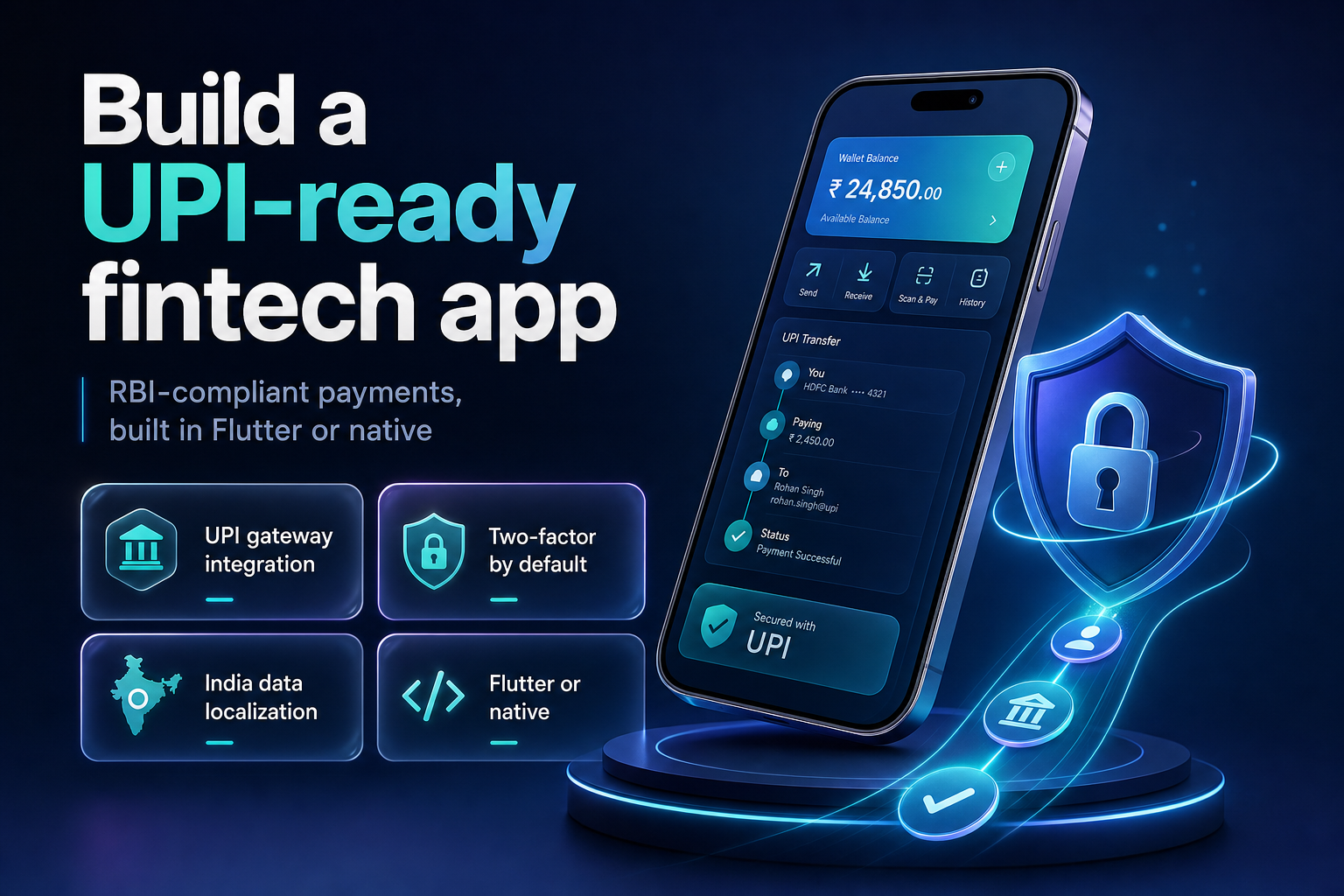
Summary. India's fintech market is large and still growing fast, which makes a UPI-ready payments app one of the highest-use products a founder can ship, and one of the hardest to get right. Mordor Intelligence values the market at about $51.30 billion in 2026, projected to reach $109.06 billion by 2031 at a 16.27% annual rate, with digital payments the largest segment at nearly 43% share. Building here means clearing real gates: RBI now requires two-factor authentication from 1 April 2026 on domestic digital payments unless specifically exempted (e.g. recurring e-mandates after the first, small-value offline and contactless payments), PCI DSS v4.0.1 certification, and data localization so all payment data of Indian users sits on Indian servers. A payment-aggregator licence alone needs ₹15 crore of net worth to apply, rising to ₹25 crore by the third year, which is why most teams build on top of a licensed aggregator instead. Indicative market pricing puts a payments MVP at ₹4,00,000 to ₹8,00,000 plus compliance work. eCorpIT's fintech and payments app development service builds UPI-ready, RBI-aligned apps in Flutter or native, handling the integration, security, and localization so you can focus on the product.
We build production apps and ship UPI checkouts already, so this is our working practice, not a pitch deck.
The opportunity, and the gates around it
The market case is straightforward. Payments dominate Indian fintech, and UPI has made in-app payment the default consumer expectation. Estimates vary by firm, from Mordor's $51.30 billion in 2026 to higher figures elsewhere, but every source agrees on the direction and on digital payments leading it. The hard part is not demand; it is compliance, because a payments app touches money and regulated data.
| Requirement | What it means | When |
|---|---|---|
| Two-factor authentication | Two factors from different categories, one dynamic per transaction | From 1 April 2026 |
| PCI DSS v4.0.1 | Card-data security certification | Before handling card data |
| Data localization | All Indian payment data on Indian servers | Ongoing |
| No raw card storage | Merchants and aggregators cannot store card numbers | Ongoing |
| KYC, KYB, and AML | Identity and anti-money-laundering checks | Ongoing, tightened from April 2026 |
These come from RBI's payment-aggregator directions and the 2026 authentication rules. They are not optional, and retrofitting them after launch is expensive. Designing for them from day one is the difference between a smooth go-live and a stalled one.
How you actually launch: build on an aggregator
Most teams should not chase a licence. There are three routes to accept UPI, and for the vast majority the practical one is clear. As the guides to building a UPI app in 2026 explain, you can become a Third Party Application Provider through a UPI-member bank, apply for direct NPCI membership, or partner with a licensed payment aggregator such as Razorpay, PayU, or Cashfree and build your product on their APIs.
The aggregator route is faster because the aggregator holds the licensing and you build the experience on top. A production-grade integration with webhook handling and reconciliation typically costs ₹1,00,000 to ₹3,00,000 and takes three to six weeks including onboarding. By contrast, a payment-aggregator licence needs ₹15 crore of net worth at application, rising to ₹25 crore by the end of the third financial year after authorisation, plus PCI-DSS certification and four to six months, then an ongoing annual system and cyber-security audit by CERT-In empanelled auditors and quarterly escrow-account certificates. eCorpIT builds on the aggregator path by default and advises on the others only when your scale genuinely warrants a licence. Our UPI market analysis for D2C brands covers why gateway-based acceptance also future-proofs you against market shifts.
What eCorpIT builds
Our service is end-to-end product engineering for a regulated payments app, not just a UI. We handle the integration, the security controls RBI expects, and the India-hosting design, and we build in the stack that fits your risk profile.
| Capability | What we do | Note |
|---|---|---|
| UPI and gateway integration | Aggregator APIs, webhooks, reconciliation | Razorpay, PayU, Cashfree, and similar |
| Secure authentication | Two-factor and biometric login, certificate pinning | Meets the April 2026 rule |
| India-hosted infrastructure | AWS Mumbai, Azure India, or compliant data center | Data localization by design |
| Fraud monitoring and audit logs | Real-time checks and complete trails | Required for payments apps |
| Cross-platform or native build | Flutter for speed, Swift and Kotlin for highest security | Chosen per product |
Flutter is a strong default for UPI apps in 2026 because it gives a near-native experience on Android and iOS from one codebase, which lowers cost and shortens delivery. For the highest-security products, native Swift and Kotlin remain the standard. We build in either, and our Flutter app development service covers the cross-platform path in more detail. For a broader view of the market and vendors, see our rundown of fintech app developers.
Cost and timeline, honestly
We size each engagement to scope rather than quoting a flat number, but the market ranges are a useful anchor. Indian fintech app pricing in 2026 puts a payments or personal-finance MVP at ₹4,00,000 to ₹8,00,000, a lending platform at ₹6,00,000 to ₹15,00,000, and neobanking at ₹8,00,000 to ₹20,00,000 or more, with an added ₹1,00,000 to ₹4,00,000 for compliance items like KYC setup and a security audit.
| App type | Indicative market range (India) | Typical timeline |
|---|---|---|
| Payments or personal-finance MVP | ₹4,00,000 to ₹8,00,000 | 2 to 4 months |
| Lending platform | ₹6,00,000 to ₹15,00,000 | 4 to 7 months |
| Neobanking product | ₹8,00,000 to ₹20,00,000+ | Longer, phased |
| Compliance add-ons | ₹1,00,000 to ₹4,00,000 | Parallel to build |
| Aggregator integration | ₹1,00,000 to ₹3,00,000 | 3 to 6 weeks |
A regulated transactional MVP usually needs 18 to 32 weeks because integrations, audit trails, error states, and security testing have to be designed and tested together, and a fully compliant platform can run 12 to 18 months. We phase delivery so you can launch a compliant core first and add features after.
Honest scope: what we do, and what we do not
We build and integrate; we do not hold your funds or grant you a licence. eCorpIT is a Gurugram-based technology organization, founded in 2021, assessed at CMMI Level 5, an MSME, and a Shopify partner, with senior-led, multi-disciplinary teams. We design applications aligned with RBI, PCI DSS, and DPDP requirements, which is different from claiming a certification on your behalf; certification and licensing remain the responsibility of you and your aggregator or auditor. Because our engineers ship secure mobile and commerce apps, the security and reconciliation work reflects real production experience.
India-specific considerations
Everything about this service is India-shaped, because the rules are. Beyond the April 2026 two-factor mandate and data localization, note that RBI has periodically adjusted compliance timelines for small-merchant UPI, so the smart path is to build to the strictest current rule and stay adaptable. Hosting on AWS Mumbai or Azure India keeps you inside data-localization and DPDP expectations at once. And because UPI itself keeps evolving, from new authentication rules to international acceptance, an app built on a licensed aggregator absorbs those changes with far less rework than a bespoke NPCI integration would.
FAQ
How eCorpIT can help
If you are building a payments or fintech app for India, eCorpIT can help you ship it right. Our senior-led teams integrate UPI and card payments through a licensed aggregator, implement the two-factor and biometric security RBI now requires, host on India-compliant infrastructure for data localization, and build the fraud monitoring and reconciliation a payments product needs. We work in Flutter or native and design aligned with RBI, PCI DSS, and DPDP requirements. Talk to our team to scope your fintech app.
References
_Last updated: 12 July 2026._