On this page · 11 sections
Summary. Almost every "ecommerce app cost in India" article prices the wrong thing. The build is a one-time number. What actually decides whether the app makes money is the stack of percentages under it, and those run forever. Razorpay's platform fee is 2% of transaction value plus 18% GST, which it states works out to 2.36% total. Cashfree lists 1.95% standard. Stripe India charges 2% for cards issued in India and 3% for cards issued outside it. Shopify Basic is ₹1,499/mo billed annually and adds a 2% fee if you use a third-party gateway. Apple's Small Business Program cuts commission to 15% for developers under 1 million USD in proceeds; Google Play charges 15% on the first $1M a year. Meanwhile the demand is real: IBEF puts India's ecommerce industry at ₹10,82,875 crore (US$125 billion) in 2024, projected to reach US$345 billion by 2030 at an 18.4% CAGR, and PIB reported that UPI handled 2,264 crore transactions worth ₹29.53 lakh crore in March 2026 alone. This is how to scope a build against those numbers instead of around them.
The engineering judgement, stated plainly: on a D2C app doing real volume, the gateway percentage will out-cost the entire build inside the first year. Scope the rails first and the screens second.
Start with the number that never stops
Take an app doing ₹50 lakh a month in gross transaction value. At Razorpay's stated 2.36% all-in, that is roughly ₹1.18 lakh a month, or about ₹14 lakh a year, on payments alone. No build quote you receive is a one-time ₹14 lakh decision in the way that percentage is a recurring one. This is the part founders discover in month seven.
So compare the rails properly before you compare developers.
| Gateway | Domestic rate | What the page actually says | |
|---|---|---|---|
| Razorpay | 2% + 18% GST | "2% of the successful transaction value for most domestic payment methods"; the "2% platform fee becomes 2.36% total cost" | |
| Cashfree | 1.95% standard | "UPI, Cards, Net Banking, Wallets Standard Fee: 1.95%", with a limited period offer fee of 1.6% | |
| Stripe India | 2% domestic | "2% for cards issued in India", "3% for cards issued outside India" | |
| Razorpay (Amex/Diners) | 3.00% | "Amex / Diners Club | 3.00%" |
| Stripe (international) | 3% to 4.3% | "4.3% for international cards with USD or other currency presentment", "+2% if currency conversion is required" |
Read the conditions, not the headline rate. Cashfree's 1.6% offer "applies only to new merchants who sign up starting 18th September 2025 and before 31st July 2026" and lasts "1 year from the date of signup". It also carries volume and mix conditions: "if the GTV exceeds ₹1 Crore in any month, the incremental GTV over ₹1 Cr will be charged at standard pricing of 1.95%", and "UPI transactions must be a minimum 40% of monthly GTV". A rate that resets after a year and reverts above ₹1 crore is a different product from a rate.
Two more line items that get missed. Stripe notes that "domestic debit card transactions have the Merchant Discount Rate (MDR) of 0.4% capped to ₹200", which materially changes the economics of high-ticket debit orders, and it charges "₹1,000.00 for each dispute you receive". If you sell a category with returns and chargebacks, model the dispute fee before you model the gateway.
Why UPI decides your checkout, not your designer
PIB reported on 30 April 2026 that UPI hit a record monthly volume of 2,264 crore transactions in March 2026, worth ₹29.53 lakh crore, with 24,161.69 crore transactions worth ₹314 lakh crore across FY2025-26 and 30.0% year-on-year volume growth. It puts UPI at 85% of India's digital payments in FY2025-26, live across 703 banks.
The two numbers that should change your build: "Person-to-merchant (P2M) transactions account for 63% of total transaction volume", and those P2M payments "were largely driven by small-ticket payments, with 86% below ₹500".
Most of Indian digital commerce is small-ticket UPI. That has direct engineering consequences. A checkout optimised for card entry, a cart designed around a ₹2,000 average order value, and a returns flow that assumes a card refund path are all built for a minority of transactions. And if 86% of P2M payments are under ₹500, a flat percentage takes a different bite than your spreadsheet assumes on a ₹300 order with shipping.
One caution on MDR. Razorpay's own explainer notes that "while the Govt charges 0% MDR, Razorpay charges a 2% Platform Fee for using their gateway technology". Zero MDR on UPI does not mean zero cost to you. That is a gateway's characterisation of policy, and you should confirm your own contract rather than assume UPI is free to accept.
Build, buy, or both
The Shopify-versus-custom question has a clean answer once you look at the penalty structure rather than the sticker price.
| Shopify plan | Price (annual billing) | Third-party gateway fee |
|---|---|---|
| Basic | ₹1,499/mo | 2% |
| Grow | ₹5,599/mo | 1% |
| Advanced | ₹22,680/mo | 0.6% |
| Plus | from ₹1,75,000/mo | Not listed on the pricing page |
The subscription is not the cost. The third-party payment provider fee is. On Basic, using your own gateway means paying Shopify 2% on top of whatever your gateway charges, roughly doubling your payment cost. That fee falls as you move up plans, which means Shopify's plan pricing is really a schedule for buying down a percentage. Model it at your actual GTV, because the plan that looks expensive gets cheaper the more you sell. Shopify also lists Basic at "₹1,994 INR/mo" on monthly billing versus ₹1,499 on yearly, and POS Pro at "₹7,000 INR/mo per location".
eCorpIT is a Shopify partner, and the honest advice is that a storefront on Shopify with a custom app layer is the right answer more often than founders expect. The build is worth funding where it changes economics or experience in a way a template cannot: a checkout tuned for sub-₹500 UPI, a catalogue with your own merchandising logic, or an app that owns the repeat-purchase relationship instead of renting it.
The app store maths
If you distribute a mobile app, two more percentages apply, and the fixed fees are trivial next to them.
| Item | Apple | Google Play |
|---|---|---|
| Developer fee | "99 USD... per membership year" | "US$25 one-time registration fee" |
| Reduced commission | 15% via the Small Business Program | "15% for the first $1M (USD) revenue earned by the developer each year" |
| Above the threshold | "the standard commission rate will apply to future sales" | "30% for earnings in excess of $1M (USD)" |
| Subscriptions | Not stated on the pages reviewed | "15%... regardless of revenue earned" |
| India-specific | Not stated on the pages reviewed | Alternative billing service fee "reduced by 4%" |
Apple's Small Business Program "features a reduced commission rate of 15% on paid apps and In-App Purchases" for developers who "made up to 1 million USD in proceeds in the prior calendar year". Google states that "97% of developers distribute their apps... at no charge" and "of those developers that are subject to a service fee, 99% are eligible for a fee of 15% or less".
The India detail is worth money: Google's alternative billing system in India carries a service fee "equal to the service fee applicable for transactions via Google Play's billing system reduced by 4%". For most physical-goods ecommerce this is moot, since store commissions apply to digital goods rather than physical ones, but if any part of your app sells a subscription or digital service, that 4% is a real line item.
The compliance work you cannot descope
Two Indian rules shape the architecture, and both are cheaper to design for than to retrofit.
RBI card-on-file tokenisation. The RBI circular of 7 September 2021 states that "with effect from January 1, 2022, no entity in the card transaction / payment chain, other than the card issuers and / or card networks, shall store the actual card data. Any such data stored previously shall be purged." You may keep "limited data - last four digits of actual card number and card issuer's name" for reconciliation. Tokenisation requires "explicit customer consent requiring Additional Factor of Authentication (AFA) validation by card issuer", and the token "shall be unique for a combination of card, token requestor and merchant". If your product roadmap includes saved cards or one-tap reorder, that last clause is a database design constraint, not a payments detail.
DPDP. PIB announced on 14 November 2025 that the DPDP Rules were notified with "an 18-month phased compliance timeline", under an Act "enacted by Parliament on 11 August 2023". Data Fiduciaries "must respond to all such requests within a maximum of 90 days", and Consent Managers "must be Indian companies". An ecommerce app collects exactly the data this regime is about. Build the consent record and the deletion path into the data model at the start; both are painful to add to a live catalogue of orders. We design applications aligned with DPDP requirements rather than bolting consent on at launch, and our notes on DPDP-ready app development go deeper.
What actually drives the build number
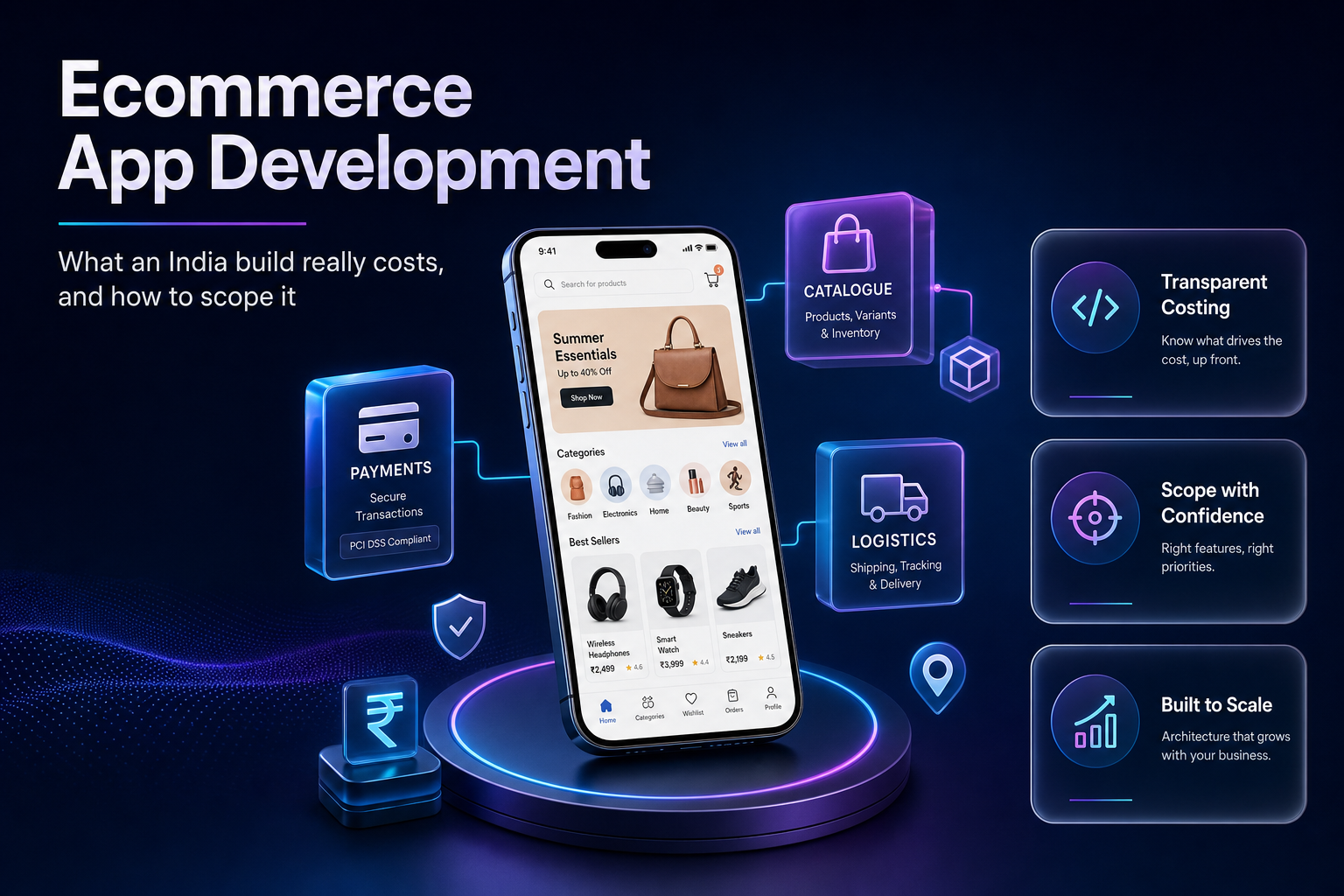
Nobody can quote your app honestly from a one-line description, and any agency that does is quoting a template. What moves the number:
| Cost driver | Cheap version | Expensive version |
|---|---|---|
| Payments | One gateway, hosted checkout | Multiple gateways, saved cards, tokenisation, retries |
| Catalogue | Flat SKUs, few variants | Variants, bundles, regional pricing, merchandising rules |
| Logistics | One aggregator | Multi-courier routing, serviceability, RTO handling |
| Returns | Manual, ops-driven | Automated, refund-path aware, per-payment-method |
| Compliance | Consent notice at signup | Consent records, deletion paths, 90-day request handling |
| Platform | Shopify plus a thin app | Custom storefront, own inventory service |
For the labour side, a real anchor: PayScale puts the average software engineer salary in India at ₹816,000 as of 2026, across 5,602 salary profiles last updated 14 April 2026, with early-career engineers at ₹754,670 across 4,098 salaries. Any quote implies a team size and a duration. Ask for both. A quote that cannot be decomposed into people and weeks is a number someone picked.
If you are running a formal process, our mobile app development RFP template covers what to ask for, and our D2C mobile app development notes cover the category specifics.
Where ONDC fits, honestly
ONDC is worth understanding and easy to over-plan for. It "was incorporated as a Section 8 company in December 2021, with the Quality Council of India and Protean eGov Technologies Limited as Founding Members", and the network went live with its first cohort in March 2022 with a beta launch in September 2022.
The framing figures on ONDC's own about page are striking but old, last modified in April 2023: "more than 12 million sellers earn their livelihood by selling or reselling products and services. However, only 15,000 of these sellers (0.125% of the total) have enabled e-commerce", against a stated aim to grow e-retail penetration "from the existing 4.3%". Treat those as 2022-era context, not 2026 facts. If ONDC is a channel decision for you rather than a build decision, our ONDC vs quick commerce channel choice piece is the better starting point.
How we scope it
Our engagement on an ecommerce build starts with the economics, not the wireframes. We model your gateway cost at realistic GTV and payment mix, because a 0.4% difference compounds into the largest line in your P&L. We decide Shopify-plus-app versus custom against that model rather than against preference. We design the data model for DPDP consent and RBI tokenisation from day one. Then we build, senior-led, in increments you can ship.
Who this is for: D2C and retail teams with real volume or a credible path to it. Who it is not for: a first test of whether anyone wants the product. If you have not sold anything yet, a Shopify store and a paid-ads budget will teach you more than an app will, and we will tell you so.
FAQ
How eCorpIT can help
eCorpIT is a CMMI Level 5 certified, MSME certified technology organisation founded in 2021 in Gurugram, with senior-led mobile and commerce teams and partnerships including Shopify, AWS, Microsoft and Google. We scope ecommerce builds against the payment economics first, design for RBI tokenisation and DPDP consent from the data model up, and are direct about when a Shopify storefront plus a focused app beats a custom build. If you want your app quote decomposed into people, weeks and the percentages you will actually pay, contact us. Our Flutter app development and fintech and payments app development teams cover the adjacent build work.
References
- Razorpay Payment Gateway Pricing and Fees Explained - Razorpay, 13 February 2026.
- Payment Gateway Charges - Cashfree official pricing page, accessed 16 July 2026.
- Pricing and Fees - Stripe India official pricing page, accessed 16 July 2026.
- UPI completes 10 glorious years, Emerges as World's Largest Real-Time Payments Platform - Press Information Bureau, Ministry of Finance, 30 April 2026.
- Tokenisation - Card Transactions: Permitting Card-on-File Tokenisation (CoFT) Services - Reserve Bank of India, RBI/2021-22/96, 7 September 2021.
- Government notifies DPDP Rules to empower citizens and protect privacy - Press Information Bureau, MeitY, 14 November 2025.
- App Store Small Business Program - Apple Developer, accessed 16 July 2026.
- Choosing a Membership - Apple Developer, accessed 16 July 2026.
- Service fees - Google Play Console Help, accessed 16 July 2026.
- Get started with Play Console - Google Play Console Help, accessed 16 July 2026.
- Shopify pricing, India - Shopify, accessed 16 July 2026.
- All About Open Network for Digital Commerce - ONDC, last modified 28 April 2023.
- India's E-commerce Boom: Growth, Trends and Future Prospects - India Brand Equity Foundation, last updated June 2026.
- Software Engineer Salary in India in 2026 - PayScale, 5,602 salary profiles, last updated 14 April 2026.
Last updated: 16 July 2026.