On this page · 11 sections
- The 2026 rate-card reality
- Cost at three complexity levels
- Where US-based wins
- Where India-based wins
- The procurement-grade trust signals that close the gap
- The hidden costs to model in both directions
- What to look for when evaluating an India-based vendor
- Frequently asked questions
- A short closing note
- Further reading
- References
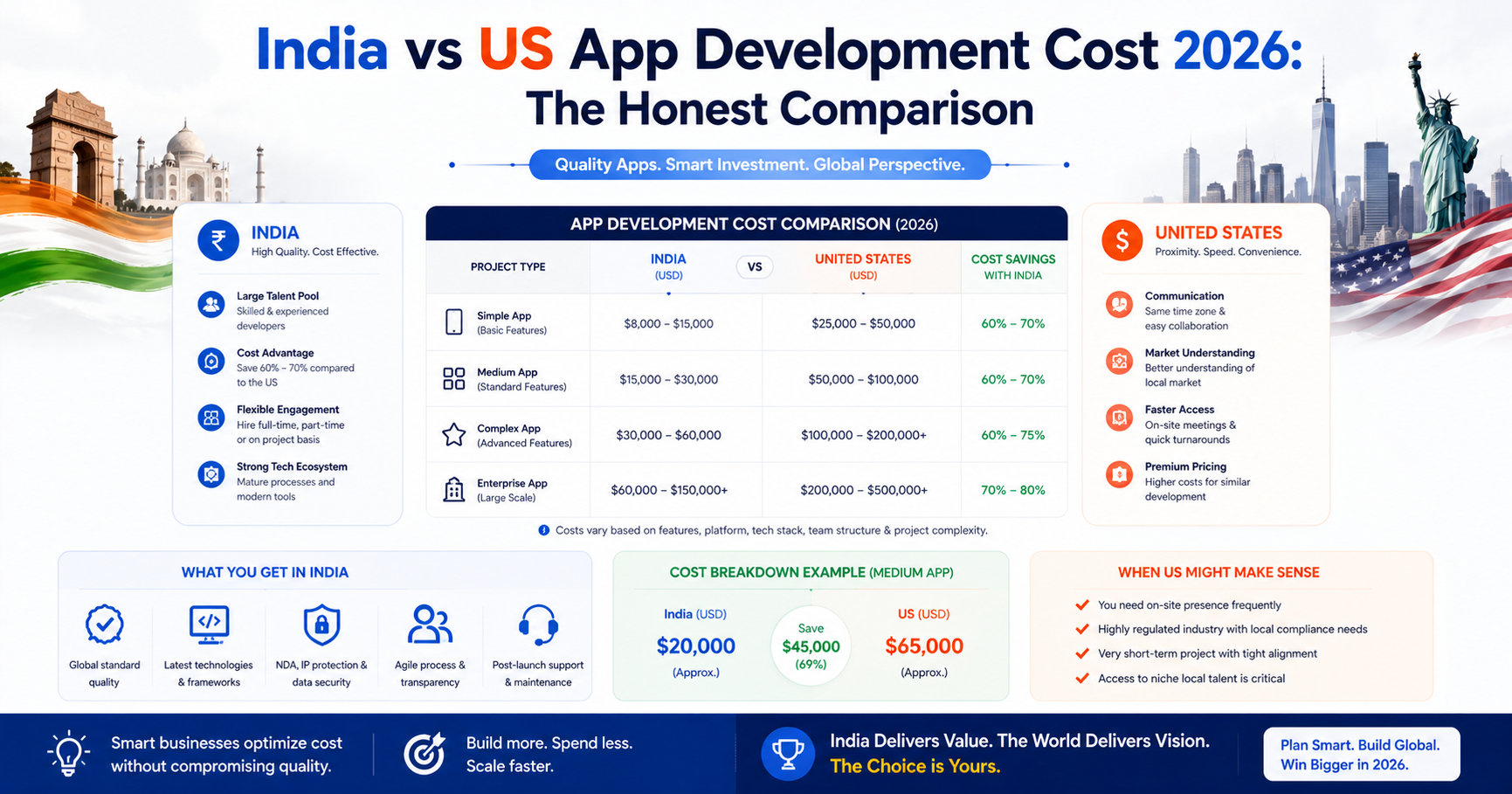
Summary. US senior mobile engineers cost $80–$150/hour in 2026. India-based senior engineers with the same shipped-app track record cost $44–$48/hour through reputable senior-only vendors. The 60–70% arbitrage is real and holds across simple MVP through complex enterprise builds. This guide does the actual math at three complexity levels, names the cases where US still wins (regulated on-site work, deep platform-feature roadmaps), and explains the procurement-grade credentials that close the trust gap.
Talk to eCorpIT about a build · Open the cost calculator
The 2026 rate-card reality
Two numbers anchor every conversation about US versus India app development cost in 2026.
US senior mobile engineer rate: $80–$150 per hour. Sourced from TechAhead's 2026 cost guide and Cynoteck's pricing data. Midpoint blends to about $115/hour for senior-led work, with US agencies adding a 10–20% project management and overhead uplift on top.
India-based senior engineer rate (through a reputable senior-only vendor): $44–$48 per hour. eCorpIT publishes this rate card openly. iOS senior sits slightly higher at $48 because senior Swift talent is scarcer globally; Flutter, React Native, and Android senior rates land at $44.
The arbitrage is roughly 60–70% on like-for-like senior staffing. Same engineer profile, same shipped-app capability, same App Store and Play Store submission discipline. Different rate card.
The arbitrage is not driven by junior backfill. Reputable India-based senior-only vendors deploy the engineer whose CV you interviewed. The cost difference reflects the labour-cost differential between the two markets, plus the lower overhead structure of India-based delivery. It is not a quality discount.
Cost at three complexity levels
Real comparison, sourced from TechAhead, Cynoteck, Appinventiv, and eCorpIT's own engagement data.
Simple MVP
Single platform or cross-platform, 5–8 screens, basic auth, BaaS backend, standard design.
| Provider | Cost | Per-hour blended | Timeline |
|---|---|---|---|
| US agency | $30K – $80K | ~$112/hour | 6–10 weeks |
| eCorpIT (India) | $8K – $25K | ~$44/hour | 6–10 weeks |
| Savings | $22K – $55K | ~60–70% | Same |
Mid-complexity app
Custom backend, payments, push, custom design, 10–15 screens.
| Provider | Cost | Timeline |
|---|---|---|
| US agency | $80K – $150K | 10–16 weeks |
| eCorpIT (India) | $15K – $60K | 10–16 weeks |
| Savings | $65K – $90K | Same |
Complex enterprise build
20+ screens, multi-role, real-time, offline-first, AI features, compliance overlay, integrations.
| Provider | Cost | Timeline |
|---|---|---|
| US agency | $150K – $300K (basic) to $500K+ (with compliance) | 16–40 weeks |
| eCorpIT (India) | $40K – $150K | 16–40 weeks |
| Savings | $110K – $350K+ | Same |
The arbitrage holds across the complexity range because both sides are charging for senior engineering hours. The hours required to ship are similar; the rate per hour is different. For your specific project the interactive cost calculator returns an eCorpIT range against US and UK baselines in 90 seconds.
Where US-based wins
The honest list of US-buyer situations where a US agency is the right call.
Regulated public-sector engagements with vendor-residency requirements. Some US federal, state, and local government procurement processes have vendor-residency or vendor-citizenship requirements. Some FedRAMP and DoD-adjacent workloads. Some FDA software-as-medical-device categories.
Engagements that require constant on-site presence. Workshops, stakeholder interviews, regulated walkthroughs that need a person in the building weekly.
Fortune 100 procurement with strict offshore-vendor caps. Some procurement processes cap offshore-vendor spend regardless of capability. Check yours specifically before scoping.
Same-day in-person crisis response. Production-emergency response is fine from any timezone (a senior on-call is awake somewhere); but if your incident-response process requires a person in your office that morning, that is a US-agency problem.
Brand familiarity for non-technical procurement. Some procurement teams have not approved offshore vendors before and the documentation cycle extends the timeline by 4–8 weeks. For tight deadlines, factor this in.
For the rest of the US mobile-app buyer market — startups, scale-ups, mid-market, most Fortune 500 procurement that has done offshore engagements before — the US-vs-India decision usually goes to the lower-cost senior-only India vendor with procurement-grade credentials.
Where India-based wins
The honest list of US-buyer situations where India-based wins.
Senior-only delivery economics. A US-bought senior-led project for $120K runs $45K with the same shipped app from an India-based senior-only vendor. The arbitrage compounds across the engagement.
Time-zone-overlap-driven projects. Counter-intuitive but real. The 6:30 PM IST start time gives US-East coast clients an "overnight" engineering team that wraps the next day's work before the US team starts. Effectively a 12-hour workday for the project.
Procurement-grade credentials at lower cost. CMMI Level 5, ISO/IEC 27001:2022, ISO 9001, ISO 20000-1, ISO 45001, D-U-N-S, GDPR alignment, DPDP. Senior India-based vendors hold the certification set US enterprise procurement requires, at significantly lower hourly rate than US agencies with the same credentials.
24/7 monitoring and on-call. US-night coverage is built in for clients who need it without paying for a second team.
Multi-region delivery. Senior India-based vendors typically serve US, UK, EU, UAE, AU, and CA simultaneously. The cross-region experience often translates into better design discipline for global launches.
The procurement-grade trust signals that close the gap
The reason "India-based" is no longer a default-disqualifier for US enterprise procurement in 2026: the senior India-based vendor market now holds the certification set US procurement requires, and the named-reference list with US clients is real.
eCorpIT specifically holds:
CMMI Level 5 — the process-maturity standard US government and Fortune 500 procurement processes use. The current appraisal is the document US procurement asks for.
ISO/IEC 27001:2022 — current information-security standard. The 2022 revision specifically. US enterprise procurement increasingly requires the 2022 update, not legacy 2013 certificates.
ISO 9001:2015 — quality management.
ISO/IEC 20000-1:2018 — IT service management.
GDPR + DPDP Act + UK GDPR + DPA 2018 alignment. Multi-jurisdiction data-protection coverage.
D-U-N-S verified registration #854367803. Vendor-classification ready.
Named US reference clients. Global Banking & Finance Review (US/UK-recognised finance media platform) and Reagan Medical Center (US healthcare network with HIPAA-aware engagement under BAA). Reference calls available under NDA.
The certifications are the floor, not the ceiling. The named-reference list and the BAA-readiness for US healthcare are what convert procurement scepticism into a signed MSA.
The hidden costs to model in both directions
Three categories of hidden cost that US buyers should model when comparing.
US-side hidden costs of an offshore engagement.
- Onboarding the offshore team into your tooling: typically 1–2 weeks of in-house engineering time.
- Communication overhead: weekly standups, async status notes, demo videos. Usually 2–4 hours per week of in-house product-manager time.
- Travel for in-person workshops: $4K–$15K per workshop if you fly your team to India or fly the vendor team to the US.
- Procurement-cycle extension for first-time offshore vendor: 4–8 weeks if your procurement team has not approved a similar vendor before.
India-side hidden costs of a US engagement.
- US-rate billing for time spent on US-process overhead (procurement reviews, security questionnaires, vendor-classification documentation). At $115/hour, a 20-hour procurement-questionnaire cycle is $2,300.
- US-tax and benefits structure built into US agency rates: typically 30–40% of the rate covers payroll tax, benefits, healthcare, and 401(k).
- US real-estate overhead: NYC, SF, Boston agencies operate from premium markets with corresponding cost structure.
For most non-public-sector US builds, the offshore hidden costs ($5K–$20K total) are dwarfed by the rate arbitrage ($50K–$300K savings). The math favours offshore for most builds.
What to look for when evaluating an India-based vendor
Five practical filters that separate senior-only India-based vendors from junior-backfill volume exporters.
Public rate card. Senior-only vendors typically publish rates. Volume exporters do not because their effective rate varies with the seniority mix they assign post-signature.
Named clients with reference-call availability. Anonymous "Fortune 500 retailer" references do not count. Named US, UK, or globally-recognised brands with named contacts the vendor can put on a call do.
Procurement-grade certifications (current, not stale). CMMI Level 5 appraisal expires after 3 years. ISO certifications expire every 3 years. Ask for the certificate with the issuing body and the expiry date.
Senior-only delivery commitment in writing. "Senior-led" is a marketing line. "The engineer whose CV you interviewed is the engineer who ships, in writing, in the MSA" is a commitment. Ask for it.
Founder or senior-leader visibility. Mid-market and high-stakes US builds benefit from founder accountability. Account-management-only models work for low-stakes engagements; for $50K+ builds, founder access matters.
Frequently asked questions
A short closing note
The India-vs-US app development cost question in 2026 has a clear answer for most US builds: 60–70% arbitrage at like-for-like senior staffing, with the senior India-based vendor market now holding the procurement-grade certifications US enterprise procurement requires. The cases where US still wins are real (regulated public sector, vendor-residency requirements, mandatory on-site presence) but narrow. For most US founders, scale-ups, and mid-market CTOs, the math favours the offshore choice with the right vendor filter applied.
If you want an honest senior read on whether eCorpIT fits your specific build versus the US-agency alternative, that is what we do on the discovery call.
Further reading
References
Page last reviewed by Manu Shukla, Founder, eCorpIT, on 30 May 2026. Next review: August 2026.