On this page · 9 sections
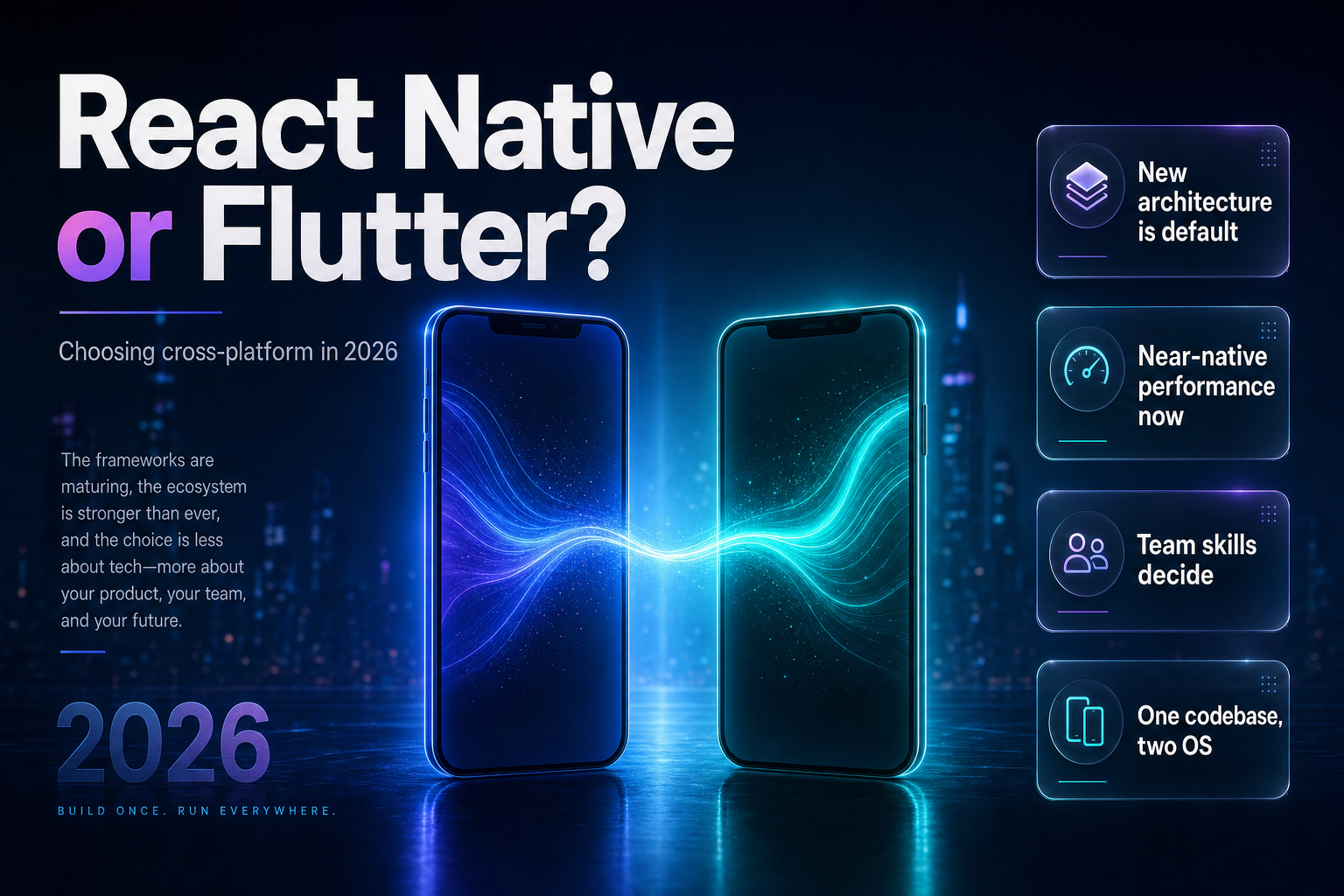
Summary. The cross-platform decision in 2026 is closer than the internet suggests. React Native 0.82 retired the old bridge and made the New Architecture the only architecture, and by 0.84 Hermes V1 shipped as the default JavaScript engine, so React Native apps now match native on scroll FPS, tap latency, and cold start for most workloads. A 2025 Statista survey of 500 enterprise teams found 42% on React Native and 38% on Flutter, a gap that narrowed sharply from 51% versus 29% in 2023. Both frameworks deliver 30-60% cost savings versus separate native builds. So the real question is not which framework is objectively best, but which fits your team, your product, and your timeline. This guide lays out the decision on facts, then explains how eCorpIT (founded 2021, Gurugram) ships production apps in either one.
Picking a framework on a benchmark screenshot is how teams end up rewriting an app 18 months later. The better approach is to match the tool to your people and your product. Here is how to do that in 2026.
What changed: React Native grew up
React Native's big knock was performance, and that argument is largely over. The New Architecture became the default in version 0.76, the old bridge was retired in 0.82, and Hermes V1 became the default JavaScript engine in 0.84, per the React Native 0.82 release and Creole Studios. The New Architecture replaces the old asynchronous bridge with the Fabric renderer and TurboModules, enabling synchronous native calls. In 0.82, trying to disable it is ignored: the app runs on the New Architecture regardless.
The result, with the New Architecture, Hermes V1, and FlashList, is that React Native 0.84 apps match native in most user-visible metrics, as Procedure documents. For standard enterprise apps, forms, product listings, navigation, both React Native and Flutter now perform indistinguishably to the end user. The performance tiebreaker most teams argue about barely exists for 95% of commercial apps.
The honest comparison
Since raw performance rarely decides it, the decision comes down to team, ecosystem, and product type.
| Dimension | React Native | Flutter |
|---|---|---|
| Enterprise adoption (2025 survey) | 42% | 38% |
| Language | JavaScript / TypeScript | Dart |
| Talent supply | 5-8x larger in many markets | Smaller, higher salaries |
| App size (Android) | 5-8MB | 8-12MB |
| Best fit | JS/TS teams, npm ecosystem | Branded, animation-heavy, multi-screen |
| Backed by | Meta |
The talent point carries the most weight for most organizations. The supply of strong React Native engineers is roughly 5-8x that of Flutter engineers in many markets, and a senior React web developer can become productive in React Native in weeks because the core concepts carry over. Flutter developers command 10-15% higher salaries, though faster MVP timelines can offset the premium, per Cozcore and AgileSoftLabs. We break the framework choice down further in our Jetpack Compose versus Flutter guide and Expo versus React Native comparison.
The economics of the decision
Framework choice is a multi-year cost commitment, so the money matters as much as the syntax.
| Aspect | Figure | Notes |
|---|---|---|
| Savings vs separate native | 30-60% | Either framework |
| Flutter salary premium | 10-15% | Often offset by MVP speed |
| React Native to Flutter migration | $50,000-$250,000 | 3-6 months for enterprise apps |
| Faster cycles post-migration | 30-40% | When migration is justified |
| Migration ROI window | 12-18 months | Payback period |
The lesson in these numbers is to choose deliberately, because switching later is expensive. A React Native to Flutter migration runs $50,000 to $250,000 and 3-6 months for an enterprise app, with ROI realized in 12-18 months, per Internative. That cost is exactly why the safest enterprise path is to base the decision on organizational reality, your existing skills and stack, rather than a benchmark you will not notice in production.
How to choose, in practice
Use a short decision rule. Choose React Native if you have a React or JavaScript and TypeScript team, lean on the npm ecosystem, or want the largest talent pool for hiring and handover; it is the low-friction choice for most web-native organizations. Choose Flutter if your app is heavily branded and animation-rich, or if you want one UI codebase across mobile, web, and desktop, such as an internal dashboard or a design-led consumer app. When neither pulls hard, default to the framework your team already knows, because delivery speed and maintainability beat theoretical benchmarks. The wrong reason to choose is a trend; the right reasons are your people, your product, and your five-year maintenance plan.
Where eCorpIT fits
eCorpIT builds production cross-platform apps in both React Native and Flutter, so our advice is not tied to one framework. Our senior-led, CMMI Level 5 teams start by mapping your existing stack, team skills, and product goals, then recommend the framework that lowers your total cost of ownership, not the one that is trending. We migrate legacy apps onto the New Architecture, build with the current toolchain, and design a maintenance path so the app you ship in 2026 is still maintainable in 2031. As a Shopify partner, we connect commerce apps to your storefront, and we align data handling with the Digital Personal Data Protection Act, 2023 (DPDP). Our Flutter app development service and guide to choosing a development company go deeper.
India-specific considerations
For Indian teams, the talent math is decisive. React Native's larger engineer pool means faster hiring and cheaper handover, which matters when a startup needs to scale a team quickly or hand a codebase to an in-house group later. Flutter's single-codebase reach across mobile, web, and desktop can win for product companies building tools and dashboards. Budget in rupees against the 30-60% saving over native, and weigh the cost of a future migration before locking in. Any app handling personal data must align with the DPDP Act, so build consent and data-handling into the architecture from the first sprint rather than retrofitting it before launch.
FAQ
How eCorpIT can help
eCorpIT (eCorp Information Technologies Private Limited, founded 2021, Gurugram) designs and ships cross-platform mobile apps in both React Native and Flutter. Our senior-led, CMMI Level 5 and MSME-certified teams pick the framework that fits your team and product, build on the current New Architecture, and design apps aligned with DPDP Act requirements. As partners of AWS, Microsoft, Google, and Shopify, we connect your app to the rest of your stack. To scope a cross-platform build or a migration, contact us.
References
_Last updated: July 13, 2026._