On this page · 9 sections
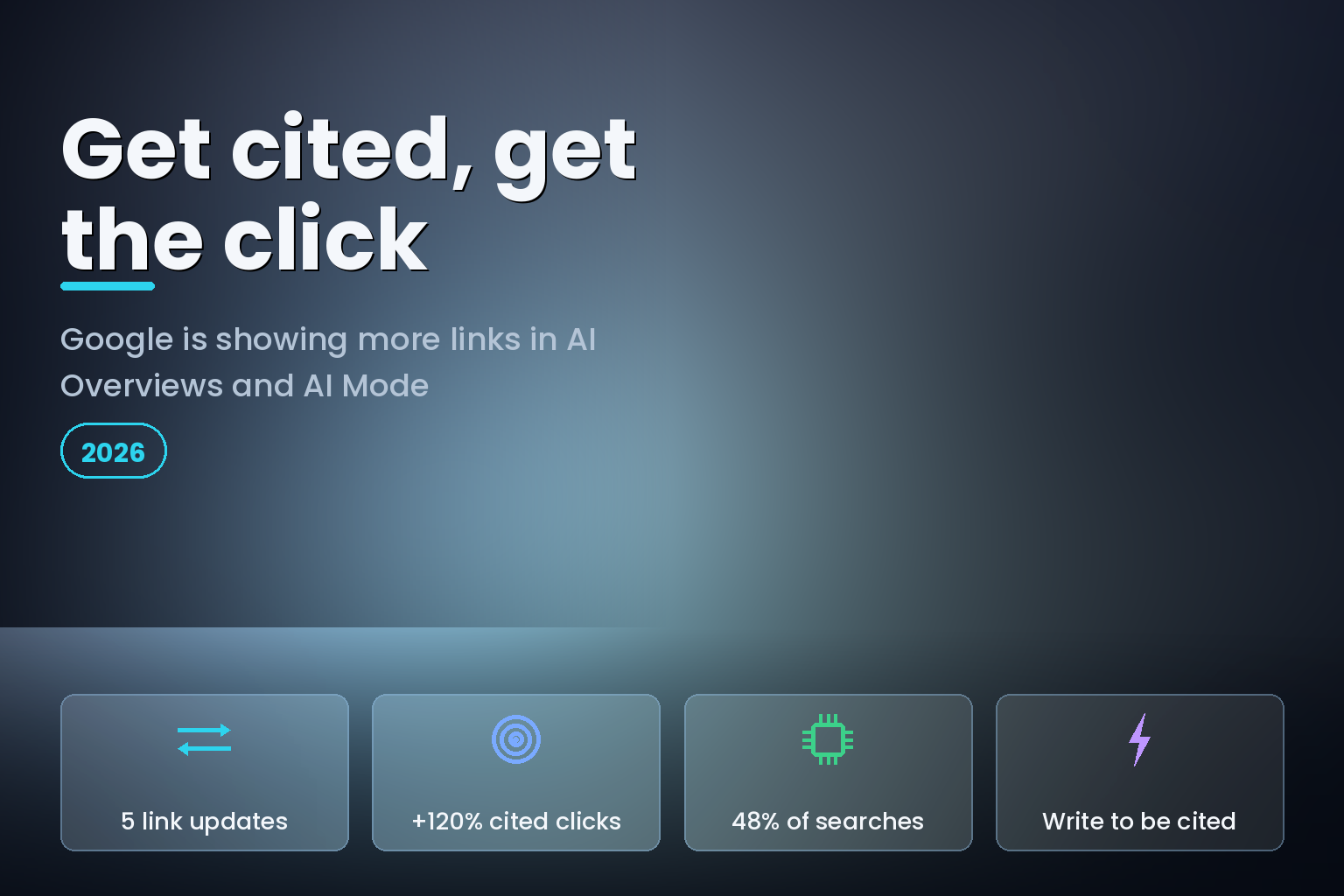
Summary. On 6 May 2026 Google announced five updates that put more links inside AI Overviews and AI Mode, its two generative search surfaces. The changes add subscription labels, more inline links, discussion and social previews, topic suggestions after answers, and desktop hover previews, written up by Hema Budaraju, VP of Product Management at Google. This matters because of one number: Seer Interactive found that brands cited inside an AI Overview earn roughly 120% more organic clicks per impression than brands that are not cited on the same query. With AI Overviews now on about 48% of Google searches as of March 2026, up from 34.5% in December 2025, and Pew Research finding users click an organic result on just 8% of searches that show an AI summary versus 15% without one, the citation is the click. For a query worth ₹2,00,000 a month in organic-driven pipeline, being one of the cited links is close to the whole game. More link slots means more chances to be that citation, and this piece covers what changed and how to earn them.
The framing that AI answers simply kill clicks is too blunt for 2026. The clicks are concentrating: they go to the sources Google cites and skip everything else. Google adding more visible links does not reverse that, it raises the stakes of being cited.
What Google changed on 6 May 2026
Google is rolling out five link updates across AI Mode and AI Overviews, detailed in its blog post on exploring the web with generative AI and covered by Search Engine Journal. Google did not share rollout timing, geography or eligibility for most of them, so treat the list as direction rather than a switch already flipped everywhere.
| Link update | What it does | What it means for you |
|---|---|---|
| Subscription highlighting | Labels links from a user's news subscriptions in AI Mode and AI Overviews | Subscriber relationships and Preferred Sources now affect visibility |
| More inline links | Places more links next to the specific passage they support | Passage-level, citable writing gets surfaced, not just whole pages |
| Discussion and social previews | Shows previews of public discussions and firsthand posts, with creator and community names | First-hand experience and community presence earn slots |
| Topic suggestions | Adds related-content suggestions at the end of many AI answers | A second path to a click after the answer ends |
| Desktop hover previews | Hovering an inline link shows the site name and page title | Clear titles and recognisable brands reduce click hesitation |
Google said that in early testing people were "significantly more likely" to click links labelled as their subscriptions, though it did not publish specific numbers. Matt G. Southern, Senior News Writer at Search Engine Journal, read the direction plainly: the updates "show Google trying to make links more visible in AI Search at a time when publishers are closely monitoring referral traffic."
Why Google is doing this now
Google is under pressure from two sides. Publishers and brands watched referral traffic move as AI Overviews expanded, and regulators and the press have questioned whether generative answers turn Search into a dead end. Adding subscription labels, inline links, discussion cards and hover previews is Google's answer: make the AI response a starting point for the web rather than a terminal screen.
There is a self-interested logic too. If AI answers feel like they hide the web, users and publishers push back, and the open web that Google indexes weakens. More visible links keep the click loop alive. For anyone doing search work, the practical reading is simple: Google is creating more citation slots, and the brands that fill them win the traffic that remains. This is the same pattern we cover in why GEO and AEO are still SEO and in our ranking versus AI Overview citation data analysis.
The click data behind the change
The numbers explain why the citation, not the ranking, is now the prize. Different studies use different methods, so read them as a range that points the same way.
| Study | Finding | Takeaway |
|---|---|---|
| Seer Interactive (2026) | Cited-in-AIO brands earn ~120% more organic clicks per impression than uncited brands | Being cited is the single biggest lever |
| Seer Interactive (2.43B impressions, 53 brands) | Organic CTR fell ~61% on queries where an AI Overview appears | Uncited pages lose most of the click |
| Pew Research (68,879 searches) | Users click an organic result on 8% of AI-summary searches vs 15% without | AI summaries roughly halve onward clicks |
| Pew Research | Users clicked a source inside the AI summary itself just 1% of the time | Link placement and prominence matter |
| Ahrefs (Feb 2026) | CTR down ~58% on queries with an AI Overview | Independent confirmation of the drop |
| Coverage (Mar 2026) | AI Overviews on ~48% of searches, up from 34.5% in Dec 2025 | Half of queries now run through AI |
Read together, these say the click has not vanished, it has narrowed. On a query with an AI Overview, most of the onward traffic flows to the handful of cited sources. Seer's roughly 120% citation advantage is the number to organise around, because it turns a defensive worry ("AI is taking my clicks") into an offensive target ("get cited and take more"). Our keyword-selection framework for click survival applies the same logic to which queries are even worth targeting.
What the new link slots mean for your clicks
Each of Google's five updates is a new way to be the cited source, and each rewards a different strength.
More inline links reward passage-level writing. If your page answers a sub-question in two clean, self-contained sentences with a specific number, that passage is easy to lift and cite next to the relevant line of an AI answer. Wall-of-text pages that bury the answer are harder to cite.
Discussion and social previews reward first-hand experience. Google is surfacing public discussion, community posts and firsthand perspectives with creator and community names attached. Brands and experts who show up in real communities, with a real point of view, become eligible for slots that a generic corporate page never will. This is the off-site side of the work, which we cover in earning third-party AI citations.
Subscription highlighting rewards direct audience relationships. Labelled subscription links get clicked more, so a loyal, logged-in audience and participation in Google's Preferred Sources become ranking-adjacent assets, not just loyalty metrics.
Hover previews reward clear titles and brand recognition. When users can see the site name and page title before clicking, a recognisable brand and an honest, specific page title beat a vague one. Clickbait that misrepresents the page loses on the preview.
What to do about it
The response is not a new discipline, it is a sharper version of good GEO and AEO practice.
First, write for citation, not just ranking. Put a direct 40-to-60-word answer under a clear question-shaped heading, lead with a specific, dated number, and keep each answer self-contained so it can be lifted. This is the structure that also wins featured snippets, and it maps to the AI Overview content strategy we already recommend.
Second, build first-hand proof and community presence. Original data, real case detail, named experts and genuine participation in the communities Google now previews are what qualify you for the discussion slots. Google's own guidance treats first-hand experience as an E-E-A-T signal.
Third, target queries an AI Overview cannot fully answer. Comparisons with real benchmarks, cost breakdowns, and decision-stage questions leave room for a cited source, where a simple definition does not. Choosing those queries is half the battle.
Fourth, measure citations, not only rankings. Track whether your pages are being cited in AI Overviews and AI Mode for your priority queries, because a page can rank well, lose the classic click, and still win by being the cited link. Our Google GEO and AEO optimisation guidance sets out how to instrument that.
India-specific considerations
For Indian brands and publishers, the shift lands on top of an already price-sensitive search market. Organic search is often the largest non-paid channel, so a query worth, say, ₹2,00,000 a month in organic-influenced pipeline is worth defending by being the cited source rather than the tenth blue link nobody reaches. India's multilingual and code-switched queries also favour firsthand, community-grounded content, which is exactly what Google's new discussion previews surface. Brands active in Indian communities and forums, with real first-hand answers, are positioned for the discussion slots that a translated corporate page will not earn. The measurement point holds too: track AI citations for your Hindi and English priority queries separately, because coverage and behaviour differ by language.
FAQ
How eCorpIT can help
eCorpIT runs GEO, AEO and SEO programmes for brands across India and beyond, tuned for the 2026 reality where the citation matters more than the ranking. Our senior teams restructure content for passage-level citation, build the first-hand proof and community presence that Google's new discussion slots reward, and instrument citation tracking across AI Overviews and AI Mode. To audit where you are being cited and where you are being skipped, talk to our team or explore our GEO and AEO content service. For the full method, start with our ultimate guide to SEO in 2026.
References
- Explore the web with generative AI in Search — Google, Hema Budaraju, VP of Product Management.
- Google's AI Search now shows more links: what SEOs need to know — Matt G. Southern, Search Engine Journal, 6 May 2026.
- AI Overviews CTR statistics 2026: every published number on clicks, zero-click and citation lift — WordsAtScale, compiling Seer Interactive, Pew Research and Ahrefs findings.
- 80+ Google AI Overview statistics 2026 — aggregated coverage and click-through data.
- Zero-click search 2026: AI Overviews cut clicks by 58% — PikaSEO, citing Ahrefs.
- Zero-click search statistics 2026 — Omnibound.
- AI SEO statistics 2026 — Omnibound.
- Zero-click search 2026: data, AI Overviews and what to do — SEO-Kreativ.
- Google expands Preferred Sources and publisher AI partnerships — Search Engine Journal.
- Data shows AI Overviews behaviour, 2026 — Search Engine Journal.
- The latest AI SEO news in 2026 — Position Digital.
- AI Overviews and click-through rates: what the 2026 data shows — Tyneside Marketing.
_Last updated: 30 July 2026._