On this page · 8 sections
Summary. SEO tracking tools lit up again in early July 2026, and many site owners watched traffic wobble with no word from Google. The one confirmed event was a spam update that ran from 24 to 26 June 2026, described only as a normal spam update for all languages and locations. The July movement itself is unconfirmed: Semrush Sensor, Sistrix, and Mozcast registered elevated volatility, but Google named no algorithm change. Meanwhile the ground under search keeps shifting toward artificial answers. When an AI Overview appears, about 83% of those searches end without a click, organic click-through can fall by roughly 61%, and the overall zero-click rate has climbed from 50% in 2019 to 64.82% in 2026. The signal that best explains who holds rankings through all of this is trust. For context on the stakes, India's advertising market is forecast at ₹1,74,605 crore in 2026 with digital near ₹1,11,976 crore, so small ranking shifts move real budgets.
This analysis separates what is confirmed from what is noise, explains why trust and experience signals now carry the day, and gives a calm recovery plan for teams whose numbers moved. The blunt version: most of the churn is not a penalty, and the worst response is to tear your site apart chasing a tracker spike.
What actually moved in mid-2026
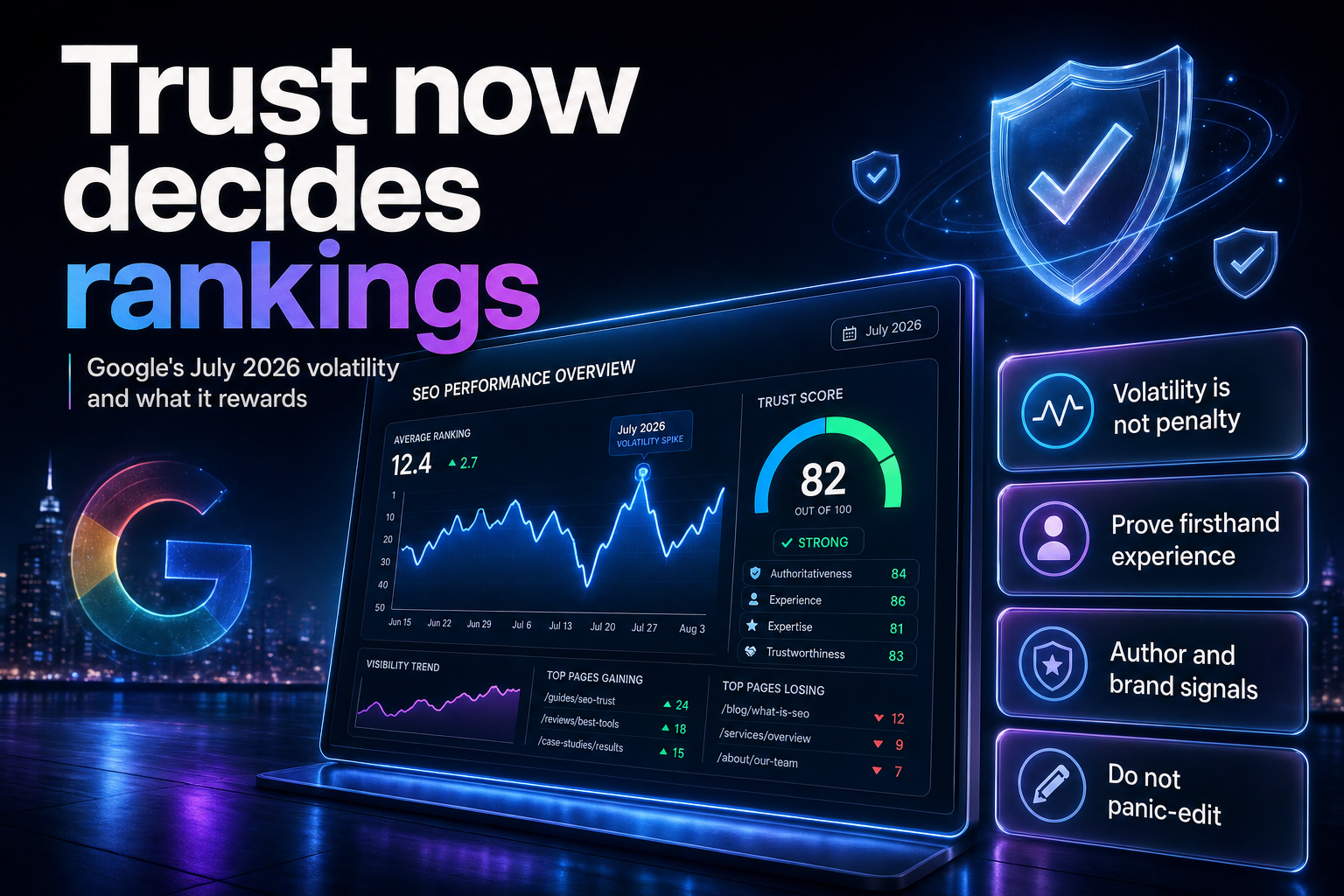
Start with the facts, because the story is quieter than the panic. Google confirmed a spam update from 24 to 26 June 2026 and said it did not target link spam or the site-reputation-abuse policy. After it finished, volatility trackers kept registering movement into July, which is where the "unconfirmed July update" talk comes from. As one detailed volatility review put it, if your rankings moved in the first days of July, you are most likely seeing the tail of that spam update, ordinary unconfirmed churn, or AI-surface testing.
That last point is the real story of 2026. This has been one of the most turbulent years in Google's history, with elevated movement almost every week since January and many sites reporting organic declines in the 20% to 35% range. Much of it correlates with Google expanding and testing AI Overviews and AI Mode rather than with any single named change. The table below sorts the noise.
| Signal or event | Confirmed by Google? | What it means for you |
|---|---|---|
| June 2026 spam update (24-26 June) | Yes, a normal spam update | Clean spam hygiene; not a content-quality reset |
| Early-July volatility | No | Tail effects, churn, or AI-surface testing |
| AI Overviews and AI Mode expansion | Ongoing, acknowledged | Fewer clicks per query, not a demotion |
| March 2026 experience emphasis | Reflected in ranking behavior | Author and experience signals gained weight |
| Brand-signal weighting | Growing evidence | Brand mentions and searches matter more |
The practical read: one confirmed spam update, a lot of AI-driven click loss, and a steady tilt toward sites that look trustworthy. None of that rewards a frantic rebuild.
Why a traffic drop is often not a penalty
The most common mistake in mid-2026 is confusing lost clicks with lost rankings. They are different problems. When Google answers a query inside an AI Overview, the user frequently gets what they came for and never clicks through. The 2026 data on this is stark: organic click-through fell about 61% on queries that show an AI Overview, dropping from roughly 1.76% to 0.61%, and paid click-through fell around 68%. You can hold position 1 and still lose a third to a half of your clicks, purely because the answer now sits above you.
Citation has also decoupled from ranking. Only about 17% of AI Overview citations come from pages that rank in the organic top 10, so the old assumption that a number-one spot guarantees the traffic no longer holds. The upside is that being cited pays: brands cited in AI Overviews earn around 35% more organic clicks and 91% more paid clicks than brands that are not. The job has changed from winning a position to being the source the answer engine trusts enough to quote. Our guide to surviving zero-click search and AI Mode goes deeper on that shift, and the AEO versus GEO versus SEO explainer maps how the three disciplines now fit together.
Trust is the signal that survives the churn
If clicks are leaking to AI answers and citations no longer track ranking, what actually decides who gets surfaced and quoted? Trust. Google evaluates content on Experience, Expertise, Authoritativeness, and Trustworthiness, and its own guidance is clear that trust is the most important member of that family: an untrustworthy page has low quality no matter how expert it looks. In a search results page increasingly built by machines, the sites that read as reliable to both a human rater and an answer engine are the ones that stay visible.
The evidence shows this is measurable, not abstract. Sites that added structured author pages with verifiable credentials and consistent bylines saw ranking improvements within weeks of the March 2026 update. Google's own people have said the same thing in plainer words. At the Search Central Live event in Toronto on 21 April 2026, Search Liaison Danny Sullivan urged creators to produce "unique, authentic and non-commodity content," and warned that generic content anyone could have written will not perform. Commodity pages are exactly what an AI Overview replaces; original, experience-backed pages are what it cites.
Here is how the pieces of E-E-A-T translate into things you can actually change.
| Signal | How Google reads it | How to demonstrate it |
|---|---|---|
| Experience | Did a real person do this? | Original photos, first-hand data, honest failures |
| Expertise | Does the author know the field? | Credentialed bylines, depth, correct detail |
| Authoritativeness | Do others treat you as a source? | Topical clusters, citations from respected sites |
| Trust | Is the site and claim reliable? | HTTPS, contact info, sourced claims, transparency |
| Brand | Do people seek you by name? | Branded search, press mentions, engagement |
Two of these are easy to underrate. Brand signals, meaning branded search volume, mentions on authoritative sites, and real engagement, now carry weight in the ranking equation, so building an actual brand around your site is no longer optional. And trust is largely technical and editorial hygiene: a valid certificate, a real contact page, and sources for every claim do more than most "SEO tweaks."
A calm recovery plan for teams whose numbers moved
If your traffic slipped in late June or early July, resist the urge to act fast. The first three to four days of movement are not reliable, and the standard advice for widespread, unconfirmed volatility is to change nothing drastic and document everything. Record which pages moved, in which direction, and on which dates, so that if Google later confirms an update you can correlate cause and effect. The worst pattern is a simultaneous redesign, URL restructure, and mass content rewrite, because you lose the ability to tell what helped.
Work the checklist below in order, one or two changes at a time.
| Action | What it addresses | When |
|---|---|---|
| Document dates and pages that moved | Diagnosis before action | Immediately |
| Audit E-E-A-T and author signals | The 2026 trust tilt | First week |
| Check Core Web Vitals | Crawl, render, and parse ease | First week |
| Review the backlink profile | Authority and spam exposure | First two weeks |
| Strengthen structured author pages | Experience and expertise | Ongoing |
| Reverse-engineer pages that gained | The direction Google is leaning | Ongoing |
That last row is the most overlooked tactic. If some pages improved while others fell, study what the winners share, because your gains often reveal Google's direction more clearly than your losses. On timing, be patient: Google has said sites hurt by a core update can regain some ground between updates but usually recover most after the next major core update, so expect weeks, not hours. For the broader playbook, our ultimate SEO guide for 2026 and the GEO and AEO optimization guide cover the durable work that outlasts any single update.
India-specific considerations
For Indian businesses, the stakes are rising with the market. Digital already accounts for about 64% of a ₹1,74,605 crore advertising market in 2026 by Madison's estimate, so the share of budgets tied to search visibility keeps growing. Two habits matter locally. First, competitive Indian niches move hard during volatility, so the "document and wait" discipline is worth more here, not less. Second, trust signals that reassure a local audience, such as a real Indian business address, a working contact number, GST or registration details where relevant, and named authors, double as the exact trust cues Google and AI answer engines look for. Building that credibility is the same work whether your reader is a person in Gurugram or an answer engine deciding whom to cite.
FAQ
How eCorpIT can help
eCorpIT is a Gurugram-based technology and digital marketing organization, founded in 2021 and assessed at CMMI Level 5. Our senior-led teams build the trust signals that hold rankings through volatile updates: credentialed author systems, clean technical foundations, structured data, and content grounded in real experience rather than commodity filler. We help brands earn citations in AI Overviews as well as classic rankings. Talk to our team for an E-E-A-T and AI-search visibility review.
References
_Last updated: 12 July 2026._