On this page · 14 sections
- What changed at I/O 2026
- The zero-click data
- The new currency is citation, not ranking
- Google's answer: it is "still SEO"
- What Google says to stop doing
- What Google says to focus on
- The agentic frontier
- A survival playbook
- Measuring visibility when clicks fall
- A note on other AI engines
- India-specific considerations
- FAQ
- How eCorpIT can help
- References
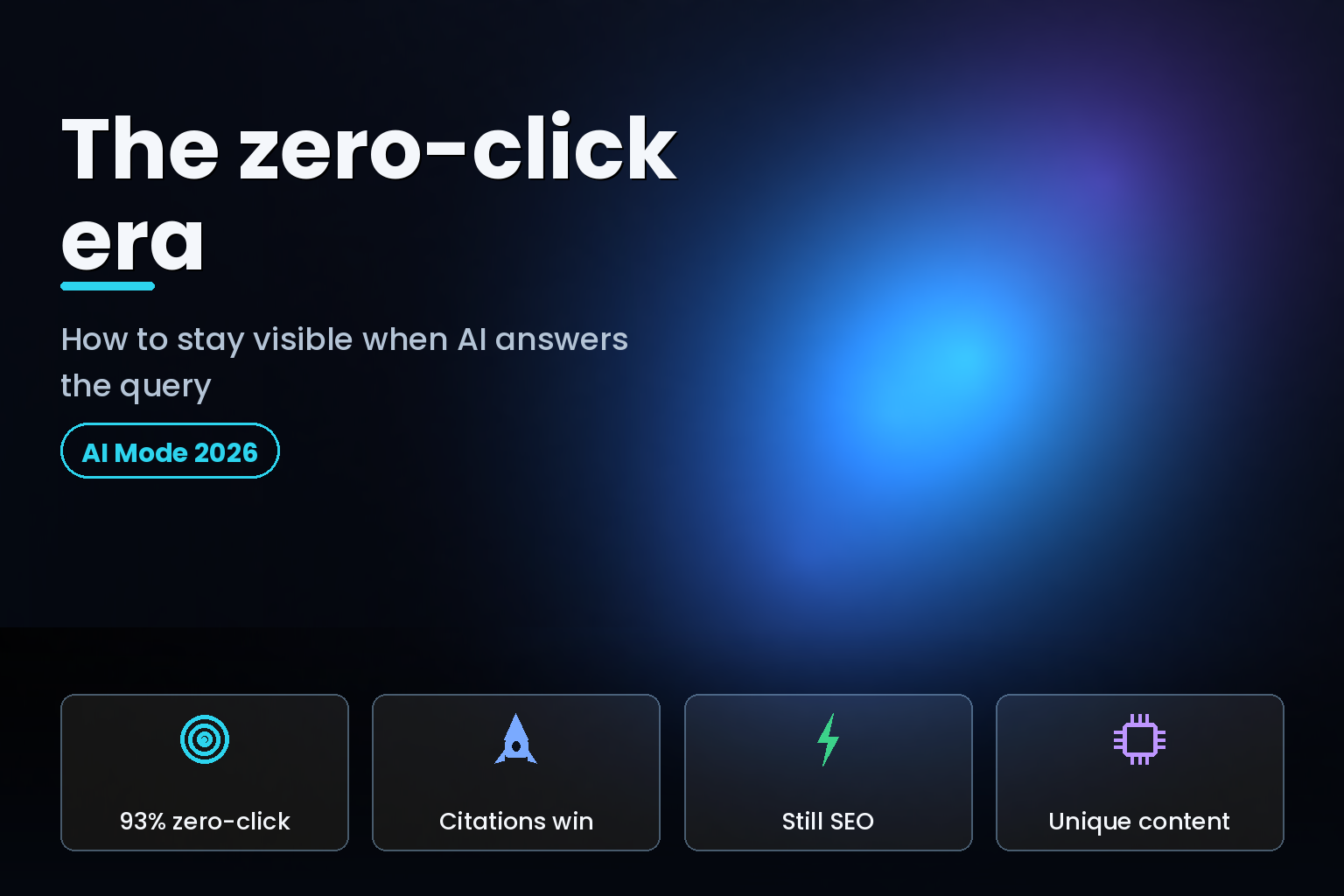
Summary. At Google I/O 2026 on May 19, Google made AI Mode the default Search experience for everyone globally, powered by its Gemini 3.5 Flash model, and rebuilt the search box for the first time in over 25 years. Google said AI Mode had already passed one billion monthly users, with queries more than doubling every quarter. The traffic consequence is stark: one analysis using Semrush data found about 93% of AI Mode searches end without a click, and Seer Interactive measured a 61% year-over-year drop in organic click-through for queries where AI Overviews appear. The counter-move is citation. Seer found brands cited inside an AI Overview earn about 35% more organic clicks than uncited competitors. On May 15, 2026, Google published a guide saying the fix is "still SEO." This is what changed and how to stay visible.
For twenty-five years, the deal was simple: rank on the first page, earn the click. AI Mode breaks that deal. When a user runs a query in AI Mode, Google no longer returns ten blue links; it returns a Gemini-generated answer that synthesises multiple sources into one block of text, with citations at the bottom. The links are still there, but most users never reach them. This is not a distant scenario. AI Mode is the default now, and the numbers below explain why every content team needs a plan.
What changed at I/O 2026
Google confirmed three things at I/O 2026. First, Gemini 3.5 Flash became the default model in AI Mode for everyone, globally. Second, AI Mode passed one billion monthly users roughly a year after its debut, with queries more than doubling every quarter. Third, Google shipped the largest redesign of the search box in over 25 years, one that accepts text, images, files, videos, or Chrome tabs as inputs. AI Mode had already been available to all US users since earlier in 2026 before this global default rollout.
The short version for marketers: the interface most of your audience now meets first is a conversation with Gemini, not a ranked list. Your content competes to be a cited source inside that answer.
The zero-click data
The traffic picture is the part that should reset your expectations. These figures come from third-party studies through late 2025 and 2026.
| Metric | Figure | Source |
|---|---|---|
| AI Mode searches ending without a click | ~93% | Semrush, 2025 |
| AI Overview searches ending without a click | ~83% | Industry analyses, 2025 |
| Organic CTR change, queries with AI Overviews (YoY) | −61% | Seer Interactive, Nov 2025 |
| Informational head-term CTR | 1.76% to 0.61% | Seer Interactive, 2025 |
| Searches showing an AI Overview | ~48% | Industry trackers, 2026 |
The mechanism is the same across all of them. When the answer is written on the results page, the click that used to follow no longer happens. Informational queries were hit hardest, with head-term click-through collapsing from 1.76% to 0.61%. If your organic strategy still assumes a first-page ranking converts into a visit, that assumption is now wrong for a large share of queries. Our earlier analysis of ranking without clicks covers the mechanics in more depth.
The new currency is citation, not ranking
Here is the part that keeps the picture from being purely grim. The click did not disappear evenly. It concentrated on the brands that get cited inside the AI answer.
Seer Interactive, in a study of 25.1 million organic impressions across 42 organizations, found that brands cited in an AI Overview earn about 35% higher organic click-through, and 91% higher paid click-through, than brands not cited on the same queries. Some 2026 analyses go further, reporting that AI Overview traffic converts at a materially higher rate than traditional organic, because a user who clicks through after reading the answer is further along in intent. The direction is consistent: being cited is now the visibility that matters, more than the old idea of holding position three. We break down the citation data separately in ranking versus AI Overview citation.
That reframes the goal. You are no longer optimising only to rank; you are optimising to be the source the model quotes. And, helpfully, Google has now said in writing how to do that.
Google's answer: it is "still SEO"
On May 15, 2026, Google Search Central published a guide titled "Optimizing your website for generative AI features on Google Search." As Search Engine Journal's senior news writer Matt G. Southern reported, its central message is blunt. Google defines AEO as answer engine optimization and GEO as generative engine optimization, then states: "From Google Search's perspective, optimizing for generative AI search is optimizing for the search experience, and thus still SEO."
The reason is architectural. Google's AI features are, in its words, "rooted in our core Search ranking and quality systems," and they use retrieval-augmented generation and query fan-out to pull content from the same Search index. AI Overviews and AI Mode are not a separate index with separate rules. Google employees Gary Illyes and Cherry Prommawin had said as much at Search Central Live; the position is now official documentation. For the fuller framework, see our guide to AEO, GEO, and SEO.
What Google says to stop doing
The guide's "mythbusting" section is the most useful part, because it names tactics a whole industry has been selling that Google says do nothing for its AI features.
| Tactic | Google's verdict | What to do instead |
|---|---|---|
| llms.txt and AI text files | Not needed to appear in AI search | Keep normal, crawlable HTML |
| Chunking content into small pieces | Not required; systems understand full pages | Write complete, well-structured pages |
| Rewriting for AI keywords | Unnecessary; systems understand synonyms | Write naturally for people |
| Chasing inauthentic mentions | "Isn't as helpful as it might seem" | Earn genuine coverage |
| Special AI schema | No special markup exists | Use structured data for rich results only |
On chunking, the guide says Google's systems "are able to understand the nuance of multiple topics on a page and show the relevant piece to users." Danny Sullivan, Google's Search Liaison, made the same point in January 2026, saying Google engineers recommended against it. If a vendor is selling you llms.txt or AI-specific chunking for Google visibility, this guide is your reason to decline.
What Google says to focus on
The positive advice is old-fashioned, which is the point. Google puts the most weight on non-commodity content: material with unique insight beyond common knowledge. Its own example contrasts a commodity headline, "7 Tips for First-Time Homebuyers," with a non-commodity one, "Why We Waived the Inspection and Saved Money: A Look Inside the Sewer Line." The second is something only a team with real experience can write, and it is exactly what an AI answer wants to cite.
The technical checklist is standard SEO: pages must be indexable and eligible for snippets, use semantic HTML, provide good page experience, and avoid duplicate content. For local and shopping visibility, Google points to Google Business Profiles and Merchant Center feeds. Structured data stays useful, but for rich-result eligibility, not -specific trick. This is the same foundation covered in our 2026 SEO guide, applied to a new surface.
The agentic frontier
The guide also opens a forward-looking section on agents, autonomous systems that book reservations or compare products on a user's behalf. Browser agents may read a page by analysing screenshots, inspecting the DOM, and interpreting the accessibility tree, so accessible, semantic markup matters more, not less. Google references the Universal Commerce Protocol, an emerging standard it co-developed with Shopify with more than 20 endorsing companies, as the way search agents will eventually transact. Google frames this as optional and early, something to explore "if this is something that's relevant to your business." Treat it as a signal of direction, not an urgent task.
A survival playbook
Pulling it together, here is the practical response for a content team in 2026.
Stop measuring success by rankings and raw impressions alone; start measuring citations in AI Overviews and AI Mode, and the quality of the referral traffic you do get. Shift budget from thin, commodity articles toward the deep, experience-based content only your organisation can produce. Keep your technical SEO clean, because AI features draw from the same index. Ignore the AI-specific gimmicks Google named. And instrument your analytics to separate AI-referred visits, so you can see conversion quality rather than mourn lost volume.
Measuring visibility when clicks fall
If the click is no longer the reliable signal, your reporting has to change with it. The old dashboard, ranking position and total organic sessions, now hides more than it shows: you can hold position one, watch impressions rise, and still see sessions fall because the answer resolved on the page. Three measurements matter more in 2026.
Track citation presence. Are you named or linked inside the AI Overview and AI Mode answer for your target queries? This is the new equivalent of a ranking, and it is what the 35% click premium attaches to. Track AI-referred sessions separately, because a visitor who arrives after reading an AI answer behaves differently from a classic organic visitor and, by several 2026 analyses, converts at a higher rate. And track the queries where you appear but are not cited, because those are your clearest opportunities to add the unique, sourced detail that earns a citation.
Google Search Console now separates AI-surface impressions, which gives you a first-party view rather than a guess. Pair that with server-side or analytics tagging of referral sources so AI-driven visits do not disappear into an undifferentiated "organic" bucket. The goal is a report that answers one question honestly: for the queries that matter to the business, are we the source the model quotes, and what happens when someone arrives?
A note on other AI engines
One caveat runs through all of this. Google's May 2026 guidance describes Google's own AI features, which draw on Google's index. It does not govern ChatGPT Search, Perplexity, or Gemini's standalone app, which may weight signals differently and cite different sources. A brand that depends on discovery should watch citations across engines, not only inside Google. The common thread, useful and genuinely sourced content, travels well between them, but the tactics and measurement differ per engine, so treat cross-engine visibility as its own workstream.
India-specific considerations
For Indian businesses, the shift lands on top of an already price-sensitive, mobile-first search market. Two points matter. First, AI Mode's global default rollout means Indian users see AI answers by default too, so local brands compete for citations, not just rankings, in their own market. Second, the "non-commodity content" rule favours firms with genuine local expertise: a Gurugram consultancy writing from real project experience can be cited where a generic listicle cannot. The move away from click volume also suits smaller teams, because one deeply useful, citable page can outperform a dozen shallow ones. Pair this with disciplined measurement, since Search Console's AI performance reporting now separates AI-surface impressions.
FAQ
How eCorpIT can help
eCorpIT helps businesses in India and abroad adapt their content and technical SEO for AI Mode and AI Overviews. If your team wants a citation-focused content audit, help instrumenting analytics to track AI-referred traffic, or a plan to move from commodity articles to content Google's AI answers will quote, our senior team can scope it with you. Reach us through the contact page.
References
- Google, Google Search's I/O 2026 updates: AI agents and more, blog.google, May 2026.
- Google Search Central, Optimizing your website for generative AI features on Google Search, developers.google.com, May 15, 2026.
- Matt G. Southern, Google's New AI Search Guide Calls AEO And GEO 'Still SEO', Search Engine Journal, May 15, 2026.
- Omnibound, AI SEO Statistics (2026), omnibound.ai.
- Nobori, Google AI Mode: 93% Zero-Click Rate, nobori.ai, 2026.
- Digital Applied, Zero-Click 2026: AI Overviews Data Update, digitalapplied.com.
- The Digital Bloom, 2026 AI Citation Position and Revenue Report, thedigitalbloom.com.
- The Stacc, Google AI Overviews Statistics 2026, thestacc.com.
- Google, 100 things we announced at Google I/O 2026, blog.google, May 2026.
- Pasquale Pillitteri, Google AI Mode and Zero-Click, pasqualepillitteri.it, 2026.
- Omnibound, Zero-Click Search Statistics (2026), omnibound.ai.
_Last updated: July 7, 2026._