On this page · 8 sections
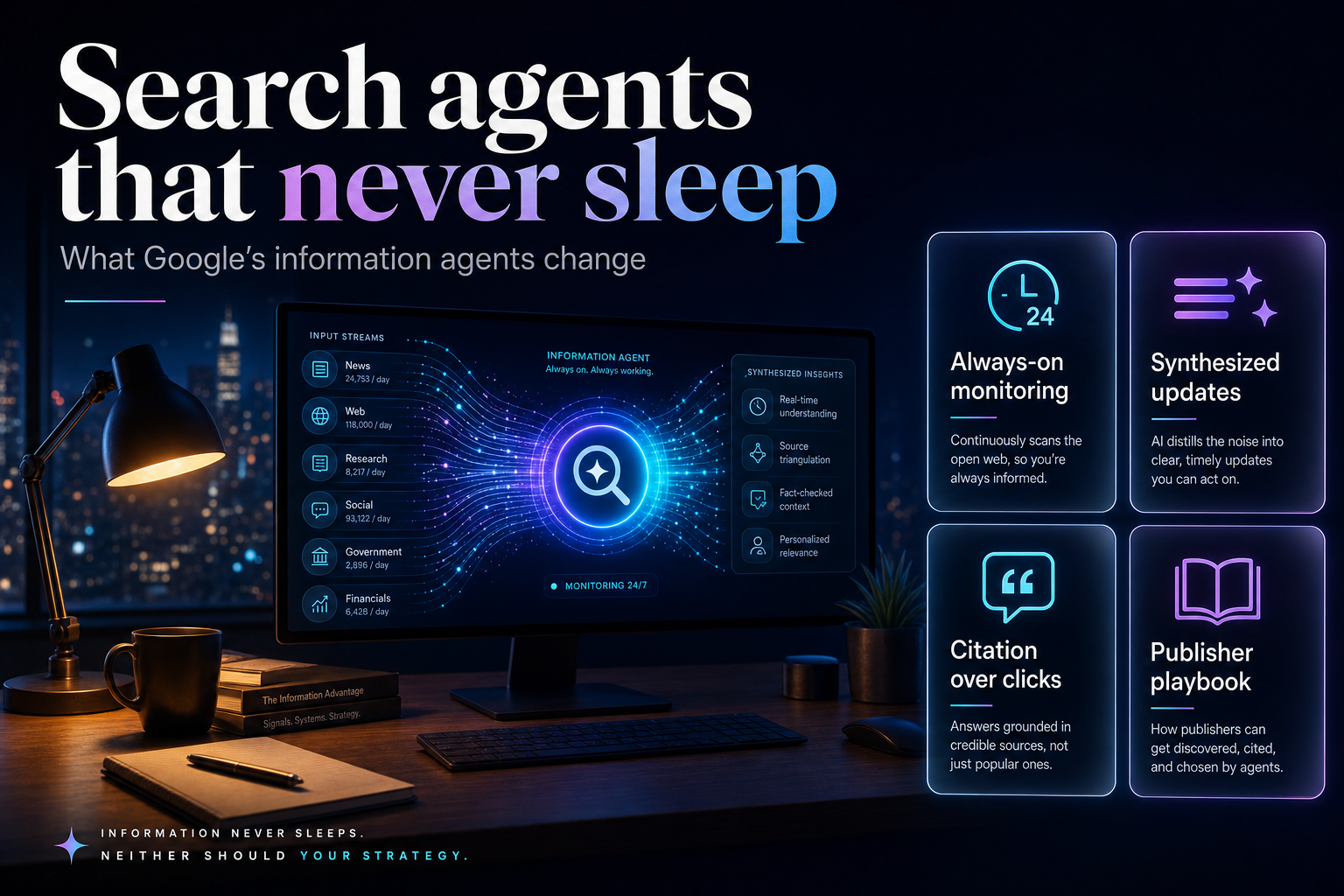
Summary. Google announced information agents at I/O on 19 May 2026: agents that run in the background 24/7, scan blogs, news sites and social posts plus live finance, shopping and sports data, and send the user a synthesized update rather than a list of links. They roll out first to Google AI Pro and Ultra subscribers this summer. Context for the scale: AI Mode passed 1 billion monthly users one year after debut, with queries more than doubling every quarter since launch, and Google says Search queries hit an all-time high last quarter. Meanwhile Chrome shipped an early preview of WebMCP in Chrome 146, with an origin trial from Chrome 149; its documentation went up on 18 May 2026 and was last updated on 9 June 2026, and that standard is the one lever a site owner actually controls. Google also expanded Personal Intelligence in AI Mode to nearly 200 countries and 98 languages on 19 May 2026, at no subscription cost. The $100-a-month AI Ultra tier is where the agents land first, so the early traffic effect is concentrated in your highest-value audience.
Two things are happening at once and most SEO coverage has merged them into one. Separating them is the whole job.
What Google actually announced, and what it did not
Elizabeth Reid, VP of Search at Google, wrote in the I/O 2026 Search post: "We're entering the era of Search agents, where you can easily create, customize and manage multiple AI agents for your many tasks, right in Search. We're starting with information agents."
The mechanics, in Google's own description: your agent looks across everything on the web, including blogs, news sites and social posts, plus Google's freshest data such as real-time information on finance, shopping and sports, to monitor for changes related to your specific question. It then sends an intelligent, synthesized update with the ability to take action. Users can run several agents at once. Google's worked examples are an apartment hunt with specific requirements and a notification when a favourite athlete announces a sneaker collaboration.
Availability: information agents launch first for Google AI Pro and Ultra subscribers this summer. That is the whole published availability statement. Anyone quoting a specific launch date, an exact trigger phrase, or a particular user-interface location for managing agents is quoting something Google has not published. Several widely-shared write-ups do exactly that.
The rest of the same announcement matters for context:
| Announcement | What it does | Availability as announced |
|---|---|---|
| Information agents | Background monitoring, synthesized updates, ability to act | AI Pro and Ultra subscribers, summer 2026 |
| Gemini 3.5 Flash in AI Mode | New default model inside AI Mode | Live globally from 19 May 2026 |
| Intelligent Search box | Biggest Search box upgrade in over 25 years; text, images, files, videos and Chrome tabs as inputs | Rolling out where AI Mode is available |
| Generative UI with Antigravity | Search builds custom layouts, tables, graphs, simulations on the fly | Everyone, summer 2026, free of charge |
| Mini apps in Search | Custom dashboards and trackers users return to | Coming months, subscribers first, U.S. |
| Personal Intelligence in AI Mode | Connect Gmail, Google Photos, soon Calendar | Nearly 200 countries, 98 languages, no subscription |
The "AI Mode is the default" claim needs correcting
Google's post says Gemini 3.5 Flash is "the new default model in AI Mode". That is a statement about which model powers AI Mode. It is not a statement that AI Mode has become the default Search experience, and the two get conflated constantly in SEO commentary. Google's own framing keeps the classic results page in play: the post says users "will continue to get a range of results from Search, just like you do today", and describes a flow from a question, to a results page with an AI Overview, to a follow-up in AI Mode, with links throughout.
Plan for a Search surface where AI answers are pervasive. Do not plan on the basis that ten blue links stopped existing on 19 May 2026, because Google did not say that. If you have read our earlier pieces on the AI Mode search visibility playbook and zero-click survival, treat this paragraph as the correction to apply while reading them.
Why information agents are a different problem from AI Overviews
An AI Overview competes with you for a click that a human was already making. An information agent removes the visit entirely, on a schedule the user set once and forgot.
That difference has four consequences worth planning around.
Frequency decouples from intent. A user who sets up an agent on "enterprise Kubernetes cost tooling" generates ongoing crawls and zero sessions. Your content gets read more often and visited less often. Impression-based metrics will drift away from session-based metrics, and the gap is not a tracking bug.
Freshness becomes a ranking-adjacent signal. The agent is explicitly monitoring for changes. A page that never changes gives the agent nothing to report. A page with a dated changelog, a revision history, or a clearly stamped "last updated" gives it something to surface. This is the first mechanism we have seen where updating a page is directly the product rather than a proxy for quality.
Structured data stops being optional. An agent reconciling "real-time info on finance, shopping and sports" against arbitrary blog prose will prefer the source it can parse without ambiguity. Price, availability, dates and specifications belong in schema, not only in sentences.
The subscriber skew is the sting. Information agents land first with AI Pro and Ultra subscribers, and the Ultra plan Google announced at the same event costs $100 a month. That is a self-selected population of high-intent, high-budget users. Losing visit-level contact with them first is worse than losing an equivalent number of casual visits.
The five changes to make now
1. Ship a machine-readable change signal
Give agents something to detect. At minimum: a visible last-updated date, a dateModified in your Article or Product schema that actually reflects edits, and a changelog section on pages where facts move. If you publish prices, availability or specifications, put every one of them in structured data with an explicit date.
This is cheap and most sites do it badly. A dateModified that updates on every template deploy is worse than none, because it trains agents to treat your freshness signal as noise.
2. Implement WebMCP where a user can act
This is the substantive one, and almost nobody is doing it yet.
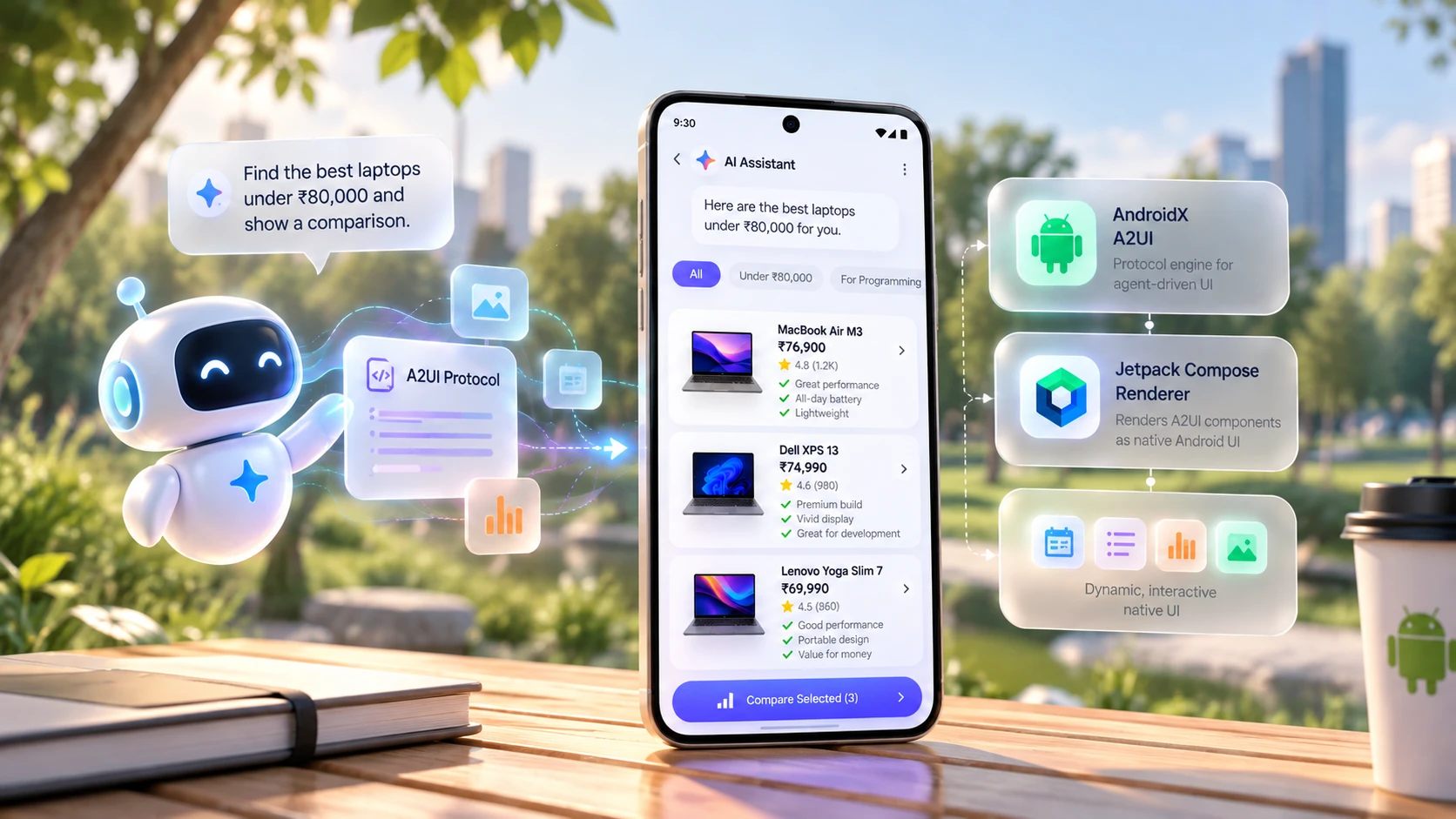
WebMCP is a proposed web standard for exposing structured tools to AI agents, published on Chrome for Developers on 18 May 2026 and last updated 9 June 2026. Instead of an agent simulating mouse clicks and keystrokes against your DOM, which Google's documentation calls actuation, your site declares what its elements do. Google's own framing of the benefit: "Instead of an agent reviewing the element, such as a button or a field, to understand its purpose, the website declares the element's purpose, so it's used correctly."
WebMCP supports three things: discovery, so pages register tools such as checkout or filter_results; JSON Schemas defining inputs and expected outputs to reduce hallucination; and shared page state so the agent knows what it can act on in real time.
There are two APIs. The Declarative API annotates standard HTML forms. The Imperative API defines tools in JavaScript for dynamic interactions. Angular has experimental support.
Status and how to test it:
| Item | Detail |
|---|---|
| Early preview | Shipped in Chrome 146 |
| Origin trial | From Chrome 149 |
| Local development flag | chrome://flags/#enable-webmcp-testing, set to Enabled, relaunch Chrome |
| Testing tool | Model Context Tool Inspector extension, prompts default to gemini-3-flash-preview |
| Demos | Pizza maker and React flight search use the Imperative API; a bistro demo uses the Declarative API |
The security model is stricter than most people expect and you should read it before scoping work. WebMCP is only available in origin-isolated documents; if a document has document.domain enabled through the Origin-Agent-Cluster: ?0 header, the APIs are disabled outright. Both APIs are gated by the tools Permissions Policy, which defaults to self, so tool registration works in top-level and same-origin contexts and is disabled for cross-origin iframes. To allow tools inside a cross-origin iframe you must add allow="tools" to the iframe.
The published limitations are equally worth knowing. Tool calls run in JavaScript, so a browser tab or webview must be open; there is no headless support. Complex interfaces need refactoring to handle application and interface state. And discoverability is weak: clients and browsers must visit a site directly to learn it has callable tools.
That last limitation is the strategic read. WebMCP does not win you agent traffic you were not already going to get. It makes the agent traffic you do get complete its task on your site instead of failing halfway and reporting a summary. If your site has a booking flow, a quote form, an availability check or a filtered search, this is where the work belongs. Teams that already run an MCP server for internal tools will find the mental model familiar; we covered that build in our MCP server development and integration service notes.
3. Measure impressions and citations, not sessions
Your analytics will tell you a story about decline that your Search Console data will contradict. Trust the second one. Track impression share and citation frequency in AI surfaces separately from clicks, and set targets on both. We walked through the reporting mechanics in the Search Console AI performance report, and the broader argument for citation-first measurement in ranking first with no clicks.
4. Publish the thing an agent cannot synthesize away
An agent monitoring for changes will happily summarise your news post. It cannot summarise a calculator, a dataset you update, a configuration file that works, or a benchmark you ran yourself. Original data and working artifacts survive synthesis because using them requires arriving.
This is the same logic that makes comparison content and cost breakdowns hold up while definitional content collapses, which we set out in the GEO platform playbook.
5. Audit how an agent actually experiences your site
Not how Googlebot experiences it. Agents operate a browser. Run your key flows in a headed browser with an agent driving and watch where it fails: a date picker it cannot parse, a modal it cannot dismiss, a filter that needs three interactions. Each of those is a task an agent will abandon and report as unavailable. Our notes on auditing for agentic browsing with Lighthouse cover the tooling.
What this means for Indian sites specifically
Personal Intelligence in AI Mode has expanded to nearly 200 countries and territories across 98 languages with no subscription required, so the AI Search surface is already fully live for Indian users. Information agents, tied to AI Pro and Ultra subscriptions, will reach India's paying tier later and thinner than the U.S. That gives Indian publishers and D2C brands a genuine head start: several months to ship structured data and WebMCP tools before the agent volume arrives.
Two India-specific cautions. First, Personal Intelligence works by letting users connect Gmail, Google Photos and soon Google Calendar. If your site collects personal data that then flows into an agent-mediated workflow, your obligations under the Digital Personal Data Protection Act 2023 do not change because an agent is the one clicking. Consent, purpose limitation and the fiduciary duty stay with you.
Second, price and availability data in Indian e-commerce is frequently rendered client-side after a personalisation call. An agent monitoring for a price change reads what the page declares in structured data. If your ₹ prices live only in a React state object, the agent has nothing to monitor and your competitor with clean schema gets the update slot.
The honest uncertainty
Google has published capability and rough timing, not volume. Nobody outside Google knows how many agents will be created, how often they poll, whether agent-driven fetches will appear distinctly in Search Console, or whether Google will send any referral traffic at all when an agent "takes action". Anyone giving you a traffic-loss percentage for information agents is guessing.
What is defensible today: the direction is toward machines completing tasks on your site rather than humans browsing it, and the two concrete, shippable responses are structured data that describes your facts and WebMCP tools that describe your actions. Both are useful even if information agents underdeliver. That is the test we would apply to any recommendation in this space.
FAQ
How eCorpIT can help
eCorpIT builds the technical layer that decides whether an AI agent completes a task on your site or gives up and summarises it. Our senior engineering teams audit how agents actually traverse your key flows, fix the structured data behind prices, availability and update signals, and implement WebMCP tools on the booking, quote and search interactions that carry your revenue. We work across Sanity, Astro, React and Angular front ends, and we design applications aligned with Digital Personal Data Protection Act 2023 requirements. If information agents are about to read your site more often than people visit it, talk to us about what to ship before that happens.
References
- A new era for AI Search — Elizabeth Reid, VP Search, Google, 19 May 2026.
- 100 things we announced at I/O 2026 — Google, 20 May 2026.
- WebMCP — Chrome for Developers, published 18 May 2026, last updated 9 June 2026.
- WebMCP Imperative API — Chrome for Developers.
- WebMCP Declarative API — Chrome for Developers.
- WebMCP tool security — Chrome for Developers.
- WebMCP versus MCP — Chrome for Developers.
- WebMCP explainer on GitHub — Web Machine Learning Community Group.
- WebMCP on Chrome Status — Chrome Status.
- Sundar Pichai's I/O 2026 opening keynote — Google, May 2026.
- Google AI subscription plans — Google.
- Permissions Policy — Chrome for Developers.
- Origin agent cluster — web.dev.
- WebMCP demo source code — Google Chrome Labs.
Last updated: 22 July 2026.