On this page · 11 sections
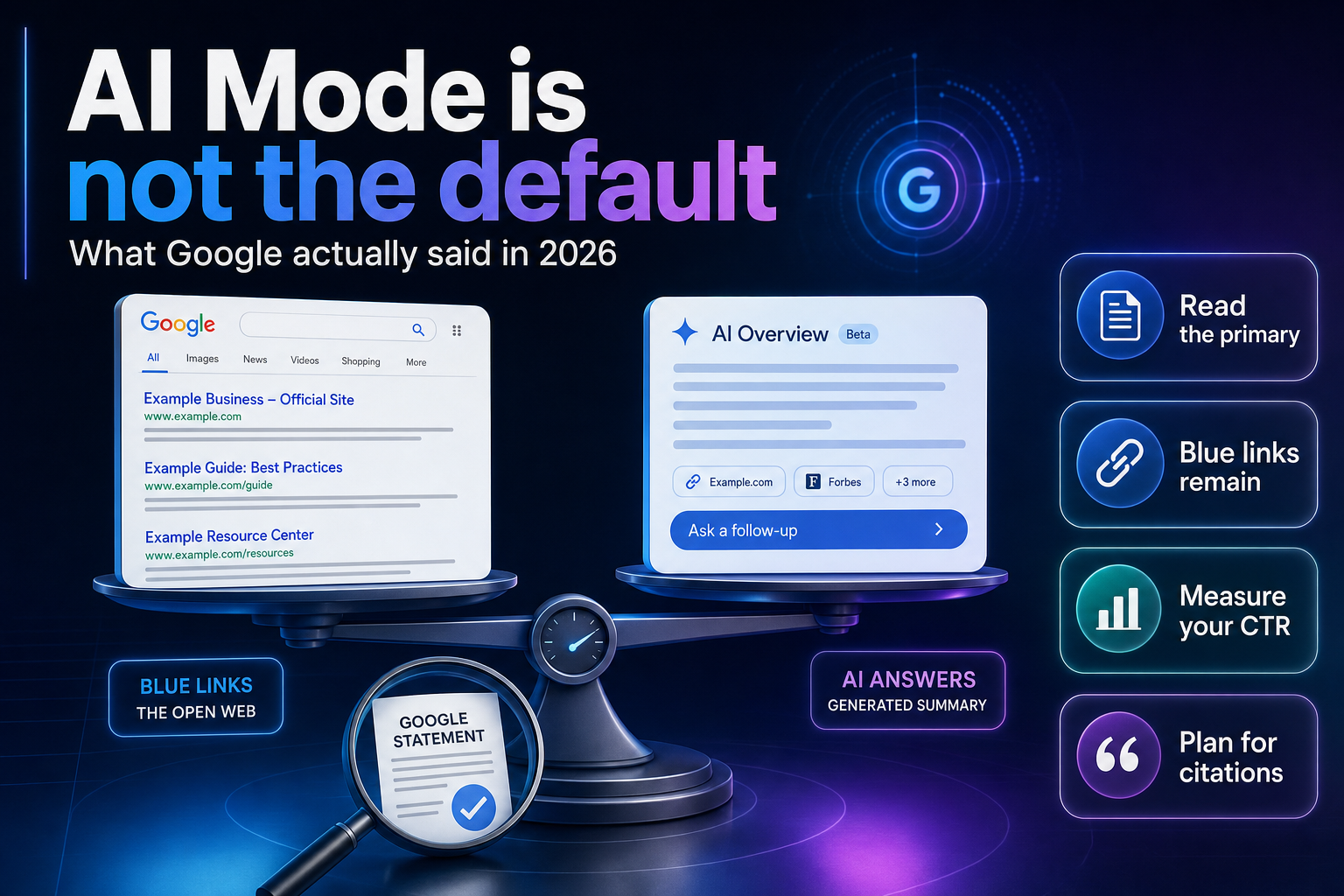
Summary. A Google spokesperson told Press Gazette, in a statement published on 26 May 2026: "You'll continue to see blue web links in the results, in addition to AI responses, and AI Mode is not the default experience in Search." Google's own I/O announcement of 19 May 2026 says AI Mode passed 1 billion monthly users and that Gemini 3.5 Flash is "the new default model in AI Mode", which is a statement about which model runs inside AI Mode, not about AI Mode replacing the results page. Seer Interactive's April 2026 study, covering 53 brands, 5.47 million queries and 2.43 billion organic impressions, found organic CTR on AI Overview queries rebounded from a 1.3% floor in December 2025 to 2.4% in February 2026, an 85% rise. Being cited inside an AI Overview is worth +120% more organic clicks per impression than not being cited. This page previously repeated the "AI Mode is now default" framing. That was wrong, and this is the corrected version.
We publish a correction rather than quietly editing, because the claim we got wrong is one the whole industry is still repeating.
What we previously said, and why it was wrong
An earlier version of this article stated that AI Mode had become Google's default search experience and that the ranked list of ten links was no longer the primary discovery surface. That framing came from a cluster of coverage in July 2026 reporting that Google had "completed" a switch to AI-first results.
We did not check it against a Google source. It does not survive that check.
The rest of that article, including the schema and front-loaded-facts guidance, still holds. The premise on top of it did not.
What Google actually said
Two primary sources settle this.
The first is Google's own I/O post, A new era for AI Search, published 19 May 2026 under the byline of Elizabeth Reid, VP of Search. It announces Gemini 3.5 Flash as "the new default model in AI Mode for everyone globally". That phrase is the origin of most of the confusion: it sets a default model inside AI Mode. It does not make AI Mode the default surface.
The same post says plainly, of the redesigned Search box: "You'll continue to get a range of results from Search, just like you do today."
The second is a direct statement Google gave to Press Gazette, published in Alice Brooker's 26 May 2026 report:
"You'll continue to see blue web links in the results, in addition to AI responses, and AI Mode is not the default experience in Search. When you do a standard text search in the Search box, or a visual search with Lens, you will continue to see the search results page. If your results include an AI Overview, you can choose to follow up in AI Mode."
Lily Ray, founder of the SEO and AI search consultancy Algorythmic, called that outcome significant: AI Mode not becoming the default "is a big deal" and "many businesses can sort of breathe a small sigh of relief". She added the caveat that matters more than the relief: "But all of these new search features will absolutely continue to cut into organic traffic across the board, as Google provides many more features, tools, and experiences directly in the Search interface."
Ray also named the condition under which the default does change: it will happen "once they figure out how to drive as much ad revenue from AI Mode as they currently generate from organic search".
That is the forecast to plan against. Not a switch that already happened.
What did ship at I/O 2026
Dismissing the default claim is not the same as saying nothing changed. Google's post lists real launches, with real rollout constraints that most summaries drop.
| Announcement | Who gets it | When, per Google |
|---|---|---|
| Gemini 3.5 Flash as default model in AI Mode | Everyone, globally | From 19 May 2026 |
| Redesigned intelligent Search box | All countries and languages where AI Mode is available | Rolling out from 19 May 2026 |
| Information agents (background monitoring) | Google AI Pro and Ultra subscribers | Summer 2026 |
| Agentic booking for local services | Everyone in the US | Summer 2026 |
| Generative UI in Search | Everyone, free of charge | Summer 2026 |
| Antigravity mini apps and custom dashboards | AI Pro and Ultra subscribers, US first | Coming months |
| Personal Intelligence in AI Mode | Nearly 200 countries, 98 languages, no subscription | From 19 May 2026 |
Google also reports AI Mode queries "more than doubling every quarter" since launch, and that total Search queries reached an all-time high last quarter.
The subscriber gating on agents is the detail worth holding onto. A feature limited to AI Pro and Ultra subscribers in the US is not yet a traffic event for an Indian D2C brand.
The 5 numbers that matter
Seer Interactive published its 2026 AI Overview CTR update in April 2026, tracking January 2025 to February 2026 across 53 brands, 5.47 million queries, 2.43 billion organic impressions and 296.9 million paid impressions. Five findings should shape budget.
First, the collapse stopped. Organic CTR on AIO-present queries fell for 18 months to a floor of 1.3% in December 2025, then climbed to 2.4% by February 2026. Seer's own model had forecast continued decline. It notes the reversal directly: the data "turned the other way". Seer frames this as a levelling off rather than a recovery and warns against forecasting from two months of data.
Second, citation is the lever. Being cited in an AI Overview delivers "+120% more organic clicks per impression versus when you are not cited". Seer is equally clear about the ceiling: a cited result still underperforms a no-AIO SERP by 38%. Citation is an advantage relative to everyone else on the same AI Overview page, not a route back to 2023 traffic.
Third, cited brands saw CTR fall for a reason that was not a click problem. Seer found impressions more than doubled while clicks stayed flat, which pushed the ratio down. Their guidance: "Always look at clicks and impressions separately before calling something a problem."
Fourth, exposure is concentrated by query type. Across 30,842 tracked informational queries, comparison queries triggered an AI Overview 95.4% of the time, 267 of 280 tracked. Question-format queries triggered one over 85% of the time. Commercial queries showed an AIO 8% of the time and transactional queries 5%.
Fifth, non-AIO queries got better, not worse. CTR where no AI Overview appears rose from 2.8% in January 2025 to 3.8% in February 2026.
| Segment | Jan 2025 | Latest reported | Direction |
|---|---|---|---|
| Organic CTR, AIO present | Declining to 1.3% floor (Dec 2025) | 2.4% (Feb 2026) | Up 85% in two months |
| Organic CTR, no AIO | 2.8% | 3.8% (Feb 2026) | Up 1 percentage point |
| Organic CTR, AIO present and brand cited | 0.7% | 1.65-1.7% (Dec 2025) | Roughly doubled |
| Paid CTR, AIO present | 14.6% | 16.2% | Slowly up |
| Paid CTR, no AIO | 26% | 21.8% (Feb 2026) | Down about 16% |
Our own data says the same thing, painfully
We can add a first-party data point, because we have the same problem.
We rank on page one for iOS 27 release-date queries. In our current Search Console window, the query "is ios27 out" returned 213 impressions for this site at an average position of 7.3 and a click-through rate of 0.47%. "has ios 27 released" returned 60 impressions at position 6.2 and a 1.67% CTR.
Ranking was never the problem. Those are answer-shaped queries, and an AI Overview answers them in the SERP.
That is the practical lesson underneath the AI Mode argument. Whether or not AI Mode is the default changes less than which queries you chose to target. A ₹50 lakh annual content budget aimed at comparison and question-format queries is aimed at the two segments Seer measured triggering an AI Overview 95.4% and 85% of the time.
We wrote the target-selection framework separately in our keyword selection guide for click survival, and the ranking-versus-citation trade-off in our analysis of ranking versus AI Overview citation data.
What to do differently
Barry Adams, news SEO consultant and founder of the News and Editorial SEO Summit, put the content decision bluntly: "if your content is already being replaced by AI Overviews in Google Search then the writing is on the wall, you shouldn't really be producing more of the content, at least not for the purposes of generating traffic."
That is the correct reading of the Seer segments. Four moves follow.
Stop writing to answer-shaped queries for traffic. Definitions, release dates and simple when-and-who questions are the queries with the highest AIO trigger rates and the worst measured CTR. Write them if they serve brand or support, not if you are counting sessions.
Compete for the citation on the queries you keep. A +120% click advantage over uncited competitors on the same SERP is the realistic prize. That means front-loaded, specific, verifiable facts near the top of the page, clean structured data, and a claim a model can lift and attribute.
Separate clicks from impressions in reporting. Seer's cited-brand finding shows a falling CTR that was actually doubling impressions. A dashboard that shows only CTR will produce the wrong decision.
Defend commercial and transactional queries. At 8% and 5% AIO trigger rates, these are comparatively protected right now, and they are also where revenue sits.
For the schema and structure side of this work, our GEO and AEO guide under AI Overviews covers implementation, and our guide to Google Preferred Sources covers the surface where brand demand converts into visibility.
How to check a claim like this yourself
The reason this correction was needed is worth generalising, because the same failure will happen again with the next Search announcement.
Aggregator coverage of Google Search reliably conflates three different things: a default model inside a feature, a feature rolling out broadly, and a feature replacing the results page. The May 2026 announcement contained the first two. It was reported as the third.
Before you rebuild a strategy on a Search claim, find the sentence on blog.google or a named Google statement to a publication. If the only sources are secondary posts describing what Google "has completed", treat it as unverified. Google's spokesperson statement to Press Gazette took one fetch to find.
We publish enough on this topic that getting it wrong has a cost, which is why the correction is on the page rather than in a changelog.
India-specific considerations
Most of the agentic launches at I/O 2026 are gated to the US or to paid tiers at first, so the near-term Indian impact is the AI Overview layer rather than agents. Personal Intelligence is the exception, expanded to nearly 200 countries and 98 languages with no subscription required.
For Indian B2B and services businesses, the Seer segment data is the more useful planning input than the AI Mode question. Commercial and transactional intent, where most Indian services demand actually sits, still shows AI Overviews on well under one in ten queries.
FAQ
How eCorpIT can help
eCorpIT builds AI search visibility programmes on measured data rather than on the current headline: query-segment analysis from your own Search Console, structured data and content changes that earn citations, and reporting that separates clicks from impressions so you can tell a real decline from a growing denominator. Our senior engineering and content teams work from Gurugram with Indian and global brands. Talk to us about auditing which of your query segments are actually exposed.
References
- A new era for AI Search — Elizabeth Reid, VP of Search, Google, 19 May 2026.
- What Google's expanded AI features mean for publishers — Alice Brooker, Press Gazette, 26 May 2026.
- Search Engine Land and other search publications cite Seer's 2026 CTR AIO research — Seer Interactive, April 2026.
- Google AI Overviews CTR shows early signs of recovery: Study — Search Engine Land.
- AI Overview CTR Fell 61%, But Clicks Didn't Collapse — Search Engine Journal.
- AI Overview CTR fell 61%: Seer Interactive 2026 — Writtenly Hub.
- Google AI Mode goes live in the UK — Press Gazette.
- Lily Ray on AI Mode not becoming the default — Algorythmic, via LinkedIn.
Last updated: 20 July 2026.