On this page · 10 sections
Summary. One optimization playbook does not win all AI engines. In 2026, only about 11% of the domains cited by ChatGPT are also cited by Perplexity, because each engine draws on a different index and source bias. Perplexity cites sources in roughly 97% of answers, Google AI Overviews in about 34%, and ChatGPT in about 16%, so the same page can be invisible on one engine and dominant on another. The upside is worth the work: AI search traffic converts about 4.4x better than traditional organic, and LLM visitors convert at 15.9% from ChatGPT, 10.5% from Perplexity, and 5% from Claude, against 1.76% for organic search. The U.S. generative engine optimization (GEO) market is projected to reach $365.4 million in 2026 at a 42.9% CAGR. This guide gives you a separate, tactical playbook for each of the three engines, plus the fundamentals that lift citations everywhere.
Generative engine optimization is the practice of structuring content so AI answer engines cite or recommend it. If classic SEO earns a blue link, GEO earns a place inside the synthesized answer. The mistake most teams make in 2026 is treating it as one channel. It is three, and they reward different things.
Why one playbook fails
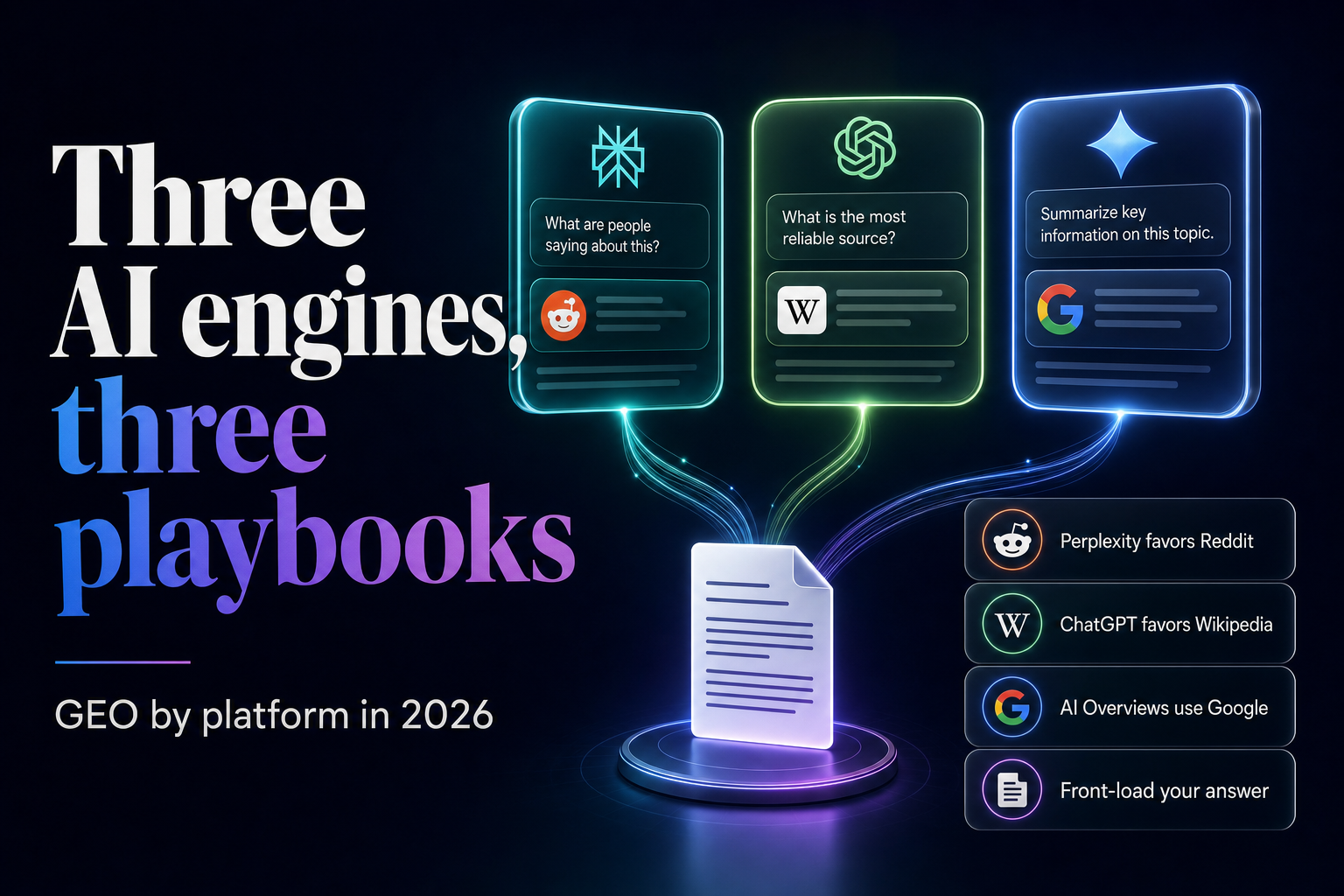
The engines disagree on where truth lives. ChatGPT leans heavily on Wikipedia, which accounts for roughly 47.9% of its cited sources. Perplexity leans on Reddit, around 46.5% of its citations, and strongly favours recent content. Google AI Overviews build on Google's own index, enriched with authority and E-E-A-T signals. According to Leapd and Discovered Labs, that divergence is why the domain overlap between ChatGPT and Perplexity sits near 11%. Optimizing generic content for "AI search" spreads effort thin across three systems that want different signals.
| Engine | Primary source bias / index | Highest-use tactic |
|---|---|---|
| Google AI Overviews | Google index plus E-E-A-T signals | Rank well, add structured data |
| ChatGPT Search | Wikipedia-heavy, trusted prose | Earn mentions across many publications |
| Perplexity | Reddit-heavy, recency-weighted | Community presence, fresh dated content |
| Gemini | Google ecosystem signals | Structured, authoritative coverage |
| Claude | Curated, authoritative sources | Clear, well-cited primary material |
Playbook 1: Google AI Overviews
AI Overviews reward the work you already do for Google, then add extraction signals on top. About 83% of AI Overview citations come from pages outside the organic top 10, so ranking helps but is not a gate. Semantic completeness, structured data, and E-E-A-T now influence selection independently of position.
The tactics: cover the topic fully so one page answers the whole question and its follow-ups; add Article, FAQPage, and HowTo schema so crawlers can read content boundaries; keep a visible last-updated date; and use descriptive headings that mirror real questions. If you already rank on page one, treat AI Overview visibility as an extension of that foundation, as we describe in our Google AI search optimization guide and AI Overview content strategy.
Playbook 2: ChatGPT Search
ChatGPT rewards being a known entity across the open web, not keyword density. It responds better to clear, natural prose, and it favours brands mentioned consistently across many trusted publications. Distributing content and earning mentions across multiple sites can lift AI citations by up to 325%, per Frase.
The tactics: build a clean, accurate presence on the sources ChatGPT trusts, starting with a well-maintained Wikipedia-grade entity footprint and consistent brand facts across the web; write in plain, declarative prose rather than SEO-stuffed copy; and pursue digital PR so third parties describe you in the same terms you use. Consistency of description across sources matters more than any single page.
Playbook 3: Perplexity
Perplexity is the recency-and-community engine. It cites sources in about 97% of answers, favours content published within the past 12 months, and pulls heavily from Reddit and forums. Content under 30 days old can earn roughly 3.2x the citations of older material, and simply including a visible year signal such as "2026" in titles and headings can lift Perplexity citation rates by around 30%.
The tactics: publish and refresh often, and date everything visibly; put the current year in titles and headings where honest; and participate authentically in the subreddits, Quora threads, and niche forums where your buyers already discuss the topic. For fast-moving categories, Perplexity is the engine where a small, current publisher can beat a large, stale one.
What lifts citations on every engine
Some fundamentals travel across all three. The peer-reviewed GEO research popularized by the Princeton-backed framework, drawn from 10,000 queries across 10 engines, found content changes can raise source visibility by up to 40%. Independent benchmarks agree on the mechanics.
| Content element | Reported citation lift | Source |
|---|---|---|
| Adding quotations | +41% | ConvertMate GEO benchmark |
| Adding statistics | +32% | ConvertMate GEO benchmark |
| Adding inline citations | +30% | ConvertMate GEO benchmark |
| Schema markup | +67% discoverability | Marketing LTB / GEO stats |
| 3+ statistics per 300 words | 2.1x citation frequency | ConvertMate GEO benchmark |
Two structural facts explain most of it. About 44.2% of all LLM citations come from the first 30% of a page, so front-load your answer in the opening lines. And roughly 80% of AI-cited pages use lists and structured elements, so write for extraction with clear headings, short direct answers, tables, and a summary up top. Our AEO, GEO and SEO guide covers this extraction structure in depth.
Measure before you optimize
Do not guess where you stand. Take your 30 most important queries and run them through ChatGPT, Perplexity, Google AI Overviews, Gemini, and Claude. Record where you are cited, where competitors are cited, and which engine matters most for your buyers. For B2B brands whose buyers do deep research, Perplexity deserves early attention. For brands whose buyers start in Google, AI Overviews are the natural extension. For broad consumer awareness, ChatGPT's user base makes presence-building a long-term bet. That baseline tells you which of the three playbooks to run first.
India-specific considerations
For Indian brands, the platform mix skews the priorities. Google's dominance in India makes AI Overviews the first battleground for most local businesses, so E-E-A-T, structured data, and a strong Google index presence come first. Perplexity and ChatGPT matter more for B2B, SaaS, and export-facing brands whose buyers research globally. Budget accordingly: a Gurugram D2C brand should not spend equally on all three when its customers overwhelmingly start in Google search. Match spend to where your buyers actually ask.
FAQ
How eCorpIT can help
eCorpIT (eCorp Information Technologies Private Limited, founded 2021, Gurugram) runs GEO, AEO, and SEO programs that treat each AI engine as its own channel. Our senior-led teams baseline your citations across ChatGPT, Perplexity, Google AI Overviews, and Gemini, then build the schema, content structure, and digital-PR footprint each engine rewards. As partners of Google and Microsoft, we align AI-search work with your traditional search foundation. To audit where you are cited today, contact us.
References
_Last updated: July 13, 2026._