On this page · 11 sections
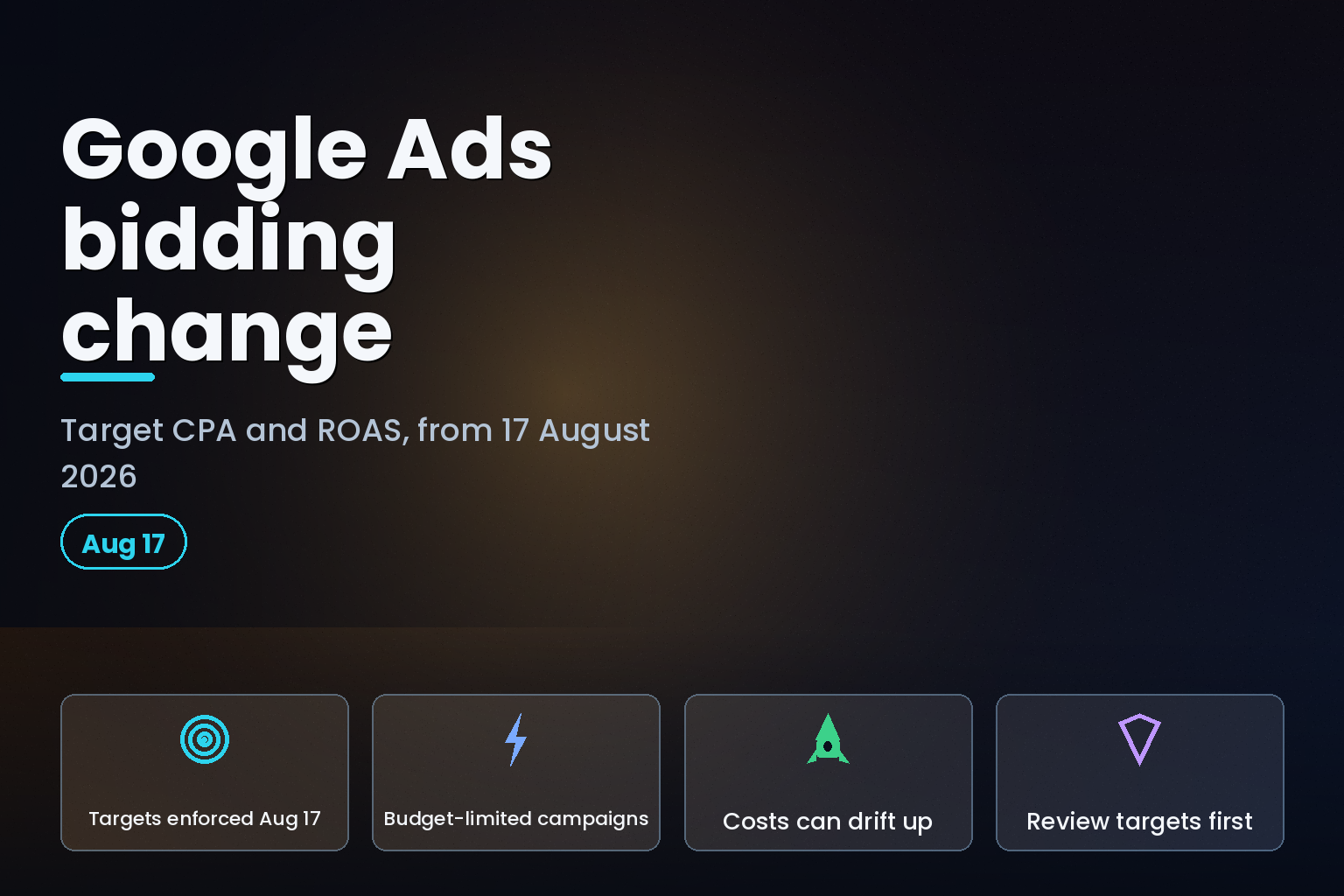
Summary. On 17 August 2026, Google Ads changes how budget-limited campaigns on a target-based bid strategy behave. Today a campaign marked "Limited by budget" often beats its target: an advertiser sets a Target CPA of $10 and Smart Bidding quietly delivers conversions near $5. After 17 August, delivery moves toward the number in the target field, so a campaign whose stated Target CPA sits far above its recent actual cost can see that cost drift up toward the stated figure unless you lower the target first. PPC.land reported this can roughly double some advertisers' cost per acquisition. The change affects Search, Shopping, Performance Max, Demand Gen, and Travel campaigns. Google opened a Bid Target Adjustment Tool inside Google Ads on 6 July 2026, and it flags accounts that were budget-limited at any point in the last 12 months. You have a six-week window, and the fix is a target audit, not a panic.
This is a settings problem with a real cost, and it rewards advertisers who act before the deadline. The mechanic is simple once you see it: for years, "Limited by budget" campaigns have been overdelivering against loose targets, and many advertisers never noticed because the results looked good. Google is now aligning delivery with the stated target so budget changes produce predictable outcomes. That is reasonable behavior. It also means every stale, too-high target in your account is now a liability.
Below is what changes, who is affected, the exact tool Google shipped, and a step-by-step audit you can run this week. If you manage paid search in-house, this pairs with our guide to Google Ads PPC ROI in Gurugram and the wider digital marketing strategy playbook.
What changes on 17 August 2026
Google's own documentation states that campaigns limited by budget on a target-based bid strategy will "more consistently perform toward your target, including when you make budget adjustments." That is the entire change, and it only bites in one direction.
Under the old behavior, a budget-limited campaign spent its full budget and let Smart Bidding find the cheapest conversions it could, which frequently landed well under the Target CPA or over the Target ROAS you set. Under the new behavior, the system treats the target as the goal to hit rather than a ceiling to beat, so a campaign that had been delivering a $5 cost per acquisition against a $10 target can move toward $10. The stated target becomes the operating point.
Nothing changes for campaigns that are already delivering close to their targets, or for campaigns that are not limited by budget. If your Target CPA and your actual CPA are near each other, you will not feel this. The exposure sits entirely with accounts carrying targets that no longer reflect real performance.
| Aspect | Before 17 August 2026 | After 17 August 2026 |
|---|---|---|
| Budget-limited campaign delivery | Often beats the target (spends full budget for cheapest conversions) | Moves toward the stated target |
| A $10 Target CPA delivering $5 | Keeps delivering near $5 | Cost can drift up toward $10 |
| Budget increases | Hard to predict resulting CPA or ROAS | More predictable, tied to the target |
| Where the risk sits | Hidden overdelivery looks fine | Stale, too-loose targets raise cost |
| Advertiser action needed | None by default | Audit and lower targets before the date |
Why this matters: the cost-drift math
The reason this update has advertisers worried is that the exposure is invisible until it hits. A campaign showing a healthy $5 cost per acquisition against a forgotten $10 target looks like a winner on the dashboard. The gap between stated target and actual performance is exactly the room the cost has to rise into.
Work the commonly cited example. A campaign carries a Target CPA of $10 and has been quietly delivering $5. That is a 100 percent cushion. After 17 August, if the system moves delivery toward the $10 target, the effective cost per acquisition can approach twice what you were paying, for the same conversions. The same logic runs in reverse for Target ROAS: a campaign beating a modest ROAS target can see return per rupee or dollar of spend pulled back down toward the stated figure. Multiply that across a portfolio of budget-limited campaigns with targets nobody has touched in a year, and the account-level cost increase is material.
The fix is not to fight the system. It is to make your targets tell the truth. If a campaign genuinely performs at a $5 cost per acquisition, set the target near $5, and the delivery has nowhere to drift. Fred Vallaeys, CEO of Optmyzr and a former Google AdWords evangelist, advised advertisers to automate this: "we actually have a pre-built automation in Optmyzr that automatically decreases your tCPA whenever your actual CPA drops below 70% of your target." The principle holds whether you automate it or do it by hand: keep the stated target close to real performance.
Which campaigns are affected, and which are not
The change is scoped. It applies to Search, Shopping, Performance Max, Demand Gen, and Travel campaigns using a target-based bid strategy, managed in Google Ads or Search Ads 360, plus Demand Gen campaigns managed in Display and Video 360. App campaigns, Video reach campaigns, and Video view campaigns are not affected. Hotel and Display campaigns already behave this way, so nothing changes for them.
| Campaign type | Affected on 17 August 2026? |
|---|---|
| Search (Target CPA / Target ROAS) | Yes |
| Shopping | Yes |
| Performance Max | Yes |
| Demand Gen | Yes |
| Travel | Yes |
| App, Video reach, Video view | No |
| Hotel, Display | No change (already behave this way) |
If your account is mostly App or Video campaigns, you can breathe. If your revenue runs through Search, Shopping, or Performance Max with target-based bidding, this is your priority for the next few weeks.
The Bid Target Adjustment Tool
Google did not leave advertisers to find affected campaigns by hand. The Bid Target Adjustment Tool went live inside Google Ads on 6 July 2026. Accounts with campaigns that were budget-limited at any point in the last 12 months and that use a target-based bid strategy see an in-account notification pointing to it.
The tool surfaces each flagged campaign's recent performance and offers three choices. You can keep the current target, match the target to recent actual performance, or set a custom target. Matching to recent performance is the one-click option for advertisers who want delivery to stay where it is: it moves the stated target down to what the campaign is actually achieving, which removes the cushion the cost would otherwise drift into. Applying a custom target gives you room to push for more volume or tighter efficiency deliberately, rather than by accident.
Treat the tool as a starting audit, not a final answer. Its recommendation is based on recent performance, which is the right default, but you know your margins, seasonality, and growth goals better than the recommendation does.
Your pre-17 August playbook
Run this sequence before the deadline.
First, pull every campaign with a "Limited by budget" status that uses Target CPA or Target ROAS. These are the only campaigns exposed. Second, for each one, compare the stated target with the actual CPA or ROAS over the last 30 to 90 days. The bigger the gap, the bigger the risk. Third, decide per campaign: if you want to hold cost steady, lower the Target CPA (or raise the Target ROAS) to match recent performance; if you want more volume and can afford a higher cost, leave the target loose on purpose and fund it. Fourth, where volume matters, Vallaeys suggests a shared budget so the better-performing campaigns claim more of it. Fifth, document what you changed and why, then watch the first two weeks after 17 August closely.
| Your situation | Recommended action before 17 August |
|---|---|
| Target far above actual CPA, cost must stay flat | Lower the Target CPA toward recent actual performance |
| Beating Target ROAS, want to protect return | Raise the Target ROAS to match recent performance |
| Want more volume and can fund higher cost | Keep the loose target on purpose, raise the budget |
| Many small budget-limited campaigns | Consolidate into a shared budget for better allocation |
| Targets already match performance | No action; monitor after the date |
The through-line is control. Google is removing an accidental discount that budget-limited campaigns have been getting. You either lock in your current cost by tightening targets, or you consciously choose to spend more for more volume. Doing nothing is the one option that quietly raises your costs.
After 17 August: what to watch
The change lands on a fixed date, so treat the two weeks after 17 August 2026 as a monitoring window rather than a set-and-forget. Watch four numbers per affected campaign. The first is cost per acquisition, or return on ad spend, against the new stated target: if you lowered targets to match performance, delivery should hold near where it was, and a sharp move means the target still has slack or the campaign has left its budget-limited state. The second is conversion volume, because tightening a target can reduce volume as the system bids less aggressively, so confirm the volume you gave up was worth the cost you protected. The third is the "Limited by budget" flag itself, since a campaign that stops being budget-limited falls outside this change and behaves differently again. The fourth is impression share lost to budget, which tells you whether adding budget would now buy predictable, target-priced volume.
In the first 72 hours, resist the urge to keep editing. Smart Bidding needs a short learning period after any target change, and stacking edits hides which lever moved the result. Make one change per campaign, note the date, and let it settle before the next adjustment.
Three mistakes are common in the first fortnight. The first is over-correcting: cutting every target to its recent low, which starves campaigns of volume the moment budgets rise. Set targets at real performance, not below it. The second is editing targets and budgets in the same session, which makes it impossible to attribute a performance change to either lever. The third is ignoring Performance Max and Demand Gen because they feel automated, when they sit squarely in scope and often carry the loosest targets in the account.
A calmer way to hold this: the update does not make Google Ads more expensive by itself. It makes your targets honest. Accounts that already run tight, regularly reviewed Target CPA and Target ROAS settings will barely notice 17 August. Accounts that have coasted on hidden overdelivery will pay for that habit unless they audit first. The work is small and the deadline is fixed, which is the best kind of problem in paid media.
The broader 2026 automation shift
This change did not arrive alone. Google updated its Google Ads terms of service on 1 July 2026, applied automatically with no acceptance step, giving Google explicit authorization to use automated systems to format, select, and generate ads, targets, and destinations on advertisers' behalf. The direction is consistent: more of the account is run by Google's automation, and the advertiser's job shifts from manual bidding to setting correct targets, guardrails, and budgets. The 17 August bidding change is the same story told through Smart Bidding. Managing that shift well is the core of a modern paid-media operation, which is why we treat Google Ads AI Max controls as a discipline, not a switch.
India-specific considerations
For Indian advertisers and D2C brands, the mechanic is identical, and targets set in rupees behave exactly like targets set in dollars. The common local pattern is a Diwali or end-of-season campaign that was budget-limited, quietly overdelivered against a target set months earlier, and then drifted. If a campaign's stated Target CPA is far above its recent actual cost in rupees, expect that cost to move toward the stated figure after 17 August unless you lower the target. Indian accounts running many small, budget-capped campaigns benefit most from consolidating into shared budgets so spend flows to the best performers.
Two India-specific notes. First, if you rely on Google's consent-mode signals and conversion modeling, keep your consent implementation aligned with the Digital Personal Data Protection Act, 2023 (DPDP Act), because Smart Bidding decisions are only as good as the conversion data feeding them. Second, brands scaling on paid search should read this alongside their organic and marketplace channels; our note on the best digital marketing company in Gurugram covers how paid and owned channels fit together for Indian growth teams.
FAQ
How eCorpIT can help
eCorpIT is a senior-led digital marketing and engineering organisation in Gurugram that runs paid search for D2C and B2B brands across India and global markets. We audit target-based bid strategies, right-size Target CPA and Target ROAS against real performance before deadlines like this one, and build shared-budget structures that protect cost while chasing volume. If you want your account reviewed before 17 August 2026, talk to our team via /contact-us/ and we will map the exposure campaign by campaign.
References
_Last updated: 2 August 2026._