On this page · 9 sections
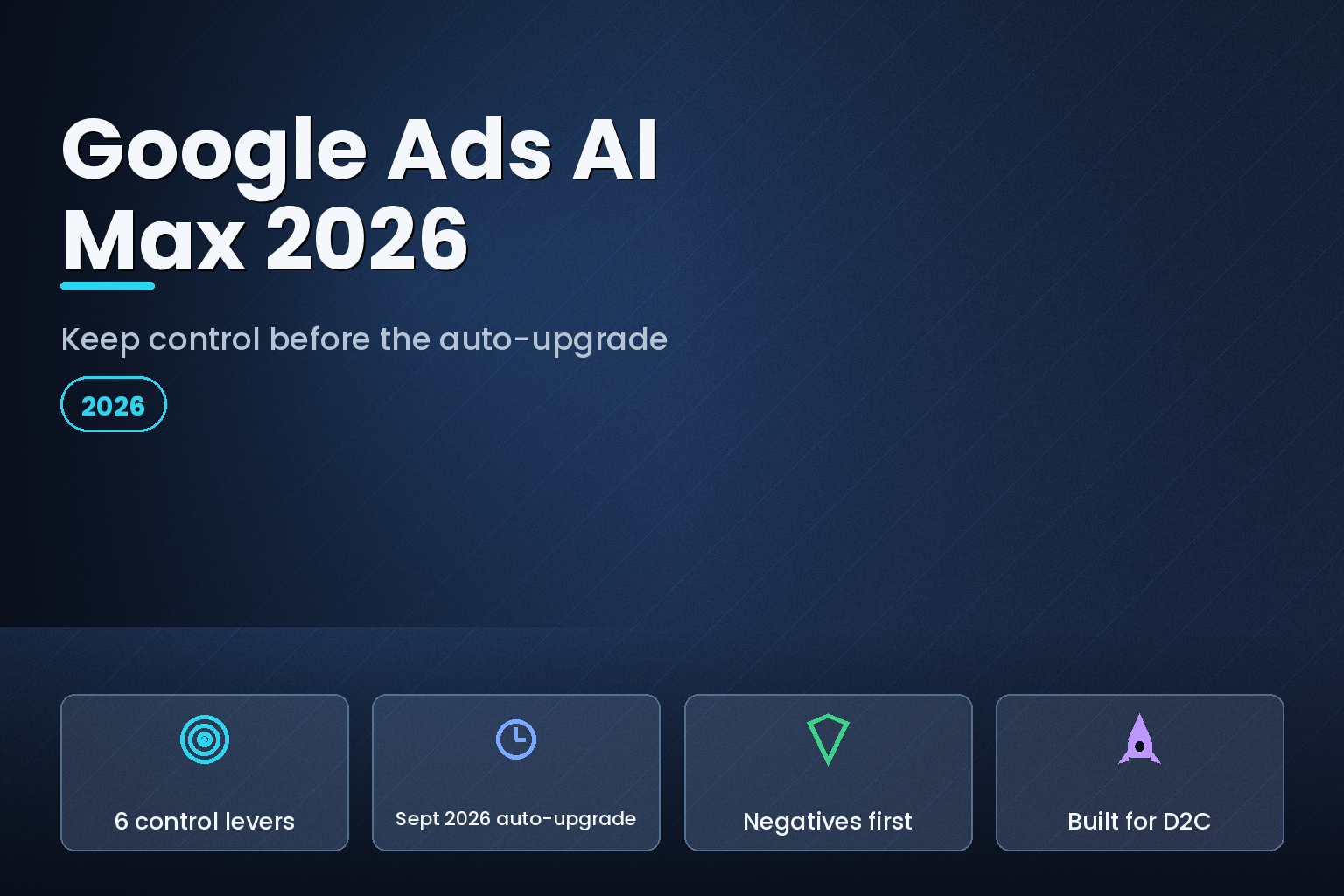
Summary. Google moved AI Max for Search out of beta on 15 April 2026, and it is now upgrading older campaign types into it on a staggered schedule. Automatically created assets and the campaign-level broad match setting auto-upgrade to AI Max from September 2026. Dynamic Search Ads were meant to follow in the same window, but a 11 June 2026 update pushed the DSA sunset and auto-upgrade to February 2027. Google reports a 7% average lift in conversions or conversion value at a similar CPA or ROAS when the full AI Max feature set is on. The risk for D2C teams is not the automation itself, it is accepting Google's default match and URL expansion with no guardrails. This guide covers what changes, when, and the six controls to set first. It matters in a market where Indian digital ad spend is on track for about US$14.56 billion in 2026, and a mid-market D2C brand can push ₹2,00,000 to ₹20,00,000 a month through exactly these campaign types.
AI Max is not a new campaign type you opt into. It is a set of features layered onto Search campaigns, and Google is switching legacy setups over to it whether or not you act. That is the part advertisers keep missing. If you run Dynamic Search Ads, automatically created assets, or campaign-level broad match today, your account is on a migration path with a date attached.
What is changing, and when
Brandon Ervin, Director of Product Management at Google Ads, wrote that AI Max campaigns "see an average of 7% more conversions or conversion value at a similar CPA/ROAS when using the full feature suite, search term matching, text customization and final URL expansion, compared to using search term matching alone." That figure is Google internal data for non-Retail advertisers, so treat it as a directional claim, not a guarantee for your account.
The timeline is the thing to write down. Google's original plan folded Dynamic Search Ads into the September 2026 wave, then revised it. The 11 June 2026 note on the announcement extended the DSA sunset to February 2027 after advertiser feedback, while keeping created assets and broad match on the September date.
| Legacy setup | Auto-upgrade begins | AI Max features on by default |
|---|---|---|
| Automatically created assets (ACA) | September 2026 | Search term matching, text customization |
| Campaign-level broad match | September 2026 | Search term matching |
| Dynamic Search Ads (DSA) | February 2027 | Search term matching, text customization, final URL expansion (legacy URL controls preserved) |
| New DSA creation (UI, Editor, API) | Ends at DSA sunset | Not applicable; create AI Max instead |
| Voluntary one-click upgrade | Available now | You choose the feature mix |
Two phases run in parallel. Phase 1 is voluntary: Google has shipped upgrade tools that port your historical settings and data into standard ad groups with AI Max switched on, plus pop-up banners in the UI for ACA and broad match users. Phase 2 is automatic, on the dates above, and once it runs for DSA you can no longer create new Dynamic Search Ads in Google Ads, Google Ads Editor, or the Google Ads API.
The practical read: you have a window to move on your own terms and set controls deliberately, rather than inheriting a mirrored setup and discovering the match behaviour later in your search-term report.
Why this is happening now
Two forces sit behind the change. The first is product direction. Google has spent 2026 pushing automation deeper into Search, and AI Max is how that reaches keyword-adjacent formats. Text guidelines, the feature that lets you define approved terminology, prohibited phrases, tone, and competitor mentions, went global on 26 February 2026. AI Brief, which takes natural-language instructions for how the system should generate ads and pick queries, arrived alongside the April general-availability release.
The second is contractual. Google updated its advertising terms of service on 1 July 2026 to authorize its automated systems to "format, select, or generate targets, ads, or destinations" on an advertiser's behalf, as reported by Search Engine Land. There was no separate opt-in step, so every account was bound when the terms took effect. The terms also keep responsibility with the advertiser: you still own reviewing and approving what the system produces.
That combination, automation on by default plus responsibility that stays with you, is exactly why the controls below matter. The system will expand your reach. Your job is to fence the edges.
The 7% headline, and what independent tests show
Google's 7% figure describes the full feature suite against search-term-matching alone, not against a tightly managed keyword campaign. Independent results are more mixed and depend heavily on account type.
| Factor | AI Max tends to help | AI Max tends to hurt |
|---|---|---|
| Business model | Ecommerce with deep catalogue and clean conversion data | Lead-gen with loose conversion signals |
| Site content | Rich product and category pages | Thin or templated pages |
| Tracking | Stable, server-side, deduplicated | Fragmented or click-based only |
| Query space | Long-tail, high-variation demand | Small, brand-heavy query set |
| Oversight | Weekly search-term and asset review | Set-and-forget |
Susan Yen of SearchLab Digital, speaking on the firm's 2026 PPC session, made the point that these systems are not set-and-forget: if you are not adding negatives, watching where ads show, and structuring campaigns properly, you are handing over control and budget. Agency case data lands the same way. Coalition Technologies reported a single ecommerce client seeing a revenue jump inside 30 days of switching AI Max on, but framed it as a result for a mature account with strong content and stable tracking, not a universal outcome.
The lesson for a D2C team is not "avoid AI Max." It is that the upside shows up when the inputs, product feeds, landing pages, and conversion data, are already in good shape, and when a human still reviews the outputs.
The 6 control levers to set before the auto-upgrade
Every lever below comes from Google's own controls. Set them before Phase 2 reaches your campaigns, not after.
| Control lever | What it governs | Where to set it |
|---|---|---|
| Negative keywords | Blocks queries before AI expansion runs | Campaign and account negative lists |
| Brand controls | Keeps ads off competitor and unrelated brand queries | Brand lists and branded-search setting |
| Text guidelines | Approved and prohibited wording, tone | AI Max text guidelines |
| AI Brief | Plain-language steer for query and ad generation | Campaign AI Max settings |
| Final URL expansion | Which landing pages traffic can reach | URL expansion opt-out and page exclusions |
| Search-term review | Catches waste and drift after launch | Search-term report and one-click experiments |
1. Negative keywords
Standard negatives still work in AI Max, and Google applies them before its expansion logic. Any query containing a negative is excluded regardless of how semantically relevant the system thinks it is. Before the upgrade, build out competitor names, irrelevant product terms, and low-intent modifiers as campaign and account negatives. This is the single most reliable brake you have.
2. Brand controls
AI Max can match your ads to queries that mention other brands. Google added a branded-search control setting and brand lists so you can keep ads off competitor and unrelated brand terms, or deliberately include them. Decide your stance per campaign. For most D2C brands the default should be to exclude competitor brand queries from broad expansion and handle them, if at all, in a separate, watched campaign.
3. Text guidelines
Text guidelines let you define approved terminology, banned phrases, and tone, so AI-generated ad text stays on-brand. This is where you protect claims that carry legal or compliance weight, such as pricing language, health or finance wording, and offer terms. Load these before the system starts writing on your behalf, because after the auto-upgrade text customization is on by default for DSA and ACA campaigns.
4. AI Brief
AI Brief takes natural-language instructions for how AI Max should generate ads and choose searches. Treat it as a creative and targeting steer: name your core products, your audience, the intent you want, and the intent you do not. A specific brief plus text guidelines gives the system a much narrower and safer path than the generic setup it defaults to.
5. Final URL expansion
Final URL expansion lets Google send a query to whichever page on your domain it predicts will convert best. That is useful on a clean site and dangerous on a messy one. Turn it off if your site has pages that should never take paid traffic, or keep it on and immediately add URL exclusions for checkout steps, login pages, out-of-stock URLs, and thin content. For DSA campaigns your legacy URL controls carry over, so audit them now.
6. Search-term review
After the switch, the search-term report is your feedback loop. Review it weekly for the first month, add negatives for anything off-intent, and check which landing pages expansion is choosing. Google's one-click experiments let you A/B the AI Max feature set against your current setup, so you can measure the change on your own conversion data rather than trusting the 7% average. A conservative pattern is to run four to six weeks with tight exclusions, then loosen only where the data earns it.
What this means for Indian D2C brands
For Indian advertisers the stakes are rising with the budgets. Digital ad spend in India is projected to reach roughly US$14.56 billion in 2026, and a growing share of it now flows through automated Search and Shopping formats where the advertiser sets guardrails rather than individual bids.
Three points deserve attention locally. First, feed and landing-page quality decide whether AI Max helps, and many Indian D2C catalogues still ship with thin descriptions and weak category pages. Fix the inputs before you widen the match. Second, budgets are smaller and volatility hurts more, so the weekly search-term review is not optional at a ₹2,00,000 to ₹20,00,000 monthly spend where a week of loose matching can burn a meaningful share of the plan. Third is data protection. AI Max leans on your conversion data and any customer-match audiences you upload, which brings the Digital Personal Data Protection Act 2023 into scope. Confirm you have a lawful basis and consent for the customer data feeding these campaigns, and that your tag setup respects consent state. eCorpIT designs advertising and tracking stacks aligned with DPDP Act requirements rather than claiming any blanket certification.
For channel context, brands weighing where paid demand should sit can read our take on the ONDC versus quick-commerce channel choice before committing more budget to Search.
A pre-upgrade checklist
Work through this before Phase 2 reaches your account:
- Export current DSA, ACA, and broad match campaigns and note their September 2026 or February 2027 date.
- Build campaign and account negative-keyword lists, including competitor terms.
- Set brand controls and decide your branded-search stance per campaign.
- Write text guidelines for approved and prohibited wording.
- Draft an AI Brief per campaign with products, audience, and excluded intent.
- Decide final URL expansion on or off, and add URL exclusions either way.
- Schedule a weekly search-term review for the first month post-switch.
- Run a one-click experiment so you measure AI Max on your own conversions.
None of this stops the upgrade. It decides whether you walk into it with the settings you chose or the settings Google inherited for you.
How eCorpIT can help
eCorpIT is a Gurugram-based technology and performance-marketing organisation, founded in 2021, with CMMI Level 5, MSME, and ISO 27001:2022 credentials and a Google partnership. Our senior-led teams manage Google Ads for D2C and ecommerce brands: we audit your DSA, ACA, and broad match exposure ahead of the September 2026 and February 2027 auto-upgrades, set the six controls above, and stand up the search-term and experiment reviews that keep AI Max honest. We also align conversion tracking and customer-data handling with DPDP Act 2023 requirements. If you want the upgrade handled deliberately rather than by default, talk to our performance-marketing team. You can also read our PPC and Google Ads ROI guide, our digital marketing strategy playbook, and how we operate as a full-service digital marketing partner.
FAQ
References
_Last updated 31 July 2026._