On this page · 11 sections
- What 10x ROI actually means
- Discipline 1: attribution that ties spend to revenue
- Discipline 2: AI augmentation across the marketing stack
- Discipline 3: channel mix chosen by ROI, not habit
- Discipline 4: measurement that drives decisions
- The 90-day 10x ROI sprint
- Common digital marketing failures
- India-specific notes
- FAQ
- How eCorpIT can help
- References
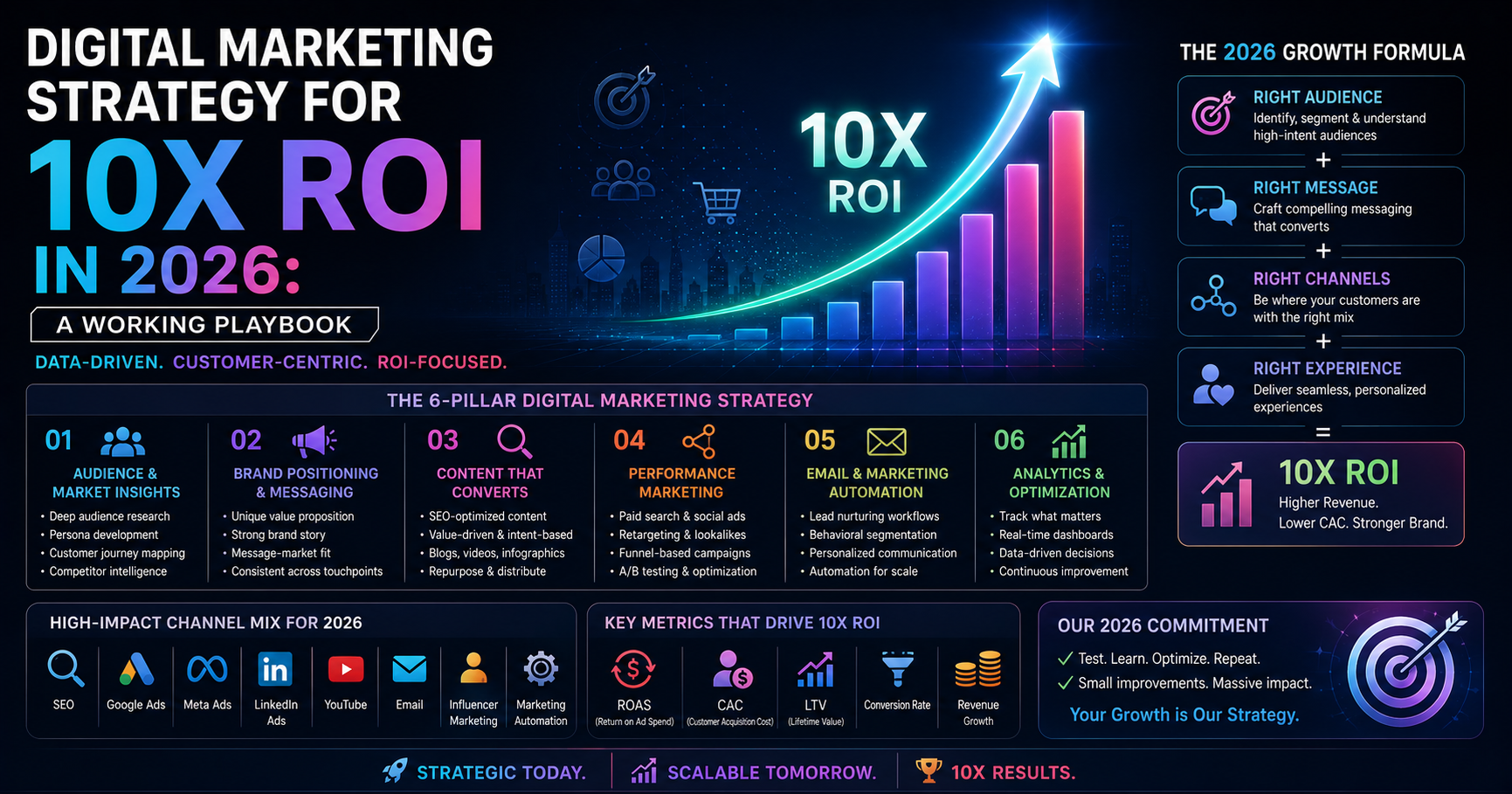
Summary. Most digital marketing programs do not deliver 10x ROI in 2026. The ones that do share four operational disciplines — proper attribution, AI-augmented production, disciplined channel mix and ruthless measurement. The numbers are clear: organisations implementing multi-touch attribution report average marketing ROI improvements of 18%, lead quality improvements of 22%, sales cycle acceleration of 13% and customer acquisition cost reductions of 15%. Advanced attribution models lift marketing ROI 15-30%. AI-augmented marketing teams report 37% productivity improvement, content production 59% faster, and 12% revenue uplift on AI-assisted sales accounts. India's digital advertising market is on track to hit roughly ₹69,856 crore in 2026, accounting for 61% of total ad spend, with mobile taking 78% of digital budgets. This playbook walks through what 10x ROI digital marketing actually looks like in 2026 — the strategy, the attribution stack, the AI augmentation, the channel mix and the measurement discipline.
The framing that consistently fails in 2026 is "more channels, more content, more spend." The framing that works is fewer channels chosen deliberately, content fewer but deeper, AI-augmented production at every step, attribution that ties spend to revenue and a measurement cadence that lets the team kill what is not working before it consumes the budget.
This guide is built for CMOs, VPs of Marketing, founders running their own demand generation and performance marketing leaders at growth-stage and mid-market companies. The research draws on Forrester and McKinsey attribution studies, eCorpIT's B2B Performance Marketing Playbook, industry surveys from PwC, NVIDIA, Deloitte, and patterns observed across digital marketing programs across India, the US and the UK.
What 10x ROI actually means
A practical definition before the tactics. 10x ROI does not mean every campaign returns 10 rupees for every rupee spent. It means the marketing function as a whole — including the channels that produce direct revenue, the channels that produce pipeline that converts months later, and the brand work that lifts conversion across everything — produces revenue that exceeds total marketing investment by a factor of approximately ten over the measurement period.
For SaaS and subscription businesses, this typically translates to a customer lifetime value (LTV) to customer acquisition cost (CAC) ratio of 5:1 or better, with payback periods under 12 months. For ecommerce, it means a marketing-driven return on ad spend (ROAS) of 4x or better in the first month, with brand and retention lifting that toward 8-10x across the full customer life. For B2B with long sales cycles, it means pipeline-to-spend ratios that pencil to 10:1 once close rates are applied.
The disciplines that follow are what separate the marketing functions that hit these ratios from those that do not.
Discipline 1: attribution that ties spend to revenue
The single biggest predictor of marketing ROI in 2026 is whether the team can trace revenue back to specific marketing actions.
Multi-touch attribution as the foundation. Approximately 35% of US marketers plan to invest in multi-touch attribution over the next year, per industry research. Organisations implementing MTA report 18% average marketing ROI improvement, 22% lead quality improvement, 13% sales cycle acceleration and 15% customer acquisition cost reduction. Companies adopting advanced attribution see 15-30% improvement in marketing ROI.
Data-driven attribution beats rule-based. Data-Driven Attribution (DDA) uses machine learning to analyse thousands of conversion paths and assign fractional credit to each touchpoint based on its actual contribution. Rule-based models (first-touch, last-touch, linear, time-decay) are blunt instruments by comparison. The major attribution platforms in 2026 — Funnel, Northbeam, SegmentStream, Rockerbox, Factors, Cometly — all run DDA-style models.
Combined with marketing mix modelling. Multi-touch attribution captures the digital path. Marketing mix modelling (MMM) captures the impact of non-digital and brand-level activity. Mature programs combine both, plus incrementality testing on specific channels.
Server-side tracking to recover lost signal. Paid social channels affected by iOS 14.5 and similar privacy changes typically see 40-60% modelled (versus observed) conversions. Server-side tracking implementations can recover 15-25% of that lost signal by moving measurement logic off the browser and into a first-party data environment.
The single highest-impact investment most marketing functions can make in 2026 is upgrading attribution. Without it, every other tactic is run blind.
Discipline 2: AI augmentation across the marketing stack
The 2026 reality is that AI-augmented marketing teams outperform unaugmented teams by a wide margin. The productivity numbers are concrete: 37% productivity improvement on marketing tasks, 59% faster content production, 12% revenue uplift on AI-assisted sales accounts.
Content production at scale. AI accelerates the production of blog posts, landing pages, email sequences, social content, ad creative variants and SEO content. The discipline that wins: AI drafts; humans edit; brand voice fine-tuning keeps outputs consistent; measurement focuses on conversion impact, not raw production volume.
Creative variant testing. AI generates dozens of ad creatives for testing on Meta, Google, LinkedIn and TikTok. The marketer's role shifts to defining the testing framework and the success metric, not producing every variant manually.
Audience and segmentation work. AI clusters customer data into behavioural segments that marketers can target specifically. Lookalike modelling becomes more precise. Predictive churn and predictive purchase models identify the right messages at the right moment.
Personalisation at every surface. Website, email, push notification, in-app messaging — all personalised to the individual customer's behaviour and predicted intent. Done badly, this becomes surveillance. Done well, it lifts conversion by 15-30% across the funnel.
Agentic marketing workflows. The 2026 frontier is agents that plan and execute multi-step campaigns autonomously within human-set guardrails — drafting copy, generating creative, allocating budget across channels in real time, reporting results. Adoption is still emerging but accelerating.
For deeper coverage, eCorpIT's coverage of AI in business operations walks through marketing as one of the major function-by-function transformations.
Discipline 3: channel mix chosen by ROI, not habit
Most marketing programs spend on channels they have always spent on. The high-ROI programs choose channels by what is actually producing measurable revenue against the customer they are trying to acquire.
Paid search. Still the highest-intent paid channel for most categories. Google Ads, Microsoft Ads. The 2026 evolution is Performance Max and AI-driven bidding, which work well when fed clean conversion data but poorly when the conversion signal is weak.
Paid social. Meta (Facebook, Instagram), LinkedIn, TikTok, X (formerly Twitter), Pinterest, Reddit, Snapchat. Each has a distinct demographic and intent profile. The 2026 winners use AI creative testing to find the variants that work, then concentrate spend on those.
Programmatic display and CTV. The Trade Desk, DV360. Connected TV is increasingly part of the mix for brands with mid-funnel awareness needs. Programmatic display remains useful for retargeting and contextual placement.
Organic search (SEO, AEO, GEO). Covered in detail in eCorpIT's Ultimate Guide to SEO 2026. Long payback period but high marginal cost — once content is built, traffic compounds.
Email and lifecycle. The highest ROI channel in most companies once a customer base exists. AI personalisation, behavioural triggers and predictive churn models lift performance dramatically over batch-and-blast email.
Affiliate and partnerships. Pay-for-performance channels that scale efficiently once the program is structured. Particularly strong for ecommerce and SaaS with clear referral motions.
Influencer and creator partnerships. Particularly strong in India and ecommerce categories. The 2026 maturity is moving from celebrity influencers to mid-tier creators with engaged niche audiences.
Out-of-home, print, radio (selective). Still valuable in specific contexts — local market launches, brand-building for incumbents defending share. Use MMM to attribute appropriately.
The high-ROI pattern is not running every channel. It is running 4-6 channels well, with attribution that proves each is contributing, and discipline to cut the channels that are not.
Discipline 4: measurement that drives decisions
The marketing programs that hit 10x ROI report in revenue and pipeline, not in activity. Five operational discipline points.
Weekly reporting on revenue impact. Not impressions, not clicks, not engagement. Revenue or pipeline created, by channel, by campaign, against budget. This is the only report the leadership team should see.
Monthly cohort analysis. Customers acquired in each month are tracked through retention, expansion and lifetime value. Cohort analysis surfaces whether the customers you are acquiring this quarter are as valuable as the ones you acquired six months ago.
Quarterly attribution review. The attribution model is updated as channels shift and as conversion paths evolve. Marketing programs that run static attribution models for years drift toward inaccurate credit allocation and make wrong investment decisions.
Annual incrementality testing. Are the channels you are spending on actually causing the conversions, or just intercepting customers who would have converted anyway? Incrementality testing — geo-experiments, holdout tests, audience splits — surfaces this.
Continuous spend allocation. Spend reallocates in real time toward higher-performing channels and campaigns. Budgets are not fixed quarterly; they are managed dynamically with weekly micro-decisions and monthly strategic shifts.
The 90-day 10x ROI sprint
For CMOs and marketing leaders ready to modernise toward 10x ROI, a 90-day sprint pattern that consistently produces measurable lift.
Weeks 1-3: Baseline and audit. Establish current ROI baseline by channel. Audit the attribution stack — is multi-touch attribution running, is server-side tracking deployed, is the data clean. Inventory AI tooling and adoption across the team. Identify the channels producing the strongest and weakest measured ROI.
Weeks 4-6: Attribution upgrade. Deploy or upgrade multi-touch attribution (Funnel, Northbeam, SegmentStream, Factors, Cometly). Implement server-side tracking to recover lost signal. Reconcile MTA results with marketing mix modelling. Establish baseline ROI by channel under the new attribution.
Weeks 7-9: AI augmentation and creative testing. Deploy AI for content production, creative variant testing and personalisation. Train the team on the chosen tooling. Run a creative test across the highest-volume paid channel and measure conversion lift.
Weeks 10-13: Channel reallocation and discipline. Reallocate budget toward the channels and campaigns producing the strongest measured ROI under the new attribution. Cut channels that are not producing. Establish weekly revenue reporting, monthly cohort analysis and the quarterly review cadence.
The output of a successful 90-day sprint: a marketing function operating with attribution-driven decision-making, AI-augmented production, a disciplined channel mix and weekly revenue reporting. The financial outcome typically shows 15-30% ROI improvement within the first quarter, scaling toward the 10x target across subsequent quarters as compounding effects show up.
Common digital marketing failures
Six patterns that consistently produce poor ROI.
Vanity metrics in board reports. Impressions, reach, engagement and follower counts presented as marketing success while revenue is flat. The CFO eventually notices.
Last-click attribution. Crediting only the last touchpoint and treating every channel above the click as free. Produces systematic over-investment in branded search and retargeting and under-investment in upper-funnel.
Channel proliferation. Running 12 channels because the team is curious about each. None gets enough attention to optimise. Spend dilutes. ROI flattens.
AI without strategy. Adopting AI tools because they are AI tools, without a clear thesis on what the AI is doing differently. Production goes up; conversion stays the same; cost goes up.
Personalisation without measurement. Personalisation infrastructure deployed without explicit A/B testing of personalised versus non-personalised. The team thinks it is working; the data does not confirm it.
Creative atrophy. Running the same creative for months until it stops working, then panicking. The discipline that wins is constant creative refresh with AI-augmented production and disciplined testing.
India-specific notes
Three notes for Indian CMOs and marketing leaders in 2026.
₹69,856 crore market by 2026. Business Standard coverage projects India's digital advertising market at approximately ₹69,856 crore in 2026, accounting for 61% of total ad spend. Mobile takes approximately 78% of digital budgets. The opportunity surface is large; the discipline is in capturing it efficiently.
Multilingual creative is now table-stakes. AI translation and creative variation across Hindi, Tamil, Telugu, Bengali, Marathi, Kannada, Malayalam, Gujarati and Punjabi expands addressable audience and lifts engagement materially. English-only creative leaves significant audience on the table.
Rupee economics shift the build-vs-buy point. Indian marketing operations cost materially less than US or UK equivalents. The build-vs-buy economics on marketing automation, attribution, content production and creative test infrastructure shift toward "build" for Indian companies with engineering depth — versus the "buy" tilt that makes sense in higher-cost geographies.
FAQ
How eCorpIT can help
eCorpIT runs digital marketing programs for clients across India, the US and the UK — attribution and FinOps for marketing, AI-augmented content and creative production, paid acquisition across Google, Meta, LinkedIn, TikTok, programmatic display and CTV, organic SEO/AEO/GEO, email and lifecycle, and measurement engineering.
If you are modernising your digital marketing program for 10x ROI in 2026, our team can help. Reach us at ecorpit.com/contact-us/ or contact@ecorpit.com.
References
- eCorpIT — "B2B Performance Marketing Playbook 2026": ecorpit.com
- eCorpIT — "Ultimate Guide to SEO in 2026": ecorpit.com
- eCorpIT — "How AI Is Transforming Business Operations in 2026": ecorpit.com
- Funnel — "Top multi-touch attribution (MTA) tools for 2026": funnel.io
- Improvado — "Multi-Touch Attribution Models, Tools, and Implementation Guide for 2026": improvado.io
- KEO Marketing — "Marketing Attribution Models: Multi-Touch ROI Guide 2026": keomarketing.com
- Balistro — "Marketing Attribution in 2026: How AI Is Solving the Multi-Touch Problem": balistro.com
- Cometly — "Best Multi Touch Attribution Solutions 2026": cometly.com
- Factors — "Top 12 Marketing Attribution Tools in 2026": factors.ai
- Business Standard — "India's advertising industry may see marginal, digital-led growth in 2026": business-standard.com
Last updated 8 June 2026 by the eCorpIT Editorial team.