On this page · 13 sections
- A correction to an earlier version of this page
- What the vendors actually publish
- The 10x fork inside one vendor
- Why there is no honest human comparison number
- Zendesk's three tiers make deflection and resolution different line items
- The buy side is consolidating
- Unit costs are moving the wrong way
- When building is the right call
- How eCorpIT builds support agents
- India-specific considerations
- FAQ
- How eCorpIT can help
- References
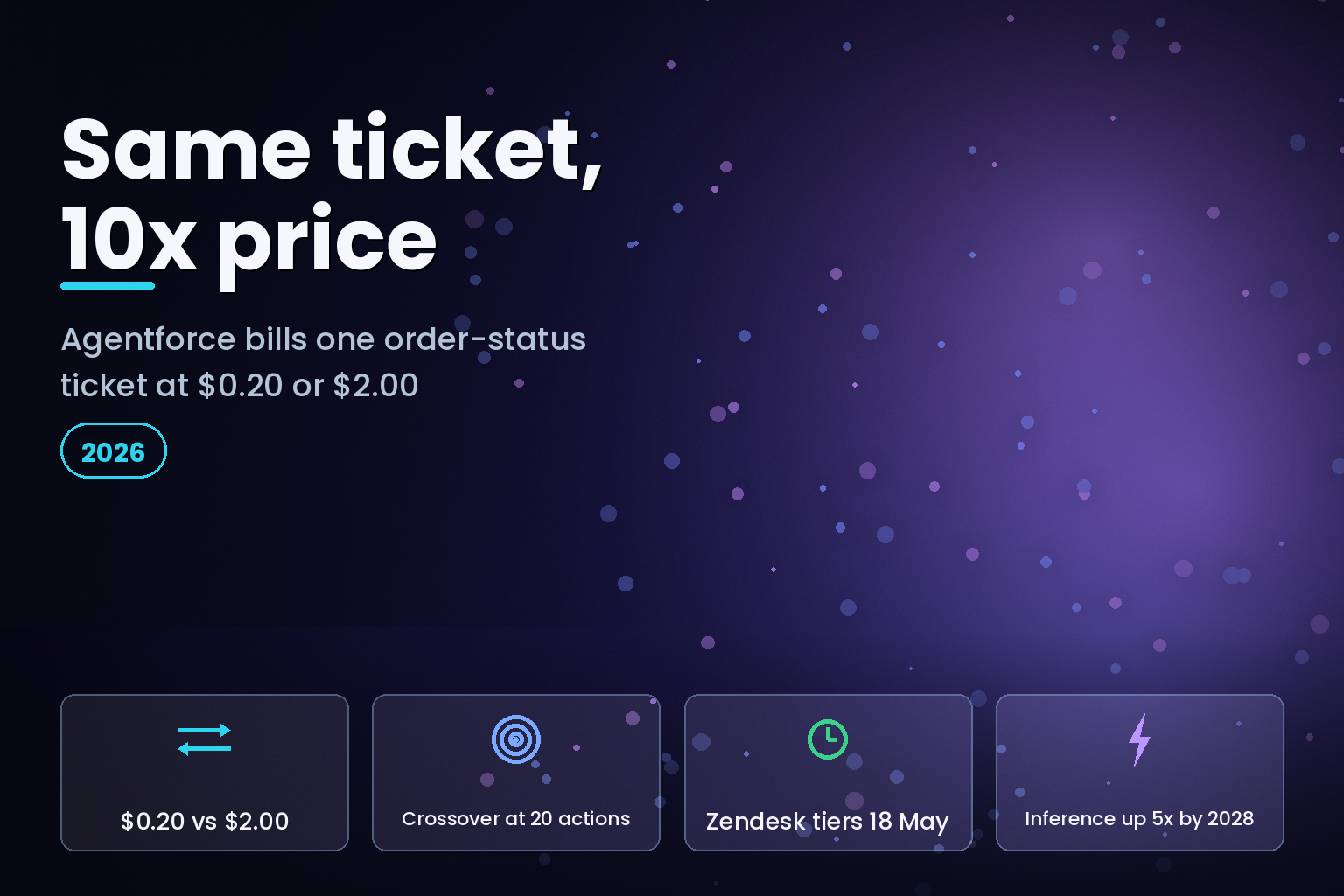
Summary. Salesforce's Agentforce pricing page, updated 31 July 2026, works through a customer self-service example titled "Where is My Order" and prices it at 2 actions, 40 Flex Credits, US$0.20. The same interaction under Salesforce's Conversations model is US$2.00. That is a 10x spread on one ticket inside one vendor's published rate card, and the vendor confirms both models "will not be supported in the same org." Across vendors the published range runs from $0.10 per session at Freshdesk to $2.00 per conversation at Agentforce. Zendesk rebuilt its billing on 18 May 2026 around three resolution tiers, and only one of them is billed. Gartner said on 17 August 2026 that inference cost per agentic workflow will rise more than fivefold through 2028. For D2C brands the buying question in 2026 is not what an AI ticket costs. It is which unit you are being billed in.
A correction to an earlier version of this page
An earlier version of this article stated that AI resolves support tickets at about $0.62 against $7.40 for a human agent, with chat at $0.41, and credited those numbers to a McKinsey 2026 customer-service sample. We have removed them.
There is no McKinsey publication by that name. The four figures trace to a single aggregator post that credits "the McKinsey AI in Customer Service 2026 sample" without a link, and McKinsey's own customer-service work publishes percentage ranges, not per-ticket dollar costs. We also removed a "340% first-year ROI" claim and a 41.2% median deflection figure from the same lineage. The AI agent unit economics analysis covers how that number cluster spread.
Everything below is priced from a vendor's own published page or a named primary source, with the date it was read.
What the vendors actually publish
Six of the seven best-known AI support agents publish something. The rates are not comparable, because the billable unit differs in each case.
| Vendor | Billable unit | Published rate |
|---|---|---|
| Freshdesk Freddy AI | Per session | $0.10 per session |
| Salesforce Agentforce | Per action (Flex Credits) | $500 per 100,000 credits, 20 credits per standard action |
| Gorgias | Per resolution, tiered | $0.90-$1.27 per resolution |
| Intercom Fin | Per outcome | $0.99 per outcome |
| Zendesk AI | Per Verified Resolution | Seat plans published; per-resolution overage not published |
| Salesforce Agentforce | Per conversation | $2.00 per conversation |
| Ada, Decagon | Custom contract | Not published |
Rates above are from each vendor's pricing page or, where marked, from third-party teardowns. Zendesk's own pricing page publishes seat rates only; the per-resolution overage rates circulating in comparisons are third-party estimates and should be treated as such.
A per-session rate and a per-outcome rate are not the same product measured two ways. Freshdesk's $0.10 is charged each time the agent engages, so one customer issue spanning four sessions bills four times. Fin's $0.99 is charged once, and only when the conversation is resolved without a human. Ranking these by sticker price produces a false ordering.
The 10x fork inside one vendor
The clearest illustration is Salesforce's, because both numbers come from the same page.
Agentforce sells two consumption models. Conversations bills $2.00 per conversation, defined as a 24-hour session, whether or not the issue was resolved. Flex Credits bills $500 per 100,000 credits, with a standard agent action costing 20 credits and a voice action 30.
Salesforce's own worked example on that page takes the highest-volume D2C ticket there is. A customer asks where their order is. The agent authenticates them from their email address and retrieves the order details: two actions, 40 Flex Credits, US$0.20. At 20 such requests a day for 30 days, Salesforce shows US$120 a month.
Run the identical ticket through the Conversations model and it bills $2.00.
| Model | Billing basis | Cost of one order-status ticket |
|---|---|---|
| Flex Credits | 2 actions x 20 credits at $0.005 | $0.20 |
| Conversations | 1 conversation, 24-hour session | $2.00 |
| Flex Credits, 5-action case | 5 actions x 20 credits | $0.50 |
| Conversations, 5-action case | 1 conversation | $2.00 |
| Flex Credits, 20-action case | 20 actions x 20 credits | $2.00 |
The crossover sits at 20 actions. Below it, Flex Credits is cheaper; above it, Conversations is. D2C support sits well below that line, because order status, returns and shipping questions resolve in two to five actions. Salesforce's FAQ on the same page states the two models "will not be supported in the same org," and that switching requires swapping every existing Conversation SKU.
So the decision that moves a D2C support bill by 10x is not which vendor you pick. It is which SKU your account executive writes on the order form. That choice is also close to irreversible inside a term, and unused Flex Credits "do not roll over into subsequent subscription terms."
Neither Agentforce model bills on resolution. A conversation the agent fails to resolve, and hands to a human, still bills.
Why there is no honest human comparison number
The number every build-versus-buy deck wants is cost per human-handled ticket, so it can be divided by the AI rate. No primary publisher gives a reproducible 2026 figure.
Intercom, which publishes its AI rate to the cent, sources its own human comparator of $6.00-$8.00 to a third-party listicle. The $13.50 per human contact figure that circulates attributed to SQM and Forrester benchmarks does not appear on SQM's cost-per-call page, and the only Forrester report on the topic is from 2007 and paywalled. The four roundups our earlier version relied on disagreed with each other by 6x on the AI side and 2.25x on the human side.
The honest method is to compute your own denominator. Take fully loaded support salary plus tooling for a quarter, divide by tickets a human closed in that quarter, and compare that to a vendor rate you have confirmed in writing. A borrowed denominator will not survive a CFO's second question.
Zendesk's three tiers make deflection and resolution different line items
Zendesk restructured billing on 18 May 2026 into three automated resolution tiers. The primary documentation defines them precisely, and the definitions matter more than the rate.
Assisted escalation covers cases where the agent collected data, authenticated the customer or routed the conversation, but a human finished it. It "does not count against your resolution allowance."
Contained resolution covers cases where the agent handled the interaction to completion and the customer did not follow up, but the verification step did not confirm it. This tier also does not count against the allowance.
Verified resolution is the billed tier. After a 72-hour window with no customer follow-up, a separate large language model evaluates the conversation text and confirms the request was satisfactorily resolved. Only conversations that pass are billed.
A vendor writing two free tiers into its own rate card is the strongest available evidence that containment and resolution are different things. Most deflection rates quoted in vendor marketing measure the first two tiers. Zendesk will not bill for either. Any business case built on a deflection percentage should be rebuilt on the resolution definition the contract actually uses, and the 72-hour verification window means resolution counts arrive three days late, which complicates real-time cost tracking.
The buy side is consolidating
On 15 June 2026 Salesforce signed a definitive agreement to acquire Fin, formerly Intercom, for approximately $3.6 billion. The transaction is expected to close in the fourth quarter of Salesforce's fiscal 2027, subject to regulatory clearance.
This changes the shape of a build-versus-buy comparison. The $0.99 per-outcome option and the $2.00 per-conversation option, the two rates most D2C shortlists weigh against each other, are becoming one company's portfolio. Salesforce states Agentforce reached $1.2 billion in ARR in the first quarter of fiscal 2027, up 205% year over year, and that Fin brings "an established global customer base of more than 30,000 companies."
Salesforce also cites Fin agents "resolving on average 76% of support volume end-to-end." That is a vendor-reported figure across Fin's customer base, not an independent benchmark, and Fin is the party publishing it.
Eoghan McCabe, Chief Executive Officer and Co-Founder of Fin, framed the deal as distribution: "By joining forces with Salesforce, we can deploy it far and wide at a rate far faster than we could have ever achieved on our own."
For a brand signing a three-year contract now, the practical question is what pricing looks like after close. Nothing published commits the combined company to keeping both models at today's rates. Contract terms that survive a change of control are worth more attention this year than a $0.20 difference in unit rate.
Unit costs are moving the wrong way
Gartner published a forecast on 17 August 2026 that AI inference costs per agentic workflow will increase more than fivefold through 2028. It names the effect the Inference Paradox: better unit economics escalating the overall cost of AI without a clear pathway to commensurate and predictable value.
"Product leaders cannot rely on more efficient token economics to rationalize AI costs," said Will Sommer, Sr. Director Analyst at Gartner. "Each successive generation of AI capability will necessitate more, and often more expensive, tokens. There is no reliable, economical one-size-fits-all model on the horizon."
Gartner puts a number on the gap between a chatbot and an agent: compared to a basic chatbot interaction, routing a task to an agentic reasoning model increases provider inference costs by at least five times, and more as task complexity grows.
That forecast cuts against the assumption underneath most three-year support-automation business cases, which is that per-unit AI cost falls every year. Token prices are falling. The work being asked of the tokens is growing faster. A contract priced per action, on a vendor whose agents get more agentic each release, has an escalator built into it that a per-outcome contract does not.
When building is the right call
Buying wins on time to value for most D2C brands, and the free tiers make a proof of concept nearly costless. Salesforce Foundations includes Agent Builder and Prompt Builder at no charge. Fin publishes a 14-day trial. Neither requires a build.
Building earns its cost in three situations.
The first is deep integration. When resolution depends on a proprietary order-management system, a custom returns engine or a loyalty ledger that generic connectors reach only through brittle middleware, the agent that "resolves" through a vendor connector is often just deflecting into a queue somewhere else.
The second is unit mismatch. Every published model bills a unit that suits the vendor. If your ticket mix is short, high-volume and highly repetitive, per-conversation and per-session billing overcharges you structurally, and the cheaper model may not be available on the platform your helpdesk already runs.
The third is contract risk. With Fin moving into Salesforce and Zendesk having changed both its billing definitions and its overage behaviour inside eighteen months, the cost of owning the agent can be lower than the cost of repricing twice.
Our enterprise AI agent development service and the AI customer support build versus buy cost analysis for India cover the architecture and the arithmetic. For the platform comparison specifically, see Agentforce against Copilot Studio on enterprise agent cost.
How eCorpIT builds support agents
eCorpIT builds custom AI support agents for D2C and ecommerce brands that have outgrown off-the-shelf tools. Our senior-led, CMMI Level 5 teams start by counting your ticket mix in actions, not conversations, because that single measurement decides which vendor model is cheapest and whether a build pays at all. We integrate the agent with your order, returns and inventory systems so it resolves rather than escalates, and we instrument resolution against the contract's own definition rather than a deflection percentage.
We are direct about the build-versus-buy call. If your ticket mix fits a published model and your integration needs are shallow, buying is the right answer and we will say so. Our chatbot development company practice covers both paths.
India-specific considerations
Two factors change the arithmetic for Indian D2C brands.
Channel and language come first. Support runs across WhatsApp, web chat and voice, frequently in more than one Indian language. Voice is priced differently in every model that publishes: Agentforce voice actions cost 30 Flex Credits against 20 for a standard action, so a voice-heavy mix shifts the Flex Credits crossover point downward. Vendors that bill per conversation charge the same for a WhatsApp exchange as for a long voice call, which favours per-action billing for brands whose volume sits on messaging.
Cost structure comes second. Human support costs less in India than in the US, so the absolute rupee saving per ticket is smaller and the business case rests on 24x7 coverage, response consistency and peak absorption rather than labour arbitrage. A dollar-denominated per-conversation rate is also an FX exposure on a rupee-denominated support budget.
Data handling is not optional. A returns or refund conversation touches payment and address data, and consent under the Digital Personal Data Protection Act, 2023 applies to every stored conversation, including the transcripts a vendor's verification model reads. We design data handling aligned with DPDP requirements from the first sprint. Where a vendor's evaluation model processes conversation text outside India, that flow belongs in the data-protection review before the contract is signed, not after.
FAQ
How eCorpIT can help
eCorpIT (eCorp Information Technologies Private Limited, founded 2021, Gurugram) builds custom AI customer-support agents for D2C and ecommerce brands. Our senior-led, CMMI Level 5, MSME-certified and ISO 27001:2022 certified teams measure your ticket mix in actions before recommending a model, integrate the agent with your commerce stack, and design data handling aligned with DPDP Act requirements. As a Shopify partner, we connect the agent to your store, orders and returns. To scope a support-agent build, or to have us price your current ticket mix against the published vendor models, contact us.
References
- Salesforce Agentforce Pricing - Salesforce, page modified 31 July 2026
- Salesforce Signs Definitive Agreement to Acquire Fin - Salesforce, 15 June 2026
- Gartner Predicts AI Inference Costs Per Agentic Workflow Will Increase More Than Fivefold Through 2028 - Gartner, 17 August 2026
- About automated resolution tiers - Zendesk, tiers introduced 18 May 2026
- AI Customer Service Agent Pricing Comparison: The Complete 2026 Guide - Intercom, 8 July 2026 (vendor page positioning Fin)
- Zendesk pricing - Zendesk, seat rates
- New Research: AI Service Agents Improve Customer Satisfaction - Salesforce, n=3,075
- Agentforce Rate Card - Salesforce
- Salesforce Digital Wallet - Salesforce, usage tracking
- Fin AI Agent - Fin, vendor-reported resolution rate
- Salesforce FY27 Q1 earnings - Salesforce, 27 May 2026
- Zendesk Relate 2026: preparing for an outcome-based future built on verified resolutions - Diginomica
_Last updated: August 22, 2026._