On this page · 10 sections
- What Apple actually changed, and when
- The definition, read carefully
- The consequence: a 13+ floor
- What the exemption costs to build
- The Social Media content descriptor is public
- This is the second age-rating change in three months
- A pre-September checklist
- India-specific considerations
- Where this sits in the wider September crunch
- FAQ
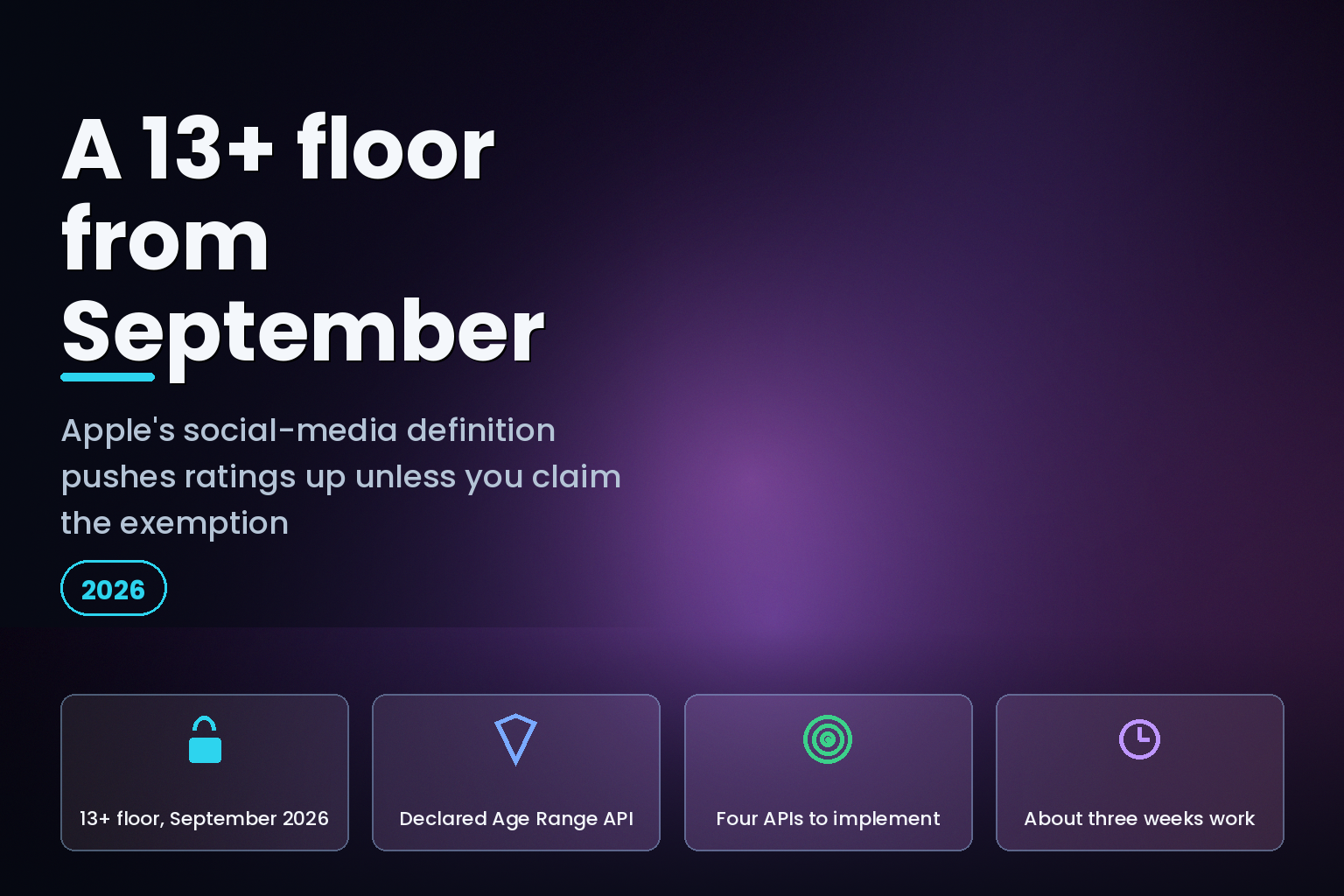
Summary. Apple added social media questions to the App Store Connect age rating questionnaire on 9 July 2026, and from September 2026 answering them becomes a condition of submitting anything. Apple's wording is unambiguous: responses will be required when submitting new apps or updates to the App Store, or when submitting apps for notarization for alternative distribution. The consequence most teams have not priced in sits in the 8 June 2026 Time Allowances announcement: if you indicate that your app or game includes social media capabilities, it is placed in the Social Media Time Allowance category and receives a minimum age rating of 13+. Apple defines a social media capability as the ability to redistribute, amplify, or interact with user-generated content through a social feed or similar discovery method that visibly spreads content to many users. That definition catches far more than social apps. A fitness app with a public activity feed, a marketplace with product reviews that surface to everyone, an education app with a shared class wall: all three need a considered answer, not a reflex. There is one documented escape route, it requires the Declared Age Range API, and it has to be built before you submit. Apple shipped a related change in Australia on 18 June 2026 that removed the 15+ rating outright, so this is the second age-rating shift in three months.
This is a product decision wearing a compliance costume. Answer it in App Store Connect five minutes before a release and you may hand your app a rating floor that removes an entire audience.
What Apple actually changed, and when
Three dates matter, and they are not the same event.
Date | What happened | What it means for you ---|---|--- 8 June 2026 | Apple announced Time Allowances for iOS 27, iPadOS 27 and macOS 27 or later | Parents get per-category time limits, including a Social Media category 9 July 2026 | Social media questions went live in the App Store Connect age rating questionnaire | You can answer them today, voluntarily September 2026 | Answers become required | No answer, no App Store submission and no notarization for alternative distribution
Apple's Time Allowances announcement explains the machinery. Time Allowances give parents flexible ways to manage the time their kids spend in apps across categories, including Entertainment, Games and Social Media, and Apple states they are developed based on expert research and tailored to a child's age to give parents a starting point that parents can then adjust. Apple is explicit that Time Allowance categories are different from the categories used for user discovery on the App Store.
For Entertainment and Games, placement is mechanical: an app with Entertainment or Games as its primary or secondary category in App Store Connect is sorted into the corresponding Time Allowance category. Social Media is the exception, and that exception is the whole story.
The definition, read carefully
Apple's definition of a social media capability, in the 9 July 2026 update, is the ability to redistribute, amplify, or interact with user-generated content through a social feed or similar discovery method. The 8 June announcement adds the qualifier that matters most: through a social feed or similar discovery method that visibly spreads content to many users.
Break it into the three tests Apple is applying.
There must be user-generated content. Content authored by your editorial team does not count. Content authored by your users does.
There must be redistribution, amplification or interaction. A one-to-one direct message between two users is a weaker case than a like button, a share, a repost or a comment thread.
There must be a discovery method that visibly spreads that content to many users. This is the clause that separates a private support chat from a public feed. A ticketing app where a customer messages an agent does not spread anything to many users. A product page where any shopper's review is shown to every subsequent shopper does.
Apply those three tests to the apps in your portfolio rather than to the label on the App Store category. Apple states directly that the Social Media Time Allowance category is based on whether your app or game offers social media capabilities, regardless of the category selected in App Store Connect. A Health and Fitness app with a public leaderboard and comments is in scope. A Games app with a global chat channel is in scope. Category selection will not save you.
The consequence: a 13+ floor
Here is the part that changes product plans rather than release checklists.
Answer you give | Time Allowance placement | Age rating effect | Extra engineering required ---|---|---|--- No social media capabilities | Not in the Social Media category | Rating determined by the rest of the questionnaire | None Yes, social media capabilities | Placed in the Social Media Time Allowance category | Minimum age rating of 13+ | None, but you lose the under-13 audience Yes, but disabled for anyone under 13 | Excluded from the Social Media category for users under 13; still in it for users 13 and above | Overall questionnaire responses determine the rating, and it may be lower than 13+ | Declared Age Range API, at a minimum
Apple's language on the middle row is direct: if you indicate that your app or game includes social media capabilities, it will be placed in the Time Allowance category for Social Media and receive a minimum age rating of 13+.
For a large category of apps that is a commercial event, not a compliance one. A 13+ floor removes children's audiences, changes which parental controls apply, and in some markets changes which app charts and editorial placements you are eligible for. If your growth model depends on family or school users, a careless yes on a Tuesday afternoon costs more than the release it unblocked.
The third row is the escape route, and it is conditional. Apple states that if you indicate social media capabilities but they are disabled for anyone under 13, the app will not be included in the Social Media Time Allowance category for users under 13, that you will also need to use the Declared Age Range API at a minimum to check users' age ranges, and that your overall questionnaire responses then determine your rating, which may come out below 13+. The app can still land in the Games or Entertainment Time Allowance category based on its App Store Connect category, and it stays in the Social Media category for users aged 13 and above.
Read that as a build requirement with a September deadline attached. You cannot claim the exemption and implement the age gate later.
What the exemption costs to build
Apple has been shipping the age-assurance API surface since the spring, largely driven by Texas law SB 2420, whose age assurance requirements took effect for new Apple Accounts in Texas on 4 June 2026. The Texas update lists the four pieces developers are expected to implement.
- The Declared Age Range API returns age category data for an Apple Account. This is the one Apple names as the minimum for the under-13 exemption.
- The Significant Change API under the PermissionKit framework covers significant changes to your app, and Apple reminds developers that deciding when a change is significant is the developer's responsibility.
- The age rating property in StoreKit exposes the rating to your own code.
- An App Store server notification tells you when a parent or guardian has withdrawn consent for your app on a child or teen's device.
Apple's own next-step guidance is to implement these and then use the sandbox testing environment to validate the implementation. The sandbox step is not optional in practice. An age-range check that silently returns the wrong bucket in production is a worse outcome than not claiming the exemption at all.
A realistic scope for an app that already has an account system: a week to wire Declared Age Range into the session bootstrap, a week to gate the social surfaces behind the returned age band, and a week of sandbox validation across fresh accounts, child accounts and consent-withdrawal notifications. Teams that have never touched PermissionKit should assume longer. Three weeks of engineering to hold a 12+ rating is a real line item, and it is the kind of scope a social media app development company has usually already priced, because the exemption work is close to identical across every app with a feed and a comment box. Our age assurance and app compliance work for Android and iOS covers the same ground on both stores.
The Social Media content descriptor is public
There is a visible consequence too, separate from the rating. Apple states that apps with social media capabilities will display a new Social Media content descriptor on their App Store product page.
That descriptor is marketing surface you do not control. For a consumer app it may be neutral or even useful. For a B2B app that happens to contain an internal comment feed, a Social Media badge on the product page is a conversation you will have with enterprise buyers. Decide whether the feature that triggers the descriptor is worth carrying, and if it is marginal, consider removing it before September rather than explaining it afterwards.
This is the second age-rating change in three months
Teams treating the September deadline as a one-off should look at what happened in Australia on 18 June 2026. Apple removed the 15+ rating from the Australian App Store: apps rated 15+ carrying unrestricted web access, frequent medical or treatment information, or loot boxes were updated to 16+. Apple's instruction in that notice is the same instruction that applies now, which is to make sure your responses to the age rating questionnaire accurately reflect your app's content.
The pattern is consistent. Apple is converting the age rating questionnaire from a one-time onboarding form into a live compliance surface that gets re-scored as regulation changes in individual markets. Treat the questionnaire as versioned configuration that belongs in your release process, not as something a product manager filled in once in 2023.
A pre-September checklist
Twenty-eight days to the start of September is enough if you begin with the audit rather than the answer.
1\\. Inventory every user-generated content surface
List every place a user's content becomes visible to a user who did not create it. Reviews, comments, activity feeds, leaderboards with custom names, shared playlists, public profiles, group chats above a certain size. Note for each whether it is on by default.
2\\. Apply Apple's three tests to each surface
User-generated, redistributed or amplified or interactive, and visibly spread to many users. A surface has to clear all three to be a social media capability. Write down the reasoning for each one, because you will be asked to defend it internally and possibly to App Review.
3\\. Decide the rating strategy per app, not per company
An app that is already 17+ loses nothing by answering yes. An app aimed at families has a genuine decision: build the Declared Age Range gate, or remove the surface. A portfolio answer applied to every app is how a kids app ends up rated 13+ by accident.
4\\. If you claim the under-13 exemption, build and validate it now
Declared Age Range at minimum, gating on the returned band, and sandbox validation. Apple ties the exemption to the implementation, not to the intention.
5\\. Answer in App Store Connect before your last August release
The questionnaire has been open since 9 July 2026. Answer it on a release that is not urgent, watch what the resulting rating and descriptor look like on the product page, and correct course while there is still time. Do not discover the 13+ floor on the build you need to ship.
6\\. Fold the questionnaire into your release runbook
Add a line to the release checklist: confirm age rating responses still reflect the current build. Any release that adds a comment box or a feed changes the answer.
India-specific considerations
For Indian product teams and the offshore teams building for overseas publishers, three points are worth separating out.
The requirement is global. It applies to submissions from anywhere, so an app built in Gurugram for a US publisher is subject to the same September gate as one built in Cupertino. If your engagement stops at code handover, agree now who owns the App Store Connect questionnaire, because a missing answer blocks the client's release and the client will call you.
Second, the under-13 exemption is a design constraint, not just a flag. Indian consumer apps in education, gaming and social commerce frequently have young users and public content surfaces at the same time. Apple's exemption path requires you to know a user's age band before you show them a feed, which pushes an age check into the sign-in flow. That interacts with how you already collect user data.
Third, the Digital Personal Data Protection Act 2023 treats children's data as a distinct category with its own consent requirements. Declaring a 13+ rating on the App Store and processing under-13 data in your backend are separable facts, and only the first is visible to Apple. If your product genuinely serves children in India, the age gate you build for Apple should be the same gate your DPDP posture relies on, rather than a second parallel mechanism. Our DPDP-ready app development practice treats those as one workstream.
Where this sits in the wider September crunch
The age rating requirement is not the only Apple-side change landing this quarter, and iOS 27 is the release that carries all of them. Teams already working through the iOS 27 enterprise readiness checklist for September 2026 should add the questionnaire to it, because unlike an SDK bump it can be done in an afternoon once the audit is complete. The broader platform picture sits in our iOS 27 enterprise fleet readiness guide, and the interface work that ships alongside it in the Liquid Glass and Xcode 27 migration guide.
The blunt version: the engineering is small, the product decision is not, and the deadline is a submission blocker rather than a warning email.