On this page · 13 sections
- What this page got wrong
- The support-AI prices a publisher actually stands behind
- The platform fee is the denominator nobody quotes
- Zendesk repriced around the deflection gap, and that is the strongest evidence in the category
- Nobody publishes a human cost per ticket you can reproduce
- The cost curve is moving the wrong way
- What the named research houses actually publish
- Adoption is real, and it is not the same as production discipline
- Build your own denominator
- India-specific considerations
- FAQ
- How eCorpIT can help
- References
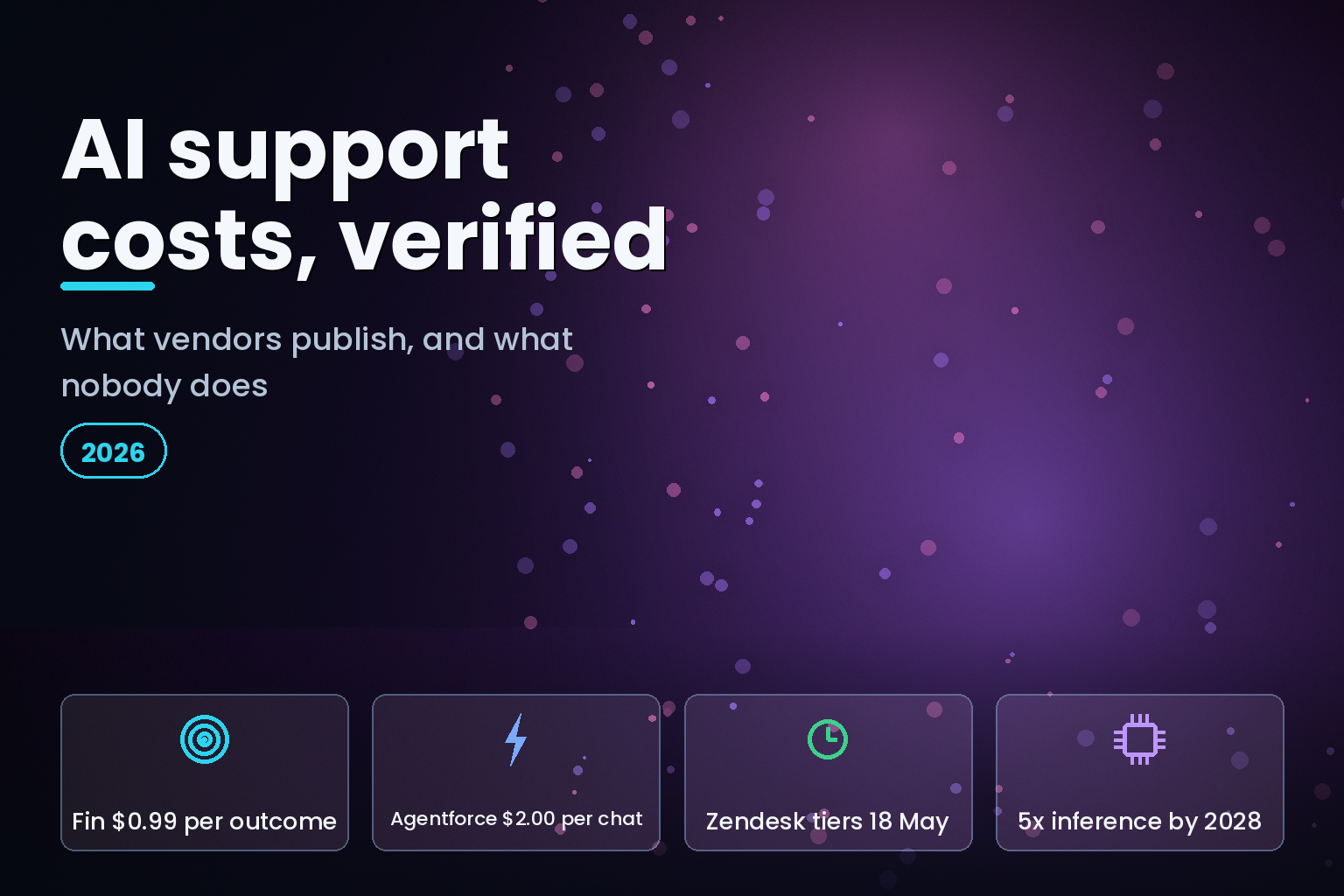
Summary. Three support-AI prices are published by the companies that charge them: Intercom bills Fin at $0.99 per outcome with no required platform fee, Salesforce bills Agentforce at $2.00 per conversation on top of Service Cloud at $175 or more per user per month, and Zendesk moved to tiered resolution billing on 18 May 2026. A fourth number, the human cost per ticket that every savings calculation divides by, is published by nobody. Gartner said on 17 August 2026 that AI inference costs per agentic workflow will rise more than fivefold through 2028. Salesforce found agentic AI use in customer service went from 39% in 2025 to 66% in 2026 across 3,075 respondents. This page previously led with a cost-per-resolution benchmark credited to a McKinsey report that does not exist. That number is gone, and this is what replaced it.
If you are building a business case for support automation, the useful move is not to find a better benchmark. It is to stop borrowing one. Vendor list prices are checkable because vendors publish them and bill against them. Your human cost per contact is checkable because you can compute it from your own payroll. Everything between those two numbers, in the 2026 statistics economy, is a chain of citations that dead-ends in a marketing page.
What this page got wrong
Until today, this article opened with a table of cost-per-resolution figures: $0.41 for AI chat, $0.62 blended, $1.18 for AI voice, $7.40 for a human agent. Each row was credited to something called "the McKinsey AI in Customer Service 2026 sample." It also carried a 340% median first-year ROI, a 41.2% median tier-1 deflection rate, a 58.7% top-quartile rate, and a 4.2-month median time to a first positive quarter.
There is no McKinsey publication with that title. We traced all four dollar figures to a single aggregator post from 22 April 2026 that credits the sample with no link, and every other site carrying them traces back to the same place or to a sibling of it. The 340% figure appears nowhere with a source at all. The deflection pair splits across two different research houses depending on which roundup you read. None of it survived a check.
We are naming the error rather than quietly editing it, for two reasons. The first is that these numbers were sitting in this page's FAQ structured data, which is exactly the format that gets lifted into AI Overviews and assistant answers, so the fabrication was being amplified rather than merely published. The second is that the correction is more useful than the original article was. A page that tells you which support-AI numbers can be checked, and which cannot, is worth more to someone signing a contract than a confident table built on sand. Our companion analysis of AI agent unit economics went through the same correction and reaches the same conclusion from the agent-cost side.
The support-AI prices a publisher actually stands behind
Three vendors publish rates in a form you can hold them to. The distinction that matters is not the sticker price. It is what event triggers the charge, because that single design choice moves your bill more than the per-unit number does.
| Vendor and unit | Published 2026 rate | What triggers the charge |
|---|---|---|
| Intercom Fin, per outcome | $0.99 | The AI resolves the issue end to end |
| Salesforce Agentforce, per conversation | $2.00 | Any conversation the AI handles, resolved or not |
| Salesforce Agentforce, Flex Credits | $500 per 100,000 credits | Per action consumed, roughly $0.10 an action |
| Zendesk, per resolution tier | Drawn from a resolution allowance | Tier assigned after the fact, verified tier billed |
| Zendesk Copilot, per seat | $50 per agent per month | Seat provisioned, independent of volume |
Intercom publishes this comparison itself, in a document positioning Fin against its competitors, so read the framing with that in mind while treating the Fin rate as authoritative. Intercom states that Fin resolves an average of 76% of customer queries at $0.99 per outcome and requires no platform fee to reach that rate. That is the cleanest published unit economics in the category, and it is clean partly because Intercom benefits from it being clean.
The Agentforce figure is the one that tends to surprise buyers, because $2.00 per conversation is charged whether or not the customer's problem was solved. A conversation the AI mishandles and escalates to a human costs the same $2.00 as one it resolves, and then costs the human handling time on top. Per-conversation and per-outcome pricing look adjacent on a comparison grid and behave very differently once your containment rate is anything short of excellent.
The platform fee is the denominator nobody quotes
Per-unit rates are quoted in isolation and almost never paid in isolation. Salesforce requires Service Cloud at $175 or more per user per month before Agentforce is available at all, and effective deployment also pulls in Data Cloud. Intercom's own comparison works the arithmetic out: at 20 agents, platform fees alone land between $2,100 and $4,600 a month before a single AI resolution is counted.
Zendesk publishes suite plans starting at $19 per month, with the tiers most support teams actually buy sitting between $55 and $115 per agent per month, and the Copilot add-on at $50 per agent per month on top. Those are seat costs that do not fall when the AI takes volume off your queue, which is the structural point. Seat licensing and outcome licensing pull in opposite directions: the first rewards you for having fewer humans, the second rewards you for the AI resolving more. Most 2026 contracts contain both, and the blended cost curve depends on which one dominates at your volume.
| Platform layer | Published cost | Behaviour as AI share rises |
|---|---|---|
| Service Cloud prerequisite | $175+ per user per month | Flat, tied to headcount |
| Zendesk suite tiers | $55 to $115 per agent per month | Flat, tied to headcount |
| Zendesk Copilot add-on | $50 per agent per month | Flat, tied to headcount |
| Agentforce conversations | $2.00 each | Rises with total volume |
| Fin outcomes | $0.99 each | Rises only with resolved volume |
The practical consequence: a team that cuts agent headcount slowly while pushing AI volume fast pays twice during the transition. That period is usually longer than the business case assumes, because the humans you keep are the ones handling the hard contacts the AI escalates, and those are the last roles you can safely remove.
Zendesk repriced around the deflection gap, and that is the strongest evidence in the category
The most-repeated warning in support-AI writing is that deflection is not resolution: a ticket can end without escalation while the customer's problem stays unsolved. That warning is usually supported with a statistic of uncertain origin. It no longer needs one, because a vendor has restructured its price list around it.
Zendesk introduced automated resolution tiers on 18 May 2026. The resolution tier field on a ticket now takes one of three values: assisted escalation, contained resolution, or verified resolution. Zendesk states that every resolution it charges for is verified both by the AI agent resolving the interaction end to end and independently confirmed by a dedicated AI evaluation model. Charges are drawn from a resolution allowance, a flexible pool that funds resolutions across the tiers.
| Zendesk resolution tier | What happened | Billing treatment |
|---|---|---|
| Assisted escalation | AI helped, a human finished the ticket | Lowest tier of the three |
| Contained resolution | Ticket closed without human escalation | Middle tier |
| Verified resolution | End-to-end resolution confirmed by a separate evaluation model | Billed at full value |
| Allowance mechanics | Tiers funded from a shared currency pool | Prevents overpaying for simple tasks |
| Confirmation window | Separate model reviews the interaction | Charge assigned after review, not at close |
Read what that implies. A company whose revenue depends on charging for AI resolutions built a second model whose job is to check whether the first one actually resolved anything, and priced the difference. If containment and resolution were close to interchangeable, that machinery would be pure cost with no commercial purpose. Zendesk built it because the gap is wide enough to price. Zendesk also positioned the change publicly as the first outcome-based pricing for AI agents in the category, and set out its broader autonomous-service direction at its Relate 2026 event.
That is a better argument than any deflection percentage we could have cited, and it has the advantage of being checkable against a live price list rather than a roundup.
Nobody publishes a human cost per ticket you can reproduce
Every savings model needs a denominator: what a human resolution costs you today. This is where the 2026 statistics economy breaks down completely.
No primary publisher gives a reproducible figure. Not the research houses, which publish percentage reductions rather than per-ticket dollars. Not the platform vendors, who have every incentive to publish a large human number and still do not. Intercom, which publishes its own AI rate to the cent, sources its human comparator to a third-party listicle. When the company with the strongest commercial motive to prove the gap will not put its own name on the human side of it, that tells you the figure does not exist in citable form.
What circulates instead is a set of mutually incompatible ranges, each presented with the confidence of a benchmark:
| Claimed source basis | AI side per resolution | Human side per resolution |
|---|---|---|
| The fabricated 2026 sample | $0.62 | $7.40 |
| Aggregated Gartner and Forrester framing | $0.50 to $1.05 | $8 to $12 |
| Published vendor list prices | $0.99 to $2.00 | $6 to $12 |
| A widely copied support-tooling roundup | $1.84 | $13.50 |
The AI side of that table spans more than 3x and the human side more than 2x. These are not four measurements of one quantity with normal variance. They are four different quantities, measured under undisclosed conditions, being presented as interchangeable. Any ROI figure produced by dividing one column by the other inherits the whole spread, which is how a business case arrives at a number like 340% and nobody notices it means nothing.
The honest engineering position is that the denominator is a local variable, not a published constant. You have payroll, benefits, tooling, management overhead, attrition cost and ticket volume. Nobody else does.
The cost curve is moving the wrong way
The 2026 business case also has to survive a trend that most support-automation modelling ignores. Gartner said on 17 August 2026 that AI inference costs per agentic workflow will increase more than fivefold through 2028, and named the mechanism the Inference Paradox: better unit economics escalating the overall cost of AI without providing a clear pathway to commensurate and predictable value.
Will Sommer, Sr. Director Analyst at Gartner, put the chatbot-versus-agent distinction directly: "The harsh economics of the Inference Paradox are exemplified by the differences between a simple chatbot and an AI agent. Where a simple chatbot must read and interpret a query and quickly respond with a probabilistically reasonable answer, an AI agent must constantly reason, negotiate, and question itself."
Gartner's release states that routing a task to an agentic reasoning model increases provider inference costs by at least five times a basic chatbot interaction, and often much more as task complexity grows. Sommer added that "defaulting to generic autonomous intelligence will result in unbounded costs orders of magnitude higher than those of optimized product ecosystems."
This matters to support specifically because the industry is migrating from scripted deflection bots to reasoning agents that look up orders, check entitlements and take actions. That migration is sold as a quality improvement and it usually is one. It is also a move onto a steeper cost curve. Gartner separately projected in March 2026 that inference on a one-trillion-parameter model will cost providers over 90% less by 2030 than in 2025, while warning that falling provider token costs will not be fully passed through to enterprise customers and that overall inference costs are still expected to rise. Cheaper tokens and higher bills are not a contradiction; they are the same forecast.
The buying implication is concrete. A per-conversation contract signed against 2026 scripted-bot behaviour prices differently once the same vendor upgrades you to a reasoning agent that makes eight model calls where the old bot made one. Ask what happens to your rate when the underlying model tier changes, and get the answer in the contract.
What the named research houses actually publish
Once the fabricated figures are removed, the credible research is thinner and more useful than the roundups suggest, because it is honest about being percentage-shaped.
McKinsey's work on gen AI in services documents a telecommunications provider that cut average handle time for agents finding relevant knowledge by 65%, and attributes the result to including frontline agents early and rebuilding cross-functional workflows rather than to the model. That is a case study, not a benchmark, and McKinsey presents it as one. Its more recent work on agentic AI in customer experience keeps the same shape: mechanisms and percentage movements, no per-ticket dollars.
Gartner's most-cited caution on agentic projects is its June 2025 prediction that over 40% of agentic AI projects will be canceled by the end of 2027. That is a forecast about project mortality, not about unit costs, and it belongs in the risk section of a business case rather than the savings section.
The pattern across both houses is consistent. They publish directional percentages, named case studies and forecasts. They do not publish the per-ticket dollar comparisons that get attributed to them. Anyone quoting a research house for a cost-per-resolution figure is quoting a roundup that invented the attribution.
Adoption is real, and it is not the same as production discipline
The adoption data holds up well and comes straight from a named survey. Salesforce's State of Service: AI Agents Edition surveyed 3,075 customer service professionals and found agentic AI use in customer service rose from 39% in 2025 to 66% in 2026, a 1.7x increase. Salesforce also reports that 70% of organisations adopting AI agents observe measurable value within 60 days, that the single most improved KPI after deployment is customer satisfaction rather than handle time or rep productivity, and that 89% of service professionals working with AI agents say their organisation would benefit from expanding usage.
The customer-satisfaction finding is the one worth pausing on, because it inverts the usual pitch. Support automation is sold on cost and it is measuring best on experience. If that holds in your deployment, the business case built purely on deflection savings is understating the return and mismeasuring where it comes from. Our breakdown of conversational AI patterns for CX covers the design decisions that produce that outcome rather than the opposite one.
What the survey does not tell you is how many of those 66% are running governed, permission-scoped agents against production systems. That gap is an engineering problem, not a procurement one, and it is the same gap that shows up across enterprise AI agents in production. An agent that can issue a refund or change account details needs scoped permissions and human checkpoints on irreversible actions, whatever its per-resolution price.
Build your own denominator
Here is a method that borrows no numbers, which is the only kind that survives a source check.
Start with your own fully loaded human cost per resolved contact. Take total support cost for a quarter, including salary, benefits, tooling, management time and recruitment, and divide by resolved contacts, not by tickets opened. Resolved is the correct denominator because it is what the AI side is measured on under outcome pricing, and comparing resolutions to tickets flatters the AI by whatever your reopen rate is.
Then price the AI side from a live quote, not a benchmark. Ask the vendor three questions and put the answers in writing: what event triggers a charge, what happens to that charge when the model tier changes, and how an escalated interaction is billed. Under per-outcome pricing an escalation costs nothing; under per-conversation pricing it costs full freight and then costs a human as well. Model both.
Next, model the double-running period honestly. Seat licences do not fall on the day AI volume rises, and the agents you keep longest are the expensive ones handling escalations. Assume headcount reduction lags AI volume by at least two quarters unless you have a specific reason to think otherwise.
Finally, instrument resolution rather than containment before you sign, not after. If your current tooling cannot tell you what share of closed-without-escalation tickets came back within seven days, you cannot verify any savings claim you are about to make, and Zendesk's decision to build a separate evaluation model tells you which direction the error runs.
The real cost is usually the knowledge base, not the model. An agent resolves what your documentation can support and escalates the rest, so the content work that nobody budgets for is the variable that actually moves the resolution rate.
India-specific considerations
For Indian businesses and for the many global support operations run from India, two things change.
The compliance position is live. Under the Digital Personal Data Protection Act, 2023, an AI agent handling customer personal data, including names, contact details and order history, needs a lawful basis, purpose limitation and an audit trail. Build consent capture and interaction logging into the first channel rather than retrofitting them across five, because retrofitting an audit trail into a deployed agent means replaying conversations you did not log. We design support-automation systems aligned with DPDP requirements as part of the build rather than as a later phase.
The economics shift as well, in both directions. Indian support labour costs less in dollar terms, which compresses the gap that makes dollar-denominated AI pricing look dramatic, and support-AI list prices are dollar-denominated regardless of where your agents sit. That combination makes the borrowed-benchmark problem worse, not better: a US-derived savings model applied to an Indian cost base overstates the return substantially. Compute your own denominator in rupees.
Language coverage is the third factor. Resolution quality, not containment, depends on the agent handling the languages your customers actually use. An English-only agent that closes a Hindi query without resolving it produces a contained resolution under Zendesk's own taxonomy and not a verified one, which is a useful way to think about the failure even if you run a different platform.
FAQ
How eCorpIT can help
eCorpIT is a Gurugram-based, CMMI Level 5, ISO 27001:2022 certified and MSME-certified technology organisation. Our senior engineering teams build support automation measured on verified resolution rather than containment, with scoped agent permissions, human checkpoints on irreversible actions, and instrumentation that reports reopen rates before you commit to a vendor. As a chatbot development company we also model the cost case against your own contact data rather than a published benchmark. Talk to us through our contact page and we will work through the numbers for your contact volume.
References
- Gartner Predicts AI Inference Costs Per Agentic Workflow Will Increase More Than Fivefold Through 2028 — Gartner, 17 August 2026.
- Gartner Predicts That by 2030, Performing Inference on an LLM With 1 Trillion Parameters Will Cost GenAI Providers Over 90% Less Than in 2025 — Gartner, 25 March 2026.
- Gartner Predicts Over 40% of Agentic AI Projects Will Be Canceled by End of 2027 — Gartner, 25 June 2025.
- AI Agent Pricing Compared: Fin vs Zendesk vs Agentforce — Intercom Learning Center.
- Intercom Pricing — Intercom.
- About automated resolution tiers — Zendesk help documentation.
- Upgrading from automated resolutions to resolution allowances — Zendesk help documentation.
- Zendesk First in CX Industry to offer Outcome-Based Pricing for AI Agents — Zendesk newsroom.
- Zendesk Introduces the Autonomous Service Workforce — Zendesk newsroom, Relate 2026.
- Zendesk Pricing Plans — Zendesk.
- New Research: AI Service Agents Improve Customer Satisfaction — Salesforce news.
- The State of Service: AI Agents Edition — Salesforce.
- Agentic AI and the future of customer experience — McKinsey.
_Last updated: August 21, 2026._