On this page · 14 sections
- The ROI reality: real returns, real failures
- Use case 1: Autonomous resolution
- Use case 2: the agent-assist copilot
- Use case 3: Intelligent triage and routing
- Use case 4: Proactive outreach and churn prevention
- Use case 5: Personalization and next-best-action
- Use case 6: Self-service and knowledge automation
- Use case 7: Voice of customer and quality automation
- The economics behind the returns
- Where the ROI breaks
- What it means for India
- FAQ
- How eCorpIT can help
- References
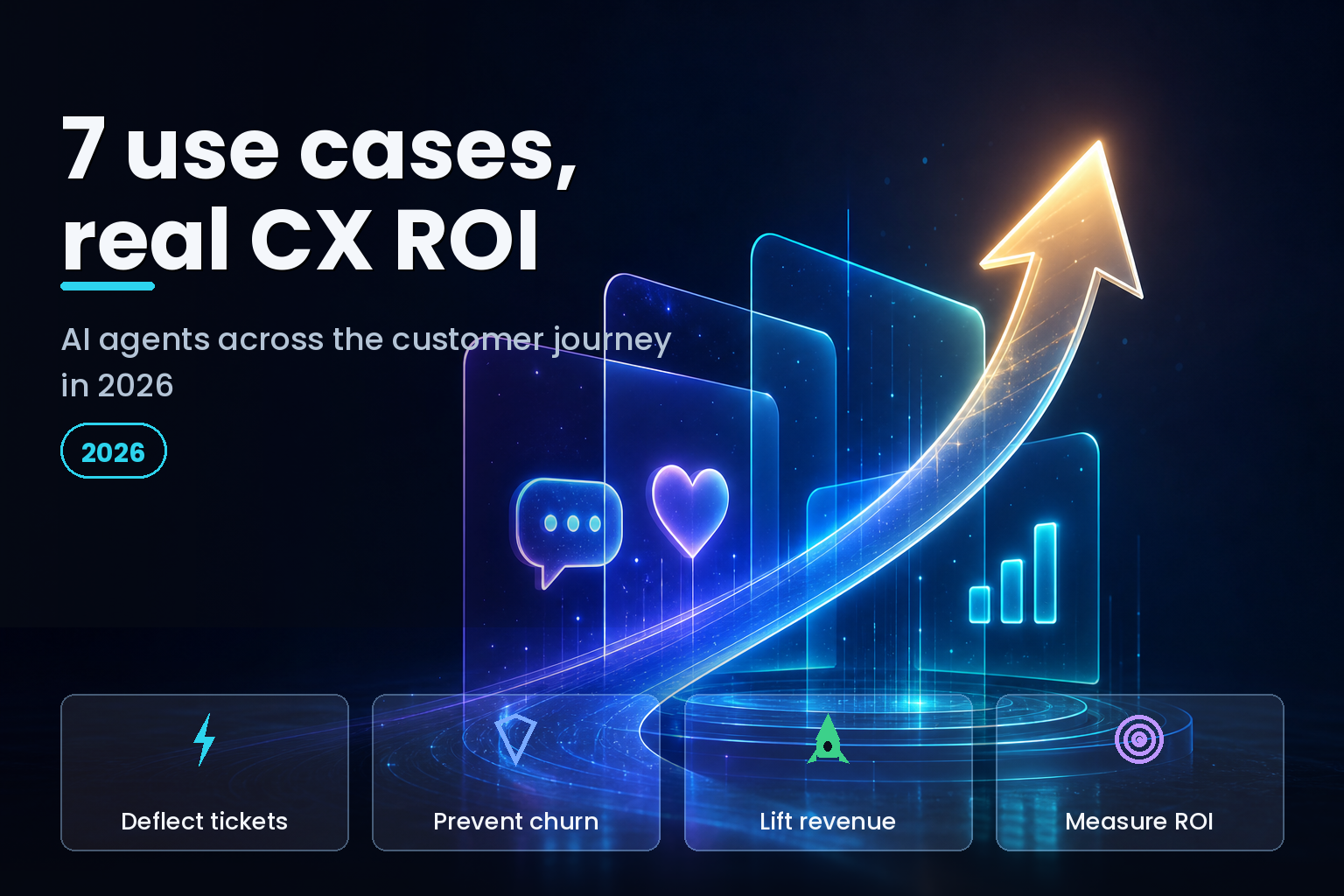
Summary. AI in customer experience finally has a return number, and a failure number to match. Companies investing in AI customer service report about $3.50 back for every $1 spent, with leaders reaching 8x, and most reach payback in three to six months on outcome-based pricing. The trajectory compounds: roughly 41% return in year one, 87% in year two, and past 124% by year three. The unit economics are stark, with a contained ticket costing roughly $0.99 to $2.00 against $6 to $12 for a human-handled one, and Gartner still expects conversational AI to remove $80 billion in contact-centre labour cost by the end of 2026. But the value is uneven. Forrester expects about a third of brands to roll out AI self-service and fail, and Gartner expects more than 40% of agentic AI projects to be cancelled by 2027. The difference is which use cases you pick and how you run them. This playbook sets out seven AI agent use cases driving real ROI across the customer journey, the benchmark for each, and where the returns break. It is the use-case companion to our guide on the conversational-agent patterns that cut support costs.
The mistake is treating AI in CX as one switch. It is a portfolio. Some use cases cut cost, some protect revenue, and some lift satisfaction, and they carry very different risk. The seven below are ordered roughly by how fast they pay back, with the return lever and the trap for each.
The ROI reality: real returns, real failures
Start with the honest version. The headline returns are real: $3.50 per $1 on average, payback in three to six months, and a year-one return near 41% that compounds past 124% by year three. So is the failure rate. Forrester principal analyst Max Ball predicts about one in three brands will push AI into self-service and fail, usually because they shipped it before it was ready under cost pressure, and Forrester adds that three of four companies that build agentic architectures entirely on their own will fail too.
The pattern behind both numbers is the same. ROI comes from picking bounded use cases, wiring them to a verified source of truth, and keeping a clean human path, while failure comes from optimising for cost alone. Klarna learned this in public: its assistant did the work of 700 agents, then the company rebuilt human support in 2025 after quality slipped, with chief executive Sebastian Siemiatkowski conceding that when cost is "a too predominant evaluation factor," what you get is "lower quality." Treat the returns below as achievable, not automatic.
Use case 1: Autonomous resolution
The fastest payback is letting AI resolve common, bounded queries end to end. Production deployments report 20% to 40% call containment and 25% to 35% lower cost per contact, and the named results back it up: Fin resolves an average of 67% of conversations across more than 7,000 customers, and a Sierra deployment at WeightWatchers reached about 70% resolution with a 4.6 out of 5 satisfaction score in its first week. The economics scale brutally well. NiCE models a contact centre handling one million interactions a month at $5 each: automating 30% saves $1.5 million a month, or $18 million a year.
The lever is a deflected ticket that never reaches a person. The trap is a confident wrong answer on a refund or a dispute. Scope it to intents you can verify, and route the rest to a human. The mechanics are covered in our guide to the conversational-agent patterns that cut support costs.
Use case 2: the agent-assist copilot
The lowest-risk return keeps a human in charge and makes them faster. An assist copilot surfaces the right knowledge, drafts the reply, and summarises history live. McKinsey reported one firm cut knowledge-lookup handle time by 65% with a copilot, and Freshworks customer Fairmoney reported a 20% faster response time and a 15% gain in customer satisfaction with its AI assist.
The lever here is throughput and quality together rather than headcount cut, which makes it the safest first deployment for sensitive or complex contacts. Because the human still owns the outcome, satisfaction holds while capacity rises, and new agents reach competence faster because the copilot encodes what a veteran already knows.
Use case 3: Intelligent triage and routing
Much of the cost in a contact centre is spent before anyone solves anything. A triage agent reads intent from the first message, gathers the account and reason for contact, checks entitlement, and routes the case to the right queue. Even when a human still resolves it, the case arrives qualified and pre-filled, so expensive minutes go to resolution rather than discovery, and misroutes and repeat transfers fall.
The lever is partial containment: the agent does not resolve the issue, but it removes a third of the handling time around it and cuts the transfers that frustrate customers. It is low risk because it decides the path, not the outcome, and it pairs naturally with the first two, feeding simple intents to autonomous resolution and complex ones to a copilot-equipped agent.
Use case 4: Proactive outreach and churn prevention
This is where AI in CX stops being a cost story and becomes a revenue one. A retention agent scores accounts on usage, support history, and engagement, flags the ones drifting toward churn, and triggers outreach before the customer leaves. Proactive outreach driven by predictive analytics cuts churn by roughly 15% to 25%; for a mid-market SaaS company at $10 million in annual recurring revenue and 7% churn, that is $105,000 to $175,000 in retained revenue a year. At scale the numbers are larger still, with Netflix attributing around $1 billion a year in saved revenue to the churn its recommender prevents.
The lever is retained revenue, which is worth far more than the cost it saves, because the classic Bain finding holds that a 5% lift in retention can raise profits by 25% to 95%. The trap is creepiness and noise: outreach that feels like surveillance, or fires too often, costs trust. Tie it to a genuine fix the customer wanted.
Use case 5: Personalization and next-best-action
A personalization agent matches each customer's history and behaviour to the most relevant offer, answer, or next step, in real time. The returns show up as cross-sell and average revenue per customer. In one digital-bank deployment, personalised recommendations doubled cross-sell uptake against generic campaigns and lifted revenue per customer, the kind of result McKinsey describes in its work on an AI-powered next best experience for every interaction.
The lever is revenue per customer and relevance, not deflection. The trap is personalisation that is wrong or intrusive, which erodes trust faster than generic messaging. Personalisation also leans hard on customer data, so it has to be built inside the privacy rules that govern that data, not bolted on around them.
Use case 6: Self-service and knowledge automation
The cheapest contact is the one never opened. A self-service agent answers the customer where they already are, in a help widget, a search box, or a status page, and keeps the knowledge base current. Deployments report 30% to 50% higher self-service adoption and a 60% to 80% reduction in time-to-answer for common intents, which deflects contacts at the source ahead of any per-resolution charge.
The lever is deflection at the lowest marginal cost of any use case, because one well-written, AI-maintained answer serves thousands of customers for the price of writing it once. The trap is hiding the path to a human. Self-service wins when it makes help easier to reach, not when it is used to wall customers off from people.
Use case 7: Voice of customer and quality automation
The last use case turns every conversation into insight. AI can summarise and score 100% of contacts for quality, rather than the 1% to 2% a human quality team can review by hand, and surface the themes driving contacts in the first place. That feeds two returns: it catches quality problems across the whole operation rather than a sample, and it tells the business which product or process failures are generating expensive contacts so they can be fixed at the root.
The lever is quality coverage and root-cause insight, which compounds because fixing the cause removes future contacts entirely. The trap is measuring everything and acting on nothing. The value is in closing the loop, routing what the analysis finds back to product and operations.
| Use case | ROI lever | Reported benchmark |
|---|---|---|
| 1. Autonomous resolution | Tickets deflected before a person | 20-40% containment; Fin 67%; NiCE $18M a year |
| 2. Agent-assist copilot | Throughput and quality together | 65% lower knowledge-lookup time (McKinsey) |
| 3. Triage and routing | Less time on discovery and transfers | Up to a third less handling time |
| 4. Proactive and churn prevention | Retained revenue | 15-25% less churn; Netflix about $1B a year |
| 5. Personalization | Revenue per customer | Cross-sell uptake doubled (digital bank) |
| 6. Self-service automation | Deflection at lowest marginal cost | 30-50% higher self-service adoption |
| 7. Voice of customer and QA | Quality coverage and root-cause insight | 100% of contacts scored vs 1-2% by hand |
The economics behind the returns
The ROI rests on a tenfold gap in unit cost. A human-assisted contact runs about $6 to $12, and a contained AI interaction costs roughly $0.99 to $2.00. The global market for AI customer service is forecast near $15.12 billion in 2026, growing about 25% a year, which is the spend chasing that gap.
| Channel | Cost per contact | Source |
|---|---|---|
| Human-assisted contact | $6 to $12 | Industry benchmarks 2026 |
| Contained AI interaction | $0.99 to $2.00 | Industry benchmarks 2026 |
| Fin (per resolution) | $0.99 | Fin |
The number that decides ROI is not the rate. It is the containment: a model billed per resolution at $0.99 is a saving only if it actually resolves. A model that charges per conversation and still escalates half its cases can cost more than the agents it replaced.
Where the ROI breaks
The returns assume quality holds, and that is exactly where rushed deployments fail. Pure-AI handling lands around 4.1 out of 5 on satisfaction against 4.3 for human agents, but a well-designed hybrid that escalates cleanly narrows that gap to about 0.05 points. The failures cluster in disputes, fraud, hardship, and any vulnerable-customer situation, where a wrong automated answer is expensive in trust and sometimes in law.
The discipline that protects ROI is the same across all seven use cases: pick bounded problems, wire the agent to a verified source of truth, keep an easy human path, and measure quality next to cost. Forrester's warning that a third of self-service rollouts will fail, and Gartner's that 40% of agentic projects will be cancelled, are both about teams that automated for cost and ignored quality. The governance that keeps a fleet of these agents safe is covered in our guide to governing the AI agents in the average company.
What it means for India
India runs roughly 40% of the world's outsourced customer experience work, so these use cases reshape a core national industry rather than a niche. The cost-cutting use cases, autonomous resolution and self-service, automate exactly the routine voice and chat work that Indian operations have historically delivered, which is why leading providers are moving up the value chain into building, governing, and supervising the agents and handling the complex contacts they route out.
The revenue use cases travel differently. Personalization and churn prevention depend on customer data, so any Indian deployment falls under the Digital Personal Data Protection Rules notified on 13 November 2025, with their consent, security, and 72-hour breach-notification duties. A retention agent that scores customers on their behaviour is processing personal data, and it has to be built inside those rules. The practical rule for Indian CX leaders is to sequence by risk: start with agent assist and self-service for fast, low-risk ROI, then add the revenue use cases with the data governance in place from day one.
FAQ
How eCorpIT can help
eCorpIT is a CMMI Level 5 technology organisation in Gurugram whose senior engineering teams design and integrate AI agents across the customer journey, from autonomous resolution and agent assist to churn prevention and personalization. We help CX leaders pick the use cases that fit their volume and risk, wire them to a verified source of truth, keep a clean human path, and measure quality and retention alongside cost, with the data governance to match. You can read more about eCorpIT and its director Manu Shukla. To scope an AI customer-experience project, contact our team.
References
_Last updated: 21 June 2026._