On this page · 11 sections
- The enterprise AI maturity picture in 2026
- The five-stage enterprise AI maturity model
- The three architectural choices: RAG, fine-tuning, agents
- The build-vs-buy decision
- Governance: the part that breaks enterprises in 2026
- ROI measurement that the CFO will accept
- A 90-day enterprise AI strategy sprint
- India-specific considerations
- FAQ
- How eCorpIT can help
- References
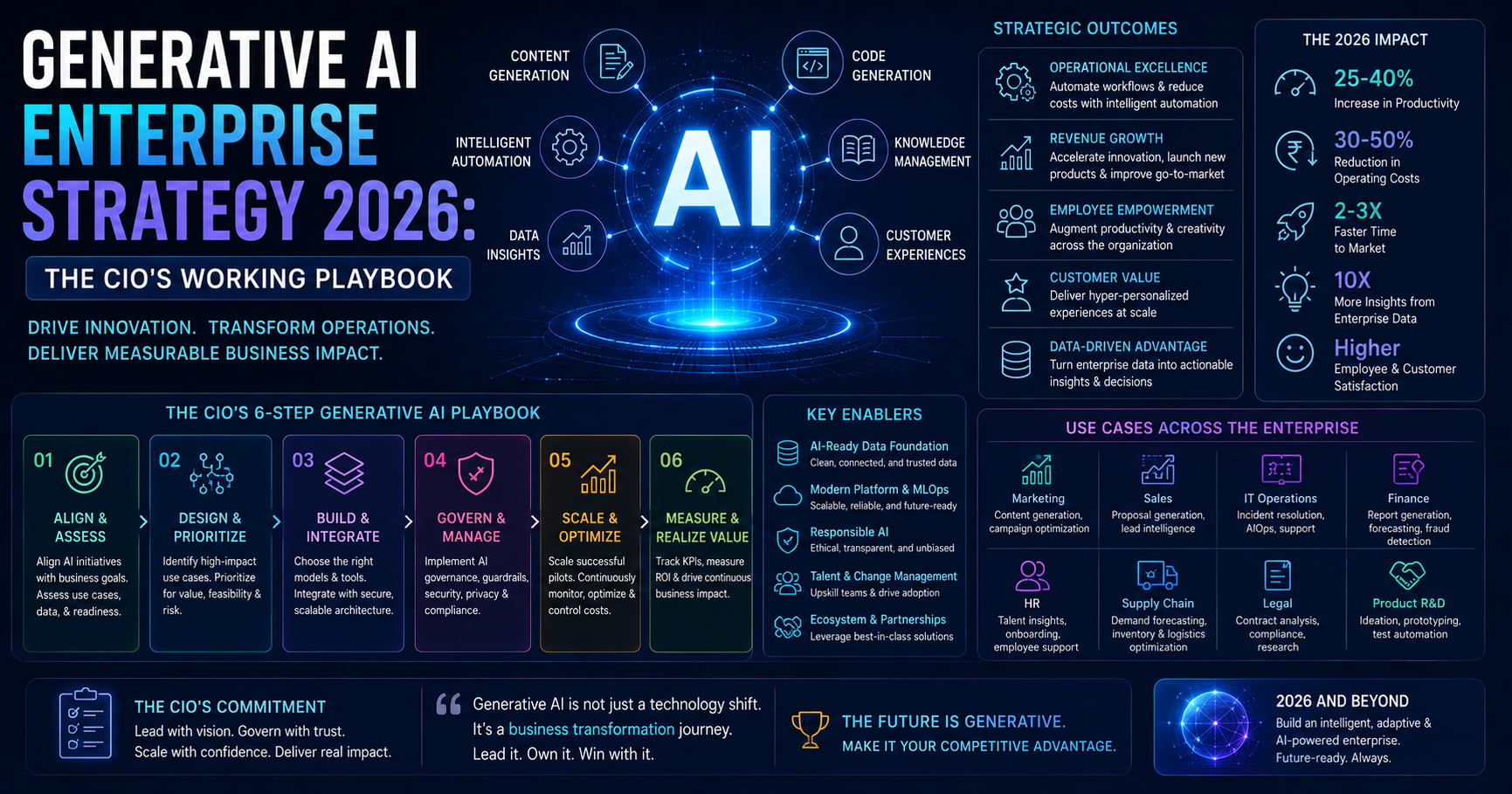
Summary. In 2026, 90-99% of enterprises are using generative AI in some capacity, but only about 1% consider themselves AI-mature, and only 39% report measurable EBIT impact, according to McKinsey's most recent State of AI research. The gap between adoption and impact is the entire story of generative AI strategy this year. This guide is for the CIOs, CTOs, Heads of AI and product leaders responsible for closing that gap — covering the maturity model, the build-vs-buy decision, RAG vs fine-tuning vs agentic architectures, governance, ROI measurement, and what shipping looks like in India, the United States and the United Kingdom.
The fastest way to misread the current moment is to treat generative AI as a feature you bolt on. It is not. It is an architectural change that compounds across every product, every operational workflow and every internal function. Companies that treat 2026 as the year to formalise their AI strategy — not the year to keep piloting — will reach 2028 with structural advantages their competitors cannot copy quickly.
This article surveys what good looks like in 2026: how to think about maturity, how to choose between architectures, how to govern what you ship, and how to actually measure return. The reference points are McKinsey, Gartner, Deloitte and Bain research from the past 18 months, alongside operational patterns observed in enterprise deployments across India, the US and the UK.
The enterprise AI maturity picture in 2026
Three numbers frame the strategy question.
McKinsey's State of AI research finds that nearly 90-99% of organisations use AI in some capacity, that more than two-thirds use it in multiple functions, and that half use it in three or more functions. Yet only about 1% of enterprises describe themselves as AI-mature, and just 39% report measurable EBIT impact from their AI work. The capability is widespread; the operational scale and the financial impact are not.
Gartner's 2026 predictions say more than 80% of enterprises will have generative AI APIs and models running in production by end-2026, and up to 40% of enterprise applications will embed task-specific AI agents — up from less than 5% in 2025. Over 60% of enterprise apps will use embedded generative AI to augment workflows.
Deloitte's State of AI in the Enterprise reports that worker access to AI tools rose 50% in 2025, that companies with 40% or more of AI projects in production are expected to double within six months, and that the AI skills gap remains the largest barrier to integration.
The composite picture: experimentation is mature; production is rapidly catching up; mature, financially-impactful deployment remains rare. The opportunity for any enterprise that gets the strategy right in 2026 is to move from the experimentation cohort into the production cohort while most peers are still piloting.
The five-stage enterprise AI maturity model
Most enterprise AI work falls into one of five stages. Honest assessment of where you actually are saves months of wasted effort.
Stage 1 — Tooling. Employees use ChatGPT, Claude, Gemini or Copilot for personal productivity. There is no enterprise-level commitment, no controlled data flow, no measured impact. Most large enterprises are here for some functions even when they have shipped polished AI in others.
Stage 2 — Point solutions. Specific teams have shipped specific AI features — a customer support assistant, a marketing copy generator, a sales-call summariser, a developer copilot. Each works. None talks to the others. ROI is anecdotal.
Stage 3 — Integrated workflows. AI is wired into core processes that span teams. A customer enquiry can travel from chatbot to ticket to engineering, with AI helping at every step. Retrieval, governance and observability are in place. ROI starts being measured at the workflow level.
Stage 4 — Operating model transformation. AI is part of how the business runs. Process design, headcount planning, capital allocation and product strategy all assume AI capability. Governance is institutional. The CFO can see the financial impact in the P&L.
Stage 5 — Differentiated capability. The business does things competitors cannot, because its proprietary data, its workflow design and its AI capability compound. This is the level McKinsey's "1% mature" descriptor refers to. Very few enterprises are here in 2026.
The honest place to start is stage two for most enterprises, with one or two functions at stage three. Strategy work in 2026 is about climbing this ladder deliberately rather than skipping rungs.
The three architectural choices: RAG, fine-tuning, agents
The single most common strategic confusion in enterprise AI right now is which architectural pattern to use for which problem. The answer in 2026 is hybrid, but the components have to be chosen deliberately.
Retrieval-Augmented Generation (RAG) combines a base model with a system that retrieves relevant documents from your data and passes them to the model as context. RAG suits cases where the model needs current, specific or proprietary information — internal documentation, customer records, knowledge base content, product manuals. RAG implementations typically take 4–8 weeks for a first version. The main advantages are speed of update (change a document, the model sees it immediately), lower hallucination rates, and clear control. The trade-off is that RAG quality depends heavily on retrieval quality, which is its own engineering discipline.
Fine-tuning customises a base model on your specific data so it produces outputs in your tone, format and style. Fine-tuning suits cases where the model needs to behave consistently — generate documents in a specific format, respond in a specific voice, classify into specific categories. Fine-tuning implementations typically take 8–16 weeks. The main advantage is consistent behaviour without long prompts. The trade-off is that fine-tuning is brittle: your data has to be high quality, your evaluation has to be rigorous, and the model needs re-training as your needs evolve.
Agentic AI combines models with tools, memory and reasoning to take autonomous multi-step actions. Agents suit cases where the workflow involves multiple steps, multiple systems, or multi-system reasoning — a procurement agent that pulls quotes from vendor systems and recommends a purchase, a support agent that diagnoses an issue and triggers a fix. Agent implementations typically take 12–24 weeks for production-grade systems. The main advantage is workflow compression: tasks that previously took hours collapse into minutes. The trade-off is governance complexity, which we cover below.
In 2026, the standard enterprise architecture is hybrid: fine-tuned models for domain understanding and output format, RAG for current and proprietary knowledge, agentic patterns for multi-step workflows. None of these is the right answer alone. The strategy question is which combination fits which use case.
The build-vs-buy decision
A practical rule from the last three years of deployments: the build-vs-buy breakpoint sits at about three dedicated machine learning engineers. Below that, buy. Above that, build selectively.
Buy when: the use case is generic (customer support, sales productivity, marketing copy, developer assistance), commercial vendors already have a mature product, the data sensitivity allows third-party processing, and the cost of an enterprise licence is well below what an internal build would cost.
Build when: the use case touches proprietary data that cannot leave your environment, the workflow is specific enough that no commercial vendor matches it, the data quality and volume are sufficient to support customisation, and the business has the engineering depth to maintain it. Even within "build," the right call is usually to build on top of an open-source model (Llama, Mistral, Qwen, Gemma) or a commercial API rather than train from scratch.
Hybrid is increasingly common. A typical enterprise architecture in 2026 has commercial APIs for most coding and copy work, fine-tuned open-source models for specific business processes, and bespoke agentic systems for workflow automation that touches proprietary data.
A cost note worth remembering. McKinsey research finds that custom-built models tend to drive the largest ROI gains, but the operational cost of running them at scale is substantial. A roughly $10 fine-tuning experiment to add a domain-specific skill to a small model often outperforms paying $1–3 per thousand tokens to a commercial API in perpetuity — but only if you have the engineering capability to operate the result reliably.
Governance: the part that breaks enterprises in 2026
Only about 12% of enterprises had mature AI governance processes in place at the start of 2026, according to research from HFS and Infosys. Most enterprises are deploying agentic AI faster than they can govern it. This is the central operational risk of the year.
Three governance failures are showing up in production systems.
Shadow agents. AI agents enter the enterprise through multiple channels — new application development, updates to existing SaaS tools, standalone agent deployments by individual teams. Many never go through proper review. The result is an unknown number of autonomous systems acting on behalf of the enterprise without the security, compliance and observability that production systems require.
Unclear accountability. When an agent makes a decision that produces a poor outcome, who is responsible? The vendor whose model was used? The team that deployed the agent? The business owner of the workflow? Most enterprises do not have a clear answer, which means they cannot run the post-incident review process that mature engineering practice requires.
Inadequate observability. Most agents are running in production without the logging, metric collection and trace infrastructure that gives engineering teams visibility into what the agent is actually doing. The result is that when things go wrong, root-cause analysis becomes guesswork.
What good governance looks like in 2026:
- A cross-functional Agentic Governance Council (CIO, CTO, Head of AI, Chief Information Security Officer, Legal, Compliance, Business Unit Heads) that meets monthly, reports to the board quarterly, and holds decision rights over agent deployment, modification and retirement.
- A mandatory agent registration process that catalogues every AI agent operating in the enterprise, with details of what data it accesses, what actions it can take and who owns it.
- A standard observability and audit trail for every production agent — including prompt logging, retrieval logging, tool-call logging and outcome tracking.
- Clear policies for data minimisation, lawful processing and transparency that align with GDPR, India's DPDP, US sectoral regulations and the Singapore Model AI Governance Framework for Agentic AI launched in January 2026.
Enterprises that solve governance in 2026 will be the ones that deploy at scale in 2027. Enterprises that defer it will be the ones that experience public incidents that delay their AI programs by 6–12 months.
ROI measurement that the CFO will accept
The most common AI ROI failure in 2026 is reporting productivity gains the finance function cannot link to the P&L. "Our developers are 55% faster" is not a CFO-acceptable answer. The CFO needs to see one of three categories of impact.
Revenue uplift. AI-assisted sales reports an average 12% revenue lift across deployed accounts, per industry research summarised at UC Today. Measure this as deal velocity, conversion rate or average deal size — not as "AI helped."
Cost reduction. AI-augmented customer service reports 37% faster response times, with cost-per-interaction dropping by roughly 12x compared to human-handled tickets. Measure this as cost per ticket, total support headcount or cost per customer served — not as "tickets resolved faster."
Capital efficiency. AI-augmented engineering reports an average 40% productivity gain on knowledge work tasks, including 55% reduction in coding time. Measure this as features shipped per engineer per quarter, time-to-market for releases, or cost per shipped feature — not as "engineers report saving 2.2 hours per week."
The discipline is to commit to a measurement plan before deploying. Define the baseline, define the metric, define the timeframe, and pre-commit to whether the investment continues or stops based on the result. Most enterprise AI investments fail not because the technology did not work but because the measurement was vague enough that the result was inconclusive.
A 90-day enterprise AI strategy sprint
For CIOs and CTOs who want to move their organisation from stage two to stage three in 2026, here is a 90-day sprint pattern that has worked across several enterprise deployments.
Weeks 1–3 — Diagnose. Audit existing AI use across the enterprise. Catalogue every tool, every model and every agent in operation. Identify the three workflows where AI could produce the largest financial impact. Pick one for the sprint.
Weeks 4–6 — Design. Architect the chosen workflow as a hybrid RAG plus fine-tuning plus agent system. Define the data sources, the model choice, the agent boundary and the human-in-the-loop checkpoints. Set the measurement plan with the CFO.
Weeks 7–10 — Build. Ship the workflow into a controlled pilot environment with real data and real users. Instrument every step. Run for two weeks, learn, iterate.
Weeks 11–13 — Productionise. Roll out to a broader population, with the governance framework in place: registration, observability, audit trail, policy alignment. Begin reporting to the executive team and the board on the financial metric, not the activity metric.
The output of a successful 90-day sprint is one shipped workflow with measurable impact, a governance template you can apply to subsequent workflows, and credibility to invest in stage three across other functions.
India-specific considerations
For Indian enterprises, three additional factors shape the 2026 strategy decision.
Data residency and DPDP. India's Digital Personal Data Protection Act (DPDP) places requirements on how Indian personal data is processed. Enterprises operating in India should design their AI architecture so that Indian personal data stays inside Indian processing boundaries unless explicit consent and contractual safeguards are in place. This favours hybrid architectures where sensitive retrieval and reasoning happen inside Indian-residency cloud regions, and only non-sensitive operations call out to global model APIs.
Cost optimisation under rupee economics. Indian enterprise IT budgets typically run tighter than US or European equivalents. Open-source model deployment on Indian-residency GPU capacity (AWS, Azure, GCP, Yotta, Tata Communications, E2E Networks) is often more economical than perpetual commercial API spend once usage crosses a few million tokens per day. Indian enterprises should model the cost crossover explicitly.
Talent supply is favourable. India's machine learning talent pool is large and well-distributed across Bengaluru, Hyderabad, Delhi NCR, Pune and Chennai. The build-vs-buy breakpoint shifts toward "build" for Indian enterprises with engineering depth, because the cost of three ML engineers is materially lower than in the US or UK.
FAQ
How eCorpIT can help
eCorpIT builds enterprise generative AI systems for clients across India, the United States and the United Kingdom. Our work covers strategy facilitation, architecture design, model selection, RAG and fine-tuning, agentic workflow design, governance setup and production deployment. We work with founders, CIOs, CTOs and Heads of AI at growth-stage companies, mid-market enterprises and global brands.
If you are running an enterprise AI strategy review in 2026 — or you are ready to move from pilots into production with a 90-day sprint — our team can help. Reach us at ecorpit.com/contact-us/ or contact@ecorpit.com.
References
- McKinsey — "The state of AI in 2025: Agents, innovation, and transformation": mckinsey.com
- Gartner — "Strategic Predictions for 2026": gartner.com
- Gartner — "40% of Enterprise Apps Will Feature Task-Specific AI Agents by 2026": gartner.com
- Deloitte — "The State of AI in the Enterprise — 2026 AI report": deloitte.com
- Techment — "RAG vs Fine-Tuning vs AI Agents: Choosing the Right LLM Strategy": techment.com
- UC Today — "What Do the Best AI Productivity Reports Reveal in 2026?": uctoday.com
- Arthur AI — "How to Build an AI Governance Framework: 10-Step Guide [2026]": arthur.ai
- Cyberhaven — "How to Build an Agentic AI Governance Framework": cyberhaven.com
- Atlan — "Enterprise RAG Platforms Comparison 2026": atlan.com
- eCorpIT — AEO/GEO/SEO Complete Guide: ecorpit.com
Last updated 8 June 2026 by the eCorpIT Editorial team. We will refresh this article in December 2026 with year-end research from McKinsey, Gartner and Deloitte.