On this page · 8 sections
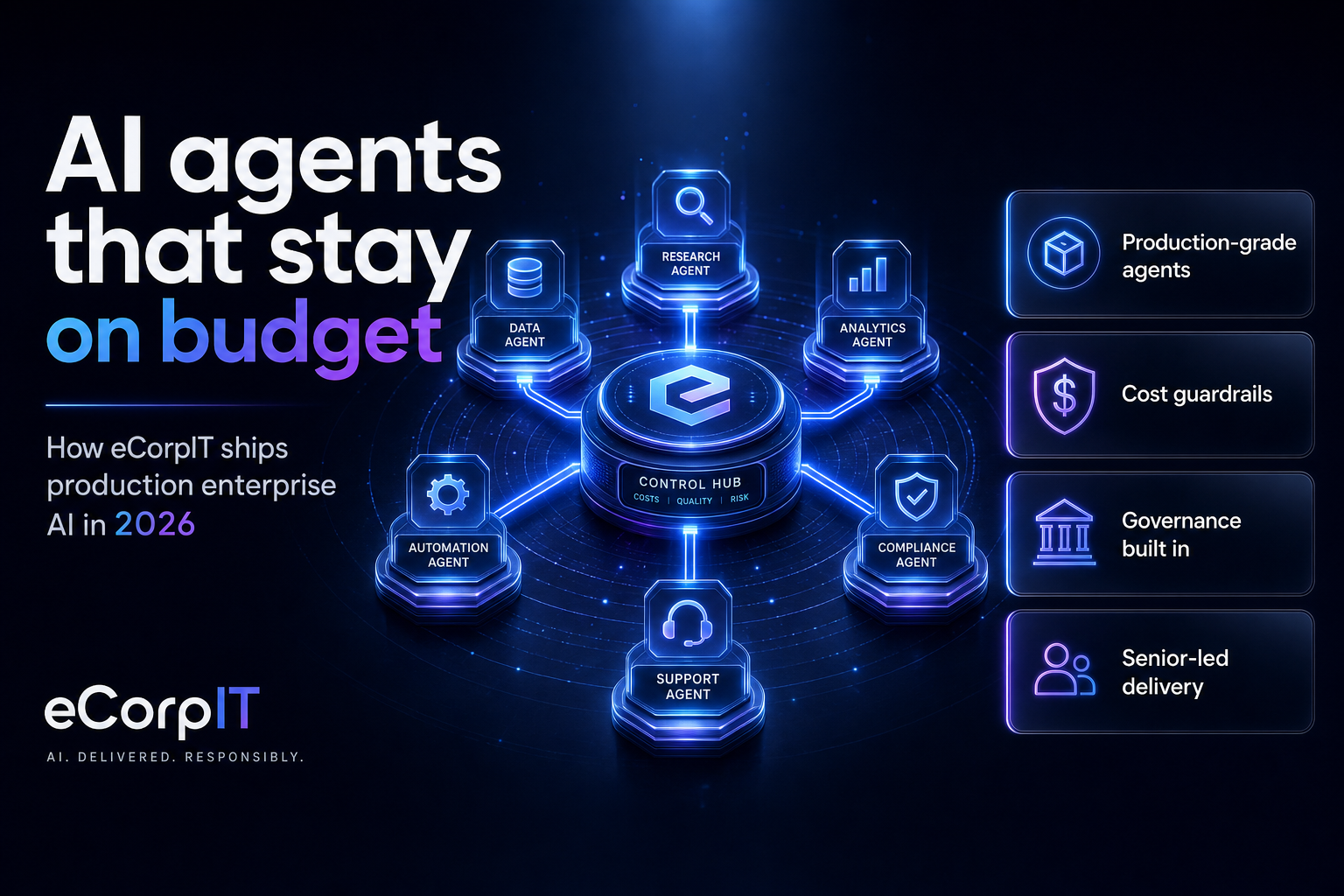
Summary. Enterprise AI agents work when they reach production, and most do not. Across 2026 research, the majority of agent pilots never make it live, with estimates from 78 to 95 percent depending on the study, and Gartner expects over 40 percent of agentic AI projects to be cancelled by the end of 2027. The causes are rarely the model. Forrester tied 41 percent of failures to unclear success criteria, 33 percent to insufficient tool or data access, and 26 percent to evaluation drift. Meanwhile the economics are real: a contained customer-service ticket resolved by an agent costs about $0.46 against $4.18 for a human, and knowledge workers recover a median 6.4 hours per week. eCorpIT, a Gurugram-based, CMMI Level 5 consultancy founded in 2021, builds the missing production layer: evaluations, cost guardrails, governance and ownership. Here is how.
The 2026 reality: agents everywhere, most pilots dead
Agents are being embedded fast. Roughly 80 percent of enterprise applications shipped or updated in the first quarter of 2026 include at least one AI agent, up from 33 percent in 2024, yet only about a third of enterprises have one in production, led by banking and insurance at 47 percent. The gap between building and shipping is the whole story. Gartner attributes the coming wave of cancellations to three things: escalating costs, unclear business value, and inadequate risk controls. None of those is a model problem, which is why buying a better model does not fix them. Our enterprise AI agent production use cases show where agents earn their keep.
Why agents fail, and what actually fixes it
The failure modes are consistent and, importantly, fixable with engineering discipline rather than a bigger model.
| Failure driver | Share of failures | What eCorpIT builds to fix it |
|---|---|---|
| Unclear success criteria | 41 percent | A metric and evaluation harness before any build |
| Insufficient tool or data access | 33 percent | Integration and data-access design up front |
| Evaluation drift | 26 percent | Continuous evals and monitoring in production |
| Runaway token cost | Cited by Gartner | Routing, caching and budget guardrails |
| No production owner | Common | A defined ownership and handover model |
The pattern is that these are operational gaps, not intelligence gaps. An agent that loops without a cost ceiling, or ships without a definition of success, will fail regardless of which model sits underneath it.
What "on budget" actually requires
Cost is where good agents quietly go bad. Consumption pricing means spend scales with agent activity, and agent loops multiply model calls per task, so per-engineer spend on agentic tools already runs $500 to $2,000 a month and Gartner expects AI coding spend to pass the average developer salary by 2028. We design against that from day one. The levers are the same ones we cover in our GPT-5.6 inference cost analysis: route easy calls to a cheaper tier, cache stable context, batch non-interactive work, and cap spend per task. A production agent should have a budget the way any other system has a resource limit.
| Metric | 2026 figure | What it means for you |
|---|---|---|
| Contained ticket cost (agent vs human) | $0.46 vs $4.18 | Roughly 9x cheaper when it works |
| Median time-to-value | 5.1 months | Budget for a quarter or two, not a week |
| Payback within 12 months | 41 percent of deployments | Set success criteria to land inside that window |
| Time recovered per knowledge worker | 6.4 hours per week | The value case is labour, not novelty |
| Projects cancelled by 2027 (Gartner) | Over 40 percent | Governance is the difference, not the model |
How eCorpIT builds it
Our senior engineering teams work in a fixed sequence, because the order is what keeps projects alive. We start with the metric: what does success look like, and how will we measure it, before writing agent code. We build an evaluation harness on your real traffic, design tool and data access explicitly, and add a cost layer with routing, caching and per-task budgets. We wire in monitoring and continuous evaluation so drift is caught early, and we hand over with a named owner and a runbook rather than a demo. We design systems aligned with governance and data-protection requirements rather than claiming certification. Our AI agent governance layers guide describes the control model we implement.
India-specific considerations
For Indian enterprises, the same discipline applies with a data-protection overlay. Agent access to customer data brings the Digital Personal Data Protection Act, 2023 into scope, so we design consent, least-privilege data access and logging into the agent from the start. The rupee cost of a runaway agent loop is as real as any cloud bill, so budget guardrails are not optional. For the wider planning frame, see our enterprise AI strategy guide.
FAQ
How eCorpIT can help
eCorpIT is a Gurugram-based, CMMI Level 5 and MSME-certified consultancy, and an AWS, Microsoft and Google partner, founded in 2021. Our senior engineering teams build enterprise AI agents that reach production and stay on budget: evaluation harnesses, cost guardrails, governance and a clear ownership handover. If you want an agent that ships rather than a pilot that stalls, talk to our team.
References
- AI agent adoption 2026: 120+ enterprise data points - Digital Applied.
- Why 78% of AI agent pilots never reach production - Zen van Riel.
- 89% of AI agent pilots never scale: Gartner and IDC 2026 data - The Daily Brief.
- Enterprise AI statistics 2026: ROI, AI agents and spending - The AI Index.
_Last updated: July 10, 2026._