On this page · 8 sections
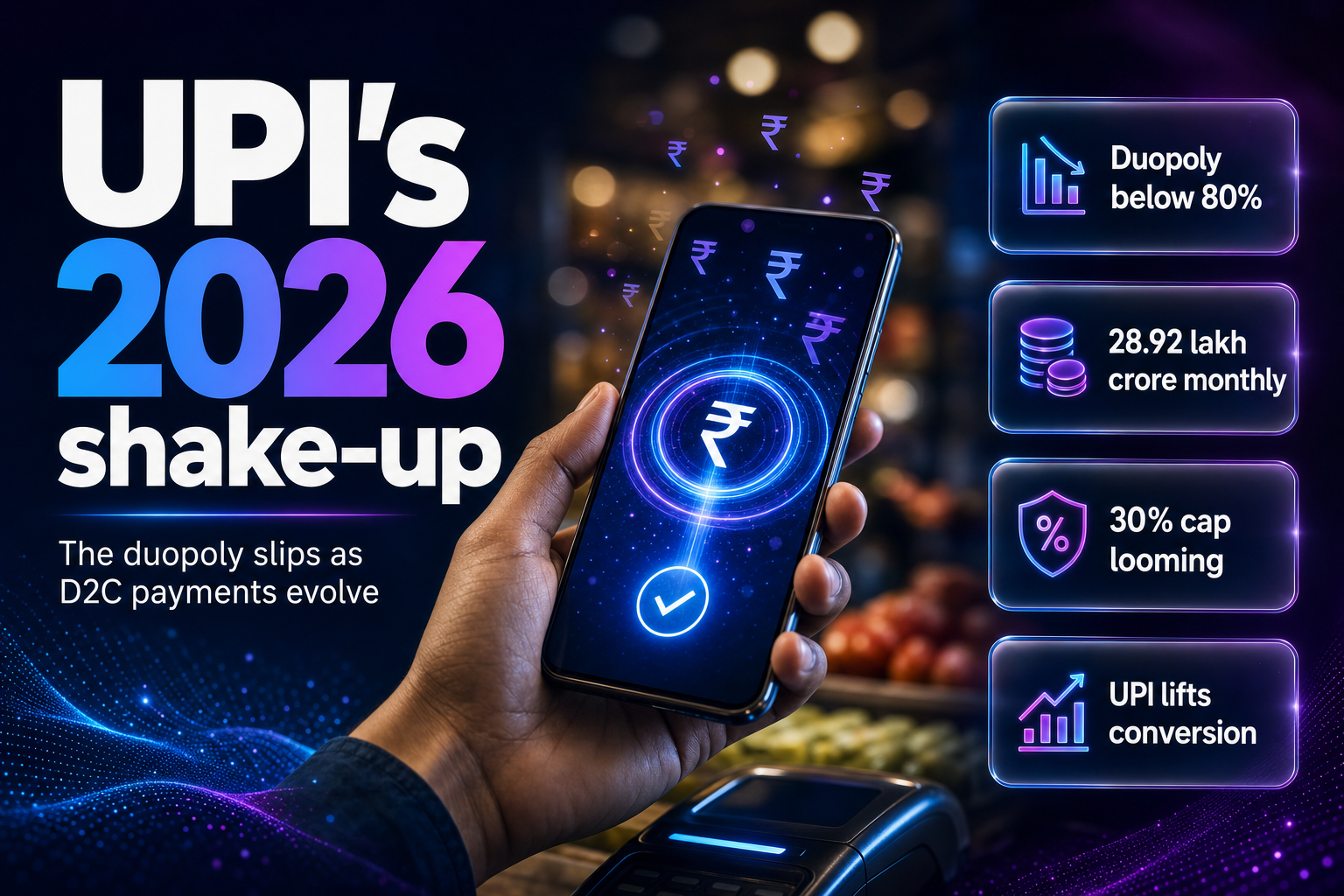
Summary. India's UPI rail is both bigger and less concentrated than it was a year ago, and both facts matter for direct-to-consumer brands. In June 2026, UPI processed 22.72 billion transactions worth ₹28.92 lakh crore, about 757 million payments a day, with volume up 23% year over year. At the same time, the duopoly cracked: in May 2026 the combined UPI share of PhonePe and Google Pay fell below 80% for the first time, to roughly 79%, with PhonePe near 46.2% and Google Pay near 32.7%. Newer apps such as Navi and Flipkart's super.money have taken a combined 5.5%. NPCI's 30% per-app cap is now due on 31 December 2026, and a policy fight over merchant fees is live. For a D2C founder, the practical questions are where customers now pay, what it costs, and how to keep checkout converting. This analysis answers those.
The one-line takeaway: accept UPI through a gateway rather than betting on any single app, keep your payment mix cheap by leaning on bank-funded UPI, and plan for a possible return of merchant fees on large sellers.
The market got bigger, then less concentrated
Scale first. UPI processed ₹28.92 lakh crore in June 2026 across 22.72 billion transactions, with an average of roughly ₹96,405 crore moving every day. Growth stayed strong year over year even as both volume and value dipped slightly from May, when UPI first crossed 23 billion monthly transactions. The table shows the month at a glance.
| Metric | June 2026 | Change |
|---|---|---|
| Transactions | 22.72 billion | +23% year over year |
| Value | ₹28.92 lakh crore | +20% year over year |
| Daily transactions | ~757 million | Down 2.1% from May |
| Daily value | ~₹96,405 crore | Down 3.3% from May |
| May 2026 peak | 23.20 billion | First time above 23 billion |
The more interesting story is concentration. For years, two apps owned nearly the entire rail. That is finally loosening. Outlook Business reported that PhonePe and Google Pay's combined share slipped below 80% in May 2026, the first time it has done so. The gap is being filled slowly by challengers, with Navi and super.money taking a combined 5.5% since launching about two years ago.
Why the 30% cap looms over all of this
The diversification is not only organic. NPCI wants no single app to handle more than 30% of UPI volume, a rule meant to limit concentration risk on critical payments infrastructure. After repeated delays, that cap is now scheduled for 31 December 2026. The problem is arithmetic: the two leaders are far above the line.
| App | May 2026 share | Versus 30% cap |
|---|---|---|
| PhonePe | ~46.2% | Well above |
| Google Pay | ~32.7% | Above |
| Navi and super.money | ~5.5% combined | Below |
| Other apps | Remainder | Below |
| Cap deadline | 31 December 2026 | Enforcement pending |
If enforced as written, the cap would push volume away from the leaders toward smaller apps, which is exactly the kind of shift that breaks a checkout wired to one provider. Whether NPCI enforces on schedule or delays again, the direction is clear: your customers will spread across more apps over time. Building for that now is cheaper than reacting later. Our ONDC and D2C scale playbook covers the wider India commerce shift this sits inside.
What UPI actually costs a D2C brand
Here is where founders lose or protect margin. In 2026, standard person-to-merchant UPI debited from a bank account still carries zero MDR, which is why UPI is the cheapest mainstream rail in India. But not every UPI flow is free, and the exceptions are where costs creep in.
| Payment rail | MDR or interchange | Applies when |
|---|---|---|
| Bank-funded UPI (P2M) | 0% | Standard UPI from a bank account |
| Wallet-funded UPI (PPI) | 1.1% interchange | On amounts above ₹2,000 |
| RuPay credit-on-UPI | 1.1% to 2% | Above ₹2,000, from June 2026 |
| Cards | Up to ~2% | Credit and debit card orders |
| Proposed large-merchant MDR | ~0.30% | If policy changes; not yet law |
The Razorpay breakdown of UPI MDR shows how the blend works in practice. If 60% of your orders are bank-funded UPI at zero MDR and 40% are cards at about 2%, your blended effective rate lands near 0.8%. Shift more volume to bank-funded UPI and the number falls. This is a real lever: nudging customers toward the cheapest rail at checkout directly protects contribution margin, especially for low-ticket, high-frequency D2C categories.
The merchant-fee fight you should plan for
Zero MDR is a policy choice, not a law of nature, and it is under review. A Parliamentary Standing Committee report in March 2026 recommended reintroducing MDR on large merchants, and the Payments Council of India has pushed for a 0.30% rate on large-merchant UPI and RuPay debit transactions to make the free-payments model sustainable. No binding RBI or CBDT notification has followed, so nothing has changed yet.
For a D2C brand, the honest planning stance is to treat zero MDR as a benefit you enjoy today, not one to build permanent unit economics around. Model a scenario where large-merchant UPI carries 0.30%, see what it does to your margins at scale, and keep your payment mix diversified so a single fee change does not blindside you. Small merchants are likely to stay exempt, so the risk is concentrated at the top of the size curve.
Turn payments into a growth lever, not just plumbing
The strategic point that gets missed: payments are a conversion surface, not a back-office cost. Offering UPI-based flexibility at checkout has lifted conversion by 20% to 30% and raised average order values by 30% to 40% for some D2C brands, because UPI is fast, familiar, and cheap for Indian buyers. That is a marketing-grade result from a payments decision.
Three moves follow from everything above. Accept UPI through a payment gateway rather than a single app's intent flow, so you keep working as market shares shift and the 30% cap bites. Design checkout to favor bank-funded UPI, which keeps your blended MDR low. And treat UPI's growing international acceptance across several markets as a genuine option for NRI and cross-border customers. For teams building or rebuilding the storefront itself, our guide to D2C mobile app development and the quick-commerce and ONDC playbook cover the surrounding stack.
FAQ
How eCorpIT can help
eCorpIT is a Gurugram-based technology organization, founded in 2021 and assessed at CMMI Level 5, and a Shopify partner. Our senior-led teams build D2C storefronts and apps with UPI-first checkout, gateway-based payment routing, and analytics that show your real blended MDR. If you want a checkout that converts and stays cheap as UPI's market shifts, talk to our commerce team about a payments and conversion review.
References
_Last updated: 12 July 2026._