On this page · 12 sections
- Why D2C mobile is different
- The D2C mobile stack in 2026
- D2C cost ranges
- The payment stack architecture
- The loyalty and retention mechanics that work
- Brand consistency: cross-platform or native?
- The D2C-specific compliance overlay
- Where eCorpIT's D2C engagement starts
- Frequently asked questions
- A short closing note
- Further reading
- References
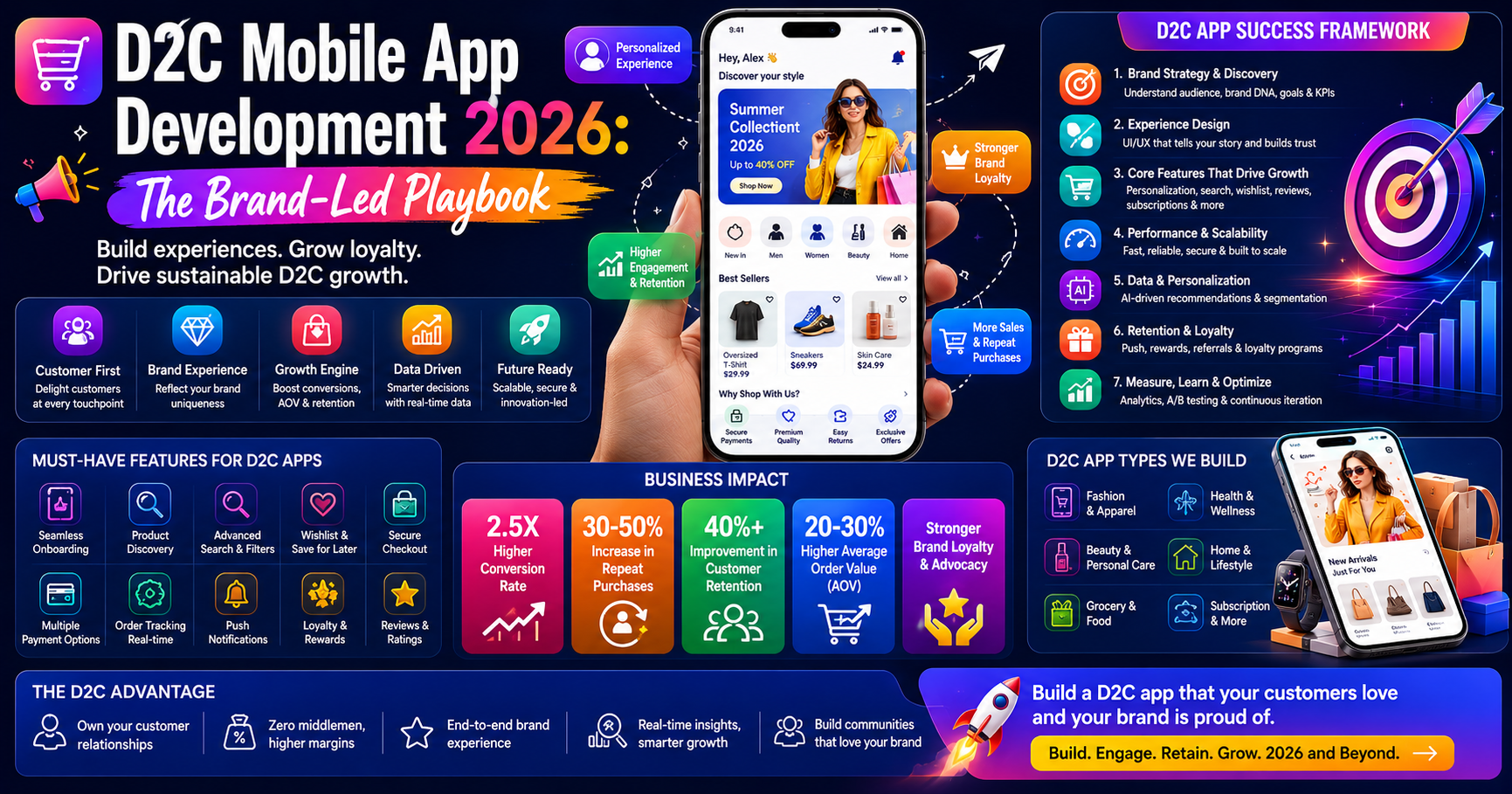
Summary. D2C mobile development in 2026 is a brand-and-economics discipline. The app exists to lift average order value, increase repeat purchase rate, and create a direct customer relationship outside Meta and Google ad spend. The right D2C mobile stack is cross-platform (Flutter or React Native default), payment-stack-comprehensive (Stripe + Apple Pay + Google Pay + regional PSP), loyalty-and-push-driven, AOV-optimised, and retention-disciplined. This guide gives you the brand-led playbook, the payment-stack architecture, and the cost ranges through eCorpIT versus US agencies.
Talk to eCorpIT about your D2C build · Open the cost calculator
Why D2C mobile is different
Three structural realities that shape D2C mobile differently from B2B or enterprise builds.
The app's job is economic, not operational. D2C apps exist to increase AOV, increase repeat rate, and reduce customer acquisition cost over time. The success metric is contribution margin per user, not "did we ship the feature."
Brand consistency is the differentiator. D2C brands compete on aesthetic, voice, and customer experience. The app's design and motion language are the brand. Cross-platform pixel-identical rendering matters more than platform-native feel.
Customer relationship discipline is the moat. D2C brands that capture the direct relationship (mobile app, owned email, SMS, loyalty) survive Meta CPM inflation. Brands that depend on Meta and Google ad spend die in the next cycle.
These three realities push D2C builds toward: cross-platform (Flutter or React Native) for brand consistency and one-team economics, comprehensive payment stack for friction-free checkout, loyalty and push for retention, and analytics discipline so the contribution-margin math is visible.
The D2C mobile stack in 2026
Five components that define a competent D2C mobile build.
Cross-platform engineering layer. Flutter or React Native for most builds. Flutter wins on pixel-identical rendering across iOS and Android, which matters for brand consistency. React Native wins when you already have a React web team and want shared business logic. Both ship to App Store and Play Store from one codebase.
Comprehensive payment stack. Stripe Elements for card payments. Apple Pay and Google Pay for friction-free checkout. Regional PSP (Razorpay for India, Adyen for Europe, Worldpay for UK) where transaction economics demand. BNPL integrations (Klarna, Affirm, Simpl) where category-appropriate. Wallet integrations for repeat-customer convenience.
Loyalty and push notification system. Tier-based loyalty (silver / gold / platinum), points-based rewards, referral mechanics, segmented push notifications. Tools: LoyaltyLion, Smile.io, Yotpo, or custom integration depending on scale.
Analytics and contribution-margin tracking. GA4, Mixpanel, Amplitude for behavior. Customer-level contribution-margin tracking through CRM (Klaviyo, Bloomreach, custom). The data architecture supports unit-economics analysis, not just vanity metrics.
Retention discipline. Subscription mechanics, replenishment cadence, abandoned-cart recovery, win-back campaigns. The mobile app as the central touchpoint, not as an isolated channel.
D2C cost ranges
Real ranges, through eCorpIT senior rates versus US agency benchmarks.
Simple D2C MVP ($15K–$25K)
Cross-platform, 8–12 screens, Stripe + Apple Pay + Google Pay, push notifications, basic loyalty, custom design, App Store and Play Store submission. 8-week build.
- US agency: $50K–$100K
- eCorpIT: $15K–$25K
Standard D2C app ($25K–$60K)
Cross-platform, 12–18 screens, multi-PSP, tier-based loyalty, segmented push, referral mechanics, abandoned-cart recovery, custom design, accessibility audit. 10–14 week build.
- US agency: $90K–$180K
- eCorpIT: $25K–$60K
Premium D2C platform ($60K–$120K)
Cross-platform, 20+ screens, multi-PSP plus BNPL, subscription mechanics, complex loyalty (tiers + points + referrals + birthday rewards), comprehensive analytics, A/B test infrastructure, premium design with motion, multi-region launch readiness. 16–20 week build.
- US agency: $180K–$320K
- eCorpIT: $60K–$120K
The 60–70% arbitrage holds because eCorpIT's senior rate is the same across project sizes. For your specific D2C project the interactive cost calculator returns a personalised range.
The payment stack architecture
The detail D2C builds underestimate. Five layers that need to work together.
Card payments. Stripe Elements is the default for US/UK/EU. Adyen for Europe-heavy retailers. Razorpay for India. Worldpay for UK enterprise. Multi-PSP architecture (e.g., Stripe + Razorpay) for global brands.
Wallet integrations. Apple Pay and Google Pay are non-negotiable. Single-tap checkout is the AOV-lift mechanism most underestimated. Implementation cost: 40–60 hours total for both.
BNPL integrations. Klarna, Affirm, Afterpay for US/UK. Simpl, ZestMoney for India. Adds 30–60 hours per integration. AOV lift typically 20–30% for categories where BNPL is appropriate.
Subscription mechanics. Stripe Billing or RevenueCat for iOS/Android subscription handling. RevenueCat handles cross-platform subscription state and customer support tooling. Saves 40–80 hours of custom subscription work.
3DS2 / SCA flows for European cards. PSD2/PSD3 Strong Customer Authentication is mandatory for European transactions. The SCA exemption matrix is standard senior knowledge.
The payment stack design should be finalised in the discovery call. Retrofitting payment-stack changes mid-build is expensive.
The loyalty and retention mechanics that work
Six mechanics with measurable impact on D2C unit economics.
Tier-based loyalty. Silver/Gold/Platinum or equivalent. Tiers drive aspiration and signal status. Customers in higher tiers have 1.5–2.5× higher AOV and 2–3× higher repeat rate.
Points + redemption. Points per purchase, redemption against future purchases or specific rewards. Adds 40–80 hours of engineering. ROI depends on category but typically positive within 6–9 months.
Birthday and anniversary rewards. Personalised triggered campaigns. Low engineering cost, high emotional impact. Conversion rates on birthday emails and push notifications run 3–5× standard rates.
Referral mechanics. "Give friend $10, get $10" or category-appropriate equivalent. Lifetime referral value typically 2–4× single-purchase value. Adds 40–60 hours of engineering.
Subscription mechanics. Replenishment subscriptions (coffee, beauty, supplements). Subscription customers have 5–8× higher annual value than one-time purchasers. Adds 80–160 hours of engineering plus subscription-management tooling.
Abandoned-cart recovery. Triggered push + email when cart is abandoned. Recovery rates typically 8–15% of abandoned carts. Adds 20–40 hours of engineering.
The right mix depends on your category and your unit economics. The vendor should help you scope which to ship in the MVP and which to defer.
Brand consistency: cross-platform or native?
The D2C-specific framing of the broader native-vs-cross-platform question.
Cross-platform (Flutter or React Native) wins for D2C in most cases.
- Pixel-identical rendering on iOS and Android maintains brand consistency.
- Single team ships to both stores, ships feature parity automatically, releases on coordinated cadence.
- Motion design (page transitions, scroll behaviour, micro-animations) lands consistently across platforms.
- Cost efficiency: ~1.15× single-platform cost vs ~1.7× for dual-native.
Native wins for D2C in specific cases.
- Premium US/UK/EU consumer brands where iOS audience is 80%+ and the iOS-first roadmap matters (Apple Intelligence integration, Vision Pro extension, Live Activities).
- Brands with peak performance requirements where every byte and millisecond matters.
- Brands extending existing native iOS or Android codebases.
For most D2C brands in 2026, cross-platform Flutter or React Native is the default. The Flutter vs React Native pillar gives the within-cross-platform decision.
The D2C-specific compliance overlay
GDPR + UK GDPR + DPA 2018 + DPDP are mandatory. PCI-DSS-aware design for payment-handling is mandatory. CCPA / CPRA for California audiences. Children's privacy (COPPA) if under-13 audience.
Compliance overlay cost impact.
- GDPR + UK GDPR alignment: 10–15% of base build cost.
- PCI-DSS-aware payment-stack design: 20–30% of payment-handling effort.
- CCPA / CPRA compliance: 5–10% of base build cost.
- DPDP Act (India): 10–15% of base build cost for India-serving builds.
The compliance overlay is non-negotiable for brands selling into regulated markets. The vendor should price this explicitly at proposal stage.
Where eCorpIT's D2C engagement starts
The 14-day onboarding from NDA to first demo, tuned for D2C brands.
Day 0 — NDA in 4 hours.
Day 1 — 60-minute discovery call. Manu joins. We map the brand positioning, target audience geography, payment-stack requirements (PSP choices, BNPL, subscriptions), loyalty mechanics scope, and the AOV/retention math. One-page strategy document by end of day.
Days 2–5 — 3 anonymised CVs of senior D2C engineers, interviews, selection.
Day 7 — MSA + DPA signed. PCI-DSS-aware payment-handling clauses included. GDPR-aligned DPA for European data.
Days 8–10 — Environment setup, PSP sandbox access (Stripe, Razorpay), design files, Apple Developer Program enrollment confirmation.
Day 11 — Sprint 1 planning. Technical design document with PCI-DSS data-flow diagram for the checkout path.
Days 12–13 — Sprint 1 build.
Day 14 — First demo. Working build of the first user-facing feature with the payment-stack data flow already aligned.
For D2C brands selling globally, the 14-day onboarding includes multi-PSP architecture decisions baked into the technical design document on Day 11.
Frequently asked questions
A short closing note
D2C mobile development in 2026 is a brand-and-economics discipline. The right vendor brings cross-platform engineering discipline, payment-stack architecture, loyalty mechanics, and unit-economics-aware analytics. The cost ranges from $15K for a simple MVP to $120K for a premium platform; through eCorpIT, the senior-only delivery model preserves quality at every price point.
If you want a senior read on which D2C build shape fits your brand, that is what we do on the discovery call. Manu joins every new D2C engagement personally.
Further reading
- Retail Digital Transformation: D2C and Quick Commerce in India 2026 — the broader retail context.
- B2B Performance Marketing Playbook 2026 — how the apps we build feed measurable pipeline.
References
Page last reviewed by Manu Shukla, Founder, eCorpIT, on 30 May 2026. Next review: August 2026.