On this page · 14 sections
- The nine playbooks at a glance
- 1. Run the margin math before anything else
- 2. Treat quick commerce as one channel, not the strategy
- 3. Win the dark-store shelf
- 4. Chase the categories that are actually growing
- 5. List on ONDC to widen distribution
- 6. Re-architect pricing and pack sizes for quick commerce
- 7. Own your first-party data
- 8. Build the supply chain for 10-minute fulfilment
- 9. Stay DPDP-ready by design
- India-specific considerations
- FAQ
- How eCorpIT can help
- References
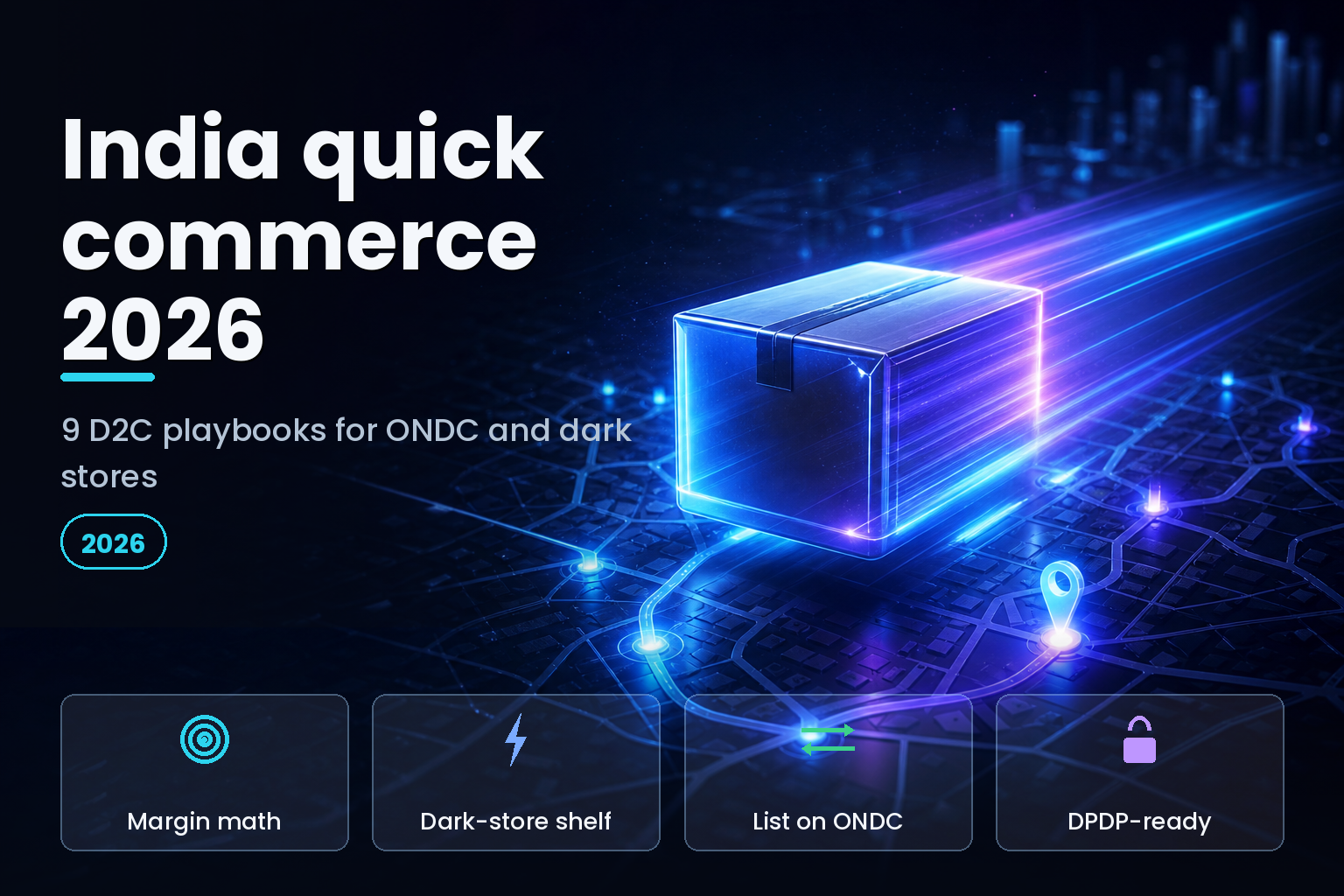
Summary. India's quick commerce GMV is projected to climb from $8.3 billion in 2026 to $68 billion by 2031, a 52% CAGR, according to Inc42. Three platforms own most of it: Blinkit held about 48% of the market in 2025, Swiggy Instamart 24%, and Zepto 22%. The country crossed 6,000 operational dark stores in 2026. That scale is the opportunity and the trap, because quick commerce platforms charge 18 to 35% commission, and a D2C brand without the gross margin to absorb that loses money on every order. This guide gives 9 practical playbooks for D2C founders: run the margin math, treat quick commerce as one channel not the whole strategy, win the dark-store shelf, chase non-grocery growth, list on ONDC, re-architect pricing, own your first-party data, build for 10-minute fulfilment, and stay compliant with the DPDP Rules 2025 notified on November 13, 2025. Each playbook below is built for India's 2026 reality, not a generic retail template.
Quick commerce stopped being a grocery story and became the default way urban India buys. For a D2C brand, that creates a hard question: the channel delivers volume and visibility, but its economics can erase the margin you built the brand on. The nine playbooks here are about capturing the growth without handing your contribution margin to a platform.
The nine playbooks at a glance
| Playbook | Core move | Why it matters |
|---|---|---|
| 1. Run the margin math | Test gross margin against 18 to 35% commission | Decides if the channel is viable at all |
| 2. Treat it as one channel | Quick commerce for trial, own site for margin | Protects contribution margin |
| 3. Win the dark-store shelf | Optimise for high-velocity SKUs | Determines if you get stocked |
| 4. Chase non-grocery growth | Lean into lifestyle and personal care | Fastest-growing categories |
| 5. List on ONDC | Reach beyond the big three platforms | Wider, lower-take distribution |
| 6. Re-architect pricing and packs | Build q-commerce-specific SKUs | Defends per-order economics |
| 7. Own your first-party data | Drive repeat on owned channels | Reduces platform dependence |
| 8. Build for 10-minute fulfilment | Hyperlocal stock placement | Meets the speed promise |
| 9. Stay DPDP-ready | Consent, deletion, security by design | Avoids fines up to ₹250 crore |
1. Run the margin math before anything else
This is the playbook that decides the other eight. Quick commerce platforms charge 18 to 35% commission depending on category, with personal care and packaged foods around 20 to 28%. On your own website the same product might deliver a 28 to 32% margin because there is no commission layer. Vinay Bansal, founder of Inflection Point Ventures, put the threshold plainly: "D2C brands generally need 50–70% gross margins to sustain multiple channels and still move towards contribution positivity. Anything below 50% makes long-term sustainability difficult."
So the first move is arithmetic, not ambition. Take your true landed gross margin, subtract the platform commission for your category, then subtract fulfilment, returns, and the ad spend the platform expects, and see what is left. If the answer is negative, quick commerce is a marketing cost, not a profit channel, and you should size it as one.
2. Treat quick commerce as one channel, not the strategy
The brands that win in 2026 design a system rather than picking a single channel. The common pattern: quick commerce for urban trial and replenishment, marketplaces for search-driven conversion, and an owned website for margin and data. Each channel does a job it is good at, and none carries the whole P&L.
The discipline this imposes is healthy. Use quick commerce to acquire and to build visibility where impulse and convenience rule, then move repeat demand to channels you control, where the margin and the customer relationship are yours. Mani Singhal of Alvarez & Marsal captured the wider shift: "The Indian ecommerce sector is moving away from 'growth at all costs' to sustainable economics. The margin narrative has become extremely important now." A brand that treats quick commerce as the entire plan inherits the platform's economics; a brand that treats it as one node keeps its own.
3. Win the dark-store shelf
Quick commerce is a shelf-space game played inside dark stores, and the shelf is short. India crossed 6,000 operational dark stores in 2026, and each one stocks only high-velocity SKUs because space and inventory are deliberately tight. A dark store running around 1,500 orders a day cannot carry a long tail, so it carries proven movers.
For a D2C brand that means earning the slot. Lead with your fastest-selling, highest-repeat SKUs rather than your full catalogue, prove velocity quickly so the platform's algorithm keeps you stocked, and accept that a slow SKU will be dropped. Zepto's newer dark stores reach profitability in about 9 months, down from 15 to 18 months earlier, which means platforms are more ruthless than ever about what occupies that space.
4. Chase the categories that are actually growing
Quick commerce began with groceries, but the growth has moved. Non-grocery categories are growing about 1.6 times faster than groceries in 2026, and lifestyle and personal care are leading that shift. For a D2C brand outside the grocery aisle, this is the opening, because platforms want exactly the higher-margin, higher-consideration categories that D2C brands tend to occupy.
The move is to position your range against this demand: stock the lifestyle, beauty, personal care, or specialty SKUs that urban buyers increasingly expect in 10 minutes, and time launches to the categories platforms are actively expanding. Riding a category the platform is investing in earns better placement than fighting for space in a saturated one.
5. List on ONDC to widen distribution
The big three platforms are not the only route to fast commerce. The Open Network for Digital Commerce (ONDC) has grown into a serious network, with over 3 lakh sellers onboarded, more than 100 buyer apps, and operations across 400-plus cities and towns. The Government of India aims for ONDC to handle 25% of all e-commerce by 2030, and the network plugs small kirana stores directly into the quick-commerce ecosystem.
For a D2C brand, ONDC offers reach without locking you to one platform's take rate or terms. Listing on the open network lets buyers on many apps discover your products, and it extends into Tier 2 and Tier 3 markets that the major platforms reach unevenly. Treat ONDC as a parallel distribution layer that improves your negotiating position with the large players rather than a replacement for them.
6. Re-architect pricing and pack sizes for quick commerce
A SKU built for a supermarket shelf often loses money on a 10-minute order. The commission, the small basket, and the delivery cost compress the economics, so the pack and price have to be designed for the channel. Build quick-commerce-specific SKUs and bundles that carry enough value to absorb the take rate, set price points that hold your margin after commission, and avoid simply porting your retail MRP onto a higher-cost channel.
The brands that protect per-order economics treat the platform as a distinct format with its own pack architecture, not a digital copy of the supermarket shelf. This is detailed, unglamorous work, and it is where quick-commerce profitability is usually won or lost.
7. Own your first-party data
On a quick commerce platform, the customer relationship and most of the data belong to the platform. That is a strategic cost as real as the commission. The counter-move is to use quick commerce for acquisition and visibility, then convert repeat demand onto channels where you own the data: your website, your app, and your loyalty programme. Owned channels are also where discovery compounds, which is why investment in search visibility for your owned store pays back over time.
Owning first-party data is not only a margin play. Under the DPDP Rules 2025, how you collect and hold that data is now regulated, so building a clean, consented first-party dataset is both a growth asset and a compliance requirement at once.
8. Build the supply chain for 10-minute fulfilment
The promise that defines the channel, delivery in minutes, is a supply-chain problem, not a marketing line. Brands are shifting from national warehouses to hyperlocal stock placement so inventory sits close to demand. For a D2C brand selling through quick commerce, that means forecasting demand at the city and dark-store level, keeping your high-velocity SKUs in stock where they sell, and avoiding the stockouts that cost you the slot and the sale.
This is where operational maturity separates brands, and where an enterprise AI strategy for demand forecasting and inventory placement earns its keep. A brand that cannot keep a fast SKU in stock at the right dark store does not benefit from the speed the channel promises.
9. Stay DPDP-ready by design
Every playbook above touches customer data, and the rules changed. India notified the DPDP Rules 2025 on November 13, 2025, operationalising the Digital Personal Data Protection Act 2023. Consent must be free, specific, informed, and based on a clear affirmative action, the Consent Manager framework becomes operational on November 13, 2026, and full compliance is expected by about mid-May 2027. E-commerce platforms treated as significant data fiduciaries must delete personal data within three years of a customer's last interaction.
The stakes are large: penalties run up to ₹250 crore per violation, with processing without valid consent carrying up to ₹200 crore. We design D2C data and consent flows aligned with DPDP requirements rather than claiming any setup is automatically compliant. For a founder, the practical move is to build consent capture, data-deletion timelines, and breach-notification readiness into your stack now, while your data footprint is still small enough to fix cheaply.
India-specific considerations
These playbooks are India-specific by design, but two threads deserve emphasis. ONDC has no real equivalent in most markets, so Indian D2C brands have a government-backed open network that can rebalance power away from a few dominant platforms, and early movers shape how it works. And the DPDP regime, with its consent-first model and ₹250 crore penalty ceiling, makes data governance a board-level retail topic rather than a legal footnote. A brand that builds for both, open distribution and clean data, is building for the India market that 2026 actually is.
FAQ
How eCorpIT can help
eCorpIT is a senior-led technology consulting organisation in Gurugram that helps D2C and retail teams build the systems behind a multi-channel strategy. We build owned commerce stores and loyalty stacks that move repeat demand off high-commission channels, integrate ONDC and quick-commerce operations, set up demand-forecasting and inventory placement for dark-store fulfilment, and design consent and data flows aligned with the DPDP Rules 2025. If quick commerce is reshaping your distribution, contact us to build a channel strategy that protects your margin.
References
_Last updated: June 22, 2026._