On this page · 9 sections
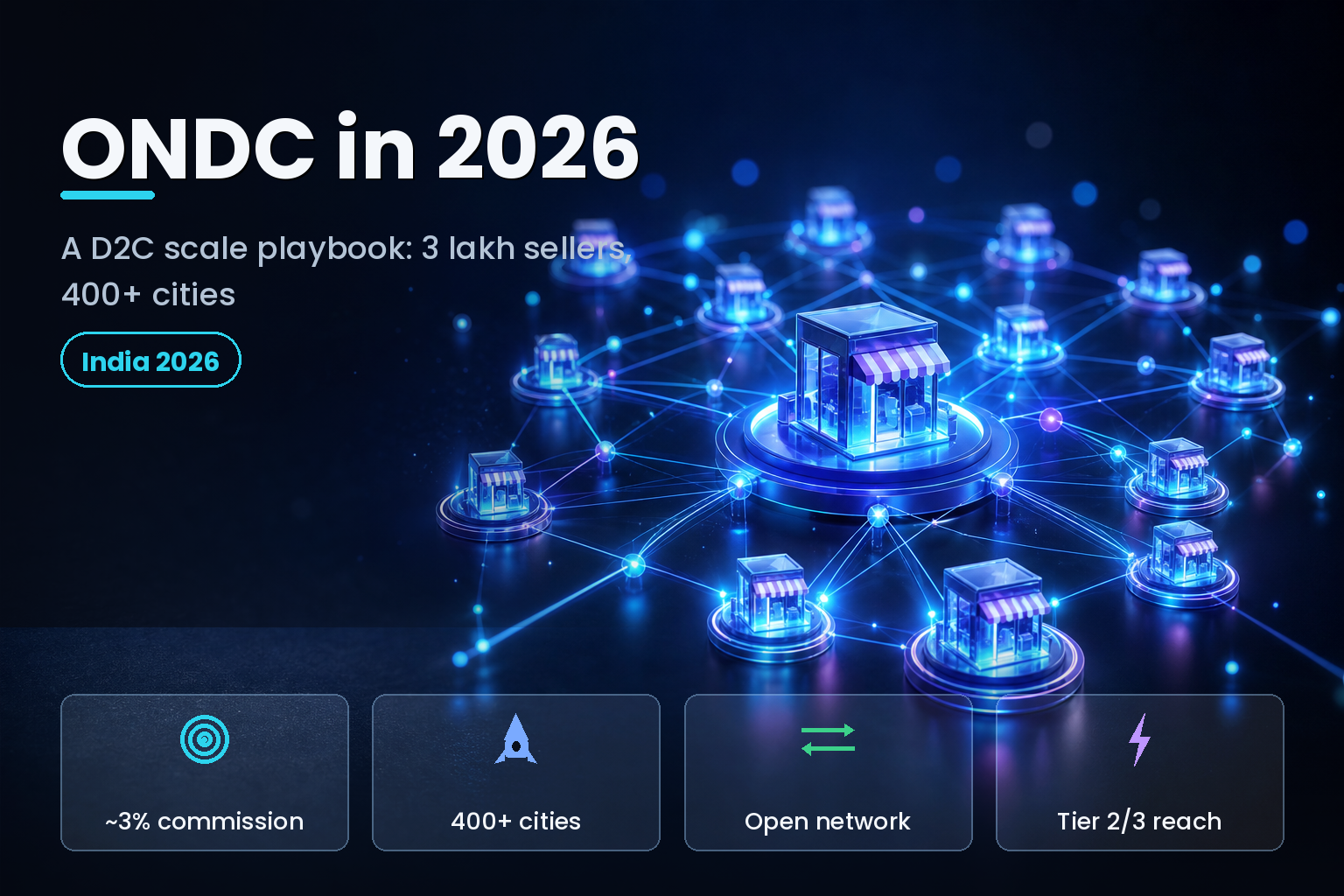
Summary. The Open Network for Digital Commerce has grown from an experiment into infrastructure. As of 2026 it spans more than 3 lakh sellers across 400+ cities, with over 100 buyer apps and 70% of its sellers small and medium businesses. Its defining economics is commission: ONDC caps buyer-app fees near 3%, against the 15 to 25% that incumbent marketplaces typically charge, which on a ₹1,000 order is roughly ₹30 versus ₹150 to ₹250. For a D2C brand, that gap is the difference between a channel that erodes margin and one that protects it. ONDC's own leadership expects seller numbers to multiply, with MD and CEO T. Koshy forecasting at least ten times growth in the coming year. This playbook explains what the scale means, how to get your brand onto the network, and where ONDC fits alongside your own store and the marketplaces.
The core idea is unbundling. On a marketplace, discovery, checkout, logistics, and the seller are locked into one company's stack. ONDC separates them into an open network, so your catalogue, listed once, can appear across many buyer apps. For a D2C brand fighting rising acquisition costs, that reach at low commission is the reason to pay attention in 2026.
What ONDC is, and why the numbers matter
ONDC is a government-backed open network, not a marketplace. Instead of one company owning buyers and sellers, it defines a protocol so any compliant buyer app, seller app, and logistics provider can transact together, per ONDC's own description. The scale figures are what make it credible: more than 3 lakh sellers, presence across 400+ cities, over 100 buyer apps, and, by the network's broader counts, more than 150 million transactions to date, per analysis of ONDC's growth. Around 70% of sellers are small and medium businesses, and tier-2 and tier-3 cities are driving much of the demand.
T. Koshy, ONDC's managing director and chief executive, frames the point in terms of access: "ONDC's interoperable QR code breaks down the barriers that have held small businesses back. Now, every seller has the power to reach customers digitally, just like the e-commerce giants." He has also said he expects seller numbers to multiply, forecasting "at least ten times growth" in the coming year, per ONDC's own reporting. For a D2C brand, the takeaway is that the network has crossed the scale where it is worth building for.
The economics: near 3% versus 15 to 25%
The single most important number for a D2C brand is commission. ONDC's model keeps buyer-app fees near a 3% ceiling, against the 15 to 25% typical of incumbent marketplaces, per industry analysis. On a ₹1,000 order, that is roughly ₹30 in fees rather than ₹150 to ₹250. Across thousands of orders, the difference is the margin that lets a bootstrapped brand reinvest rather than subsidise a platform.
Lower commission is why ONDC is attractive to exactly the brands that struggle on marketplaces: small and bootstrapped D2C businesses that cannot absorb a quarter of revenue in fees. It lets a brand offer competitive prices while keeping margin, and it reduces dependence on any single platform, so a brand is not hostage to one marketplace's algorithm or fee changes.
How to get your D2C brand onto ONDC
You do not integrate with ONDC directly; you join through a seller-side partner. The cleanest path is a Seller Network Participant, or Seller App, that has already built the tools to plug into the network, per guidance on ONDC seller providers. Platforms in this space handle catalogue creation, pricing, logistics setup, and payment configuration, and once you are on, your catalogue becomes visible across many buyer apps without separate registrations.
The practical sequence for a D2C brand is short. Connect your existing store to an ONDC-enabled seller platform. Publish and structure your product catalogue on the network, with clean titles, pricing, and images. Wire up order and payment processing through the platform. Select a logistics partner, since access to logistics is embedded in most seller apps and you choose by coverage and cost. Then monitor inventory across channels to avoid stockouts, because your catalogue now sells in more places than your own site.
| Step | What to do | Why it matters |
|---|---|---|
| 1. Pick a seller app | Choose an ONDC Seller Network Participant | Your route onto the network |
| 2. Publish catalogue | Structure titles, pricing, images | Discoverable across buyer apps |
| 3. Configure payments | Set up order and payment flow | Clean checkout across apps |
| 4. Add logistics | Select an embedded logistics partner | Fulfilment by coverage and cost |
| 5. Manage inventory | Sync stock across channels | Prevents oversell and stockouts |
What 400+ cities really means
The geographic spread is the other half of the story. ONDC's growth is concentrated in tier-2 and tier-3 cities, where both demand and seller participation are rising. For a D2C brand whose own site skews metro, ONDC is a way to reach buyers in smaller cities without building that distribution alone. This complements the broader shift in Indian commerce, where tier-2 and tier-3 towns now drive a majority of new D2C orders, a theme we cover in our retail and D2C tech bets for 2026.
The reach is real, but treat it as incremental demand rather than a replacement for your brand site. ONDC brings volume and low fees; your own store brings the customer relationship and first-party data. The strongest 2026 strategy uses both.
Where ONDC fits, and where it does not
An honest playbook names the limits. ONDC's discovery and buyer-app experience are still maturing, and they vary across the many buyer apps, so the polished, controlled experience of your own store is not guaranteed on the network. Brand storytelling is thinner in a protocol-driven listing than on your site. Returns and cash-on-delivery handling, a real cost in Indian e-commerce, depend on the seller app and logistics partner you choose. And because the network is open, you compete on a level field where price is visible, which is good for buyers but demands discipline on your margins.
So the fit is clear. Use ONDC for reach and unit economics, especially into tier-2 and tier-3 India, while keeping your own store as the home of the brand and the customer data. It is a channel in the mix, and a compelling one at near-3% commission, not the whole strategy.
| Factor | ONDC | Traditional marketplace |
|---|---|---|
| Commission | Near 3% ceiling | 15 to 25% typical |
| Model | Open, interoperable network | Single-company platform |
| Reach | 400+ cities, tier-2 and tier-3 strong | Broad but platform-locked |
| Brand control | Protocol listing, less control | Platform-defined |
| Data ownership | More seller independence | Platform-held |
India-specific considerations
Two India factors shape an ONDC strategy. First, the network is designed for Bharat, not just the metros: with 70% of sellers being small and medium businesses and demand rising in tier-2 and tier-3 cities, ONDC suits a brand that wants reach beyond metro buyers without marketplace-level fees. Second, data protection: as a seller you handle customer data through your seller app, so the Digital Personal Data Protection Act, 2023 (DPDP) applies, and ONDC's own stated priorities include privacy and trust by design. Build your catalogue and order flows with clear consent and sound data handling, and keep your first-party data working for you rather than leaving it stranded in a channel. For related strategy, see the eCorpIT blog.
FAQ
How eCorpIT can help
eCorpIT is a Gurugram-based technology organisation with senior-led engineering teams that build commerce technology for D2C and retail brands. We can integrate your store with an ONDC seller platform, structure your catalogue and order flows for the network, connect logistics and payments, and keep your first-party data and DPDP compliance intact across channels. If you want an ONDC scale plan that protects margin and your brand, contact us. You can also browse the eCorpIT blog or read about our team.
References
_Last updated: July 5, 2026._