On this page · 12 sections
- What actually shipped on 3 August 2026
- The pricing table nobody publishes side by side
- The costs neither column shows
- Where each option genuinely wins
- The security argument, examined honestly
- The Smart Router number, and what it is measuring
- A decision framework you can apply in an afternoon
- India-specific considerations
- What to do next
- FAQ
- How eCorpIT can help
- References
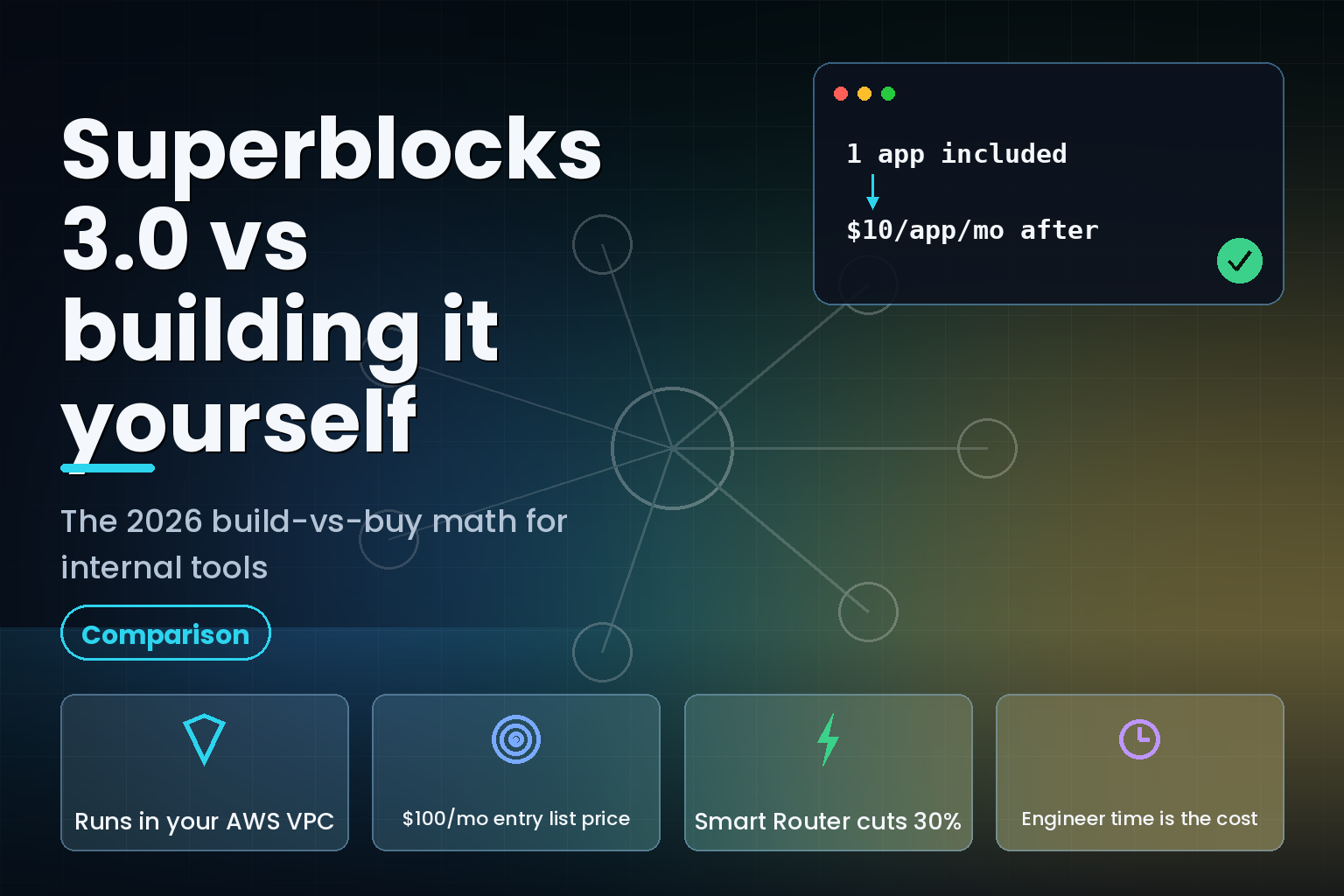
Summary. On 3 August 2026, Superblocks and AWS announced a multi-year collaboration that puts the Superblocks platform inside a customer's own AWS virtual private cloud, with all AI inference running through Amazon Bedrock. Superblocks lists its Teams plan at $125 per month billed monthly, or $100 per month billed annually, including 100 Governed Agent Units, 1 hosted app and up to 15 builders, with additional apps at $10 per app per month. Enterprise pricing, which is where VPC deployment, SSO and audit logs live, is quote-only. The company says its Smart Router on Amazon Bedrock reduces AI inference costs by up to 30% by routing routine coding tasks to open-weight models. Superblocks has raised $60M from Kleiner Perkins, Spark Capital, Meritech Capital and Greenoaks. Against those numbers, the honest comparison is not licence cost versus zero. It is licence cost versus the fully loaded cost of an engineer maintaining an admin panel nobody wants to own.
That framing decides most of these arguments before the spreadsheet opens. A team of 3 engineers in Gurugram spending a fifth of their time on internal tooling is a real annual cost in the ₹15,00,000 range, and no platform licence in this category comes close to it.
What actually shipped on 3 August 2026
The announcement has three parts, and only the first is the one being reported.
The collaboration itself makes Superblocks available within customer AWS environments, including Amazon Bedrock. Amazon's press release describes the deployment model directly: Superblocks "runs fully managed in the customer's own AWS environment", and AWS becomes Superblocks' preferred cloud provider, with procurement available through AWS Marketplace.
The second part is infrastructure automation. Superblocks integrates with Amazon Aurora to spin up a database per generated application inside the customer VPC, with scale-to-zero capability. AWS states Aurora delivers "up to 6x the throughput of standard engines". Superblocks' own engineering post adds that when a user publishes from development to production, the platform runs migrations across environments automatically, and that S3 is provisioned the same way.
The third part is the governance layer, which is the actual product. Every code change is checked by static analysis for issues such as SQL injection, hardcoded secrets and insecure data flows, then by security agents that build context across authentication, authorisation, data access and application logic. IT teams can add Custom Policy Agents to enforce company-specific rules. The platform connects to a private package registry and restricts public NPM access at the network level, maintains a Software Bill of Materials per application, and alerts owners when new CVEs affect deployed dependencies.
Brad Menezes, CEO of Superblocks, framed the gap the product targets: "Today, business users are vibe coding on their local desktops with no secure path to production on top of their private enterprise data. Our partnership with AWS provides the infrastructure for that secure path, and it lets IT teams configure policy agents that check AI-generated code against enterprise standards before it ever reaches production."
Jason Bennett, Vice President and Global Head of Startups and Venture Capital at AWS, described the same trade from the cloud side: "Enterprises want speed and control - Superblocks delivers both, enabling self-serve automation org-wide while IT maintains governance."
The pricing table nobody publishes side by side
Here is what the vendor pricing pages and independent trackers actually say, checked on 9 August 2026.
| Option | Entry list price | What that includes | Where the cost goes next |
|---|---|---|---|
| Superblocks Teams | $100/month billed annually ($125 monthly) | 100 Governed Agent Units, 1 hosted app, 50+ integrations, up to 15 builders, RBAC | $10 per additional app per month; GAU packs as add-ons |
| Superblocks Enterprise | Quote only | VPC deployment, SSO/SAML/OIDC, audit logs, Smart Model Routing, security agents, private registry | Negotiated; AWS Marketplace committed-spend eligible |
| Retool Team | About $10-$12 per builder per month, annual billing | Apps and workflows, limited governance | SSO sits in Business, reported at $50-$65 per builder |
| Retool free tier | $0 | Up to 5 users, unlimited apps, 500 workflow runs/month, 20 agent hours | Per-user pricing above the cap |
| Build it yourself | $0 licence | Whatever you write | Engineer time, on-call, auth, audit logging, upgrades |
The Retool figures come from independent pricing trackers rather than a vendor page we could retrieve, so treat them as indicative list prices and confirm against a quote. The Superblocks numbers are from the company's own pricing page.
Two structural details matter more than the headline rates. First, the Superblocks Teams plan bills per organisation with a builder cap, not per seat, which inverts the per-user maths that Retool-style pricing is built on. Second, everything a regulated buyer needs — VPC deployment, SSO, audit logs, observability pipelines — sits behind the Enterprise quote. If you are in BFSI or healthcare, the Teams price is not your price.
The costs neither column shows
Build-vs-buy spreadsheets fail in the same place every time: they compare a licence fee against zero, because internal engineering time is already budgeted and therefore feels free.
It is not free. An internal admin panel that anyone depends on eventually needs authentication that survives an audit, role-based access control at row level, an audit trail, a deployment pipeline, a staging environment, dependency upgrades, and someone reachable when it breaks at month-end close. Each of those is a week the team did not spend on the product customers pay for.
| Cost line | Build in-house | Buy a governed platform |
|---|---|---|
| Initial build | 2-8 engineer-weeks per app | Hours to days, per Superblocks case studies |
| Authentication and SSO | Build or integrate per app | Included at Enterprise tier |
| Audit logging | Build per app | Platform capability |
| Dependency and CVE management | Your responsibility | SBOM plus Security Center alerts |
| Data residency control | Yours by construction | Cloud-Prem keeps data in your VPC |
| Ongoing maintenance | Permanent, grows with app count | Licence, plus GAU consumption |
| Exit cost | None — it is your code | Superblocks states you own generated code and can connect your own git repository |
That last row is where most low-code arguments used to end. Superblocks' pricing FAQ answers it explicitly: "you fully own all code generated in Superblocks and connect it to your git repository." That is a materially different lock-in profile from a platform where the application only exists inside a proprietary runtime, though the runtime, integrations and governance layer are still the vendor's.
Where each option genuinely wins
Buy when the app is a CRUD interface over data you already have, the requester is not an engineer, and the value is in shipping this quarter. Superblocks publishes two customer examples that fit this shape exactly. At Virgin Voyages, the company reports non-technical teams building their own applications with 15+ production apps, seven departments onboarded and zero dedicated frontend engineers. At Matthews, a marketing manager with no coding background built an application generating offering memorandums, cutting a 3-to-5-day process to 12 hours. These are vendor-published case studies, so read them as the best available outcome rather than the median one, but the pattern is credible: internal tools are mostly forms over databases, and forms over databases are the most automatable software there is.
Build when the tool is a product surface in disguise. If the internal application will become customer-facing, needs a bespoke interaction model, carries latency requirements a generated layer cannot meet, or sits on the critical path of revenue, it belongs in your codebase under your test suite. The same applies when the data model is genuinely novel — generated CRUD is excellent over a normalised schema and poor over one that needs domain logic in the middle.
There is a third answer that gets skipped. Build the platform, buy the apps. Several teams get the best result by standardising authentication, secrets, deployment and observability once as an internal platform, then letting business teams generate applications on top of it. That is the same instinct behind platform engineering and application modernisation patterns, applied one layer up.
The security argument, examined honestly
Superblocks is positioning against shadow IT rather than against Retool. Its August post describes employees pasting sensitive customer data into personal accounts on consumer prototyping tools, and prototypes made public without organisational SSO or permissioning. That risk is real and most CISOs recognise it.
The mitigation the product offers is architectural rather than procedural: run the platform inside the customer's own AWS VPC so data, code, applications and inference stay inside the existing security perimeter, governed by the customer's own AWS IAM, networking, encryption and audit policies. Inference runs through Amazon Bedrock using models an organisation admin approves, and the company states prompts and data are never used to train models.
Three deployment models exist. Cloud runs everything in the Superblocks cloud. Hybrid keeps production data in the customer VPC for deployed applications while non-production data is accessed in the Superblocks cloud. Cloud-Prem puts the full platform, inference included, inside the customer's AWS, GCP or Azure environment while Superblocks manages it. The company lists SOC 2 Type II certification and HIPAA compliance.
The honest caveat: a security agent swarm reviewing AI-generated code is a control with an obvious circularity problem, and Superblocks pairs it with deterministic static analysis for that reason. The static scanners catch the classes of bug they are written to catch. The agents are described as catching permission bypasses, business-logic flaws and multi-step attack paths that rule-based scanners miss. Treat the agents as an additional filter, not as a replacement for a human review gate on anything touching money or personal data. Teams thinking about this seriously should read it alongside how they govern AI agent security and guardrails and how they run secure AI-assisted development.
The Smart Router number, and what it is measuring
The most quoted figure from the announcement is 30%. It deserves precision. Superblocks states its Smart Router "can reduce AI inference costs by up to 30%" at enterprise-wide scale by breaking a build into specialised tasks and routing each to an appropriate model, reserving frontier models for planning and difficult reasoning while open-weight models handle routine coding.
That is a saving on inference spend, not on total cost of ownership. If your inference bill is $2,000 a month, a 30% reduction is $600 a month, which will not move a build-vs-buy decision by itself. The number matters at the scale where organisations run thousands of generated applications, and it matters as a signal about where the market is heading: model routing is becoming a platform feature rather than something each team wires up. Teams already doing this manually will recognise the pattern from AI gateway and model routing for FinOps.
A decision framework you can apply in an afternoon
Score your candidate application on these six questions. Four or more "yes" answers point to buying.
- Is it CRUD over an existing database or SaaS API, with no novel interaction model?
- Will the primary requester be a non-engineer who will change requirements often?
- Does it need to exist within weeks rather than quarters?
- Would it otherwise be built by an engineer whose time has higher-value alternatives?
- Is the data sensitive enough that a governed path beats an ungoverned spreadsheet, but not so sensitive that only your own code will pass audit?
- Do you already run AWS, so a VPC deployment is a configuration change rather than a new cloud relationship?
Now the disqualifiers. Any one of these points back to building:
- The application will become customer-facing within 18 months.
- Latency or throughput requirements are specific and tested.
- It sits on the revenue critical path with a defined recovery time objective.
- Your compliance posture requires source-level review of every deployed line by your own staff.
- You genuinely have spare senior capacity and a maintained internal platform to build on.
India-specific considerations
For Indian teams the arithmetic tilts differently in both directions at once.
Labour cost cuts toward building. The fully loaded annual cost of a mid-level engineer in Gurugram or Bengaluru is a fraction of the equivalent in New York, so the "an engineer's time is more expensive than the licence" argument that carries US buyers is weaker here. Three engineers spending 20% of their time on internal tooling is real money, but a dollar-denominated Enterprise quote converted at roughly ₹88 to the dollar in August 2026 is real money too, and it recurs whether or not you ship anything that quarter.
Data residency cuts toward the VPC model. Under the Digital Personal Data Protection Act 2023, an internal tool that reads customer records is processing personal data, and the questions auditors ask are about where it lives and who can reach it. A Cloud-Prem deployment inside an AWS India region keeps the data and inference in your own account, which is a materially easier conversation than a multi-tenant SaaS in another jurisdiction. Teams designing for this should look at data residency and DPDP cloud architecture before choosing a deployment model, not after.
The practical Indian pattern we see most often is a split: buy for internal operations tooling where speed wins and the data is low-sensitivity, build for anything touching payments, KYC or customer records. That maps cleanly onto how teams already separate custom web application development from off-the-shelf tooling.
What to do next
Run a two-week trial with one real application, not a demo. Pick something a business team has actually asked for twice and engineering has deferred twice — that combination is the honest test case. Measure three things: how long it took to reach production, how many times an engineer had to intervene, and what the governance review found. Then price the Enterprise quote against the engineer-weeks the same application would have consumed.
If the answer is close, build the second application both ways. The comparison stops being theoretical the moment two versions of the same tool exist.
FAQ
How eCorpIT can help
eCorpIT builds internal applications and the platforms they run on, and we are equally willing to tell a client that a licence beats a build. Our teams run the two-week comparison described above as a scoped engagement: one real application, delivered both ways where it makes sense, with the governance review and the fully loaded cost written down rather than assumed. We are CMMI Level 5 and ISO 27001:2022 certified, and we design applications aligned with DPDP requirements. If you are weighing a platform purchase against an internal build, talk to our engineering team.
References
- Superblocks and AWS Announce Strategic Collaboration to Bring Secure Enterprise AI App Development to Amazon Bedrock - Amazon Press Center, 3 August 2026.
- Superblocks 3.0: Secure Private Vibe Coding on AWS - Superblocks, 3 August 2026.
- Superblocks Pricing - Superblocks, accessed 9 August 2026.
- Superblocks and AWS collaboration announcement - Businesswire.
- AWS is helping vibe-coding startup Superblocks, and the implications are big - TechCrunch, 3 August 2026.
- AWS integrates Superblocks tool for private cloud AI development - Crypto Briefing.
- Retool Pricing 2026: Free, Team, Business - Automation Atlas.
- Retool pricing explained: Full guide - UI Bakery.
- Superblocks Software Reviews, Demo and Pricing 2026 - Software Advice.
Last updated: 9 August 2026.